
August 7, 2026
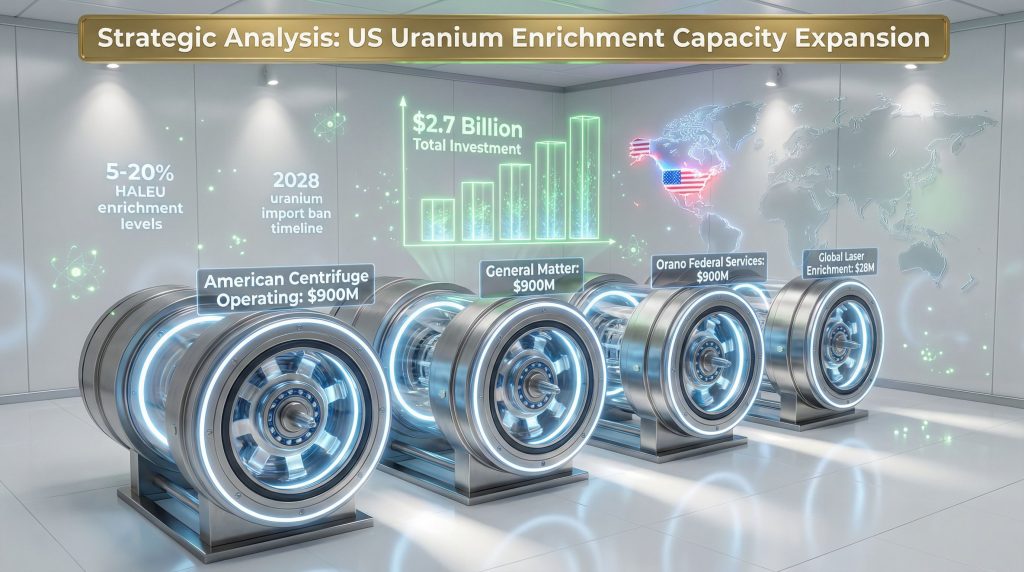
The American energy sector stands at a pivotal moment where uranium enrichment orders totaling $2.7 billion signal a fundamental shift towards supply chain resilience in critical energy infrastructure. The convergence of geopolitical tensions, advanced reactor deployment schedules, and supply chain dependencies creates unprecedented urgency for rebuilding domestic enrichment infrastructure. This strategic imperative extends beyond immediate energy security concerns to encompass technological leadership, economic competitiveness, and long-term nuclear fuel cycle autonomy.
The uranium enrichment orders represent more than government procurement—they signal a fundamental shift toward supply chain resilience in critical energy infrastructure. Unlike previous approaches that relied on international partnerships and market-based solutions, this investment framework prioritises domestic capacity building across multiple enrichment technologies to eliminate single points of failure in nuclear fuel supply chains.
Current Market Position and Strategic Context
Global Uranium Enrichment Landscape
Russia's dominance in global uranium enrichment services creates strategic vulnerabilities that extend far beyond immediate supply disruption risks. Current market dynamics reveal Russia producing approximately 40% of the world's enriched uranium through state-controlled entities, while maintaining exclusive commercial production of high-assay low-enriched uranium (HALEU) at enrichment levels between 5-20%. This monopolistic position in HALEU production directly constrains advanced reactor deployment timelines and creates pricing leverage that impacts nuclear power economics globally.
The technical specifications underlying this market concentration demonstrate the complexity of uranium enrichment operations. Conventional light-water reactors operate using uranium enriched to approximately 3-5% uranium-235 concentration, while advanced reactor designs require HALEU enrichment levels reaching 20% to optimise fuel efficiency and enable compact core geometries essential for small modular reactor economics.
Strategic Dependency Assessment
Current American nuclear fuel procurement strategies reveal systematic dependencies that compromise energy security objectives. The United States has not produced enriched uranium domestically since the Paducah Gaseous Diffusion Plant ceased operations in 2013, creating reliance on foreign suppliers including Urenco (owned by Germany, Netherlands, and UK) and historically supplemented by Russian supply contracts.
Furthermore, the Russian uranium import ban timeline creates strategic urgency for developing alternative supply sources. Key Vulnerability Metrics include Russian market share of 40% global uranium enrichment capacity, Russia as sole commercial HALEU producer, complete prohibition on Russian uranium by 2028, and zero commercial-scale domestic enrichment since 2013.
The 2028 uranium import ban timeline, established through the Uranium Enrichment Security Act, creates a strategic deadline requiring operational domestic capacity within 24 months of current award announcements. This compressed timeline necessitates parallel development across multiple enrichment technologies to ensure supply continuity during the transition period.
When big ASX news breaks, our subscribers know first
Investment Breakdown and Recipient Analysis
Award Distribution Strategy
The $2.7 billion uranium enrichment orders demonstrate deliberate technological diversification rather than concentration with single vendors. This strategic approach distributes risk across proven centrifuge technology, innovative laser enrichment methods, and established chemical conversion processes to ensure supply resilience if any individual enrichment method encounters technical or regulatory challenges.
| Recipient | Award Amount | Technology Focus | Production Timeline |
|---|---|---|---|
| American Centrifuge Operating | $900 million | Gas centrifuge HALEU production | 2028-2032 |
| General Matter | $900 million | Proprietary enrichment technology | 2029-2033 |
| Orano Federal Services | $900 million | Low-enriched uranium expansion | 2027-2031 |
| Global Laser Enrichment | $28 million | Laser isotope separation development | 2030-2035 |
American Centrifuge Operating Strategic Positioning
American Centrifuge Operating, operating as a subsidiary of Centrus Energy, brings established centrifuge technology infrastructure and historical enrichment experience to the uranium enrichment orders program. The company's existing pilot-scale operations provide technical foundations for scaling to commercial production volumes targeting approximately 900 metric tons of uranium separative work units (tSWU) annually at full capacity implementation.
Gas centrifuge technology represents the most proven enrichment method globally, with operational precedents at Urenco facilities in the Netherlands, Germany, and United Kingdom achieving combined capacity exceeding 14 million tSWU annually. This technological maturity reduces technical risk associated with the $900 million investment while providing predictable scaling pathways to meet HALEU demand projections.
General Matter Innovation Approach
General Matter's $900 million award represents the highest-risk, highest-potential-reward component of the uranium enrichment orders portfolio. Backed by venture capital including Peter Thiel's technology investment network, the company maintains proprietary enrichment methodology details under confidential development, suggesting non-traditional approaches that could provide competitive differentiation beyond conventional centrifuge or chemical separation methods.
However, the strategic rationale for including unproven technology in critical infrastructure investment reflects confidence in innovation acceleration potential while maintaining technology diversification. General Matter's market positioning targets breakthrough capabilities that could transform enrichment economics through energy efficiency improvements or production cost reductions compared to established methods.
Orano Federal Services Expansion Mandate
Orano Federal Services receives $900 million specifically for low-enriched uranium (LEU) production expansion, addressing the broader nuclear fuel supply requirements beyond HALEU for existing light-water reactor fleets. The company's established uranium conversion facilities and nuclear fuel services provide operational foundations for rapid capacity scaling to support approximately 93% of global nuclear reactors currently operating with conventional LEU fuel.
This investment component addresses immediate supply security concerns while HALEU production capabilities develop for advanced reactor deployment. In addition, Orano's French parent company operates multiple enrichment and fuel conversion facilities across Europe, providing technical expertise and operational templates for domestic capacity expansion.
HALEU Production and Advanced Nuclear Economics
Technical Specifications and Performance Advantages
High-assay low-enriched uranium fundamentally transforms nuclear reactor economics through enhanced fuel efficiency that enables smaller core designs and extended fuel cycles. HALEU enrichment levels between 5-20% uranium-235 concentration provide neutron economy advantages that optimise fuel utilisation while reducing uranium mining and enrichment volumes required per unit of electricity generation.
HALEU Performance Metrics include burnup enhancement of 150-200 MW days per metric ton versus 50-75 MWd/MTU for conventional LEU, fuel efficiency improvement of 2-3x higher energy extraction per kilogram of uranium, core downsizing potential of 20-30% reduction in fuel assembly requirements, and cycle extension of 18-24 month refuelling intervals versus 12-18 months for conventional reactors.
Small Modular Reactor Deployment Dependencies
Advanced reactor designs including small modular reactors achieve economic viability specifically through HALEU utilisation that enables compact geometries and simplified cooling systems. NuScale Power's 77-megawatt thermal modules require approximately 18-25 metric tons of HALEU annually for 12-module installations, while TerraPower's Natrium design projects 40-50 metric tons of HALEU requirements at full 345 MW capacity operation.
The technical interdependency between HALEU availability and SMR deployment creates critical path constraints where enrichment capacity directly limits advanced reactor commercialisation timelines. Current SMR development schedules, including NuScale's Idaho National Laboratory deployment targeted for 2029-2030, establish HALEU supply requirements that domestic production must satisfy to avoid project delays or continued foreign dependency.
Production Timeline and Capacity Milestones
Domestic HALEU production scaling follows a structured development framework spanning the ten-year contract period with specific milestone-based achievement targets:
Phase 1 (2026-2028): Infrastructure Development
- Facility construction and equipment procurement
- Regulatory licensing through Nuclear Regulatory Commission
- Initial demonstration enrichment runs and operational testing
Phase 2 (2028-2031): Production Ramp
- Commercial production initiation at 300-400 tSWU annually
- Quality assurance systems implementation
- Supply contract fulfilment for initial SMR deployments
Phase 3 (2032-2036): Full Capacity Achievement
- Target production volumes of 600-900+ tSWU annually
- Market supply capability for expanded SMR fleet deployment
- Technology optimisation and cost reduction implementation
What Are the Geopolitical Implications of Domestic Enrichment?
Supply Chain Resilience Enhancement
The uranium enrichment orders address fundamental national security vulnerabilities created through decades of domestic capacity atrophy following Cold War-era facility closures. Russia's weaponisation of energy exports during geopolitical conflicts demonstrates the strategic risks associated with critical infrastructure dependencies on potentially hostile nations or unstable regions.
Consequently, domestic enrichment capacity provides strategic buffer capabilities that extend beyond immediate supply requirements to encompass emergency reserve production, allied nation support, and crisis response flexibility. This infrastructure resilience becomes increasingly critical as uranium market dynamics accelerate and enrichment service demand grows across both civilian and naval reactor applications.
International Competitive Positioning
Global Enrichment Capacity Distribution (2025-2026):
| Country/Region | Annual Capacity (tSWU) | Technology Platform | Market Position |
|---|---|---|---|
| Russia | 26,000+ | Gas centrifuge | Market dominant |
| Europe (Urenco) | 14,000+ | Gas centrifuge | Technology leader |
| China | 8,000+ | Gas centrifuge | Rapidly expanding |
| United States | 0 (pre-2026) | N/A | Import dependent |
The uranium enrichment orders position American domestic capacity to achieve approximately 1,000-1,200 tSWU annually by 2035, representing roughly 3-4% of current global capacity but sufficient to satisfy domestic HALEU requirements and reduce import dependency for conventional LEU. This capacity scaling provides foundation for potential export capabilities and technology leadership in advanced enrichment methods.
Technology Export and Alliance Strengthening
Domestic enrichment capability development creates opportunities for technology sharing and fuel supply agreements with allied nations pursuing nuclear power expansion or advanced reactor deployment. Countries including Canada, United Kingdom, and Japan maintain strong nuclear partnerships with the United States while seeking HALEU access for their own advanced reactor programs.
Furthermore, the strategic value extends to naval reactor fuel supply, where highly enriched uranium requirements for submarine and aircraft carrier propulsion systems benefit from domestic enrichment infrastructure and technical expertise developed through civilian HALEU production programs.
Enrichment Technology Comparison and Innovation Potential
Gas Centrifuge Technology Assessment
Gas centrifuge uranium enrichment represents the most mature and widely deployed commercial enrichment method globally, with proven operational reliability and established scaling pathways. Centrifuge systems achieve uranium isotope separation through high-speed rotation that concentrates heavier uranium-238 isotopes at the periphery while lighter uranium-235 isotopes concentrate near the rotation axis.
Centrifuge Technology Advantages include energy efficiency of approximately 50 kWh per separative work unit versus 2,500 kWh for gaseous diffusion, modular scaling through individual centrifuge units enabling flexible capacity adjustments, operational maturity with decades of commercial operation, and lower proliferation risk compared to gaseous diffusion methods.
American Centrifuge Operating's $900 million investment leverages this proven technology platform while incorporating modern materials and design optimisations to achieve competitive operational costs and enhanced reliability compared to older centrifuge designs operated by international competitors.
Laser Enrichment Innovation Trajectory
Global Laser Enrichment's $28 million development award supports atomic vapour laser isotope separation (AVLIS) technology that offers potential advantages in energy efficiency and production flexibility compared to conventional centrifuge methods. Laser enrichment achieves isotope separation through selective photoionisation of uranium-235 atoms using precisely tuned laser frequencies.
Laser Enrichment Technical Characteristics include energy requirements potentially 10-20% lower than centrifuge systems, production flexibility through rapid enrichment level adjustments between LEU and HALEU, higher initial investment requirements offset by operational efficiency, and advanced prototype phase requiring demonstration scaling.
Cameco Corporation's equity participation in Global Laser Enrichment provides Canadian uranium industry expertise and potential market access for technology commercialisation, while the reduced award amount reflects higher technical risk associated with unproven commercial deployment.
Technology Risk Assessment Framework
The diversified investment approach across multiple enrichment technologies reflects strategic risk management principles that balance proven reliability with innovation potential:
| Technology Type | Technical Risk | Commercial Readiness | Scaling Potential | Energy Efficiency |
|---|---|---|---|---|
| Gas Centrifuge | Low | Proven | High | Moderate |
| Proprietary (General Matter) | High | Unknown | Unknown | Unknown |
| Chemical Conversion | Low | Proven | Moderate | Low |
| Laser Enrichment | Moderate | Developmental | High | High |
This portfolio approach ensures supply continuity through proven technologies while supporting innovation development that could provide long-term competitive advantages and cost reductions for domestic enrichment operations.
Security and Regulatory Framework Evolution
Proliferation Risk Management
HALEU production at enrichment levels up to 20% uranium-235 requires enhanced security protocols and safeguards implementation compared to conventional LEU operations. While remaining significantly below weapons-grade enrichment thresholds (90%+ U-235), HALEU handling necessitates specialised containment systems, personnel security clearances, and international monitoring compliance.
Nuclear Regulatory Commission licensing requirements for HALEU production facilities incorporate physical security measures, material accountability systems, and cybersecurity protocols that address both domestic production policy concerns and International Atomic Energy Agency safeguards obligations. These regulatory frameworks balance commercial operation efficiency with non-proliferation commitments and national security requirements.
Environmental Impact Assessment
Domestic uranium enrichment facility development requires comprehensive environmental impact assessments addressing radioactive waste management, atmospheric emissions, and groundwater protection measures. Historical enrichment operations at Paducah and Portsmouth facilities created environmental remediation challenges that inform modern facility design and operational protocols.
Contemporary enrichment technologies demonstrate significantly reduced environmental impacts compared to legacy gaseous diffusion methods, with gas centrifuge operations producing minimal waste streams and lower energy consumption per unit of enriched uranium production. For instance, laser enrichment methods offer additional environmental advantages through reduced chemical processing requirements and waste generation.
The next major ASX story will hit our subscribers first
Nuclear Power Economics and Market Transformation
Fuel Cost Structure Impact Analysis
Domestic HALEU production transforms nuclear power plant economics through supply cost predictability and reduced foreign exchange exposure that historically created fuel cost volatility. Nuclear fuel typically represents 10-15% of total electricity generation costs for nuclear plants, with enrichment services comprising approximately 30-35% of total fuel cycle costs.
Fuel Cycle Cost Comparisons (per MWh) show import-dependent scenarios at $8-12 per MWh with currency and supply risk premiums, domestic production scenarios at $9-11 per MWh with stable pricing and supply security, and long-term contract stability enabling 15-20 year fuel supply agreements versus 3-5 year import contracts.
The economic benefits extend beyond immediate cost structures to encompass project financing advantages where domestic fuel supply security reduces perceived investment risks for new nuclear construction and advanced reactor deployment projects.
Advanced Reactor Commercialisation Acceleration
HALEU availability directly enables advanced reactor commercialisation timelines by removing fuel supply constraints that previously limited deployment schedules. Small modular reactor developers including NuScale Power, X-energy, and TerraPower maintain HALEU fuel supply as critical path dependencies for achieving commercial operation dates between 2029-2032.
The strategic alignment between domestic enrichment capacity development and US uranium production technology creates synergistic market development where domestic fuel supply capabilities support American reactor technology exports to international markets pursuing nuclear power expansion or carbon reduction objectives.
Nuclear Renaissance Investment Climate
Domestic uranium enrichment orders signal governmental commitment to nuclear power expansion that improves investment climate conditions for broader nuclear industry development. Financial markets interpret supply chain security investments as de-risking factors that enhance project bankability and reduce capital costs for nuclear power plant construction and advanced reactor deployment.
This investment climate improvement extends to uranium mining operations, nuclear component manufacturing, and nuclear services sectors that benefit from increased domestic demand visibility and reduced regulatory uncertainty associated with foreign supply dependencies.
How Will Long-Term Strategic Outcomes Enhance Energy Security?
Energy Independence Metrics and Objectives
The uranium enrichment orders target strategic energy independence metrics that reduce foreign dependency percentages across multiple timeframes and supply scenarios. Current American nuclear fuel import dependency approaches 100% for enrichment services, creating systematic vulnerabilities that compromise energy security objectives during international crises or supply disruptions.
Independence Achievement Targets include 2030 milestone of 40-50% domestic enrichment capability for existing reactor fleet, 2035 objective of 80-90% domestic HALEU production for advanced reactor deployment, strategic reserve of 12-18 month emergency supply inventory maintenance capability, and allied support through surplus capacity for technology sharing and fuel supply agreements.
Industrial Base Revitalisation Impact
Domestic enrichment capacity development catalyses broader nuclear industrial base revitalisation through high-skilled job creation, advanced manufacturing requirements, and technology innovation ecosystems. Each enrichment facility requires approximately 200-400 direct employees with specialised nuclear engineering, operations, and maintenance expertise.
Economic Multiplier Effects include direct employment of 800-1,200 jobs across four award recipients, indirect employment of 2,000-3,000 supporting industry positions, regional economic impact of $150-250 million annual economic activity per facility, and technology export potential through international market opportunities for American enrichment technology.
Moreover, the strategic industrial benefits extend to supply chain development for specialised centrifuge components, laser systems, and nuclear-grade materials that support broader nuclear industry competitiveness and technology leadership objectives.
Technology Leadership and Innovation Acceleration
Investment in multiple enrichment technologies positions American nuclear industry for global technology leadership through innovation development and commercial demonstration of next-generation enrichment methods. General Matter's proprietary technology development and Global Laser Enrichment's AVLIS advancement represent potential breakthrough capabilities that could transform global enrichment economics.
This technology leadership creates export opportunities for American enrichment equipment, services, and expertise to international markets while establishing American companies as preferred partners for countries pursuing nuclear power expansion or fuel cycle independence objectives.
The uranium enrichment orders represent strategic transformation from import dependency toward domestic capability leadership, positioning American nuclear industry for sustained competitiveness in expanding global nuclear power markets while achieving critical energy security objectives through supply chain resilience and technological innovation.
However, market conditions remain subject to various factors including US uranium market disruption scenarios and evolving international trade policies. The success of these investments ultimately depends on execution capabilities, technology development achievements, and sustained political support for nuclear power expansion initiatives.
This analysis is based on publicly available information and government announcements as of January 2026. Market conditions, technology development timelines, and regulatory requirements may evolve based on operational experience and policy developments. Readers should consult current sources for the most recent developments in uranium enrichment capacity and nuclear fuel market conditions.
Ready to Capitalise on America's Nuclear Renaissance?
Discovery Alert's proprietary Discovery IQ model delivers real-time alerts on significant uranium and energy sector discoveries across the ASX, empowering investors to identify actionable opportunities ahead of the broader market. With America's $2.7 billion uranium enrichment investment signalling unprecedented nuclear sector growth, now is the ideal time to explore Discovery Alert's dedicated discoveries page and begin your 30-day free trial to position yourself strategically in the expanding uranium market.