May 22, 2026
Understanding Uranium Hexafluoride Production Systems
The emergence of a new uranium conversion facility represents a pivotal development in nuclear fuel supply chain infrastructure, addressing critical gaps in domestic conversion capacity that have persisted for decades. Nuclear fuel supply chains operate through a series of precisely controlled chemical transformations, with uranium conversion representing one of the most critical yet least understood components of modern energy infrastructure.
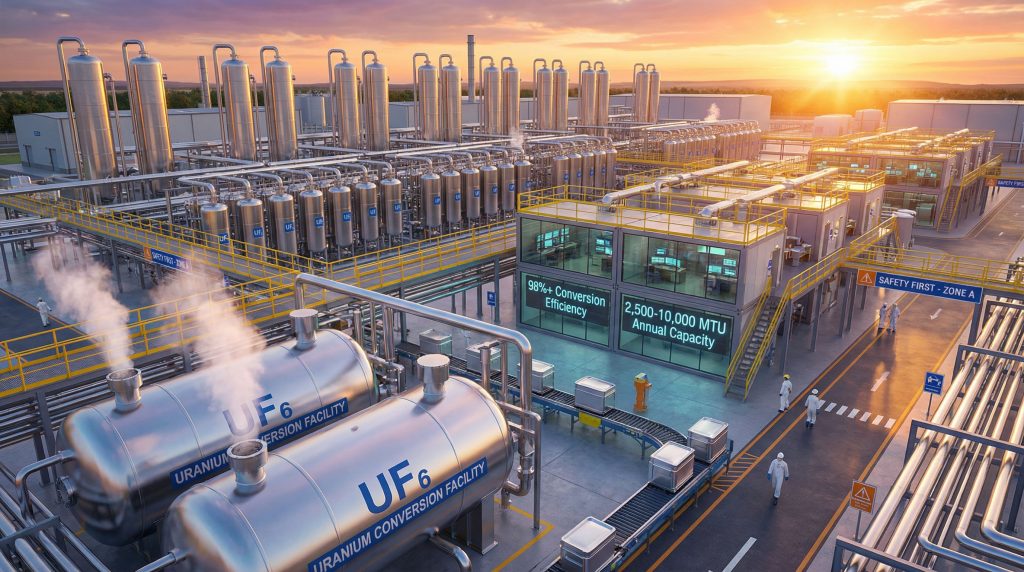
The process of converting uranium oxide concentrate into uranium hexafluoride gas requires sophisticated engineering systems that bridge mining operations with enrichment facilities. This creates the foundation upon which nuclear power generation depends, particularly as uranium market volatility continues to influence strategic planning decisions across the sector.
The chemical transformation from uranium oxide (U₃O₈) to uranium hexafluoride (UF₆) involves complex thermodynamic processes operating at elevated temperatures. UF₆ transitions directly from solid to gas above 64.05°C at atmospheric pressure, defining the entire operational framework of conversion facilities.
Quality control standards for nuclear-grade materials demand 95-97% conversion efficiency through multi-stage purification protocols. These eliminate impurities whilst maintaining isotopic specifications that meet downstream enrichment facility requirements.
When big ASX news breaks, our subscribers know first
Current Infrastructure Limitations and Strategic Dependencies
The United States currently operates with severely constrained uranium conversion capacity, relying primarily on the Metropolis Works facility in Illinois. This facility experienced operational suspension from early 2018 through planned restart in 2023 under Honeywell management, highlighting vulnerability in critical nuclear fuel supply chains.
Furthermore, the concentration of national conversion capacity at a single facility creates inherent supply chain risks. These affect both commercial nuclear fleet operations and strategic energy security considerations, particularly in light of the recent US Senate uranium ban affecting Russian imports.
Honeywell's restart initiative involved hiring 160 full-time employees plus contractors by end of 2022. However, import dependency gaps emerge when domestic conversion capacity falls short of enrichment facility input requirements.
The U.S. Navy reactor fleet and commercial nuclear power plants combined represent substantial UF₆ demand. This must be satisfied through either domestic production or international sourcing, with geopolitical implications for supply continuity during potential trade disruptions.
Economic impact assessments reveal that a new uranium conversion facility generates substantial regional economic development opportunities. Capital investment requirements for modern conversion plants involve complex financial structuring, whilst long-term operational costs must account for regulatory compliance and environmental monitoring.
Job creation potential extends through multiple economic sectors, including construction and specialised equipment manufacturing. Regional economic multiplier effects typically exceed direct facility employment by factors of 2-3 times, creating sustainable economic development in host communities.
Advanced Engineering Specifications for Modern Conversion Plants
Next-generation uranium conversion facilities incorporate modular design principles that enable phased capacity expansion. These scalable systems contrast with historical fixed-capacity installations, providing operational flexibility to respond to fluctuating market demand whilst optimising capital deployment strategies.
| Engineering Parameter | Modern Standard | Advanced Target |
|---|---|---|
| Annual Capacity (MTU) | 8,000-15,000 | 2,500-10,000+ |
| Conversion Efficiency | 95-97% | 98%+ |
| Modular Expansion | Limited | Fully Scalable |
| Process Control | Manual/Semi-Auto | Fully Automated |
| Environmental Systems | Standard Compliance | Advanced Containment |
Automated process control systems represent significant technological advancement over historical conversion operations. Digital monitoring technologies enable real-time optimisation of reaction parameters and predictive maintenance scheduling, which reflects broader industry innovation trends across the mining sector.
Enhanced environmental protection measures incorporate advanced filtration systems and emission control technologies. These engineering improvements address regulatory compliance requirements whilst potentially reducing operational costs through energy efficiency optimisation.
Integration capabilities with digital monitoring technologies enable remote oversight and automated quality assurance testing. This connectivity supports just-in-time inventory management and reduces storage costs for both feedstock materials and finished UF₆ products.
Advanced containment systems address unique safety challenges associated with UF₆ handling. Redundant containment protocols incorporate lessons learned from decades of conversion facility operations whilst meeting modern regulatory standards.
Regulatory Pathways and Compliance Requirements
The Nuclear Regulatory Commission oversees conversion facility licensing under 10 CFR Part 40 Source Material License regulations. Environmental impact assessments follow National Environmental Policy Act procedures, requiring detailed analysis of potential impacts to air quality and water resources.
Safety Analysis Report specifications demand thorough evaluation of credible accident scenarios and corresponding mitigation systems. These technical documents must demonstrate adequate protection against potential UF₆ releases, including worst-case scenarios involving equipment failures.
Construction permit applications require extensive documentation of facility design parameters and site characteristics. The regulatory review process involves multiple agencies, including state environmental authorities and local emergency management organisations.
Operational licensing phases follow environmental assessment completion and construction permit approval. These milestones typically involve:
- Pre-operational testing and commissioning activities
- Workforce training and certification programs
- Emergency response plan implementation and testing
- Environmental monitoring system activation
- Initial operational oversight and inspection protocols
State and federal compliance considerations extend beyond NRC authority to include Clean Air Act standards. Facilities must maintain compliance with 40 CFR Part 60-61 air quality standards whilst meeting OSHA radiation protection requirements.
Waste handling protocols address uranium conversion byproducts through compliance with 10 CFR Part 61 licensing requirements. These regulations govern both solid waste streams and liquid effluent management systems that must meet environmental discharge standards.
Market Forces Driving Investment in Conversion Capacity
FluxPoint Energy's market entry represents the first new uranium conversion facility announcement in over 70 years. This indicates fundamental shifts in market dynamics that support conversion capacity investment, according to World Nuclear News coverage of the development.
The company's positioning targets both existing light-water reactor requirements and emerging advanced reactor fuel needs. This suggests a diversified demand thesis supporting long-term operational viability in an evolving nuclear landscape.
Existing reactor fleet demand forecasting involves complex analysis of fuel cycle schedules and planned capacity uprating projects. Commercial nuclear plants operate on 18-24 month fuel cycles, creating predictable demand patterns that support conversion facility capacity planning.
Advanced reactor technology development introduces additional demand variables through specialised fuel requirements. Small modular reactor deployments could significantly increase total conversion demand whilst potentially requiring flexible production capabilities.
The competitive landscape transformation from monopolistic supply to competitive market structure could drive pricing efficiency whilst ensuring supply security through redundant capacity providers.
International competition factors include conversion capacity in allied nations and potential trade policy impacts. These considerations affect both competitive positioning and national security implications of domestic conversion capacity development.
Customer contract structures in conversion markets typically involve long-term supply agreements with enrichment facilities. Pricing mechanisms may incorporate capacity reservation fees and performance incentives that align conversion facility operations with customer fuel cycle requirements.
Revenue model optimisation requires balancing capacity utilisation rates and maintenance scheduling. Working capital management becomes critical due to uranium material inventory values and extended production cycle timelines.
Technological Innovation in UF₆ Production Methods
Process innovation opportunities in modern conversion facilities focus on energy-efficient methodologies. Waste minimisation techniques incorporate closed-loop systems that recover and recycle process chemicals, reducing both environmental impact and raw material consumption.
Real-time monitoring and optimisation systems enable continuous process adjustment based on feedstock quality variations. These technological capabilities support consistent product quality whilst maximising resource utilisation efficiency and minimising waste generation.
Environmental technology integration addresses emission control through advanced filtration systems. Modern facilities can incorporate renewable energy systems to offset electrical consumption whilst implementing waste heat recovery to improve overall energy efficiency.
Automated quality control systems reduce human error whilst providing comprehensive documentation for regulatory compliance. Digital record-keeping systems enable traceability throughout the conversion process, supporting both operational optimisation and regulatory reporting obligations.
Process chemistry improvements may include catalyst technologies that enhance reaction efficiency. Alternative chemical pathways could reduce hazardous byproduct generation through modular reactor designs that enable flexible production scheduling.
The next major ASX story will hit our subscribers first
Strategic Site Selection and Infrastructure Requirements
Location factors significantly influence conversion facility development costs and operational efficiency. Proximity to uranium supply sources reduces transportation costs and logistics complexity, particularly given the current uranium mining status in key regions.
Transportation infrastructure requirements encompass both rail and highway access for uranium material handling. Specialised equipment needs for UF₆ container transport require emergency services proximity due to potential hazardous material release scenarios.
Electrical power supply specifications demand reliable, high-capacity service due to conversion process energy requirements. Industrial-grade power infrastructure must accommodate process equipment startup loads and continuous operation demands.
Water resource availability affects both process operations and environmental compliance systems. Conversion facilities require substantial water supplies for cooling systems, emergency response capabilities, and environmental monitoring programs.
Regional regulatory environments vary significantly between potential facility locations. State-level policies regarding nuclear material handling affect licensing timelines, environmental compliance costs, and operational restrictions.
Financial Structuring and Investment Analysis
Capital expenditure requirements for a new uranium conversion facility involve substantial upfront investments in specialised equipment. Construction cost estimates must account for site preparation, process equipment procurement, and safety system installation.
Equipment procurement represents a significant portion of total project costs. Specialised conversion reactors and UF₆ handling systems require long lead times and substantial capital commitments, similar to challenges faced in other mining projects requiring sophisticated capital raising strategies.
Licensing and regulatory compliance costs extend throughout project development phases. These expenses include technical consulting, legal support, regulatory filing fees, and extended timeline carrying costs during approval processes.
Revenue projections require sophisticated modelling of conversion market dynamics and customer contract terms. Pricing volatility in uranium markets affects both feedstock costs and product pricing, requiring financial hedging strategies.
Return on investment calculations must incorporate extended development timelines and regulatory approval uncertainties. Project financing typically requires multiple funding sources, including equity investment, debt financing, and potentially government loan guarantee programs.
Working capital requirements reflect uranium material inventory values and extended production cycles. Operational funding must support ongoing regulatory compliance, environmental monitoring, and specialised workforce compensation competitive with nuclear industry standards.
Advanced Reactor Fuel Requirements and Market Evolution
High-Assay Low-Enriched Uranium applications in advanced reactor designs require modified conversion processes. These specialised fuel requirements could drive demand for flexible conversion capabilities beyond traditional light-water reactor fuel needs.
Small modular reactor deployment scenarios project substantial increases in total nuclear capacity. This expansion would proportionally increase conversion capacity requirements whilst potentially requiring distributed conversion facilities to serve regional reactor clusters.
Next-generation reactor fuel cycles may incorporate different uranium compounds or recycled materials. Research and development collaboration between conversion facility operators and reactor developers becomes essential for maintaining fuel supply compatibility.
Technology integration challenges emerge when conversion facilities must accommodate multiple fuel specifications simultaneously. Flexible production systems require sophisticated process control capabilities to maintain fuel quality segregation and prevent cross-contamination.
Quality specifications for advanced applications may exceed current standards. These requirements could drive conversion facility upgrade investments and operational procedure modifications to meet enhanced purification processes.
National Security and Strategic Implications
Domestic conversion capacity development directly addresses foreign dependency vulnerabilities in critical nuclear fuel supply chains. Strategic material supply assurance becomes essential for both commercial nuclear operations and naval reactor programs.
Industrial base strengthening through conversion facility development creates specialised manufacturing capabilities. These capabilities become particularly valuable during periods of international tension or trade disruption affecting global supply chains.
International trade balance improvements result from reduced uranium conversion imports whilst potentially creating export opportunities. Domestic conversion capability positions the United States as a more reliable partner for international nuclear fuel supply arrangements with allied nations.
As noted by the American Nuclear Society, workforce development initiatives associated with new conversion facilities create specialised technical capabilities. Training programs and engineering expertise development enhance overall national nuclear technical competency.
Research and development ecosystem growth emerges when conversion facilities collaborate with national laboratories and universities. These partnerships accelerate innovation whilst maintaining U.S. technological leadership in nuclear fuel cycle operations.
This analysis is provided for educational purposes and does not constitute investment advice. Nuclear facility development involves significant technical, regulatory, and financial risks that require professional evaluation. Market projections and technical specifications may vary based on evolving industry conditions and regulatory requirements.
Ready to Capitalise on Critical Infrastructure Developments?
Discovery Alert's proprietary Discovery IQ model delivers real-time notifications on significant uranium and mineral discoveries across the ASX, empowering investors to identify actionable opportunities in strategic sectors like nuclear fuel supply chains. Begin your 14-day free trial today to gain immediate access to market-leading insights that transform complex commodity developments into clear investment opportunities.