June 19, 2026
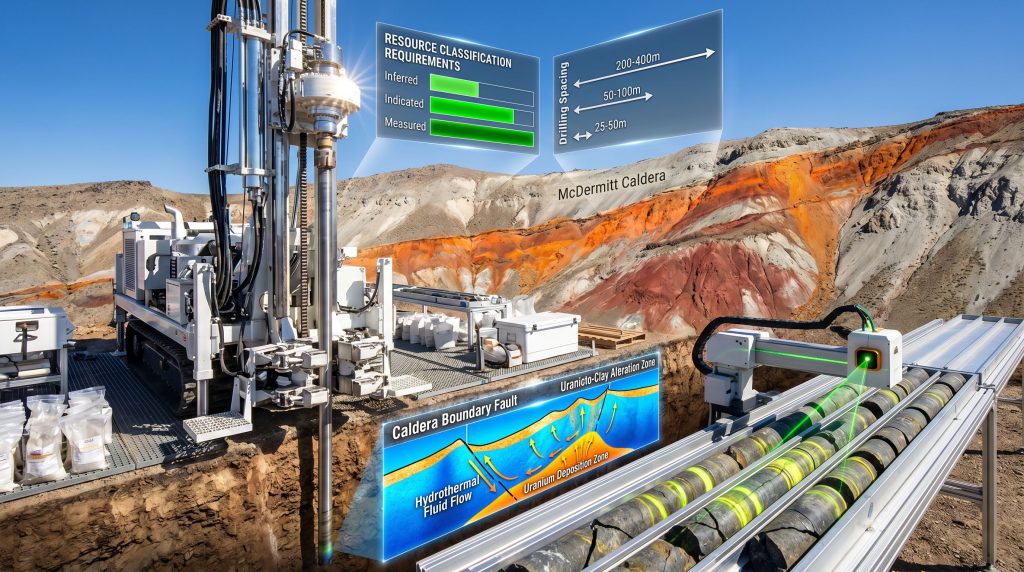
Modern uranium exploration has evolved far beyond simple prospect identification, with contemporary projects requiring sophisticated drilling methodologies that address complex geological uncertainties and regulatory requirements. The shift toward comprehensive investigative drilling at Oregon uranium site programs reflects industry recognition that incomplete subsurface understanding represents the primary risk factor in uranium development economics.
Advanced Drilling Technologies Reshaping Uranium Resource Definition
Investigative drilling campaigns now employ multiple complementary technologies to maximize geological understanding while minimizing environmental disturbance. Diamond core drilling provides continuous rock samples essential for detailed mineralogical analysis, while reverse circulation methods offer cost-effective approaches for initial target testing.
Furthermore, AI in drilling applications are revolutionising data collection efficiency. Hyperspectral core logging systems enable real-time uranium content analysis, dramatically reducing the traditional lag between drilling and resource model updates. These automated systems can process up to 500 feet of core daily, identifying mineralization patterns and alteration zones within hours of sample retrieval.
Table: Modern Drilling Technology Capabilities
| Technology | Sample Quality | Analysis Speed | Cost Factor |
|---|---|---|---|
| Diamond Core | Excellent | 24-48 hours | High |
| Reverse Circulation | Good | 12-24 hours | Medium |
| Sonic Drilling | Variable | 6-12 hours | Very High |
| Air Rotary | Poor | 4-8 hours | Low |
Directional drilling capabilities allow exploration of multiple geological targets from single drill platforms, reducing surface disturbance while maintaining comprehensive subsurface coverage. Steerable drilling systems can deviate up to 60 degrees from vertical, enabling access to mineralized zones previously requiring multiple surface locations.
When big ASX news breaks, our subscribers know first
Regulatory Evolution and Environmental Integration
Federal land management agencies have fundamentally restructured uranium exploration oversight, emphasizing proactive environmental stewardship throughout project development phases. The Bureau of Land Management now requires comprehensive baseline studies before approving large-scale drilling programs.
Multi-agency coordination protocols between federal, state, and tribal authorities create complex approval pathways that can extend permitting timelines by 6-12 months compared to historical standards. However, companies that invest in thorough environmental characterisation often experience accelerated construction permitting once projects advance to development phases. For detailed guidance on this process, mining permitting insights provide valuable context for operators.
Cultural resource surveys now encompass traditional ecological knowledge integration, requiring consultation with tribal representatives throughout exploration activities. This collaborative approach has identified previously unknown archaeological sites while building community support for responsible uranium development.
Key Regulatory Milestones for Oregon Uranium Projects:
- Environmental baseline data collection (6-12 months)
- Cultural resource documentation (3-6 months)
- Wildlife impact assessment (12-18 months)
- Groundwater protection planning (6-9 months)
- Air quality monitoring establishment (3-6 months)
McDermitt Caldera: Geological Advantages Driving Investment
The McDermitt Caldera complex along the Oregon-Nevada border represents a unique geological environment where volcanic activity created ideal conditions for large-scale uranium concentration. This 16-million-year-old volcanic system hosts zeolite-clay alteration zones that naturally concentrate uranium through ion exchange processes.
Caldera-hosted deposits typically exhibit superior metallurgical characteristics compared to traditional sandstone uranium resources. The zeolitic host rocks enable simpler acid leach processing, potentially reducing operating costs by 20-30% compared to conventional uranium recovery methods. Additionally, the northern Nevada uranium project demonstrates the regional potential for significant discoveries.
Investigative drilling at Oregon uranium site operations target specific geological structures within the caldera complex, focusing on welded tuff units and hydrothermal breccia zones where uranium mineralisation reaches economic concentrations. These geological environments often produce deposits with consistent grade distribution, minimising selective mining requirements during eventual extraction operations.
Table: McDermitt Caldera Geological Characteristics
| Feature | Advantage | Impact on Mining |
|---|---|---|
| Zeolite Alteration | Enhanced uranium mobility | Simplified processing |
| Large-scale Hydrothermal | Extensive mineralisation | Higher resource potential |
| Favourable pit slopes | Reduced strip ratios | Lower mining costs |
| Consistent grades | Predictable ore distribution | Operational efficiency |
Economic Drivers Accelerating Drilling Investment
Uranium market fundamentals have created compelling incentives for aggressive exploration investment, with long-term contract prices reaching levels not seen since the early 2010s. Utility companies are actively seeking supply diversification amid geopolitical uncertainties affecting traditional uranium sources. The US uranium import ban has further intensified domestic sourcing requirements.
Small Modular Reactor (SMR) development programmes represent a significant new demand driver, with projected uranium requirements potentially increasing by 15,000-25,000 pounds annually per deployed reactor. This emerging market segment values supply security over price optimisation, creating premium opportunities for domestic uranium producers.
The 27,000-foot investigative drilling programme at the Aurora Uranium Project exemplifies industry confidence in Oregon's uranium potential. Such large-scale exploration investments typically indicate management belief in multi-million-pound resource potential, given current drilling costs of $150-200 per foot in remote locations. Moreover, companies are leveraging massive uranium deposits to fuel the nuclear renaissance.
Industry analysts suggest that domestic uranium projects with proven resources exceeding 10 million pounds could command significant premiums in strategic partnership negotiations, particularly given current supply chain security concerns.
Resource Estimation Precision and Investment Implications
Modern geostatistical modelling requires systematic drilling patterns to achieve the statistical confidence levels demanded by contemporary resource classification standards. The transition from inferred to indicated resource categories typically requires tripling drilling density, representing substantial capital commitments. For investors new to evaluating these results, interpreting drill results techniques prove essential.
Kriging interpolation methods now incorporate geological continuity constraints that better reflect actual ore body characteristics. These advanced modelling approaches can reduce resource uncertainty by 40-60% compared to traditional estimation techniques, enabling more accurate economic assessments.
Table: Drilling Density Requirements by Resource Category
| Classification | Confidence Level | Typical Spacing | Data Points/km² |
|---|---|---|---|
| Inferred | 25-50% | 400m x 400m | 6-8 |
| Indicated | 50-75% | 200m x 200m | 25-30 |
| Measured | >90% | 100m x 100m | 100-120 |
Block model validation through cross-validation techniques ensures resource estimates maintain statistical rigour throughout project development phases. Companies that invest in comprehensive resource definition often achieve 15-25% higher valuations in acquisition scenarios compared to projects with limited drilling data.
Infrastructure Logistics and Operational Challenges
Remote uranium exploration requires substantial logistical coordination, with equipment mobilisation costs representing 25-35% of total drilling budgets in frontier regions. Access road construction, water sourcing, and equipment transportation demand months of advance planning.
Seasonal drilling windows in high-elevation uranium districts create compressed operational timeframes. Weather constraints in Oregon's eastern regions typically limit drilling activities to May through October, requiring precise coordination between drilling contractors, analytical laboratories, and regulatory oversight teams.
Helicopter-supported drilling operations enable access to environmentally sensitive areas while minimising surface disturbance. These specialised programmes can cost $500-800 per foot, but provide exploration capabilities in previously inaccessible geological targets.
Critical Infrastructure Elements for Remote Drilling:
- Improved access roads (typically $50,000-150,000 per mile)
- Reliable water sources (minimum 2,000 gallons daily per rig)
- Communication systems (satellite connectivity essential)
- Equipment staging areas (minimum 2-acre cleared zones)
- Fuel storage facilities (diesel consumption 200-300 gallons daily)
The next major ASX story will hit our subscribers first
Pre-Feasibility Engineering Integration
Contemporary drilling programmes must satisfy multiple analytical objectives simultaneously, collecting geological, geotechnical, and metallurgical data from shared core samples. Integrated sampling protocols ensure maximum value extraction from each metre drilled while maintaining sample integrity.
Metallurgical test work requires representative samples from throughout the resource area, demanding careful core preservation and chain-of-custody procedures. These samples undergo acid leach testing, column testing, and pilot plant evaluation to optimise future processing parameters.
Geotechnical characterisation focuses on rock mass properties essential for pit slope design and underground excavation planning. Core recovery rates, rock quality designation (RQD), and structural measurements guide eventual mining method selection.
Engineering Data Requirements from Drilling Programmes:
- Rock strength parameters (unconfined compressive strength testing)
- Hydrogeological characteristics (permeability and porosity analysis)
- Metallurgical recovery rates (acid consumption and uranium extraction)
- Structural geology mapping (fault systems and joint patterns)
- Geochemical baseline conditions (pre-mining water and soil chemistry)
Strategic Market Positioning Through Resource Development
Well-defined uranium resources create significant advantages in strategic partnership negotiations, with resource confidence directly correlating to investor interest and equity valuations. Companies with measured and indicated resources typically trade at 2-4 times higher multiples than early-stage exploration projects. However, the volatile uranium market requires careful timing considerations.
Off-take agreement negotiations favour projects with comprehensive geological understanding and established resource estimates. Utility companies increasingly demand detailed technical data packages before committing to long-term uranium supply contracts.
The strategic optionality created by thorough resource definition enables multiple development pathways, including joint ventures with established mining companies, streaming agreements with precious metals firms, or direct acquisition by uranium-focused entities seeking production growth.
Market Positioning Advantages of Comprehensive Resource Definition:
- Enhanced credibility with institutional investors
- Improved access to project financing options
- Strengthened negotiating position in partnership discussions
- Reduced technical risk perception among stakeholders
- Accelerated regulatory approval timelines through demonstrated competence
Future Outlook for Oregon Uranium Development
The combination of favourable geology, evolving regulatory frameworks, and strengthening market fundamentals positions Oregon uranium projects for significant development activity over the next decade. Investigative drilling at Oregon uranium site programmes beginning in summer 2026 will provide critical data for evaluating the region's long-term production potential.
Success in these comprehensive exploration programmes could establish Oregon as a significant domestic uranium supply source, contributing to national energy security objectives while supporting regional economic development. The integration of advanced drilling technologies, environmental stewardship, and systematic resource development represents the evolution of responsible uranium exploration practices.
Consequently, the investigative drilling at Oregon uranium site initiatives will serve as crucial determinants in establishing the state's position within America's domestic uranium production landscape. The outcomes of these drilling campaigns will ultimately influence strategic decisions across the entire nuclear fuel supply chain.
Disclaimer: This analysis contains forward-looking statements and speculative elements regarding uranium market development and exploration outcomes. Actual results may vary significantly from projected scenarios. Investment decisions should be based on comprehensive due diligence and professional financial advice.
Ready to Capitalise on the Next Major Uranium Discovery?
Discovery Alert's proprietary Discovery IQ model delivers real-time alerts on significant uranium and mineral discoveries across the ASX, instantly empowering subscribers to identify actionable opportunities ahead of the broader market. Understand why historic discoveries can generate substantial returns by visiting Discovery Alert's dedicated discoveries page, then begin your 14-day free trial today to position yourself ahead of the market.