August 11, 2026
Understanding Uranium Isotope Separation Fundamentals
Nuclear reactors depend on precise isotopic composition to sustain controlled fission reactions, yet natural uranium contains only 0.7% of the fissile U-235 isotope required for most commercial applications. The remaining 99.3% consists of U-238, which cannot maintain chain reactions under typical reactor conditions. This fundamental challenge has driven decades of technological development in uranium enrichment methods, including the emerging field of laser uranium enrichment.
The Science Behind Isotopic Differentiation
The atomic structure difference between U-235 and U-238 creates the foundation for separation technologies. While both isotopes share identical chemical properties, their three-neutron mass difference enables physical separation techniques. U-235 atoms contain 143 neutrons compared to 146 neutrons in U-238, creating subtle but exploitable differences in atomic behavior during excitation processes.
Commercial nuclear reactors typically require uranium enriched to 3-5% U-235 concentration for light water reactor applications, while advanced reactor designs may demand higher enrichment levels. Furthermore, high-assay low-enriched uranium (HALEU) specifications call for 5-20% U-235 content, representing a growing market segment for next-generation reactor technologies.
Traditional Enrichment Methods vs. Laser Technology
Gas centrifuge technology currently dominates global uranium enrichment capacity, utilising high-speed rotation to separate isotopes based on mass differences. These facilities require massive infrastructure investments and consume substantial electrical energy, typically operating 50,000-70,000 RPM centrifuges arranged in cascading configurations.
Gaseous diffusion, the historical workhorse of uranium enrichment, relied on molecular effusion through porous barriers but proved extremely energy-intensive. These plants required 2,400-2,500 kilowatt-hours per separative work unit (SWU), compared to modern centrifuge facilities consuming approximately 50-60 kWh per SWU.
However, advances in US uranium production technology have demonstrated significant efficiency gains. Laser uranium enrichment promises dramatically reduced energy consumption and capital requirements, potentially achieving 10-20 times higher separation factors per stage compared to centrifuge technology. This efficiency improvement could fundamentally alter enrichment economics and facility design parameters.
When big ASX news breaks, our subscribers know first
How Does Laser Uranium Enrichment Technology Function?
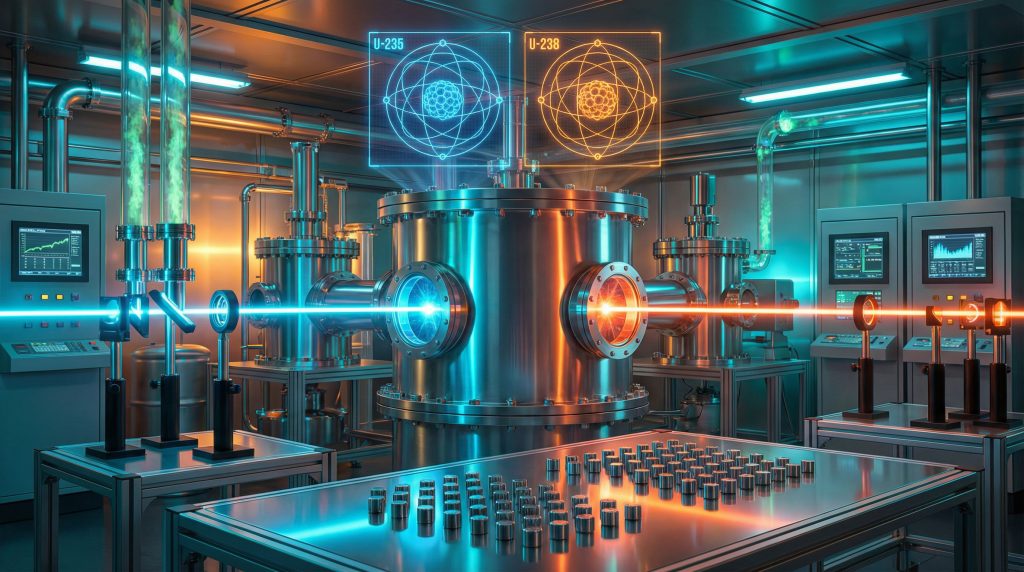
The precision of laser uranium enrichment relies on exploiting minute energy differences between uranium isotopes through carefully controlled photon interactions. Unlike mechanical separation methods, laser enrichment operates at the molecular level using electromagnetic radiation tuned to specific atomic or molecular vibrational frequencies.
Photoexcitation Process Mechanics
Laser enrichment systems direct monochromatic light at precisely calibrated wavelengths to selectively excite U-235 atoms or uranium-bearing molecules. This selective excitation creates temporary energy states that enable isotope separation through ionisation or chemical reaction pathways. The process requires wavelength accuracy within 0.01 nanometer tolerances to maintain selectivity between isotopes.
Target atoms absorb photon energy matching their specific electronic or vibrational transitions, creating excited states that facilitate separation from non-excited U-238 isotopes. Collection systems then harvest the excited or ionised U-235 through electromagnetic fields or chemical processes designed to preserve enrichment gains.
AVLIS (Atomic Vapor Laser Isotope Separation) Method
The AVLIS process begins with uranium metal vaporisation in high-temperature electron beam furnaces, creating atomic uranium vapour containing both isotopes. Copper vapour lasers or dye laser systems provide the precise wavelengths required for U-235 selective ionisation, typically operating in the visible and near-infrared spectrum.
Ionised U-235 atoms carry positive electrical charges that enable collection through negatively charged plates positioned within the vapour chamber. Consequently, the remaining neutral U-238 atoms continue through the system without collection, maintaining isotopic separation throughout the process cycle.
SILEX (Separation of Isotopes by Laser Excitation) Process
SILEX technology operates on uranium hexafluoride gas feedstock, utilising infrared laser radiation to selectively excite molecular vibrational modes specific to UF6 molecules containing U-235. This molecular excitation creates velocity and reactivity differences that enable physical separation through gas dynamic processes.
For instance, the excited molecules exhibit altered collision cross-sections and chemical reactivity compared to ground-state U-238-bearing molecules. Separation chambers exploit these property differences through carefully controlled pressure and temperature gradients that preferentially direct excited molecules toward collection regions.
What Are the Economic Advantages of Laser Enrichment?
The commercial potential of laser uranium enrichment centres on dramatic reductions in capital intensity and operational complexity compared to traditional enrichment technologies. Early-stage deployments indicate significant economic advantages across multiple operational parameters, particularly given current uranium market volatility.
Capital Investment Requirements
LIS Technologies announced a $1.38 billion investment for their Oak Ridge commercial facility, representing the first major U.S. commercial laser enrichment plant development. The company acquired 206 acres at the historic K-25 site for $8 million, utilising existing nuclear infrastructure to reduce greenfield development costs.
The facility will create 203 jobs and target commercial operations before 2030, following site preparation and construction phases scheduled for 2026. This investment timeline suggests accelerated deployment capability compared to traditional centrifuge facilities requiring 7-10 year development cycles.
In addition, construction will leverage existing infrastructure at the K-25 uranium enrichment complex, potentially reducing total capital requirements through shared utilities, security systems, and regulatory frameworks already established at the site.
Operational Efficiency Metrics
According to Jay Yu, Executive Chairman and CEO of LIS Technologies, laser enrichment technology fundamentally changes enrichment economics through faster deployment, lower capital intensity, and long-term cost advantages. The technology promises separation factors 2-20 times higher than conventional methods per processing stage.
Energy consumption projections suggest laser enrichment could operate at significantly lower power requirements than centrifuge cascades, though specific kilowatt-hour per SWU figures remain proprietary. Furthermore, the precision of laser targeting eliminates mechanical wear components that drive maintenance costs in rotating centrifuge systems.
Processing capacity flexibility represents another operational advantage, with laser systems potentially adjusting output levels through power modulation rather than physical equipment reconfiguration required in centrifuge facilities.
Production Economics Analysis
LIS Technologies raised $17 million in oversubscribed funding in January 2026, bringing total accumulated funding to $64 million. This financing pattern indicates investor confidence in the technology's commercial viability despite competition from established enrichment providers.
The Department of Energy's $3.4 billion LEU Enrichment Acquisition Program includes six companies, with Global Laser Enrichment receiving $28 million for technology development while Orano secured $900 million for conventional LEU enrichment expansion. These funding allocations suggest government recognition of laser enrichment potential alongside established technologies, particularly in light of the recent US Senate uranium ban.
Disclaimer: Investment projections and cost comparisons are based on company statements and may not reflect actual commercial performance once facilities achieve full operational status.
Which Companies Are Developing Commercial Laser Enrichment?
The laser uranium enrichment sector features a concentrated group of developers advancing different technological approaches toward commercial deployment. Current industry activity centres on two primary companies with distinct development strategies and funding sources.
LIS Technologies Oak Ridge Investment
LIS Technologies represents the most advanced commercial laser enrichment deployment in the United States, with specific site acquisition, construction timeline, and regulatory engagement already initiated. The company selected Oak Ridge for both strategic and symbolic reasons, positioning their facility at the historic foundation of American uranium enrichment capability.
The 206-acre LIST Island facility (formerly Duct Island) will serve as the company's first commercial plant, leveraging the K-25 complex's existing nuclear infrastructure and regulatory framework. Site preparation and nonnuclear construction phases begin in 2026, contingent on Nuclear Regulatory Commission licensing and local permitting approval.
Key development metrics include:
- Total facility investment: $1.38 billion
- Land acquisition cost: $8 million for 206 acres
- Employment impact: 203 direct jobs
- Construction timeline: 2026 site preparation start
- Commercial target: Operations before 2030
- Regulatory status: NRC licensing process underway
The company's funding progression demonstrates sustained investor interest, with four consecutive oversubscribed funding rounds totalling $64 million as of January 2026. This financial trajectory suggests confidence in technology readiness and market opportunity assessment.
Global Laser Enrichment Technology Development
Global Laser Enrichment secured $28 million through the Department of Energy's LEU Enrichment Acquisition Program, positioning the company as an alternative laser enrichment developer with federal backing. The award represents recognition of laser enrichment viability within DOE strategic planning for domestic uranium supply security.
GLE's selection among six companies in the $3.4 billion cumulative contract ceiling program indicates government interest in diversifying enrichment technology portfolios beyond traditional centrifuge methods. However, the company's development timeline and facility plans remain less publicised compared to LIS Technologies' Oak Ridge announcement.
Technology Readiness Assessment
The nuclear industry's systematic approach to technology development suggests laser uranium enrichment has progressed beyond laboratory demonstration toward commercial validation stages. Both major developers indicate readiness for full-scale facility construction, though specific Technology Readiness Level assessments vary by organisation.
Regulatory engagement represents a critical milestone, with LIS Technologies actively pursuing NRC licensing while maintaining construction readiness. This parallel approach suggests confidence in technology maturity sufficient for regulatory approval within projected timelines.
Consequently, the industry's movement from research and development toward commercial deployment indicates technological challenges have been substantially resolved, though operational validation at commercial scale remains pending.
What Are the Technical Challenges in Laser Enrichment?
Despite promising commercial developments, laser uranium enrichment faces substantial technical obstacles that must be overcome for reliable industrial operation. These challenges span precision engineering, materials science, and process control domains.
Laser System Precision Requirements
Maintaining wavelength stability within 0.01 nanometer tolerances over continuous industrial operation presents significant engineering challenges. Laser systems must deliver consistent power output while preserving spectral purity essential for isotope selectivity, requiring sophisticated feedback control systems and environmental isolation.
Temperature fluctuations, mechanical vibrations, and optical component degradation can shift laser characteristics beyond acceptable parameters. Industrial facilities must incorporate precision environmental control systems maintaining temperature stability within ±0.1°C and vibration isolation systems protecting optical components from facility operations.
Furthermore, power output consistency becomes critical for maintaining enrichment efficiency across processing cycles. Laser degradation over operational lifespans requires predictive maintenance protocols and component replacement strategies that minimise production interruptions.
Material Handling Considerations
Uranium vapour and uranium hexafluoride gas systems demand specialised containment technologies resistant to highly corrosive and radioactive environments. UF6 reacts aggressively with atmospheric moisture, creating handling challenges that require sophisticated purification and recovery systems.
Processing chambers must maintain ultra-high vacuum conditions while enabling continuous feedstock introduction and product recovery. Contamination control systems prevent cross-mixing between enriched and depleted uranium streams that would compromise separation efficiency.
In addition, safety protocols encompass both radiological protection and chemical hazard management, requiring integrated monitoring systems and emergency response procedures specific to laser enrichment operations. These considerations become increasingly important given nuclear waste disposal safety requirements.
Scale-Up Engineering Obstacles
Laboratory demonstration systems typically process gram quantities of uranium, while commercial facilities must handle metric tons per day throughput levels. This scale increase requires parallel processing arrays and sophisticated process control integration.
Quality control standardisation becomes increasingly complex as facility size increases, demanding real-time isotopic monitoring systems and automated process adjustment capabilities. However, maintaining enrichment specifications across multiple parallel processing lines requires advanced process control algorithms.
The transition from batch processing to continuous operation presents additional engineering challenges, including steady-state process optimisation and dynamic response to feedstock composition variations.
How Does Laser Enrichment Impact Nuclear Fuel Supply Chains?
The integration of laser uranium enrichment technology into existing nuclear fuel cycles creates opportunities for supply chain diversification while potentially disrupting established commercial relationships and capacity allocations.
Global Enrichment Capacity Analysis
Current global uranium enrichment capacity relies heavily on gas centrifuge technology, with major providers including Urenco, Orano, and Rosatom controlling significant market shares. Laser enrichment introduction could redistribute market dynamics through cost competitiveness and strategic considerations.
The Department of Energy's $2.7 billion total awards for HALEU and LEU enrichment capacity expansion demonstrates growing domestic demand beyond current supply capabilities. Traditional enrichment providers received the majority of initial funding, with Orano securing $900 million compared to $28 million for Global Laser Enrichment.
Furthermore, future demand projections incorporate advanced reactor deployments requiring HALEU specifications, creating market segments where laser enrichment efficiency advantages may prove particularly valuable. Small modular reactors and Generation IV designs represent growth markets for specialised enrichment services.
Strategic Resource Independence
Domestic enrichment capability enhancement addresses national security concerns regarding foreign uranium supply dependencies. The United States currently imports significant portions of enriched uranium from international suppliers, creating strategic vulnerabilities during geopolitical tensions.
LIS Technologies' positioning of their Oak Ridge facility as supporting America's clean energy and national security mission reflects this strategic dimension. The location selection at the historic K-25 site emphasises continuity with original U.S. enrichment capabilities.
Consequently, reduced reliance on foreign suppliers becomes increasingly important as nuclear power expansion accelerates domestically. Modern uranium investment strategies must account for these shifting supply dynamics and technological advances.
Small Modular Reactor (SMR) Applications
Advanced reactor designs requiring HALEU fuel specifications represent a specialised market segment where laser enrichment precision advantages may prove particularly valuable. These reactors demand enrichment levels between 5-20% U-235, higher than conventional light water reactor requirements.
Current HALEU production capacity remains limited globally, creating supply bottlenecks for advanced reactor deployment schedules. For instance, laser enrichment facilities designed for HALEU production could address these constraints through dedicated processing capabilities.
The flexibility of laser systems to adjust enrichment levels through operational parameter changes, rather than physical cascade reconfiguration, may enable more responsive HALEU production scheduling.
The next major ASX story will hit our subscribers first
What Are the Proliferation and Security Concerns?
The deployment of laser uranium enrichment technology raises significant proliferation concerns due to the technology's potential for weapons-grade material production and facility concealment capabilities.
Weapons-Grade Material Production Risks
Laser enrichment systems capable of producing reactor-grade uranium can theoretically be operated at higher enrichment levels approaching weapons-grade concentrations above 90% U-235. The same technological infrastructure supporting commercial fuel production could facilitate military applications under different operational parameters.
The compact nature of laser enrichment facilities compared to traditional centrifuge cascades creates challenges for proliferation detection. Smaller facilities require less observable infrastructure, potentially enabling covert weapons programs in violation of international agreements.
However, detection and monitoring systems must account for the different operational signatures of laser enrichment compared to centrifuge facilities, requiring updated surveillance technologies and inspection protocols.
Regulatory Framework Requirements
International Atomic Energy Agency oversight protocols developed for traditional enrichment technologies require adaptation for laser enrichment monitoring. The IAEA must develop new safeguards approaches accounting for laser enrichment's distinct operational characteristics and proliferation risks.
Nuclear Regulatory Commission licensing processes for domestic laser enrichment facilities incorporate enhanced security requirements and operational restrictions designed to prevent diversion of enriched materials. These regulatory frameworks balance commercial viability with nonproliferation objectives.
Furthermore, export control implications extend beyond facility technology to include laser components, control systems, and technical expertise that could enable proliferation if transferred to unauthorised recipients.
Safeguards and Verification Protocols
Material accounting systems must track uranium flows through laser enrichment processes with precision sufficient to detect diversion attempts. Real-time monitoring technologies provide continuous verification of facility operations and product specifications.
Remote monitoring capabilities enable international inspectors to verify facility compliance without constant physical presence, utilising automated sensors and data transmission systems resistant to tampering or interference.
In addition, physical security enhancements protect both uranium materials and sensitive laser enrichment technology from unauthorised access or theft attempts by state or non-state actors seeking proliferation capabilities.
What Is the Future Outlook for Laser Uranium Enrichment?
The commercial trajectory of laser uranium enrichment depends on successful demonstration of technical reliability, economic competitiveness, and regulatory acceptance across multiple deployment scenarios.
Market Penetration Timeline
Commercial deployment milestones centre on LIS Technologies' pre-2030 operational target and Global Laser Enrichment's technology development progress under DOE funding. These timelines represent the earliest potential introduction of commercial laser enrichment capacity.
Cost competitiveness projections remain largely proprietary, though company statements suggest significant advantages over traditional enrichment methods. Actual cost validation awaits operational data from full-scale commercial facilities, as detailed in various world-nuclear enrichment analyses.
Technology adoption scenarios depend on regulatory approval processes, customer acceptance, and performance validation under industrial operating conditions. For instance, early adopters may include utilities seeking supply diversification or advanced reactor developers requiring HALEU specifications.
Research and Development Priorities
Efficiency improvement targets focus on increasing separation factors per stage and reducing energy consumption per separative work unit. Research continues on alternative laser technologies and improved process automation systems, as discussed in breakthrough energy analyses.
Development priorities include extending laser system operational lifespans, reducing maintenance requirements, and enhancing process control precision. These improvements could strengthen economic advantages over conventional enrichment methods.
Furthermore, process automation advances may enable unmanned facility operations, reducing labour costs while maintaining safety and security standards essential for nuclear fuel production.
Industry Transformation Potential
Traditional enrichment facility impacts could include market share redistribution and competitive pressure on existing centrifuge operations. Investment flows may redirect toward laser uranium enrichment technology development and facility construction.
Workforce transition requirements encompass retraining programs for personnel transitioning from centrifuge operations to laser enrichment systems. The technical skill sets differ significantly between mechanical centrifuge maintenance and precision optical system operation.
However, the nuclear industry's conservative approach to new technologies suggests gradual adoption rather than rapid displacement of existing enrichment capacity, allowing extended transition periods for workforce and infrastructure adaptation.
Disclaimer: Future market projections and technology adoption timelines are based on current development progress and may be affected by regulatory decisions, technical challenges, or competitive factors not currently anticipated.
Frequently Asked Questions About Laser Uranium Enrichment
Is laser enrichment more environmentally friendly?
Laser uranium enrichment systems consume significantly less electrical energy per separative work unit compared to traditional gas centrifuge or gaseous diffusion methods. The reduced power consumption translates to lower carbon emissions and environmental impact per unit of enriched uranium produced.
The compact facility footprint reduces land use requirements and construction materials compared to extensive centrifuge cascade facilities. Nevertheless, laser enrichment still involves radioactive uranium handling and produces depleted uranium requiring disposal or storage.
How much does laser enrichment cost compared to centrifuges?
Specific cost comparisons remain proprietary among commercial developers, though company statements suggest significant economic advantages through reduced capital intensity and operational efficiency. The $1.38 billion LIS Technologies facility investment provides a reference point for laser enrichment capital requirements.
Long-term operational costs depend on laser system maintenance, energy consumption, and throughput optimisation still being validated in commercial deployments. Early cost projections should be considered preliminary until operational data becomes available.
When will laser enrichment become commercially available?
LIS Technologies targets commercial operations before 2030 at their Oak Ridge facility, representing the most specific timeline currently announced. Global Laser Enrichment's timeline remains less defined, though DOE funding supports continued technology development.
Regulatory approval processes and construction schedules will determine actual commercial availability. Consequently, the Nuclear Regulatory Commission licensing process timeline affects both major developers' deployment schedules.
Which countries are investing in laser enrichment technology?
The United States leads current commercial laser enrichment development through LIS Technologies and Global Laser Enrichment, with Department of Energy support indicating government strategic interest in the technology.
International development remains limited publicly, though several nations have historical research programs in laser isotope separation. Commercial deployment outside the United States awaits technology maturation and regulatory framework development.
Readers interested in learning more about uranium enrichment technologies can explore additional educational resources, including technical publications from the American Nuclear Society and related nuclear industry analyses available through various educational platforms.
Ready to Capitalise on the Next Uranium Discovery?
Discovery Alert's proprietary Discovery IQ model delivers instant notifications on significant uranium discoveries across the ASX, providing subscribers with actionable insights ahead of the broader market. Begin your 30-day free trial today and position yourself to benefit from the uranium sector's technological transformation and growing strategic importance.