
August 6, 2026
The ongoing uranium mine dispute in Niger has emerged as a defining case study in international mining law, highlighting the complex intersection of resource sovereignty, investment protection, and post-colonial economic relationships. This legal battle involves French multinational Orano and Niger's military government, with significant implications for global uranium supply chains and African mining governance. Furthermore, the dispute demonstrates how uranium market volatility extends beyond traditional supply-demand factors to encompass geopolitical instability.
What Legal Frameworks Govern International Mining Disputes in West Africa?
ICSID Arbitration Process and Enforcement Mechanisms
The International Centre for Settlement of Investment Disputes operates under World Bank auspices to resolve mining conflicts through binding arbitration procedures. In the ongoing uranium mine dispute in Niger, an ICSID tribunal has prohibited the West African nation from selling approximately 1,300 tonnes of uranium concentrate, demonstrating the institution's enforcement capabilities in resource extraction disputes. This prohibition represents one of the most significant interim measures orders in recent African mining arbitrations.
ICSID jurisdiction typically emerges through bilateral investment treaty provisions that protect foreign mining companies from expropriation without compensation. The Centre's arbitral process involves three-member tribunals with expertise in international law, mining regulations, and commercial disputes. Enforcement mechanisms include asset freezing orders, sales prohibitions, and diplomatic pressure through World Bank member nations.
The tribunal's ability to restrict uranium sales demonstrates sophisticated enforcement tools available in complex mining nationalizations. However, compliance remains dependent on international cooperation and diplomatic pressure, as evidenced by Niger's continued resistance to the arbitral ruling.
Resource Sovereignty vs. Investment Protection Balance
The fundamental tension between host nation mineral sovereignty and foreign investor rights creates ongoing legal complexities in West African mining disputes. Niger historically maintained a joint venture structure where Orano held a 63.4% controlling stake in the Somair uranium operation, with the remaining 36.6% owned by Niger's state-owned Sopamin. This ownership arrangement represented decades of negotiated balance between foreign technical expertise and domestic resource control.
International law recognizes permanent sovereignty over natural resources as a fundamental state right, codified through United Nations General Assembly resolutions. However, this sovereignty must be exercised consistent with international investment obligations, including fair and equitable treatment standards, full protection and security guarantees, and non-discriminatory expropriation procedures.
When Niger unilaterally nationalised the Somair mine in June 2025, it triggered these competing legal frameworks. Compensation requirements under international expropriation doctrines demand prompt, adequate, and effective payment for nationalised assets.
When big ASX news breaks, our subscribers know first
How Do Military Governments Reshape Mining Regulatory Landscapes?
Post-Coup Resource Nationalism Patterns Across the Sahel
Military governments across the Sahel region have systematically renegotiated mining agreements as legitimacy-building mechanisms following recent coups. Niger's military authorities initially took control of the Somair uranium mine in 2024, accusing Orano of planning to halt operations and sell its stake without following proper regulatory procedures. This takeover preceded formal nationalisation by approximately one year, suggesting a calculated approach rather than impulsive policy-making.
The broader Sahel trend encompasses similar resource nationalism initiatives in Mali and Burkina Faso, where military governments have curtailed Western mining influence while embracing partnerships with Russian and Chinese entities. These policy shifts represent systematic attempts to renegotiate what military leaders characterise as historically unfavourable resource-sharing arrangements established during post-independence periods.
Niger's military ruler Abdourahamane Tiani has articulated this perspective regarding both uranium and petroleum agreements. He stated that original sharing arrangements were "completely unfavourable to Niger" and required review to avoid repeating historical mistakes. This framing positions resource nationalism as correcting colonial-era inequities rather than arbitrary contract violations.
Legal Validity of Unilateral Contract Modifications
International arbitration tribunals generally reject unilateral contract modification claims without due process and adequate compensation. The ICSID tribunal's prohibition on Niger's uranium sales suggests that security concerns and procedural allegations do not justify abandoning pacta sunt servanda principles that govern international commercial relationships.
Niger's removal of uranium from the Somair site occurred in direct violation of the tribunal's ruling, demonstrating the tension between international legal obligations and domestic political pressures. Due process requirements in asset nationalisation typically include advance notice, opportunity for consultation, transparent regulatory procedures, and compensation negotiations.
Force majeure doctrines could theoretically justify contract modifications during security emergencies. However, recent attacks near uranium stockpiles occurred after nationalisation rather than before, weakening claims that security threats necessitated immediate takeover.
What Are the Technical and Operational Risks of Forced Mine Transfers?
Uranium Processing Expertise and Safety Protocols
Approximately 95,000 tons of concentrated uranium powder, known as yellowcake, awaits resolution in the uranium mine dispute in Niger, representing substantial inventory with contested ownership status. This quantity constitutes roughly 63.4% of the 150,000 tons produced at Somair during Orano's operational tenure, indicating significant accumulated production requiring specialised handling and transport protocols.
Yellowcake production involves complex milling, leaching, precipitation, and drying processes that demand extensive technical expertise and safety oversight. Uranium concentrate typically contains 80-85% uranium oxide (U3O8), requiring specialised containment systems, radiation monitoring equipment, and trained personnel for safe handling.
The transition from experienced international operators to state-owned entities raises questions about technical capacity maintenance and safety culture preservation. Orano's decades-long presence in Niger created institutional knowledge regarding local geological conditions, processing optimisation, and regulatory compliance that cannot be easily transferred.
Security Considerations in Jihadist-Affected Regions
Transportation route vulnerability assessments have become critical following recent security incidents near uranium stockpiles in Niger. Unidentified attackers who staged an assault on the capital came dangerously close to radioactive material storage areas, highlighting inadequate protection for sensitive nuclear materials in conflict-affected regions.
The proximity of jihadist groups to uranium concentrate storage creates unprecedented security challenges for radioactive material transport. International Atomic Energy Agency safeguards protocols typically govern uranium concentrate movements, requiring detailed documentation, secure transport containers, and continuous monitoring during transit.
Transport through jihadist-affected regions violates standard nuclear security practices that assume stable corridor control and reliable checkpoint security. The risk of radioactive material falling into non-state actor hands represents a catastrophic scenario requiring international intervention capabilities.
How Does Resource Nationalism Impact Global Uranium Supply Chains?
Niger's Position in Global Uranium Production
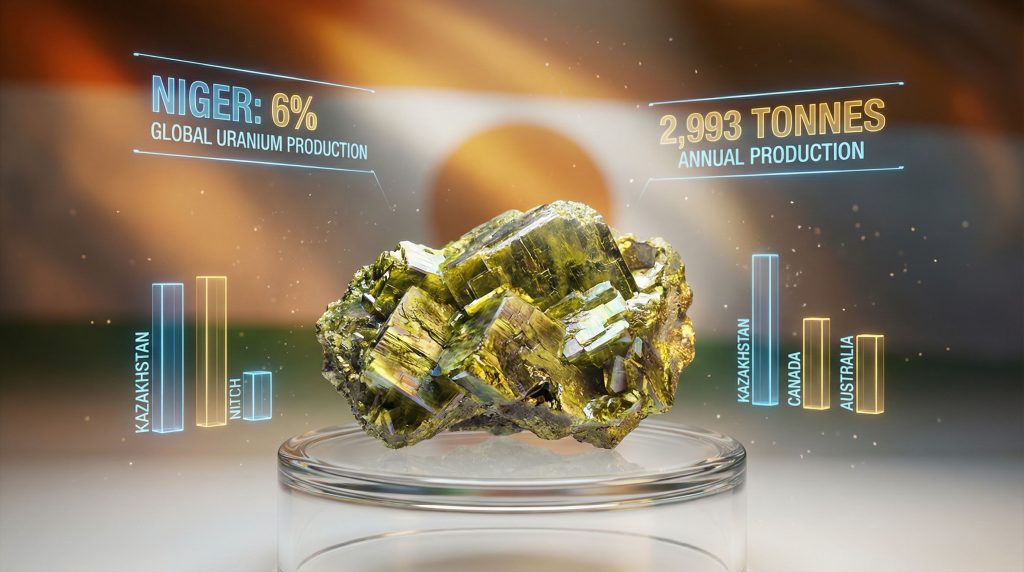
Niger ranks as the world's fourth-largest uranium producer, contributing approximately 6% of global annual production through its two major mines, Somair and Cominak. This production level positions Niger as a significant but non-critical supplier in global nuclear fuel supply chains, with sufficient alternative capacity available from Kazakhstan, Canada, and Australia to offset potential disruptions.
| Global Uranium Production Rankings (2025) |
|---|
| Country |
| Kazakhstan |
| Canada |
| Australia |
| Niger |
| Namibia |
The concentration of uranium production in Kazakhstan creates strategic dependencies that Western nuclear programmes seek to diversify through relationships with politically stable suppliers. Consequently, the critical minerals energy transition has become increasingly complex as nations reassess supply chain vulnerabilities.
Alternative Supplier Development and Market Diversification
Western dependency reduction strategies increasingly emphasise uranium supplier diversification to reduce exposure to political instability in traditional producing regions. The European Union's REPowerEU initiative specifically targets reduced reliance on Russian nuclear fuel services while developing alternative partnerships with stable democratic suppliers.
Emerging uranium production jurisdictions offer medium-term alternatives to West African sources, with significant development projects advancing in Saskatchewan, the Athabasca Basin, and Western Australian deposits. These projects benefit from established regulatory frameworks, skilled labour availability, and stable political environments that reduce nationalisation risks.
Strategic stockpiling mechanisms provide additional supply security buffers, with several countries maintaining emergency uranium reserves equivalent to 2-3 years of consumption. These stockpiles enable nuclear operators to manage short-term supply disruptions while alternative suppliers expand production capacity.
What Precedents Exist for Resolving Mining Nationalisation Disputes?
Successful Arbitration Outcomes in African Mining
Historical precedents in African mining investment disputes demonstrate mixed success rates for international arbitration mechanisms. Successful ICSID cases typically involve clear bilateral investment treaty violations, substantial evidence of procedural impropriety, and host nation willingness to engage in good-faith compensation negotiations.
Resolution timeframes commonly extend 3-5 years from initial filing to final award implementation. Compensation mechanisms in resolved mining disputes often involve structured payments combining immediate cash settlements, future production revenue shares, and operational restoration agreements.
Some successful resolutions have maintained joint venture structures while renegotiating ownership percentages and revenue allocation formulas to address host nation concerns about historical arrangements. However, the development of mining joint ventures has become increasingly challenging in politically unstable regions.
Failed Negotiations and Long-term Consequences
Economic impact assessments of unresolved mining nationalisations demonstrate severe long-term costs for host nations through reduced foreign investment, technology transfer disruption, and international reputation damage. Countries that maintain uncompensated expropriations typically experience 15-20 year investment drought periods as international mining companies avoid jurisdictional exposure.
Technology transfer disruption effects extend beyond immediate operational capacity to encompass research and development partnerships, technical training programmes, and equipment modernisation initiatives. State-owned mining entities rarely maintain the innovation capacity and capital investment levels achieved through international partnerships.
International reputation damage from mining nationalisations affects broader economic development prospects. Multilateral lending institutions, export credit agencies, and private investors incorporate governance assessments into country risk evaluations, making recovery from reputation damage a lengthy process.
How Are International Partners Responding to West African Resource Shifts?
Russian and Chinese Mining Investment Strategies
Russian nuclear fuel giant Rosatom has expanded African uranium exploration partnerships following Western operator withdrawals. These partnerships offer technical expertise without governance conditionality requirements that characterise Western investment approaches, emphasising state-to-state agreements that align with military governments' preferences.
Chinese mining investment in post-coup Sahel nations follows established resource diplomacy patterns combining infrastructure development, technical assistance, and favourable financing terms. Beijing's approach emphasises long-term supply security relationships while avoiding political interference in host nation domestic governance arrangements.
This creates attractive alternatives for military governments seeking resource development partnerships. Geopolitical implications of supplier diversification extend beyond commercial relationships to encompass nuclear fuel supply security, technology transfer controls, and strategic resource access during international tensions.
European Union Critical Minerals Security Response
The European Union's Critical Raw Materials Act establishes uranium supply diversification targets requiring 40% of annual consumption from non-Russian sources by 2030. The uranium mine dispute in Niger accelerates this timeline while reducing available alternative suppliers, potentially increasing costs and complexity for European nuclear operators.
Alternative supplier relationship development focuses on expanding partnerships with Canada's Cameco Corporation, Australia's uranium producers, and potentially Namibian operations under enhanced due diligence frameworks. These relationships require premium pricing to offset political risk differentials between stable and unstable producing jurisdictions.
The implementation of comprehensive critical minerals strategy frameworks has become essential for ensuring supply security. Strategic autonomy implications for European nuclear energy policy include reduced fuel cost competitiveness, increased supply chain complexity, and potential reactor utilisation constraints during transition periods.
The next major ASX story will hit our subscribers first
What Resolution Mechanisms Could End the Uranium Mine Standoff?
Negotiated Settlement Frameworks
Revenue-sharing agreement modifications could address Niger's concerns about historical contractual inequity while maintaining international operational expertise and investment security. Successful precedents involve increasing host nation revenue percentages from 15-25% to 35-45% while preserving international partner technical control and export market access.
Joint venture restructuring possibilities include converting majority foreign ownership to minority technical partnership arrangements where state entities hold controlling stakes but maintain international management contracts. This approach preserves essential technical expertise while addressing sovereignty concerns through ownership restructuring rather than complete nationalisation.
Gradual operational control transfer models provide transition mechanisms allowing international partners to maintain technical supervision while training local personnel. These arrangements typically involve 5-10 year transition periods with performance benchmarks and safety oversight requirements.
International Mediation and Diplomatic Solutions
African Union involvement potential remains limited given the organisation's non-interference principles and member state reluctance to challenge resource sovereignty assertions by fellow members. Regional mediation capabilities require broad consensus among member nations, which may not emerge given widespread support for resource nationalism.
Economic Community of West African States mediation faces similar constraints, with the organisation's focus on democratic governance restoration potentially conflicting with mining dispute resolution priorities. ECOWAS sanctions against Niger complicate neutral mediation positioning while reducing institutional credibility with military authorities.
Third-party arbitration alternatives might involve neutral international organisations such as the International Chamber of Commerce or specialised mining dispute resolution mechanisms. However, these alternatives require mutual consent from both parties, which Niger has shown reluctance to provide given its preference for unilateral resolution approaches.
What Long-term Implications Does This Dispute Hold for African Mining?
Investment Climate Impact Assessment
Foreign direct investment flow projections for West African mining indicate 25-40% reductions over 3-5 year periods following unresolved nationalisation disputes. International mining companies typically implement regional avoidance strategies that encompass neighbouring countries perceived as having similar political risk profiles.
Risk premium adjustments for West African mining projects now incorporate governance stability assessments, military coup probability calculations, and resource nationalism trend analysis. These adjustments typically increase project financing costs by 200-400 basis points while reducing available financing options through international development finance institutions.
The broader implications extend to other sectors, as demonstrated by recent mineral class action lawsuits that highlight governance concerns across the mining industry. Insurance and financing availability changes reflect heightened political risk perceptions, with several major political risk insurance providers reducing coverage limits or increasing premium costs.
Regulatory Framework Evolution Predictions
Model mining code development trends increasingly incorporate enhanced local content requirements, community benefit obligations, and government participation provisions that reflect resource nationalism priorities. These evolving frameworks balance foreign investment attraction with domestic control objectives through sophisticated regulatory mechanisms rather than crude nationalisation approaches.
Local content requirement strengthening typically involves gradual increases in domestic employment percentages, local supplier preferences, and skills transfer obligations over mine life cycles. Modern frameworks avoid immediate mandates that could discourage investment while ensuring meaningful domestic benefit increases over operational periods.
Environmental and social governance integration reflects international pressure for enhanced sustainability standards in African mining operations. Host governments increasingly leverage ESG requirements as negotiation tools for improved revenue sharing and community benefit arrangements while maintaining international investment attractiveness.
"The uranium mine dispute in Niger represents a broader shift toward resource nationalism across the Sahel, where military governments are renegotiating decades-old mining agreements to assert greater control over strategic mineral assets while challenging established international investment frameworks."
The resolution of this dispute will likely set important precedents for future mining investment in West Africa. According to recent analysis from mining industry experts, the outcome could influence how other African nations approach mineral resource governance.
Furthermore, the dispute's implications extend beyond Niger's borders, potentially affecting regional uranium market dynamics and international nuclear fuel supply chains. The international arbitration process continues to evolve, with stakeholders closely monitoring developments for broader implications on mining investment in politically unstable regions.
Disclaimer: This analysis involves forecasts and speculation about ongoing legal disputes, political developments, and market conditions. The uranium mine dispute in Niger remains subject to international arbitration proceedings, diplomatic negotiations, and changing political circumstances that could significantly alter outcomes. Investment decisions should not be based solely on this analysis, and readers should consult qualified legal and financial advisors before making investment or business decisions related to West African mining operations or uranium market exposure.
Ready to Capitalise on Critical Mineral Market Opportunities?
Discovery Alert's proprietary Discovery IQ model delivers real-time notifications on significant ASX mineral discoveries, instantly alerting subscribers to actionable trading opportunities in uranium, lithium, and other critical commodities before broader market awareness develops. Explore how major mineral discoveries can generate substantial returns through Discovery Alert's dedicated discoveries page, then begin your 14-day free trial to position yourself ahead of evolving market dynamics.