
August 9, 2026
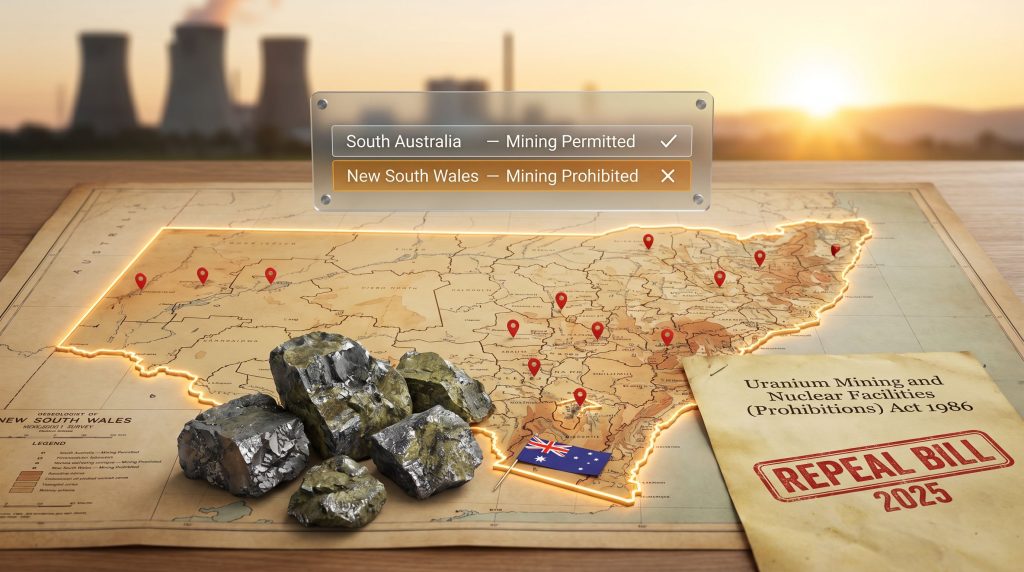
The Regulatory Wall That Held for Four Decades
Across the global uranium sector, few policy paradoxes are as structurally unusual as the one that has defined New South Wales for the better part of forty years. A state sitting atop documented uranium mineralisation has spent decades permitting geologists to identify the resource while simultaneously ensuring no commercial pathway existed to develop it. That tension is now at the centre of one of Australia's most consequential resources policy debates.
Understanding why uranium mining in NSW has remained off-limits requires unpacking a legislative architecture that was never designed to be temporary, yet now finds itself under serious parliamentary challenge for the first time in a generation.
When big ASX news breaks, our subscribers know first
The 40-Year Legislative Freeze: Understanding NSW's Uranium Prohibition Framework
What the 1986 Act Actually Put in Place
The Uranium Mining and Nuclear Facilities (Prohibitions) Act 1986 was not a narrow technical measure. It operated as a dual-layer prohibition, blocking both the physical extraction of uranium and the construction of associated nuclear infrastructure within NSW simultaneously. Critically, all uranium deposits discovered within state boundaries are legally vested in the Crown, meaning private entities hold no extraction rights regardless of what their exploration programmes uncover.
This framework has proven remarkably durable. Multiple changes of government at both state and federal levels over nearly four decades have failed to dismantle it, making NSW an outlier in Australia's broader resources policy evolution. Furthermore, uranium policy in WA offers a useful contrast, having undergone its own significant shifts over recent decades.
The 2012 Exploration Carve-Out: A Half-Open Door
The Mining Legislation Amendment (Uranium Exploration) Act 2012 introduced a selective liberalisation that created one of the more unusual legal asymmetries in Australian mining policy. Exploration licences became available, allowing companies to characterise uranium geology across the state. What the 2012 reform deliberately left untouched was any provision for extraction or processing.
The practical consequence of this partial reform is a growing body of geological knowledge paired with zero commercial pathway. NSW operators can spend capital identifying uranium deposits but remain legally prohibited from monetising what they find.
The 2012 amendment created a situation unique in Australian mining regulation: a state with an active uranium exploration sector operating under a complete uranium mining ban. Resource definition work has continued, building an evidence base that strengthens any future legislative argument for reform.
What Is the Uranium Mining and Nuclear Facilities (Prohibitions) Repeal Bill 2025?
Origins, Passage, and Current Status
The bill was introduced on 11 November 2025 by John Ruddick MLC in the NSW Legislative Council as a private member's bill. Its objective was unambiguous: not amendment or partial reform, but complete legislative removal of the 1986 framework.
Importantly, reporting from the Australian Mining Review dated 7 May 2026 confirms that the NSW Legislative Council has passed the bill. This represents a significant shift from the earlier second reading stage, where debate had been adjourned as of February 2026. The bill's passage through the upper house marks the furthest this type of reform has progressed in NSW legislative history.
What Passing the Bill Would Actually Mean in Practice
Legislative passage through the upper house is a necessary but not sufficient condition for the prohibition to fall. Several realities constrain the practical impact of any repeal:
- Full repeal removes the state-level legislative barrier to uranium mining and nuclear facility development in NSW
- Federal approvals under the Environment Protection and Biodiversity Conservation Act would still apply to proposed nuclear actions with significant environmental impact
- Repeal does not automatically activate any mining project — it initiates a new phase of project-level approvals, environmental assessments, and community consultation processes
- Individual uranium companies holding NSW exploration licences would need to progress through standard mine development pathways
Repeal of the 1986 Act would remove the foundational prohibition, but it would not compress the years of regulatory work required before any uranium mine in NSW could operate. The legislative milestone is the starting gate, not the finish line.
How Does NSW Compare to Other Australian States on Uranium Policy?
The regulatory patchwork across Australian states on uranium mining reflects decades of divergent political decisions rather than a coherent national framework.
| State / Territory | Exploration Permitted | Mining Permitted | Active Mines |
|---|---|---|---|
| South Australia | Yes | Yes | Olympic Dam, Beverley/Four Mile |
| Northern Territory | Yes | Yes | Ranger (ore treatment ceased 2021) |
| Western Australia | Yes | Yes (moratorium lifted 2008) | None currently operational |
| Queensland | Yes | No (ban since 1982) | None |
| New South Wales | Yes (since 2012) | Prohibition under challenge | None |
| Victoria | No | No | None |
Why South Australia Became the National Benchmark
South Australia's dominance in Australian uranium production reflects policy continuity over decades rather than any unique geological advantage. Olympic Dam, operated by BHP, represents one of the world's largest known uranium deposits by resource size and has anchored the state's position as Australia's primary producer.
The Beverley and Four Mile operations in the Frome Basin demonstrated that in-situ recovery (ISR) methods can operate commercially within Australian regulatory and environmental frameworks. In addition, in-situ recovery methods have attracted growing interest for their reduced environmental footprint relative to conventional extraction.
The contrast with NSW is instructive. South Australia's sustained policy clarity attracted capital that built institutional knowledge, regulatory frameworks, and workforce capability. NSW's prohibition, by comparison, has ensured that even well-defined deposits remain stranded assets.
What Uranium Deposits Exist in NSW and Why Do They Matter?
Known Geology and the Constraints of the Exploration-Only Framework
NSW hosts documented uranium mineralisation across several geological provinces. Geoscience Australia has identified uranium and thorium occurrences across the state, though the absence of any mining pathway has historically constrained the incentive for intensive resource definition drilling needed to establish bankable resource estimates.
The 2012 exploration liberalisation changed the data landscape meaningfully. Exploration activity over the past thirteen years has produced a growing geological evidence base, but without the commercial endpoint that typically drives the most rigorous resource definition campaigns.
The Regional Economic Dimension
The economic argument for unlocking uranium mining in NSW mirrors patterns observed across Australia's regional mining sector. Data compiled by the Minerals Council of Australia reveals that regions with established mining industries carry unemployment rates significantly below the national average, with median incomes substantially higher than non-mining regional communities.
The MCA has found that across major Australian mining regions, median income sits approximately $33,000 higher than the national average, with unemployment running at roughly 3.58% against a broader national rate of 5.1% at comparable measurement points. For remote NSW communities proximate to uranium mineralisation, these dynamics represent a credible economic development argument, provided the regulatory pathway is ultimately established.
The National Nuclear Energy Debate: How It Shapes NSW's Uranium Conversation
Federal Policy Layers That Remain in Place
Australia maintains a federal prohibition on commercial nuclear power generation. This means that even with the NSW prohibition repealed, the domestic end-use market for that uranium would remain legally closed. Any NSW uranium production would need to target international nuclear fuel supply chains rather than domestic demand.
The federal nuclear energy debate has intensified considerably in recent years. The federal Coalition's 2025 election platform proposed nuclear power stations as part of Australia's long-term energy mix, a position that would, if legislated, fundamentally alter the economics of domestic uranium production. Consequently, uranium investment strategies are already evolving in anticipation of potential policy change at both state and federal levels.
The Global Nuclear Renaissance and Australia's Strategic Position
International uranium demand is rising as governments across Europe, Asia, and North America recommit to nuclear power as a low-carbon baseload energy source. The geopolitics of uranium supply has become particularly acute, with Western nations actively working to reduce dependence on Russian and Kazakhstani supply chains following years of geopolitical disruption.
Australia's existing uranium export framework operates through bilateral safeguards agreements with partner nations, meaning NSW uranium, if commercially extracted, could enter international nuclear fuel cycles subject to standard federal export approvals.
NSW uranium, if unlocked, would not primarily serve a domestic market. It would feed into international nuclear fuel supply chains at a moment when allied nations are actively seeking to diversify away from geopolitically sensitive suppliers. This external demand context gives the policy debate dimensions that extend well beyond state borders.
The recently signed Australia-EU Free Trade Agreement, which establishes frameworks for minerals cooperation and supply chain development, adds a further layer of context to discussions about Australian uranium's international role. While uranium was not specifically identified in those negotiations, the broader architecture for minerals export cooperation with major European economies is strengthening.
The next major ASX story will hit our subscribers first
What Are the Key Barriers Beyond Legislative Repeal?
Regulatory Layers That Would Survive a State-Level Repeal
The removal of the 1986 prohibition would clear the most fundamental legal obstacle, but a layered set of requirements would immediately come into focus:
- Federal EPBC Act approvals: Any uranium mining project classified as a nuclear action with significant environmental impact requires Commonwealth assessment and approval, entirely independent of state legislation
- Native Title and Land Access: Uranium deposits in regional NSW may intersect with Native Title claims, requiring negotiation under the Native Title Act 1993. The MCA has specifically called for reform of the Native Title Act's future acts framework as part of broader critical minerals policy reform
- Community and Social Licence: Public acceptance of uranium mining in NSW is not established, and significant community engagement work would precede any viable project
- Infrastructure Deficits: Remote deposit locations frequently lack the road, rail, water, and power infrastructure needed for commercial operations, requiring either public or private capital commitment to resolve
Environmental and Radiological Considerations
Uranium mining generates radioactive tailings and process water requiring long-term containment and monitoring. NSW currently lacks the established regulatory frameworks for managing these specifically, meaning a new body of state-level environmental and radiological regulation would need to be constructed.
ISR methods, which involve dissolving uranium underground and pumping uranium-bearing solution to surface for processing, offer a lower surface disturbance profile than conventional open-cut or underground mining. Given the community and regulatory environment likely to apply in NSW, ISR's reduced surface footprint may make it the more socially viable extraction method for suitable deposits. South Australia's commercial ISR operations at Beverley and Four Mile provide the most relevant domestic precedent.
Scenarios for NSW Uranium Policy: Three Pathways Forward
With the Legislative Council having passed the Repeal Bill, the focus shifts to the Legislative Assembly and the question of whether the reform can complete its parliamentary journey. Furthermore, the global uranium market dynamics are increasingly relevant to how quickly legislative momentum may translate into commercial interest.
Scenario 1: Full Legislative Passage in 2026
Upper house passage accelerates pressure on the Legislative Assembly. If the bill progresses through both chambers, a transition period follows during which state regulatory frameworks for uranium mining would need to be constructed from a low base. Investment interest from companies already holding NSW exploration licences would likely accelerate immediately upon royal assent.
Scenario 2: Assembly Delay or Rejection
If the Legislative Assembly does not progress the bill before the next NSW election cycle, the reform debate is unlikely to disappear. It would be absorbed into broader energy and resources platform discussions, with federal nuclear energy policy developments capable of re-energising state-level momentum at any point.
Scenario 3: Federal Nuclear Policy Shift as the Accelerant
A federal decision to permit commercial nuclear power generation would fundamentally alter the economic and political calculus for uranium mining in NSW. Domestic demand signals combined with rising international uranium prices could create a bipartisan case for reform that transcends current political divisions. This represents the highest-impact pathway and would likely compress timelines for state legislative action considerably.
The Minerals Council of Australia's position on the NSW Repeal Bill reflects broader industry support for a consistent nationwide approach to uranium policy, reinforcing the argument that state-level reform serves a purpose beyond NSW alone.
Frequently Asked Questions: Uranium Mining in NSW
Is uranium mining currently legal in NSW?
As of the reporting date of 7 May 2026, the Legislative Council has passed the Repeal Bill. The prohibition formally remains in place until the bill completes its passage through the Legislative Assembly and receives royal assent. Exploration is permitted under the 2012 amendment; extraction and processing are not yet lawful.
What methods would likely be used to mine uranium in NSW?
Depending on deposit geology, in-situ recovery is considered the least environmentally intrusive method and has been commercially demonstrated in South Australia. Conventional open-cut or underground methods remain technically available for higher-grade deposits with different structural characteristics.
Can NSW uranium be exported if mining is legalised?
Yes. Australia's uranium export framework operates through bilateral safeguards agreements. NSW uranium could enter international nuclear fuel supply chains subject to federal export approvals and compliance with those agreements. The domestic ban on nuclear power generation does not prevent export-oriented uranium mining.
How does federal nuclear policy affect NSW uranium mining prospects?
The federal prohibition applies to commercial nuclear power generation, not uranium mining or export. NSW uranium could theoretically be mined and exported without requiring any change to federal nuclear power policy, though federal environmental approvals for individual projects would still be required.
Disclaimer: This article contains forward-looking analysis and scenario projections based on publicly available information as at the date of publication. Legislative status can change; readers should consult primary parliamentary sources for current bill status. Nothing in this article constitutes financial or investment advice.
Want to Position Yourself Ahead of the Next Major ASX Mineral Discovery?
Discovery Alert's proprietary Discovery IQ model delivers real-time alerts on significant ASX mineral discoveries — including uranium and other critical minerals — turning complex geological data into actionable investment insights for both short-term traders and long-term investors. Explore how historic discoveries have generated substantial returns and begin your 14-day free trial at Discovery Alert to secure your market-leading advantage.