June 24, 2026
When Secondary Supply Runs Out: The Structural Forces Reshaping Uranium Markets
For most of the past decade, the uranium market operated on borrowed time. Following the 2011 Fukushima disaster, a wave of reactor shutdowns flooded the market with excess inventory, and secondary supply sources, including government stockpiles, reprocessed materials, and enrichment underfeeding, absorbed the chronic shortfall between what mines produced and what operating reactors actually consumed. That buffer is now exhausted. The uranium supply gap and Russian import ban are converging at precisely the moment secondary reserves can no longer paper over the structural deficit, forcing a fundamental reckoning across the entire nuclear fuel cycle.
When big ASX news breaks, our subscribers know first
The Arithmetic of a 10,000-tonne Annual Deficit
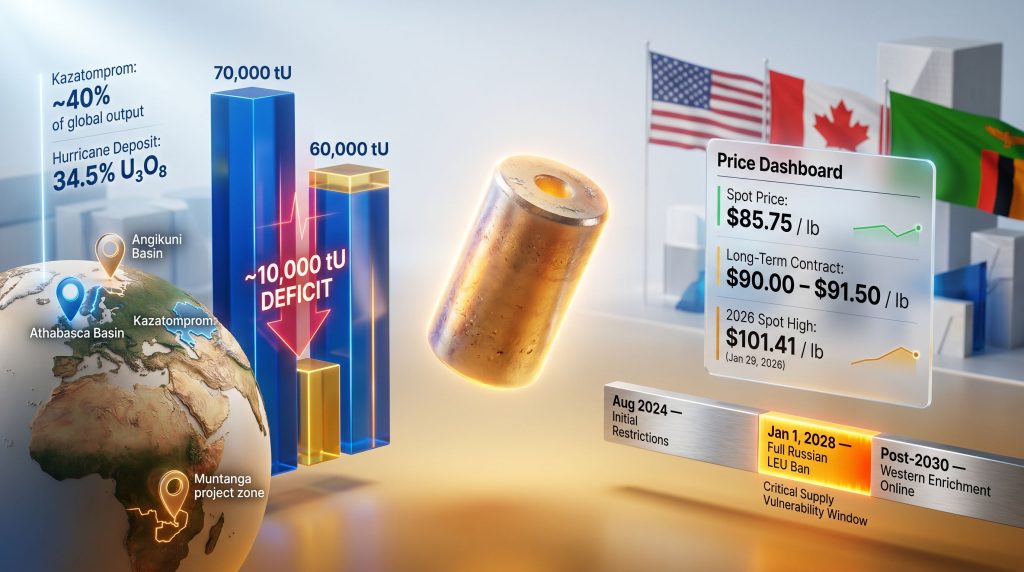
The numbers at the core of the uranium market's current predicament are straightforward, even if their implications are not. According to the World Nuclear Association's 2025 Nuclear Fuel Report, global reactors require approximately 70,000 tonnes of uranium (tU) per year, while annual mine production sits at roughly 60,000 tU. The gap of approximately 10,000 tU has historically been bridged by secondary supplies, but those reserves are now in measurable structural decline.
What makes the current situation distinct from previous uranium price cycles is the simultaneous pressure from three independent forces:
- Legislative supply removal through the Prohibiting Russian Uranium Imports Act
- Technology-driven demand growth through AI data centre nuclear procurement
- Geological and commercial constraints limiting how quickly new primary production can be brought online
Unlike the single-catalyst cycles of the past, this convergence creates a layered demand structure that is considerably harder to unwind. Each force would be significant in isolation. Together, they represent a qualitative shift in how the uranium supply gap and Russian import ban must be understood in the context of broader uranium market dynamics.
As Troy Boisjoli, Chief Executive Officer of ATHA Energy, has noted, consensus supply-demand forecasts across the sector reveal massive gaps, driven by years of underinvestment in new projects and exploration occurring simultaneously with demand growth at a pace the nuclear energy space has rarely encountered before. (Source: Crux Investor)
How the Russian Import Ban Restructures the Western Fuel Cycle
The Prohibiting Russian Uranium Imports Act, signed into law in May 2024, imposes a complete prohibition on Russian low-enriched uranium (LEU) entering the United States effective January 1, 2028. Waiver provisions allow continued imports where no viable alternative exists, preventing immediate reactor shutdowns, but the legislative clock is running. The Russian uranium import ban is, furthermore, expected to accelerate Western investment in domestic enrichment infrastructure.
The scale of what is being removed from Western supply chains is significant:
| Metric | Data Point |
|---|---|
| Rosatom's share of global enrichment capacity | ~44% |
| Russian LEU's share of US utility fuel requirements | ~25% |
| Estimated supply void created by the ban | ~486 metric tons of uranium (MTU) |
| US domestic enrichment capacity vs. Russia | Less than one-fifth |
| Urenco New Mexico annual output | Under 5 million SWU/year |
| DOE enrichment investment commitment (January 2026) | $2.7 billion |
| Total US nuclear fuel industry investment committed | $4.4 billion |
The DOE's January 2026 enrichment contracts, distributed equally across American Centrifuge Operating, General Matter, and Orano Federal Services, target expansion of both LEU and high-assay low-enriched uranium (HALEU) capacity. The critical problem is timing. Industry consensus places meaningful operational scale for new Western enrichment facilities no earlier than 2030, two full years after the ban eliminates Russian supply.
This creates a structural vulnerability window that utilities and policymakers cannot fully close through enrichment investment alone. According to the US Department of Energy, however, the ban is expected to accelerate development of a more resilient domestic nuclear fuel supply chain over the medium term.
The gap between the legislative deadline of January 2028 and the realistic commissioning timeline for replacement Western enrichment infrastructure represents the central fragility in US nuclear fuel security planning for this decade.
What Utilities Are Actually Doing About It
The behavioural response from utilities is visible in pricing data. As of June 22, 2026, uranium spot prices stood at $85.75 per pound, well below the 2026 high of $101.41 per pound reached on January 29. Long-term contract prices, however, remained at $90.00 to $91.50 per pound, a 14-year high.
| Price Metric | Level (as of June 22, 2026) |
|---|---|
| Uranium spot price | $85.75/lb |
| 2026 spot price high | $101.41/lb (January 29, 2026) |
| Long-term contract price | $90.00 to $91.50/lb |
| Long-term price context | 14-year high |
The inversion of spot prices below long-term contract prices is analytically important. It signals that utilities are prioritising supply security over cost minimisation, a behavioural shift with meaningful implications for producers and development-stage companies alike. Furthermore, this spot-term price divergence reflects a structural shift in procurement behaviour rather than temporary market noise. Annual contracting volumes across the US nuclear industry nonetheless remain below the 150 million pound replacement-rate benchmark, meaning a significant portion of post-2028 requirements has yet to be contracted.
AI Infrastructure: The Demand Variable That Wasn't in the Models
Perhaps the most structurally significant development in uranium markets over the past 18 months has been the emergence of technology companies as direct nuclear power buyers. This is not incidental to the uranium story; it is additive to existing utility demand in ways that most supply-demand forecasting frameworks had not anticipated.
In January 2026, Meta committed to procuring up to 6.6 gigawatts of nuclear power capacity by 2035 through a 20-year power purchase agreement with Vistra, supplemented by agreements with TerraPower and Oklo. Microsoft has executed parallel commitments for AI data centre baseload power. Each gigawatt of nuclear capacity requires approximately 400 tU annually for fuel.
| Technology Company Commitment | Nuclear Capacity | Implied Annual Uranium Demand |
|---|---|---|
| Meta (2035 target) | 6.6 GW | ~2,640 tU/year |
| Fuel requirement per GW of nuclear capacity | ~400 tU/year | (basis for calculation) |
| WNA projected global uranium requirements by 2030 | ~87,000 tU/year | (reference benchmark) |
Meta's commitment alone implies recurring annual uranium consumption equivalent to roughly 26% of the existing annual supply deficit. Critically, this demand sits entirely outside traditional utility purchasing frameworks. It is not substitutive; reactors contracted by technology companies require fuel in addition to, not instead of, the procurement obligations of existing operators.
AI-driven nuclear demand is additive to the baseline. It expands total uranium requirements without reducing the procurement obligations of existing reactor operators, which fundamentally changes the scale of the supply response required.
Production Constraints: Why Mine Output Is Not Recovering Fast Enough
On the supply side, the challenges are both structural and geopolitical. Kazatomprom, which controls approximately 40% of global uranium mine output, reduced its 2026 production target from 32,777 tU to 29,697 tU, removing approximately 6.8 million pounds from market supply. The company characterised this as a commercial rather than operational decision, indicating that prevailing price levels did not justify a return to full capacity.
Meanwhile, SOMAÏR in Niger produced zero uranium in 2025 following that country's transition to military junta governance, removing a supply source previously accessible to Western buyers. The political instability across parts of the African uranium belt is, consequently, accelerating interest in alternative jurisdictions outside the Kazakhstan-Russia supply corridor. In addition, the broader uranium supply-demand volatility created by these disruptions is placing further pressure on already strained procurement pipelines.
As William Sheriff, Executive Chairman of enCore Energy, has observed, the uranium market's supply side presents difficulties that are frequently underestimated. Bringing new production online has proven harder and more expensive than many participants anticipated, even as demand fundamentals remain compelling. (Source: Crux Investor)
enCore Energy's own operational data illustrates the challenge of scaling domestic production: the company achieved approximately 90,000 pounds of uranium extraction in the first quarter of 2026, a 22% year-over-year increase, at cash extraction costs of $34.94 per pound, demonstrating that in-situ recovery (ISR) operations in the US can be economic at current long-term contract prices, but scale remains constrained.
The 2030 to 2040 Supply Cliff: What the WNA Projections Actually Reveal
Looking beyond the immediate 2028 ban deadline, the supply-demand picture deteriorates further. The WNA's Reference Scenario projects that existing uranium supply sources will be capable of meeting only 46% of projected demand between 2030 and 2040. The WNA's Upper Scenario, which models a tripling of total nuclear capacity globally, requires mine production to increase by more than fourfold.
The US government's ambition to expand domestic nuclear capacity from approximately 100 GW to 400 GW by 2050 would require sustained uranium supply growth across multiple decades. This is a timeline that demands exploration and development activity beginning now. The IEA's World Energy Outlook 2025 projects annual nuclear investment rising from over $70 billion today to approximately $210 billion by 2035, contingent on adequate uranium mining, enrichment, and conversion capacity being available.
The discovery-to-production timeline in uranium averages 15 to 20 years. Mines needed to supply reactors in the 2040 to 2045 window must be discovered, de-risked, and advanced through feasibility and permitting today. Current exploration investment levels are widely regarded within the industry as insufficient relative to this requirement.
As Phil Hoskins, Chief Executive Officer of Atomic Eagle, has noted, towards the end of this decade reactors will for the first time since the 1960s become dependent on new supply coming out of the ground. The post-Fukushima period allowed the market to work through significant secondary supplies, but a deficit of around 30 million pounds will need to be addressed through primary mine production. (Source: Crux Investor)
The next major ASX story will hit our subscribers first
Where New Supply Is Being Developed: Jurisdiction Matters
The Russian import ban has introduced what market participants are describing as a jurisdictional premium into uranium procurement. Utilities and governments are actively prioritising supply from politically stable, Western-aligned countries, creating a tiered market in which the origin of uranium carries strategic as well as commercial value. Understanding the distribution of global uranium reserves is, therefore, increasingly central to procurement strategy.
Canada's Athabasca Basin: Grade as a Competitive Moat
Saskatchewan's Athabasca Basin hosts some of the world's most economically significant uranium deposits, characterised by grades that are orders of magnitude above global averages. IsoEnergy is advancing the Hurricane deposit at its Larocque East project, which hosts an indicated mineral resource of 48.6 million pounds of U₃O₈ at 34.5% U₃O₈, currently the world's highest-grade indicated uranium resource.
The deposit's depth of approximately 325 metres compares favourably with the roughly 450-metre depth at Cigar Lake, one of the world's largest high-grade uranium mines. Shallower mineralisation typically translates to lower development capital and simpler ground freeze requirements, two factors that materially influence project economics in the Athabasca Basin's challenging geological environment.
Philip Williams, Chief Executive Officer of IsoEnergy, has highlighted a procurement gap developing between Western and Chinese buyers. Chinese state entities have secured direct equity interests in African uranium projects, obtaining majority off-take rights through structures that Western utilities have been slow to replicate, placing North American and European buyers in a reactive rather than strategic procurement posture. (Source: Crux Investor)
African Uranium Outside the Russian Corridor
Atomic Eagle's Muntanga Uranium Project in Zambia represents a strategically positioned development asset. The project hosts a combined Measured, Indicated, and Inferred resource of 58.8 million pounds of U₃O₈ and sits entirely outside the Kazakhstan-Russia supply corridor. The 2026 drilling programme expanded multiple mineralised zones, returning intercepts including 5.4 metres at 422 ppm U₃O₈, with grade-confirmation drilling ongoing.
Zambia's stable governance environment and track record in mining regulation make it an increasingly attractive destination for Western uranium procurement. This is particularly relevant as political instability across parts of the Sahel continues to disrupt supply from historically accessible African sources.
Exploration-Stage Capital: Building the Pipeline for the 2040s
ATHA Energy controls 6.8 million acres of prospective uranium exploration ground across Canada, including 100% ownership of the Angikuni Basin in Nunavut. Three drill rigs are targeting approximately 20,000 metres across three mineralised corridors in 2026, following a 2025 programme that intersected uranium mineralisation on every target tested.
The 2025 results included 34.7 metres of composite mineralisation in the RIB North zone, with grades reaching 8.16% U₃O₈ over 0.5 metres. For context, grades above 1% U₃O₈ are considered high-grade in most uranium districts globally. Results at these levels in an underexplored basin suggest the potential for a resource base capable of contributing to the post-2040 supply picture, precisely the window where the WNA projects the most severe demand-supply divergence.
The Uranium Value Chain Under Structural Pressure
| Stage | Key Activity | Current Market Pressure | Timeline to Impact |
|---|---|---|---|
| Exploration | Resource discovery and delineation | Underfunded relative to future need | 15 to 20 years to production |
| Development | Feasibility, permitting, construction | Long-term contract prices support economics | 8 to 15 years to production |
| Production (existing) | Mine output and processing | Output below reactor needs by ~10,000 tU/year | Immediate |
| Enrichment | Converting natural uranium to LEU | Western capacity insufficient; Russian supply exiting | 2028 deadline; gap until 2030+ |
| Utilities | Reactor fuel procurement | Contracting below 150 Mlb replacement benchmark | Urgent: 18 months to ban |
| Technology companies | Nuclear power for AI infrastructure | New demand category outside traditional frameworks | 2030 to 2035 ramp-up |
Geopolitical Competition and the Risk of Western Complacency
One dimension of the uranium supply gap and Russian import ban that receives insufficient attention is the competitive procurement dynamic between Western buyers and state-backed Chinese entities. While US and European utilities negotiate on commercial terms, Chinese state enterprises have pursued direct equity participation in uranium projects, securing not just supply contracts but ownership stakes and majority off-take rights simultaneously.
This approach, exemplified by a recently disclosed 45% direct interest in an African uranium project paired with 60% off-take entitlements, reflects a procurement philosophy that treats uranium as a strategic asset rather than a commodity to be sourced at the lowest available price. Western utilities operating within commercial procurement frameworks are structurally disadvantaged in this competition unless they begin engaging with development-stage assets at earlier points in the project lifecycle.
The broader implication is that the uranium supply gap is not simply a production problem. It is also a strategic positioning problem, and the window for Western buyers to establish durable, diversified supply relationships outside the Russian corridor is narrowing with each passing quarter. For instance, analysis from the World Nuclear Association on uranium supply underscores the urgency of developing alternative supply chains before the 2028 deadline arrives.
This article contains forward-looking statements and projections drawn from third-party sources including the World Nuclear Association, the International Energy Agency, and publicly disclosed company information. Uranium market forecasts involve material uncertainty and actual outcomes may differ significantly from projections. Nothing in this article constitutes financial or investment advice. Readers should conduct their own due diligence before making any investment decisions.
Ready to Position Yourself Ahead of the Next Major Uranium Discovery?
Discovery Alert's proprietary Discovery IQ model delivers real-time alerts on significant ASX mineral discoveries — including uranium exploration plays — turning complex geological data into actionable investment insights before the broader market catches on. Explore historic examples of exceptional discovery returns and begin your 14-day free trial today to secure a market-leading edge as the uranium supply deficit deepens.