
May 13, 2026
When Geopolitics Disrupts the Grain Belt: Australia's Nitrogen Supply Crisis in Context
Global fertilizer markets have never been insulated from geopolitical shocks, but the events of 2026 have exposed a structural fragility in Australian agriculture that decades of import dependency quietly built. When shipping lanes close, nitrogen stops moving. When nitrogen stops moving, winter crops face a yield crisis. The story of how Australia secures 90,000t of urea via government scheme is not simply a supply chain story. It is a case study in what happens when a nation that grows food for hundreds of millions of people abroad cannot guarantee access to the most fundamental input for doing so.
When big ASX news breaks, our subscribers know first
The Strait of Hormuz: Why One Waterway Determines Australian Farm Yields
There is a peculiar vulnerability embedded in Australian agriculture that rarely surfaces in public debate. The nation exports enormous volumes of wheat, barley, and canola to global markets, yet the nitrogen fertilizer that makes those exports possible has historically transited a narrow stretch of water between Iran and Oman, roughly 33 kilometres wide at its tightest point.
Approximately 60% of Australia's urea imports have historically passed through the Strait of Hormuz, according to Argus Media reporting from May 2026. The US-Iran conflict that escalated in early 2026 fundamentally disrupted that transit corridor. Furthermore, Iranian foreign ministry officials were publicly debating the terms of safe passage as late as 11 May 2026, making clear that the waterway's reopening remained conditional on broader geopolitical resolution.
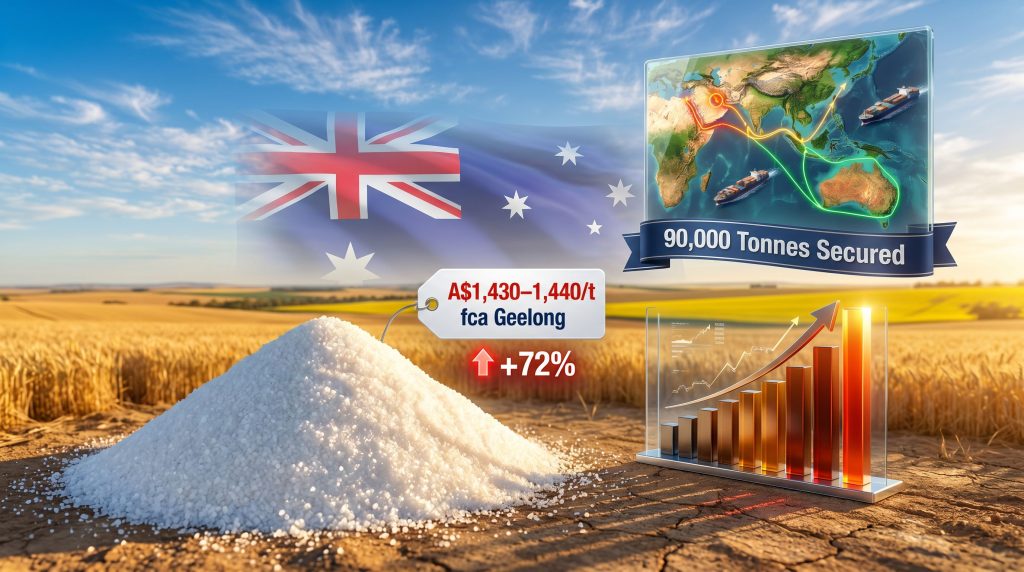
The market response was swift and severe. Argus Media assessed granular urea at A$1,430-1,440 per tonne (approximately USD $1,029-1,037/t) free carrier (fca) Geelong on 7 May 2026, representing a 72% price increase from pre-conflict levels. For Australian farmers preparing top-dressing applications ahead of the winter crop planting window, this price signal arrived at the worst possible moment.
The Strait of Hormuz bottleneck illustrates a critical but underappreciated risk in agricultural input markets: geographic chokepoints in energy trade are simultaneously chokepoints in food production, because ammonia and urea synthesis remains predominantly gas-feedstock dependent, and major Middle Eastern producers rely on Hormuz access for export.
What made the situation particularly difficult to anticipate was a demand-masking effect in the preceding months. Australian Bureau of Statistics data confirmed that urea imports declined 3% year-on-year to 572,300 tonnes in January-March 2026. Dry summer conditions and low soil moisture levels had suppressed farmer demand during that period, creating a misleading picture of supply adequacy. By the time seasonal demand reasserted itself as winter crop preparation began, the structural supply gap had become acute.
These disruptions sit within a broader pattern of trade war pressures reshaping global commodity flows, where geopolitical tensions increasingly translate into tangible supply chain consequences for agricultural nations.
Understanding the fca Geelong Price Benchmark
For those unfamiliar with fertilizer market pricing conventions, the fca Geelong benchmark requires some unpacking. The term "fca" stands for "free carrier," an Incoterms designation meaning the seller delivers goods to a named location and the buyer assumes risk from that point forward. Geelong, Victoria serves as the primary east coast hub for granular urea distribution into Australian agricultural regions, making this benchmark the de facto reference price for nitrogen input costs across southeastern Australia's grain belt.
A 72% price escalation at this benchmark does not translate uniformly across all farming operations. The impact depends heavily on:
- Application rates per hectare for specific crops (wheat typically requires 50-100kg of urea per hectare for top-dressing)
- The equity position and cash flow timing of individual farming operations
- Whether forward contracts for grain were established before or after the price spike, affecting whether elevated input costs can be recovered through grain revenue
- Geographic proximity to Geelong-based distribution networks versus reliance on inland logistics chains with additional freight premiums
For operations running thin margins, a 72% input price increase mid-season is not an inconvenience. It is a financial stress event. Indeed, Australia's resource and energy export challenges in 2025 foreshadowed many of the vulnerabilities now playing out in agricultural input markets.
How the Government Underwriting Scheme Actually Works
When the federal government announced on 13 May 2026 that it had secured 90,000 tonnes of urea across three cargoes, the mechanism behind that announcement was as significant as the volume itself.
The scheme does not involve the government purchasing urea and distributing it. Instead, it uses Export Finance Australia (EFA), a federally owned trade finance institution, to underwrite commercial transactions executed by private fertilizer distributors. The government absorbs the price volatility risk that would otherwise prevent importers from committing to large cargo purchases at current market prices.
In a market where spot urea costs A$1,430+ per tonne and no one can reliably forecast where prices will be in 60-90 days, that risk transfer function is commercially meaningful. The two participating distributors are Incitec Pivot Fertilisers and CSBP. The underwritten cargoes are additive to Incitec Pivot's separately negotiated arrangement with Indonesian state-owned producer Pupuk, which covers 250,000 tonnes scheduled for delivery across May through December 2026.
| Supply Component | Volume | Timeline | Mechanism |
|---|---|---|---|
| EFA-underwritten cargoes | 90,000 tonnes (3 cargoes) | Not publicly disclosed | Government underwriting via EFA |
| Incitec Pivot – Pupuk Indonesia | 250,000 tonnes | May-December 2026 | Commercial contract |
| Urea currently in transit (Kpler data) | ~454,000 tonnes | Delivery through June 2026 | Existing commercial flows |
| Aggregate supply pipeline | ~794,000 tonnes | Varied | Multi-mechanism |
Agriculture Minister Julie Collins confirmed the scheme's activation on 13 May 2026, noting that further supply announcements were expected within days. Australia's streamlined urea import biosecurity process has also played an important supporting role in enabling faster cargo clearance alongside these procurement efforts.
The Indonesia Pivot: Reorienting Australia's Nitrogen Supply Chains
The Incitec Pivot-Pupuk Indonesia arrangement is strategically significant beyond its volume. Indonesia operates one of the world's largest state-controlled fertilizer production networks, and Pupuk's surplus urea production capacity has positioned the country as a natural alternative supplier as Middle Eastern trade routes remain constrained.
From a supply chain architecture perspective, routing Australian urea imports through Southeast Asian producers rather than Middle Eastern ones fundamentally changes the geopolitical risk profile of the supply chain. Indonesian production is not Hormuz-dependent. It draws on domestic natural gas feedstocks and exports through regional shipping lanes that are substantially less exposed to the US-Iran conflict dynamics currently disrupting Persian Gulf commerce.
This supplier diversification mirrors a broader Indo-Pacific realignment in agricultural input security thinking, where proximity, political alignment, and alternative logistics corridors are increasingly weighted alongside pure cost considerations. In addition, Australia's import reliance on fertilizers has long highlighted the structural risks of relying on distant, geopolitically exposed supply origins.
Australia as a Price-Taker: The Global Context That Matters
To understand why Australia's situation is structurally challenging, the comparison with India's simultaneous procurement activity is instructive. On the same day Australian urea prices were assessed at a 72% premium above pre-war levels, India's state fertilizer importer IPL closed a tender securing 1.3465 million tonnes of DAP at $930-935/t cfr, according to Argus Media reporting from 12 May 2026. Fourteen suppliers from the US, South Korea, Saudi Arabia, Russia, Morocco, Jordan, and Egypt participated.
The scale differential is stark. India's single procurement event involved more than 14 times the volume of Australia's entire three-cargo underwriting scheme. This reflects a fundamental structural reality: Australia competes for prompt cargo allocation in global nitrogen markets as a relatively small buyer, going up against sovereign procurement programs that can offer guaranteed off-take at scale.
When global supply is genuinely tight, small volume buyers either pay the spot premium or go without. The government underwriting scheme is, in part, an acknowledgment that market mechanisms alone are insufficient to guarantee Australian farmer access to affordable nitrogen during periods of geopolitical disruption.
The next major ASX story will hit our subscribers first
Competition Concerns and the ACCC Question
Not everyone in the Australian fertilizer market has welcomed the scheme's design without reservation. Market participants have flagged concerns about the competitive implications of channelling government-backed supply exclusively through two distributors, as reported by Argus Media on 13 May 2026.
When Incitec Pivot already controls the 250,000-tonne Pupuk Indonesia arrangement and now participates in the government-underwritten cargoes, its combined secure supply position dwarfs what smaller independent importers can access. Competitors bidding for the same Asian supply origins face a distributor that holds both commercial scale advantages and government financial backing. This concentration effect could outlast the immediate crisis, reinforcing incumbent market positions in ways that affect competitive dynamics once supply normalises.
The government has pointed to ACCC streamlining measures announced in the 12 May 2026 Federal Budget as its response to supply chain efficiency concerns. However, the relationship between reduced regulatory friction and competitive market outcomes is not straightforward. Streamlining supply chain processes is not the same as maintaining competitive tension between importers, and the two objectives can pull in opposite directions when volume concentration accompanies efficiency improvements.
Market concentration during a supply crisis has a tendency to persist. Infrastructure investments, distributor relationships, and storage networks built during crisis conditions create structural advantages that don't automatically dissolve when the crisis ends. Regulatory monitoring of fertilizer market competition beyond the immediate emergency window would be prudent.
Australia's Domestic Production Horizon: The Perdaman Factor
All of the emergency import measures currently in place share a common limitation: they address symptoms rather than the underlying structural vulnerability of complete import dependency. The only mechanism capable of changing that structural reality is domestic urea production at commercial scale.
The Perdaman Urea Plant, located in the Pilbara region of Western Australia, represents Australia's most consequential long-term response. At a total capital value of approximately A$6.5 billion, the facility is designed to produce 2.3 million tonnes of urea per year once operational, drawing on Pilbara natural gas feedstocks. The project has received A$220 million in financing from the Northern Australia Infrastructure Facility (NAIF), with target commissioning set for mid-2027.
That timeline is critical context for assessing the current crisis. Australia must manage the 2026 supply disruption entirely through import mechanisms because domestic production capacity will not exist for at least another 12 to 18 months. There is no domestic buffer, no strategic reserve, and no fallback that does not involve international shipping.
Perdaman's Green Hydrogen Dimension
The Perdaman project is not solely a supply security investment. Its associated Project Helios component, a 750MW electrolyser designed to decarbonise the plant's production process, was shortlisted under the Australian Renewable Energy Agency's (ARENA) Hydrogen Headstart Round 2 program in May 2026, competing for part of a A$1 billion funding pool.
Project Helios is projected to reduce Perdaman's carbon emissions by 43,800 tonnes of CO2 equivalent per year. Construction of a 30MW solar farm supporting the facility commenced in March 2026. Furthermore, methanol and hydrogen projects have been dominating Australia's renewable hydrogen subsidy scheme, reflecting how the energy transition is reshaping industrial production at the same time.
If funded and completed as designed, the Perdaman complex would represent not merely a domestic nitrogen supply source, but a lower-carbon one, potentially commanding premium positioning as agricultural value chains face increasing decarbonisation pressure from export market requirements. These renewable energy transformations in mining and industrial production are consequently reshaping the economics of domestic resource processing more broadly.
Shortlisted projects under Hydrogen Headstart Round 2 must submit full applications by early September 2026, meaning the funding outcome for Project Helios will be known before the Perdaman plant's commissioning date.
A Multi-Layer Policy Architecture in Real Time
Australia's response to the 2026 urea supply crisis has unfolded across several distinct policy layers simultaneously:
Immediate supply security:
- 90,000 tonnes underwritten via EFA across three cargoes involving Incitec Pivot and CSBP
- 250,000 tonnes secured through the Incitec Pivot-Pupuk Indonesia arrangement for May-December 2026
- Approximately 454,000 tonnes in transit for delivery through June 2026 per Kpler vessel-tracking data
Regulatory and process reform:
- ACCC streamlining announced as part of the 12 May 2026 Federal Budget, framed as improving supply chain efficiency
- Biosecurity import pathway reforms providing faster clearance mechanisms for fertilizer cargo
Industry coordination:
- The Fertiliser Supply Working Group, formed in April 2026, providing a government-industry monitoring mechanism for on-water reserves and near-term supply adequacy
Long-term structural investment:
- The Perdaman Urea Plant targeting mid-2027 commissioning, with green hydrogen integration under the Helios project pursuing ARENA funding
The sequencing of these layers reflects an honest assessment of what is achievable in different timeframes. No single measure resolves the underlying dependency. Together, they represent an attempt to bridge a 12-18 month vulnerability gap while building toward a more structurally resilient position.
What Global Fertilizer Market Dynamics Tell Investors and Agribusiness Operators
The events of 2026 contain signals that extend well beyond this immediate supply event. Several structural observations are worth noting for those with exposure to Australian agricultural input markets:
Price volatility is asymmetric at Hormuz-dependent benchmarks. When the strait closes, prices spike faster than supply chain alternatives can be mobilised. The fca Geelong benchmark moved 72% before government intervention was announced. Those holding fixed-price input contracts were insulated; those relying on spot procurement absorbed the full shock.
Sovereign buyers shape global availability for price-taker nations. India's 1.3mn+ tonne DAP tender, concluded the same week as Australia's 90,000-tonne announcement, illustrates how large state procurement programs effectively pre-allocate global supply. Australia's ability to access alternative origins is constrained by how much volume larger sovereign buyers have already committed.
Government underwriting signals that market mechanisms have failed. When a government deploys a trade finance institution to absorb price risk on commodity imports, it is an explicit acknowledgment that private market participants cannot execute at commercially viable terms. This is a market failure signal, not a routine policy intervention.
Domestic production changes the risk equation permanently. Once Perdaman reaches commercial operation, a meaningful portion of Australia's urea requirement can be met without Hormuz exposure. Moreover, the critical minerals demand driving the energy transition is increasingly intersecting with the economics of domestic chemical and fertilizer production, creating new strategic investment rationales. The investment case for Australian agricultural operations changes structurally from that point forward.
Disclaimer: This article is intended for informational purposes only and does not constitute financial, investment, or agricultural advisory advice. Forecasts, price projections, and policy outcomes described are subject to change based on geopolitical developments, market conditions, and regulatory decisions. Readers should seek independent professional advice before making financial or operational decisions based on information contained herein.
For market-specific price data, trade flow analysis, and ongoing coverage of Australian and global fertilizer supply chain developments, Argus Media publishes detailed nitrogen market reporting at argusmedia.com.
Want to Stay Ahead of the Commodity and Resource Market Shifts Reshaping Australian Supply Chains?
Discovery Alert's proprietary Discovery IQ model delivers real-time alerts on significant ASX mineral discoveries, instantly translating complex resource data into actionable investment insights — explore historic discoveries and the returns they generated to understand the scale of opportunity, then begin your 14-day free trial at Discovery Alert to position yourself ahead of the broader market.