July 7, 2026
The Invisible Feedstock Problem Driving Mexico's First Domestically Owned LNG Export Terminal
Across the global LNG industry, the most overlooked value creation opportunity is rarely found in new exploration acreage or frontier basins. It sits in plain sight, burning off into the atmosphere at existing production sites. Associated natural gas, the hydrocarbon byproduct of oil extraction, has historically been treated as a nuisance rather than a resource in markets where pipeline infrastructure is insufficient to capture and transport it economically. When that gas is also contaminated with nitrogen, the commercial case for capture becomes even weaker, and flaring becomes the path of least resistance.
That is precisely the market gap the URSUS Energy Coatzacoalcos LNG plant is being engineered to fill. By positioning itself at the intersection of PEMEX's growing emissions liability and Mexico's underdeveloped LNG export infrastructure, the project represents one of the more structurally unusual investment theses in Latin American energy policy development: a commercial opportunity that grows stronger the worse the underlying environmental problem becomes.
When big ASX news breaks, our subscribers know first
Why PEMEX's Flaring Crisis Is the Commercial Engine Behind This Project
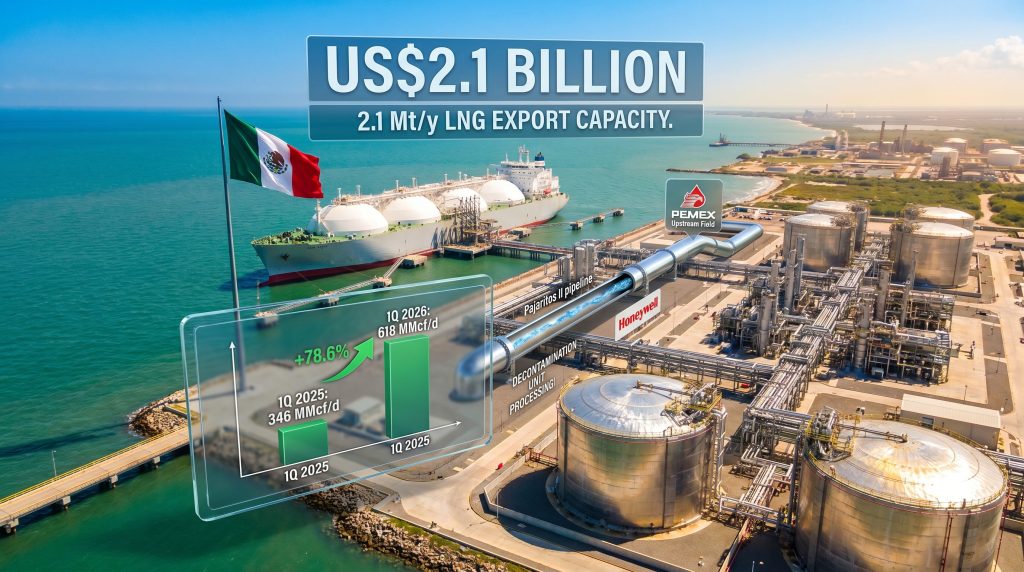
To understand the logic of the URSUS Energy Coatzacoalcos LNG plant, it helps to first understand what PEMEX has been disclosing in its own quarterly production reports. In the first quarter of 2026, PEMEX vented or flared 618 million cubic feet per day (MMcfd) of natural gas, a figure that represents a 78.6% increase compared to the 346 MMcfd recorded in the same period of 2025. That volume now accounts for 12.7% of Mexico's total gas production simply disappearing into the atmosphere.
| Metric | 1Q 2025 | 1Q 2026 | Change |
|---|---|---|---|
| Gas vented/flared (MMcfd) | 346 | 618 | +78.6% |
| Share of total gas production | Not disclosed | 12.7% | N/A |
A key technical detail that makes this feedstock commercially challenging under normal circumstances is nitrogen contamination. Associated gas extracted alongside crude oil at PEMEX's upstream fields contains elevated concentrations of nitrogen, which renders it unsuitable for pipeline injection or direct liquefaction without prior treatment. Nitrogen reduces the gas's energy content (measured in British Thermal Units per cubic foot), and LNG importers in Europe and Asia operate under strict calorific specifications. Gas that falls below those thresholds cannot be sold into premium markets regardless of its volume.
This is where Honeywell's process technology enters the value chain. The plant's liquefaction design incorporates a nitrogen rejection and decontamination step specifically engineered to strip nitrogen from the feedstock before the gas enters the liquefaction train. The result is a conditioned, spec-grade product capable of meeting international LNG quality standards. Without this step, the 618 MMcfd currently being flared by PEMEX would remain commercially unusable as LNG, regardless of how much capital was deployed around it.
Furthermore, natural gas price trends in 2025 have reinforced the commercial rationale for projects that can bring previously stranded gas volumes to market at competitive cost structures.
The commercial feedstock is simultaneously the environmental mitigation argument. The more PEMEX flares, the larger the available gas supply and the stronger the green finance case for the plant's infrastructure.
Capital Architecture: How US$2.1 Billion Gets Deployed
The total investment envelope for the URSUS Energy Coatzacoalcos LNG plant has scaled considerably from earlier disclosures. When the Samsung E&A FEED-EPC framework agreement was announced in June 2025, the figure in circulation was US$450 million for the first phase. The July 2026 announcement revealed that figure represents only the opening tranche of a much larger commitment, with total project capital now confirmed at US$2.1 to US$2.2 billion across all development phases, a 4.7x expansion of the initially disclosed number.
| Investment Component | Value | Mechanism |
|---|---|---|
| Total project investment | US$2.1 to US$2.2 billion | Full multi-phase development |
| Phase 1 opening tranche | US$450 million | FEED-EPC framework scope |
| Bancomext financing (LOI) | ~US$450 million | State development bank letter of intent |
| URSUS equity capitalization target | US$1.2 billion | Equity raise via Oppenheimer |
| Equity commitments secured | ~70% of US$1.2B target | Firm negotiations or committed capital |
Several aspects of the financial structure merit closer attention from an investor and project finance perspective:
-
Bancomext's role as anchor lender is significant because it signals that Mexico's state development bank has evaluated the project's feasibility at a preliminary level. The letter of intent covers concession obligations, site preparation, platform construction, technology licensing fees, and EPC execution costs. However, a letter of intent is not a binding commitment, and the transition to a formal credit agreement will require the project to satisfy conditions precedent that are standard in project finance but non-trivial in execution.
-
Oppenheimer's capital raising mandate spans both institutional equity investors and debt capital markets, including potential green bond issuance. Green bonds in the energy sector typically require the issuer to demonstrate a quantifiable environmental benefit, which in this case is directly supported by the volume of flared gas the plant will capture. The measurability of PEMEX's flaring data through public quarterly reports provides an unusual degree of verifiability for this purpose.
-
The 70% equity commitment figure is presented as of the time of announcement and represents capital either formally committed or in firm negotiations. The remaining 30% of a US$1.2 billion target represents approximately US$360 million in equity still to be secured before the full capital structure closes.
Technical Design and Engineering Specifications
The Coatzacoalcos II LNG Terminal is classified as a mid-scale LNG liquefaction and export terminal, a category that sits between small-scale floating or modular LNG units and the mega-scale export trains that define US Gulf Coast facilities such as Sabine Pass or Freeport LNG. Mid-scale terminals in the 1.5 to 3 MTPA range have gained commercial traction globally because they match the demand profile of smaller importing nations, island economies, and regional industrial buyers who cannot absorb the cargo volumes from large-scale facilities.
| Technical Parameter | Specification |
|---|---|
| Full-build export capacity | 2.1 Mt/y |
| Gas intake capacity | Over 200 MMcfd |
| Mid-scale operational design | ~1.5 MTPA |
| LNG storage volume | Over 120,000 m³ |
| Continuous supply buffer | Up to 14 days |
| Target first export | Late 2029 |
| Civil works commencement | Summer 2026 |
How the Liquefaction Process Works, Step by Step
-
Feedstock capture: Associated natural gas contaminated with nitrogen is collected from PEMEX upstream production fields, diverting volumes that would otherwise be vented or flared.
-
Pipeline delivery: Gas is transported to the Coatzacoalcos terminal via the Pajaritos II pipeline, operated by Impact Oil & Gas, with an alternative supply route available through the Puerta al Sureste pipeline owned by Canadian operator TC Energy.
-
Nitrogen rejection: Honeywell's decontamination technology strips nitrogen from the gas stream, bringing the feedstock up to international LNG calorific specifications.
-
Liquefaction: Conditioned gas is cooled to approximately -162 degrees Celsius, at which point it converts from gaseous to liquid form at roughly one-600th of its original volume. This density transformation is what makes LNG economically viable for marine transport.
-
Storage: Liquefied gas is held in onsite tanks exceeding 120,000 cubic metres of combined storage capacity, providing a buffer of up to 14 days of uninterrupted supply to support loading operations.
-
Marine export: LNG is transferred to vessels at the Port of Coatzacoalcos for delivery to buyers in Europe, the Caribbean, Central America, and South America.
Mexico's LNG Export Landscape and Where URSUS Fits
Mexico has historically been a net LNG importer, with regasification infrastructure located along both its Pacific and Gulf coasts. The country's pivot toward LNG export capability, should the URSUS project reach commissioning, would mark a structural shift in how Mexico participates in global gas trade. The broader LNG supply outlook for 2025 and beyond underscores the significance of new mid-scale export capacity coming online in the Atlantic Basin.
Currently, New Fortress Energy holds the distinction of being the only active LNG exporter operating from Mexican territory. The URSUS Energy Coatzacoalcos LNG plant, if completed on schedule in late 2029, would become the second LNG export operation in Mexico and, critically, the first to be owned and operated by a 100% Mexican company, a distinction that carries both commercial significance and a degree of national energy sovereignty symbolism.
| Operator | Project | Status | Target Markets |
|---|---|---|---|
| New Fortress Energy | Existing Mexico LNG operations | Operational | Various |
| URSUS Energy / Samsung E&A | Coatzacoalcos II LNG Terminal | Pre-FID; civil works targeted 2026 | Europe, Caribbean, South America |
The plant's Gulf of Mexico location provides a genuine geographic advantage for Atlantic Basin market access. LNG vessels departing Coatzacoalcos face shorter transit distances to European and Caribbean buyers compared to terminals positioned further north along the US Gulf Coast, a factor that translates directly into per-cargo freight cost savings and delivery scheduling flexibility.
Export Market Rationale
-
Europe: Post-2022 gas supply diversification remains a structural driver of new Atlantic Basin LNG offtake demand. European gas prices and supply security concerns have demonstrated a sustained preference for non-Russian supply sources among buyers across the continent.
-
Caribbean and Central America: Island and coastal economies in this region face high energy costs and are well-matched to mid-scale LNG supply, as they lack the import infrastructure to handle the large cargo volumes that emanate from mega-scale terminals.
-
South America: Industrial and power sector LNG demand in Brazil, Chile, and other South American markets continues to expand alongside the region's energy transition activity.
The Interoceanic Corridor Context: PODEBIS and Industrial Zone Competition
The CIIT framework encompasses 11 planned industrial development poles, known by their Spanish acronym PODEBIS, distributed across the Isthmus of Tehuantepec corridor connecting the Gulf of Mexico to the Pacific Ocean. The corridor was designed to attract large-scale industrial investment to a strategically located but historically underdeveloped economic region.
URSUS Energy has positioned its Coatzacoalcos II project as the first PODEBIS to demonstrably materialize within this framework, a claim that gains credibility from the scale of the announced investment and the involvement of internationally recognized partners including Samsung E&A, Honeywell, and Oppenheimer. Federal Economy Minister Marcelo Ebrard's publicly stated position at the government's morning press conference, that the federal government's priority is to advance the poles showing the greatest development progress, has been interpreted as implicitly validating the Coatzacoalcos II project's lead position within the corridor hierarchy.
It is important to note that this prioritization language reflects general federal policy rather than any confirmed project-specific government funding, designation, or accelerated permitting commitment. Ursus Energy's project page provides further detail on the company's strategic positioning within this corridor framework.
The next major ASX story will hit our subscribers first
Execution Risks That Capital Alone Cannot Resolve
Despite the scale of the announced investment and the credibility of the technical partners involved, the URSUS Energy Coatzacoalcos LNG plant faces two execution risks that remain structurally unresolved as of the announcement date. Consequently, investors and lenders will scrutinise both issues closely before committing capital.
The Mota-Engil Concession Complication
The site's legal history introduces institutional complexity that sits alongside the investment announcement. The PODEBIS Coatzacoalcos II zone was previously concessioned to Portuguese construction group Mota-Engil during the prior federal administration. Of two PODEBIS renounced by Mota-Engil in the Coatzacoalcos area, one was subsequently reassigned to URSUS Energy.
However, reporting from Global Energy Mexico indicates that a formal revocation process with Mota-Engil was still ongoing as of the announcement, meaning the prior concessionaire's legal exit from the site may not have been fully concluded at the point when the US$2.1 billion investment was disclosed. In project finance terms, an unresolved prior concession claim represents a title risk that lenders and equity investors will require to be formally cleared before capital can be deployed into civil works.
Subsurface Pipeline Constraints
The second and more technically concrete risk involves the physical site itself. Multiple active PEMEX subsurface pipelines cross the usable area of the concession zone. Construction must be engineered to avoid any activity above or near those ducts, materially limiting the buildable footprint available for the liquefaction plant, storage tanks, and loading infrastructure.
Veracruz Governor Ernesto Pérez has publicly acknowledged that the full operational designation of the second pole had not yet been finalised due to these construction limitations, describing the state government's position as one of waiting for further definition on the site's development parameters. His stated intention to provide full state government support for whatever final vocations are assigned to the site is constructive but does not resolve the engineering constraint itself.
These two risks, the unresolved prior concession and the active subsurface pipeline crossings, are not resolved by the size of the capital announcement. Civil works commencement in summer 2026 depends on both legal clearance and engineering workarounds being finalised within the same window.
In addition, broader oil price volatility across global energy markets adds a further layer of uncertainty to upstream feedstock economics, which in turn affects the commercial assumptions underpinning the project's long-term revenue model.
Key Project Parameters at a Glance
| Dimension | Detail |
|---|---|
| Total investment | US$2.1 to US$2.2 billion |
| Phase 1 financing anchor | US$450 million (Bancomext letter of intent) |
| Full export capacity | 2.1 Mt/y |
| Mid-scale operational capacity | ~1.5 MTPA |
| LNG storage | Over 120,000 m³; 14-day supply buffer |
| Feedstock source | PEMEX-flared nitrogen-contaminated associated gas |
| Process technology | Honeywell nitrogen decontamination and liquefaction |
| EPC and FEED partner | Samsung E&A |
| Pipeline supply routes | Pajaritos II (Impact Oil & Gas); Puerta al Sureste (TC Energy) |
| Target markets | Europe, Caribbean, Central America, South America |
| First export target | Late 2029 |
| Civil works start | Summer 2026 |
| Key unresolved risks | Mota-Engil concession revocation; PEMEX subsurface pipeline constraints |
The URSUS Energy Coatzacoalcos LNG plant is, in structural terms, one of the more technically coherent large-scale energy project proposals to emerge from Mexico's industrial corridor framework. Its feedstock thesis is grounded in verifiable and worsening PEMEX flaring data, its technology stack addresses the nitrogen contamination problem that has historically blocked commercialisation of this gas stream, and its partner roster carries genuine international project execution credibility. What separates announcement from delivery, as with any pre-FID project of this scale, is the resolution of legal, physical, and financial conditions that no amount of capital commitment can substitute for.
This article contains forward-looking statements and projections based on information available at the time of publication. Project timelines, investment figures, and capacity targets are subject to change pending final investment decisions, regulatory approvals, and financing outcomes. This content does not constitute financial or investment advice.
Want to Catch the Next Major Resource Discovery Before the Market Does?
Discovery Alert's proprietary Discovery IQ model scans ASX announcements in real time, instantly identifying significant mineral discoveries across more than 30 commodities and turning complex data into actionable investment insights — explore historic discovery returns on the Discovery Alert discoveries page to understand the scale of opportunity, then begin your 14-day free trial to position yourself ahead of the broader market.