July 21, 2026
The Strategic Calculus Behind America's Primary Aluminium Revival
Few industrial policy levers are as consequential as import duty architecture, and fewer still carry the geopolitical weight attached to primary aluminium. The US executive order cuts tariffs for new primary aluminium investments, marking a pivotal shift in how Washington approaches domestic industrial capacity. For most of the past three decades, the United States watched its domestic smelting industry hollow out, unable to compete against energy-subsidised production from the Gulf, lower-cost operations in Canada, and the sheer scale of Chinese capacity.
The result is a stark industrial reality: today, only four primary aluminium smelters remain operationally active across the entire United States. That number, set against the backdrop of American aerospace ambitions, defence manufacturing requirements, and the energy transition's insatiable demand for lightweight metals, represents a structural vulnerability that policymakers can no longer ignore.
The question facing Washington was never simply whether to protect existing producers. It was whether protection alone could rebuild capacity, or whether a more surgical incentive framework was needed to shift capital allocation decisions at the corporate level.
When big ASX news breaks, our subscribers know first
Why the US Primary Aluminium Gap Became a National Security Problem
Primary aluminium, unlike its recycled counterpart, requires a continuous, energy-intensive electrolytic smelting process that converts alumina into metal. The distinction matters enormously. Secondary aluminium, produced by remelting scrap, cannot replicate the metallurgical purity required for certain aerospace alloys, defence-grade components, or high-specification electrical conductors. The US military supply chain, satellite manufacturing sector, and advanced fighter aircraft programmes all depend on access to primary-grade metal that meets exacting composition standards.
The contraction of domestic smelting capacity is not a recent phenomenon. It reflects a multi-decade erosion driven by three compounding forces:
- Energy cost disadvantages: Aluminium smelting consumes roughly 13 to 15 megawatt-hours of electricity per tonne of metal produced, making power pricing the single largest variable cost in the production equation. US industrial electricity rates have historically been less competitive than those available to smelters in Iceland, the Middle East, or hydropower-rich Canadian provinces.
- Capital intensity and infrastructure age: Many surviving US smelters operate infrastructure that is decades old, requiring substantial reinvestment simply to maintain current output, let alone expand it.
- Import competition: Before the Section 232 tariff architecture was introduced, competitively priced imports from Canada, Russia, and the Middle East made it difficult for domestic producers to justify greenfield capital expenditure.
The US aluminium tariffs, initially imposed at 25% ad valorem, were designed to address the import competition dimension. By June 2025, the rate had been escalated to 50% ad valorem on full customs value, extending in April 2026 to cover copper as well. This created one of the most aggressive import duty structures ever applied to an industrial metal in US trade history.
However, a protective tariff, however steep, does not by itself fund a new smelter. The July 2026 executive order was designed to bridge that gap.
Decoding the July 2026 Executive Order Mechanism
The policy architecture introduced by the July 2026 proclamation is more nuanced than a simple tariff cut. It is a conditional incentive instrument that rewards capital commitment with a temporary cost advantage during the investment and ramp-up phase. According to the White House, the measure is designed to stimulate near-term capital deployment into new or expanded US smelting infrastructure.
How the Conditional Tariff Rate Works
| Policy Feature | Detail |
|---|---|
| Standard Section 232 Tariff Rate | 50% ad valorem on full customs value |
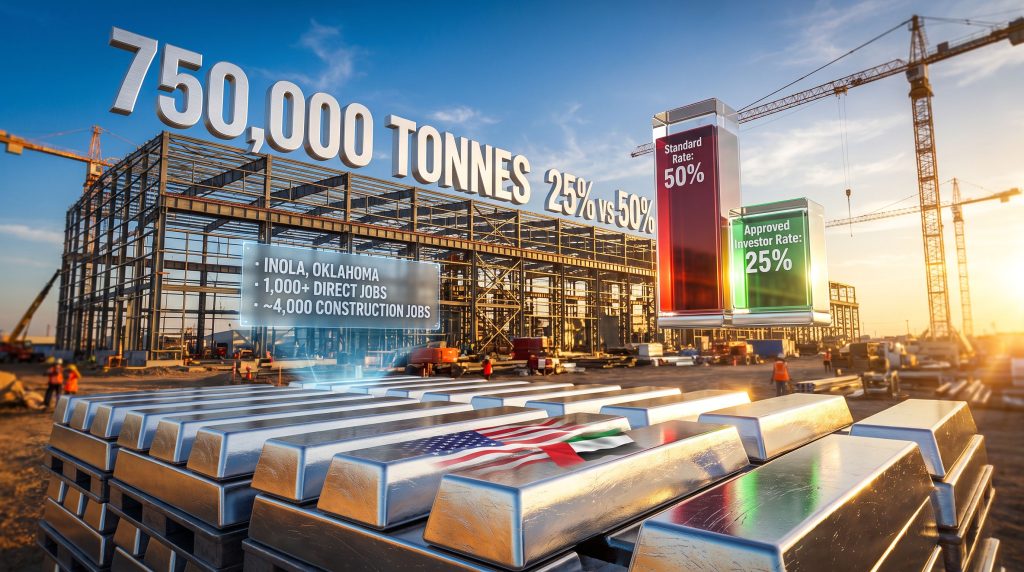
| Reduced Rate for Approved Investors | 25% (half the standard rate) |
| Eligibility Trigger | Submission and approval of a formal onshoring plan via the Commerce Department |
| Import Volume Cap | Reduced rate applies only to volumes commensurate with the facility's projected annual output |
| Equipment Tariff Adjustment Window | Extends to December 31, 2027 |
| Primary Objective | Stimulate near-term capital deployment into new or expanded US smelting infrastructure |
The operational logic works as follows. A company seeking to build, expand, or substantially refurbish a primary aluminium smelting facility within the United States submits a qualifying onshoring plan to the Commerce Department. If approved, the company gains access to the 25% tariff rate on imported primary aluminium, but only on import volumes aligned with the planned facility's expected annual production capacity.
This is not a blanket import licence at discounted rates; it is a volume-capped relief mechanism that bridges the gap between investment decision and domestic production realisation. The policy therefore creates an economic inflection point. During the years when a new smelter is under construction and not yet producing, the approved investor can still source metal at significantly reduced import cost, improving project economics during the capital-intensive construction phase.
What the July 2026 US executive order does not do is reduce aluminium tariffs broadly. The standard 50% Section 232 duty remains firmly in place for all non-qualifying importers. The reduced rate is exclusively available to companies with Commerce Department-approved domestic smelter investment plans, making this a targeted stimulus rather than a trade liberalisation measure.
The Policy Boundaries That Matter
Several common misconceptions about the executive order are worth clarifying directly:
- The broader 50% Section 232 tariff framework remains fully intact for all non-qualifying importers
- The order does not signal a reversal of the protectionist trade posture on aluminium
- It is not a subsidy, grant, or direct government funding mechanism
- The incentive is market-based and conditional, requiring a credible, Commerce Department-approved investment commitment to access
Furthermore, the top aluminium companies globally are watching this policy closely, as it signals a broader shift in how Western nations may structure industrial incentives to rebuild strategic manufacturing capacity.
The Oklahoma Primary Aluminium Project: Understanding the Scale
No single project illustrates the ambition of the new policy framework more clearly than the proposed smelter in Inola, Oklahoma, developed through a joint venture between Century Aluminum and Emirates Global Aluminium (EGA), formalised in February 2026.
Project Scale and Economic Footprint
| Impact Category | Projected Figures |
|---|---|
| Annual Production Capacity | 750,000 tonnes of primary aluminium |
| Direct Operational Jobs | 1,000+ |
| Construction Phase Employment | ~4,000 jobs |
| Contribution to US Output | Potential to more than double current national primary aluminium production |
| Project Classification | Expected to represent the largest single capital investment in US primary aluminium history |
To put the production target in context: 750,000 tonnes per annum from a single facility would be extraordinary by global standards. For comparison, EGA's flagship Al Taweelah smelter in the UAE, one of the largest single-site aluminium smelters in the world, produces approximately 900,000 tonnes per annum. The Inola project would consequently rank among the largest primary aluminium facilities ever constructed in the Western Hemisphere.
The EGA Partnership and What It Brings
The Century Aluminum and EGA joint venture is strategically significant beyond the capital commitment it represents. EGA is among the largest aluminium producers globally outside of China, operating with deep expertise in large-scale smelter construction, pot-line technology optimisation, and energy procurement. Century Aluminum contributes domestic regulatory knowledge, existing US operational infrastructure, and established relationships within the American industrial supply chain.
This combination of international smelting expertise with domestic market access creates a partnership architecture well-suited to navigating the complexity of a greenfield US smelter project. In addition, it involves not only construction execution but also long-term power purchase negotiations, permitting processes, and workforce development. This model bears some resemblance to the Alcoa-Ignis EQT venture, which similarly pairs operational expertise with strategic capital to advance aluminium infrastructure objectives.
Why Oklahoma?
The selection of Inola, Oklahoma, reflects several practical considerations:
- Access to logistics infrastructure, including rail and road networks critical for moving large volumes of alumina feedstock and finished aluminium
- Proximity to potential industrial power sources and regional grid capacity
- State-level economic development conditions that align with large-scale industrial investment
- Central positioning within the US industrial interior, reducing supply chain distances to key downstream manufacturing customers in automotive, aerospace, and construction sectors
Century Aluminum's Parallel Expansion Strategy
The Oklahoma project does not represent Century Aluminum's only capacity growth initiative. The company is simultaneously advancing an expansion at its Mt. Holly smelter in South Carolina, which is expected to increase total US primary aluminium output by approximately 10% and create around 150 additional jobs.
Century Aluminum's Operational Footprint
| Facility | Location | Type |
|---|---|---|
| Mt. Holly Smelter | South Carolina, USA | Primary aluminium smelting |
| Inola Project (planned) | Oklahoma, USA | New primary aluminium smelter |
| Hawesville Smelter | Kentucky, USA | Primary aluminium smelting |
| Grundartangi Smelter | Iceland | Primary aluminium smelting |
| Jamalco Refinery | Jamaica | Alumina refining (majority ownership) |
The Jamalco refinery stake is particularly noteworthy from a supply chain perspective. Alumina is the immediate feedstock for primary aluminium smelting, and a domestic or near-domestic refinery position provides Century Aluminum with a degree of upstream integration that reduces exposure to alumina price volatility. This vertical positioning becomes increasingly valuable as US smelter capacity grows and feedstock demand intensifies.
Century Aluminum's leadership has framed the combined Oklahoma and Mt. Holly expansion programmes as central to ensuring that defence-grade and aerospace-grade primary aluminium can be reliably sourced from within US borders, an argument that resonates directly with the national security rationale underpinning the Section 232 framework.
The Energy Economics Dimension: The Variable the Tariff Cannot Fix
Perhaps the most underappreciated dimension of the US primary aluminium revival challenge is the energy cost equation. Primary aluminium smelting ranks among the most electricity-intensive industrial processes on the planet, consuming between 13,000 and 15,000 kilowatt-hours per tonne of aluminium produced. At scale, a 750,000-tonne facility would require approximately 10 to 11 terawatt-hours of electricity annually, roughly equivalent to the residential electricity consumption of a mid-sized US state.
This creates a structural challenge that tariff policy alone cannot resolve:
- Gulf-based smelters benefit from heavily subsidised industrial power pricing that bears little resemblance to US market rates
- Icelandic and Canadian smelters access abundant, low-cost hydropower that is geographically irreproducible in most US locations
- The US industrial electricity market, while evolving, does not currently offer the price certainty that large-scale, capital-intensive smelter investors require over a 20 to 30-year project horizon
The long-term economics of Oklahoma Primary Aluminium and any future US greenfield smelter will therefore hinge heavily on the power purchase agreements that underpin each project. Gladstone aluminium repowering efforts in Australia offer a useful international parallel, demonstrating that energy transition challenges for aluminium smelters require dedicated, complementary policy frameworks well beyond tariff structures alone.
The next major ASX story will hit our subscribers first
Policy Incentive vs. Structural Protectionism: A Comparative Framework
The July 2026 executive order represents a meaningful evolution in how US trade policy approaches domestic industrial capacity building. Rather than relying purely on import barriers, it introduces a performance-linked incentive layer on top of the existing protective tariff structure.
| Approach | Mechanism | Likely Effect |
|---|---|---|
| Pure Tariff Protection (pre-July 2026) | 50% blanket import duty | Protects existing producers; raises downstream input costs |
| Incentive-Based Tariff Reduction (July 2026) | 25% conditional rate for qualifying investors | Stimulates new capacity while maintaining broad protection |
| Full Trade Liberalisation | Tariff removal | Contradicts Section 232 national security rationale; not applicable |
Industry bodies including the Primary Aluminium Association (APAA) have publicly endorsed the executive order, characterising it as a constructive addition to the existing tariff framework rather than a replacement of it. The policy layering is intentional: the 50% tariff continues to protect the existing producer base, while the conditional 25% rate creates an economic corridor for new capital to enter the sector. However, as Reuters reports, not all industry observers are convinced that tariff measures alone are sufficient to sustain a domestic aluminium revival without addressing underlying energy and infrastructure challenges.
Macroeconomic Ripple Effects for Global Aluminium Trade
A successful build-out of the Oklahoma smelter and broader US capacity expansion would carry significant implications for global primary aluminium trade flows:
- Canadian producers, who supply the majority of US primary aluminium imports under historically preferential trade arrangements, could face a structural reduction in export volumes as domestic US capacity grows
- Gulf-based producers, including EGA's wider operational network, may encounter a long-term shift in their US market exposure, though EGA's partnership role in the Oklahoma project partially hedges this risk
- LME aluminium pricing dynamics could be influenced if US domestic production reaches a scale sufficient to meaningfully reduce the country's position as a net importer of primary metal
Furthermore, broader shifts in green metals pricing trends globally may intersect with US capacity growth, particularly as downstream manufacturers increasingly seek low-carbon primary aluminium that meets sustainability procurement standards alongside national security requirements.
Speculative consideration: If the Oklahoma project reaches full capacity and additional greenfield investments follow under the same policy framework, the United States could transition from a structural aluminium importer to a near-balanced domestic market within the next decade. This would represent one of the most significant shifts in global aluminium trade geography since the rapid expansion of Gulf smelting capacity in the 2000s. This projection is speculative and subject to energy cost resolution, capital market conditions, and sustained policy continuity.
Key Takeaways: What the US Executive Order Means for the Aluminium Industry
- The July 2026 proclamation introduces a conditional 25% tariff rate, representing a 50% reduction from the standard Section 232 duty, exclusively for companies committing to new US primary aluminium smelter investment
- The policy responds to a structural crisis: only four active smelters currently operate in the United States, leaving defence, aerospace, and advanced manufacturing supply chains exposed
- The Oklahoma smelter project at 750,000 tonnes per annum is the most consequential near-term beneficiary, with the potential to fundamentally reshape the US primary aluminium supply landscape
- Century Aluminum's combined growth initiatives, including both the Oklahoma joint venture and the Mt. Holly expansion, signal a meaningful acceleration in domestic capacity investment
- The energy cost challenge remains the most significant unresolved variable, and long-term project viability will depend on power economics that extend beyond the reach of tariff policy alone
- Equipment-related tariff adjustments under the July 2026 proclamation extend through December 31, 2027, creating a defined window for capital deployment decisions
Disclaimer: This article contains forward-looking projections, including production capacity estimates, employment figures, and trade flow scenarios. These projections are based on publicly available announcements and industry analysis and are subject to change based on regulatory approvals, capital market conditions, energy pricing outcomes, and geopolitical developments. Nothing in this article constitutes financial or investment advice.
Want to Stay Ahead of the Next Major Resource Discovery?
Discovery Alert's proprietary Discovery IQ model delivers real-time alerts on significant ASX mineral discoveries, instantly turning complex resource data into actionable investment insights — explore historic discoveries and their extraordinary returns to understand the opportunity, then begin your 14-day free trial at Discovery Alert to position yourself ahead of the broader market.