
May 14, 2026
The global industrial landscape has fundamentally shifted toward supply chain resilience as manufacturers confront an era of unprecedented geopolitical volatility. Traditional just-in-time production models, once celebrated for their cost efficiency, now face scrutiny as companies reassess the true cost of operational vulnerability. Furthermore, this strategic recalibration extends beyond immediate disruption management toward comprehensive risk modeling that integrates multiple failure scenarios into long-term planning frameworks.
Within this broader transformation, certain industries stand at particularly critical junctures where supply security intersects with national economic stability. The aluminum sector exemplifies this challenge, where decades of optimisation for cost efficiency created structural dependencies that now require fundamental reevaluation. Moreover, understanding how these dependencies evolved and their current implications reveals broader patterns affecting industrial resilience across multiple sectors. The US aluminum industry resilience has become a crucial factor in assessing America's manufacturing security and economic stability.
Understanding America's Aluminum Supply Chain Vulnerabilities
The structural transformation of domestic aluminum production capacity represents one of the most dramatic industrial shifts in modern American manufacturing. Over two decades, the United States witnessed a systematic reduction from approximately 24 primary aluminum smelting facilities to just 4 operational facilities currently maintaining production. This consolidation reflects deeper economic forces beyond simple market competition.
Current Production Reality and Import Dependencies
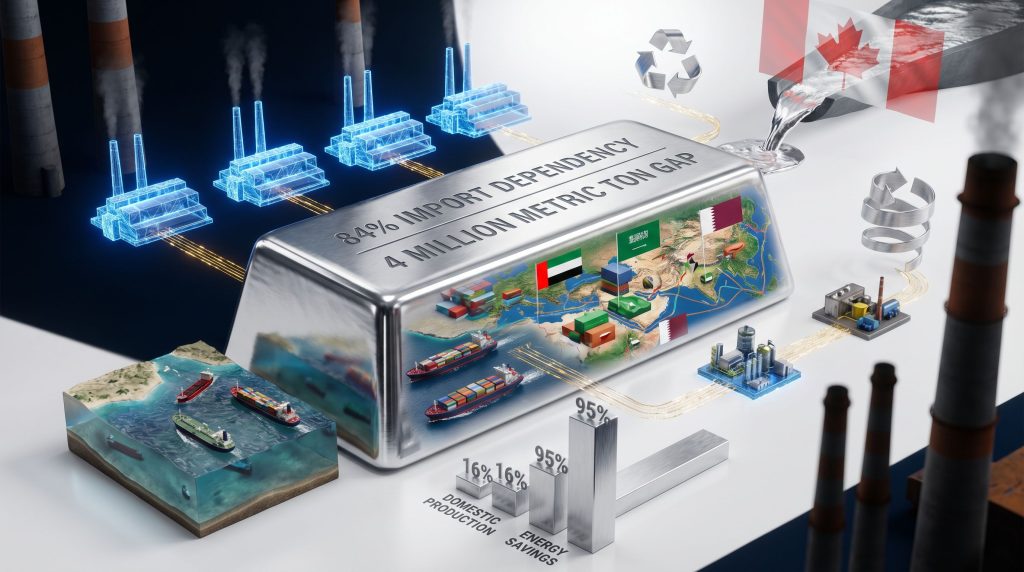
Domestic primary aluminum production now generates approximately 750,000 metric tons annually, while national demand consistently exceeds 4 million metric tons. This fundamental mismatch creates an 81-84% import dependency ratio that extends far beyond typical industrial supply chain relationships. Consequently, the scale of this dependency places the aluminum sector among the most import-reliant major industrial materials in the American economy.
The energy intensity of primary aluminum production serves as the primary driver behind this capacity reduction. Electricity costs represent 30-40% of total production expenses in North American smelting facilities, creating insurmountable competitive pressures when measured against international producers operating with subsidised or hydroelectric power sources. For instance, this cost structure differential explains why domestic facilities cannot compete with operations in Iceland, the Middle East, or regions with abundant low-cost energy resources.
Geographic Concentration of Supply Sources
The Gulf Cooperation Council region emerged as a critical supplier, accounting for approximately 22% of US primary and alloyed aluminum imports during 2025. This concentration creates multiple vulnerability layers beyond simple supplier diversification concerns. The region's smelters depend on natural gas feedstock for power generation, creating energy cost advantages that domestic producers cannot replicate under current market conditions.
Transportation infrastructure adds another complexity layer to this dependency. The Strait of Hormuz serves as a critical chokepoint through which approximately 20% of global seaborne trade passes, including substantial aluminum shipments destined for American markets. However, when regional tensions escalate or shipping lanes face disruption, alternative routing options impose significant cost and timeline penalties on importers.
Alternative Supply Channels and Their Limitations
Canada maintains its position as another major supplier corridor, though specific capacity allocation to US markets fluctuates based on domestic Canadian demand and global pricing dynamics. Australian producers offer additional diversification options, yet their geographic distance creates different logistical challenges and cost implications compared to Gulf region sources.
The challenge extends beyond identifying alternative suppliers to evaluating their capacity availability during simultaneous global demand spikes or regional disruptions. Furthermore, when multiple supply regions face constraints concurrently, the global aluminum market demonstrates how quickly supply security can deteriorate for import-dependent economies.
When big ASX news breaks, our subscribers know first
Strategic Response Mechanisms During Crisis Scenarios
Industry adaptation capabilities during supply disruptions reveal sophisticated contingency systems that operate largely outside public visibility. The Aluminum Association reported that member companies demonstrated real-time supply chain adjustment capabilities during the 2025 Middle East disruptions, with alternative sourcing activation occurring within days rather than weeks or months.
Dynamic Sourcing and Inventory Management
The US aluminum industry resilience during recent geopolitical tensions demonstrated how established relationships with diverse global suppliers enable rapid sourcing pivots. Companies activated existing agreements with producers in Australia, Iceland, and Indonesia while simultaneously accelerating domestic recycling feedstock utilisation. This multi-pronged approach prevented production stoppages across major aluminum-using sectors including aerospace, automotive, and packaging industries.
Chuck Johnson, President of the Aluminum Association, emphasised that member companies maintained supply chain flexibility through real-time monitoring systems and pre-negotiated contingency agreements. The association's assessment highlighted how distributed sourcing relationships provide resilience buffers that simple cost optimisation models often undervalue.
Transportation Route Diversification
When traditional shipping channels face constraints, alternative logistics paths impose varying cost and timeline penalties that companies must evaluate against production continuity requirements. Suez Canal routing adds 2-3 weeks transit time while increasing shipping costs by 15-25%, whereas Cape of Good Hope routing extends timelines by 4-6 weeks with 25-35% cost increases.
Emergency air freight options, while extremely expensive at 400-600% higher costs, provide critical bridging capacity for high-value applications where production delays create disproportionate economic impacts. For instance, aerospace and defense applications frequently justify these premium logistics costs to maintain delivery commitments.
Recycling Capacity as Crisis Mitigation
Domestic recycling infrastructure expansion represents a strategic response mechanism that operates independently of international supply chain vulnerabilities. Duncan Pitchford, President of Norsk Hydro's US unit, characterised expanding domestic recycling capacity as meaningful disruption mitigation, particularly during regional supply interruptions.
Secondary aluminum production requires approximately 650-700 kilowatt-hours per metric ton compared to 12,000-15,000 kWh for primary smelting, representing a 95% energy intensity reduction. This dramatic efficiency advantage positions recycling expansion as both an economic and strategic imperative for reducing import dependency.
The industry's recycling capacity development timeline indicates that facilities "coming online" during 2025 provided tangible offset capabilities against disrupted imports, though specific nameplate capacity additions require verification through individual company disclosures.
Economic Impact Assessment of Supply Chain Resilience
The economic implications of aluminum supply chain disruptions extend far beyond the metal's direct value to encompass substantial downstream manufacturing sectors. Understanding these cascading effects requires analysis of how aluminum integrates into critical American industries and their vulnerability to supply constraints. These tariffs impact on markets demonstrates the broader economic implications of trade protection measures.
| Industry Sector | Aluminum Dependency | Annual Output at Risk | Supply Disruption Impact |
|---|---|---|---|
| Aerospace & Defence | 10-12% of aircraft weight | $50B+ manufacturing value | Production delays, delivery commitments |
| Automotive Manufacturing | 5-8% of vehicle weight | $65B+ auto manufacturing | Lightweighting strategy disruption |
| Construction Materials | 3-5% of material inputs | $45B+ construction sector | Timeline flexibility higher |
| Beverage Packaging | 90%+ of can stock | $15B+ beverage packaging | Consumer goods velocity critical |
Total Economic Footprint Analysis
The aluminum industry's economic impact encompasses multiple value creation layers that amplify the significance of supply security. Primary aluminum production contributes approximately $1.7-1.9 billion in direct value annually, while secondary processing and fabricated products generate additional billions in economic activity.
Downstream manufacturing incorporating aluminum components represents an estimated $228+ billion in total final product value across aerospace, automotive, construction, and packaging sectors. This multiplier effect demonstrates how relatively modest primary production capacity translates into massive economic exposure when supply chains face disruption.
Employment and Regional Economic Clustering
Direct employment in primary aluminum smelting involves approximately 4,000-5,000 workers, while fabrication and processing operations employ 40,000-50,000 additional workers. The downstream aluminum-using industries support an estimated 300,000+ workers across aerospace, automotive, construction, and packaging sectors.
These employment figures reflect geographic clustering patterns where aluminum processing facilities anchor broader industrial ecosystems. Regional economic development often depends on these anchor facilities maintaining operational continuity, creating multiplier effects that extend beyond direct aluminum industry employment.
2025 Demand Dynamics and Market Response
Preliminary data indicated that US aluminum demand remained flat during 2025 compared to 2024 levels, with potential causation factors including Trump tariff implications and general market uncertainty. The Aluminum Association acknowledged that demand destruction could result from both direct tariff impacts and broader market hesitation, though definitive causation remained unconfirmed.
This demand stability despite supply disruptions suggests that American aluminum-using industries successfully managed through sourcing challenges without significant production curtailments. In addition, the flat demand profile may also reflect successful demand management and inventory optimisation strategies that allowed companies to maintain operations while adjusting procurement patterns.
Policy Framework Analysis for Industry Resilience
Trade protection mechanisms implemented during recent years represent significant policy interventions aimed at supporting domestic aluminum production capacity and addressing unfair international competition. Understanding these framework elements reveals both their protective capabilities and structural limitations in addressing fundamental supply security challenges.
Section 232 Tariff Implementation and Effects
The Trump administration implemented a 50% tariff on aluminum imports, representing one of the most significant trade protection measures in recent industrial policy. This tariff level substantially exceeds typical World Trade Organisation-compliant protective measures, reflecting national security justifications rather than traditional trade remedy frameworks.
Recent adjustments to these tariffs included closure of downstream goods loopholes that previously allowed unfairly traded aluminum to enter US markets through fabricated products rather than raw metal imports. Chuck Johnson noted that this loophole closure addressed a critical gap where tariff avoidance undermined the policy's protective intentions.
The effectiveness of these measures requires evaluation against multiple criteria including domestic capacity utilisation, import source diversification, and downstream industry competitiveness impacts. However, preliminary 2025 data suggests complex relationships between tariff implementation and actual market outcomes.
Domestic Capacity Expansion Pathways
Achieving meaningful domestic production capacity expansion involves substantial capital investment and infrastructure development challenges that extend beyond simple market incentives. New smelter construction requires $4-6 billion investment per facility with 5-6 year development timelines, creating significant barriers to rapid capacity additions.
| Development Option | Capacity Potential | Investment Required | Implementation Timeline |
|---|---|---|---|
| New Smelter Construction | 750,000 MT per facility | $4-6 billion each | 5-6 years |
| Idled Facility Restart | 601,000 MT total available | Variable by condition | 6-12 months |
| Recycling Infrastructure | 1-2 million MT potential | Lower capital intensity | 2-3 years |
Restarting idled facilities presents the most immediate capacity expansion option, with approximately 601,000 metric tons of dormant capacity potentially available for reactivation. Nevertheless, facility condition assessments and power supply renegotiation requirements create uncertainty around actual restart feasibility and economics.
International Trade Framework Considerations
WTO compliance requirements create constraints on the duration and scope of protective measures that can be maintained without triggering formal trade disputes. Section 232 national security justifications provide broader latitude than traditional antidumping or countervailing duty frameworks, yet international pressure for compliance continues mounting.
Alternative policy approaches include bilateral supply agreements with reliable partner nations, strategic stockpiling programmes, and investment incentives for domestic capacity development. These approaches may offer more sustainable long-term frameworks than purely protective trade measures, particularly considering trade war effects on global supply chains.
Future Resilience Scenario Modeling
Strategic planning for enhanced aluminum supply security requires comprehensive scenario modelling that evaluates multiple development pathways against varying geopolitical and economic conditions. Understanding the infrastructure requirements and investment implications for different resilience targets reveals the scope of policy and private sector coordination necessary for meaningful capacity expansion.
Domestic Self-Sufficiency Requirements Analysis
Achieving 50% domestic self-sufficiency in aluminum production would require approximately 2 million metric tons of additional annual capacity, translating to 4-5 additional large-scale smelting facilities beyond current operational capacity. This expansion level would necessitate power supply equivalent to major metropolitan areas, creating substantial utility infrastructure coordination requirements.
Skilled workforce development represents another critical constraint, as primary aluminum smelting requires specialised technical expertise that cannot be rapidly trained or transferred from other industries. Estimating 150-200 skilled workers per facility, capacity expansion would require 600-1,000 additional specialised positions along with supporting technical and maintenance staff.
Environmental compliance frameworks add complexity layers to capacity expansion timelines, with permitting processes potentially extending development schedules by 12-24 months depending on facility location and environmental impact assessments.
Technology Innovation Pathways
Advanced recycling technologies present the most immediate pathway for reducing import dependency through domestic capacity expansion. AI-driven scrap sorting and processing improvements could potentially increase recovery rates from current estimated levels while reducing contamination that limits recycled aluminum applications.
Energy efficiency breakthroughs in primary production technology could potentially alter the competitive dynamics that drove domestic capacity decline. Research into alternative smelting processes that reduce electricity intensity or utilise alternative energy sources may create opportunities for economic domestic primary production.
Digital supply chain monitoring capabilities enable real-time visibility into global aluminum flows, providing early warning systems for potential disruptions and alternative sourcing optimisation. Furthermore, these technological capabilities enhance crisis response speed and effectiveness beyond traditional procurement relationships.
Alternative Material Integration Strategies
Engineering solutions incorporating alternative materials or alloy compositions can reduce aluminum dependency in specific applications while maintaining performance requirements. Automotive lightweighting programmes increasingly evaluate multi-material strategies that optimise weight reduction without creating single-source supply vulnerabilities.
Advanced composites, high-strength steels, and magnesium alloys offer substitution possibilities in applications where aluminum's specific properties are not absolutely critical. Understanding these substitution matrices provides contingency planning options for extended supply disruptions.
Risk Mitigation Strategies for Industry Stakeholders
Comprehensive risk management for aluminum-dependent industries requires multi-layered strategies that address both immediate supply disruption scenarios and long-term structural vulnerabilities. Effective mitigation frameworks integrate procurement diversification, inventory optimisation, and alternative material strategies into cohesive operational plans, reflecting broader North American mining trends in supply chain security.
Supplier Diversification Frameworks
Optimal procurement strategies require geographic and political diversification that extends beyond simple cost optimisation models. Leading companies maintain active relationships with suppliers across at least three distinct regions to ensure continuity during localised disruptions.
Supplier evaluation criteria increasingly incorporate geopolitical stability assessments, infrastructure resilience analysis, and alternative transportation route availability. These expanded criteria may justify premium pricing for suppliers offering enhanced supply security characteristics.
Contract structures incorporating force majeure provisions, price adjustment mechanisms, and alternative sourcing rights provide legal protections during supply disruptions. Standardisation of these contractual elements across industry participants could enhance collective resilience.
Strategic Inventory Optimisation
Inventory management approaches vary significantly across aluminum-using industries based on their production requirements and supply chain characteristics. Aerospace and defence contractors typically maintain 8-16 weeks of buffer stock compared to automotive manufacturers operating on 2-4 week inventory cycles.
Optimal buffer levels require balancing carrying costs against disruption recovery time and alternative sourcing availability. Companies with geographically concentrated suppliers may justify higher inventory levels compared to those with diversified procurement networks.
Collaborative inventory pooling among industry participants could provide cost-effective resilience through shared strategic reserves. Industry association coordination of such programmes could enhance collective preparedness while distributing individual company costs.
Crisis Response Protocol Development
Standardised crisis response protocols enable rapid decision-making during supply disruptions when time constraints limit detailed analysis capabilities. These protocols should include supplier contact procedures, alternative sourcing activation triggers, and communication frameworks for coordinating with industry peers.
Real-time supply chain monitoring systems provide early warning capabilities that enable proactive responses rather than reactive crisis management. Investment in these monitoring capabilities represents insurance against extended disruption periods.
Cross-industry collaboration during crises can optimise collective response effectiveness through information sharing and coordinated procurement strategies. Industry associations play critical coordination roles in facilitating these collaborative responses, particularly in the context of mining industry innovation driving supply chain modernisation.
The next major ASX story will hit our subscribers first
Measuring Resilience Success Metrics
Quantifying supply chain resilience requires comprehensive metrics that capture both immediate disruption response capabilities and long-term structural improvements. Effective measurement frameworks enable continuous improvement in risk management strategies while providing benchmarks for industry-wide resilience advancement.
Key Performance Indicators for Industry Health
Domestic production ratio tracking provides fundamental measurement of import dependency trends over time. Current ratios around 16% domestic production coverage offer baseline measurements against which capacity expansion progress can be evaluated.
Supply chain disruption recovery time represents a critical operational metric that measures industry adaptation speed during actual crisis events. The 2025 Middle East disruption response timeline provides baseline data for evaluating future improvement in crisis response capabilities.
Price volatility coefficients during external shocks offer market stability indicators that reflect both supply security and demand management effectiveness. Industries with effective risk management strategies typically demonstrate lower price volatility during equivalent disruption scenarios.
Employment sustainability metrics track job creation and retention patterns across the aluminum value chain, providing economic impact measurements that extend beyond simple production volume indicators.
Long-Term Investment Return Assessment
Economic multiplier calculations for domestic capacity investments require comprehensive analysis of direct production value, employment impacts, and downstream manufacturing security benefits. These calculations support policy decision-making around investment incentives and strategic capacity development.
National security value quantification attempts to measure strategic independence benefits that extend beyond traditional economic return calculations. While challenging to quantify precisely, these benefits justify investment decisions that may not meet purely commercial return criteria.
Innovation spillover effects from aluminum industry investment often generate technology advancement across related industries including materials science, energy efficiency, and manufacturing process optimisation. Measuring these spillover benefits provides additional justification for resilience investments.
Environmental sustainability gains from increased domestic recycling capacity offer quantifiable benefits through reduced transportation emissions and energy efficiency improvements compared to primary production imports. This industry showing resilience demonstrates how strategic investments create multiple value streams.
Building Future-Ready Supply Chain Architecture
The evolution toward enhanced US aluminum industry resilience requires systematic transformation of traditional procurement models toward integrated risk management frameworks. This transformation involves technological advancement, policy coordination, and industry collaboration that extends beyond conventional business relationships.
Technology-Enabled Supply Chain Visibility
Advanced monitoring systems incorporating artificial intelligence and real-time data analytics provide unprecedented visibility into global supply chain conditions. These systems enable predictive analysis of potential disruptions while optimising alternative sourcing decisions based on comprehensive risk assessments.
Blockchain technology offers transparent supply chain verification capabilities that enhance traceability and authenticity verification across complex international procurement networks. Implementation of these technologies strengthens both security and efficiency in critical material sourcing.
Strategic Partnership Development
Long-term supply security requires cultivating strategic partnerships that extend beyond traditional buyer-seller relationships toward integrated value chain collaboration. These partnerships involve shared investment in supply chain infrastructure, joint risk management planning, and coordinated capacity development.
International partnerships with geopolitically stable supplier nations provide diversification benefits while supporting diplomatic relationship strengthening. Such arrangements offer mutual economic benefits while enhancing collective supply security.
The US aluminum industry resilience demonstrated during recent global disruptions reveals both existing adaptive capabilities and underlying structural vulnerabilities that require continued strategic attention. While immediate crisis response mechanisms proved effective in maintaining production continuity, long-term supply security demands comprehensive policy and investment coordination addressing fundamental capacity constraints. Furthermore, this analysis demonstrates how strategic planning and industry collaboration can transform supply chain vulnerabilities into competitive advantages through proactive risk management and infrastructure development.
This analysis is intended for informational purposes and should not be considered investment advice. Supply chain dynamics and policy frameworks continue evolving, requiring ongoing assessment of risk factors and mitigation strategies. Readers should consult with relevant industry experts and conduct independent research when making business or investment decisions related to aluminum industry exposure.
Looking to Invest in Supply Chain Resilience Opportunities?
Discovery Alert's proprietary Discovery IQ model delivers real-time notifications on significant ASX mineral discoveries, including critical materials essential for industrial supply chain security. Stay ahead of market movements by exploring historic discovery returns and begin your 14-day free trial today to position yourself strategically in the evolving commodities landscape.