August 1, 2026
What Does the Collapse of US Aluminum Smelting Mean for National Security?
Strategic industries form the backbone of national resilience, yet America's aluminum production capacity has undergone a dramatic transformation that challenges conventional assumptions about industrial policy effectiveness. The convergence of energy market dynamics, technological competition, and global trade patterns has created conditions where traditional manufacturing faces unprecedented pressure from emerging sectors willing to pay premium rates for the same essential inputs. Furthermore, the US aluminium smelter loss represents a critical vulnerability in national manufacturing capacity that extends beyond simple market economics.
From 20+ Facilities to Just 5: Mapping the Industrial Decline
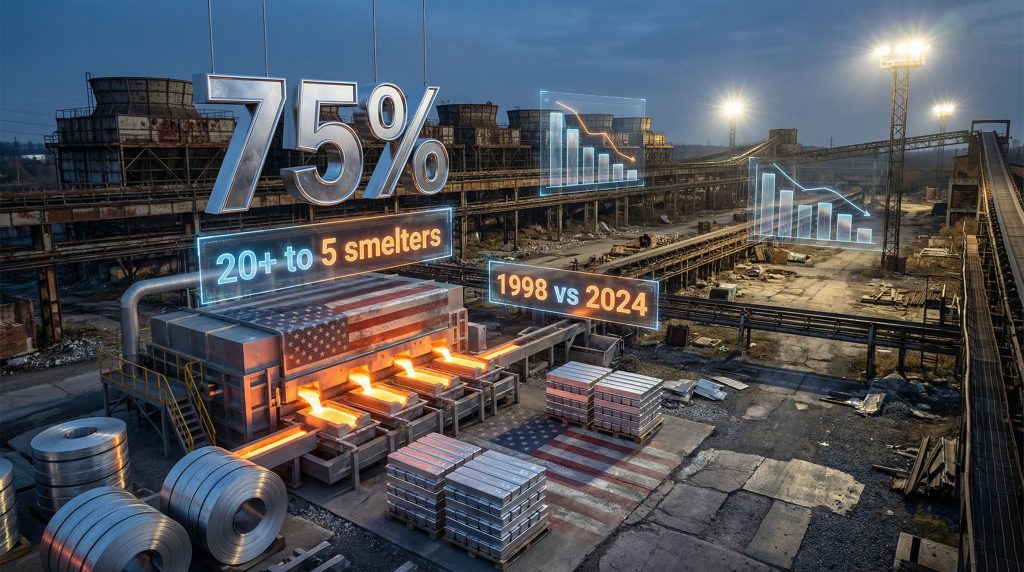
The numbers tell a stark story of industrial retreat. Bank of America Global Research analysis reveals that the United States has witnessed a 75% reduction in operational aluminum smelters since 1998, declining from more than 20 facilities to merely 5 operational plants as of December 2025. This represents not just facility closures but a fundamental restructuring of America's primary metals landscape.
| Metric | 1998 | 2024 | Change |
|---|---|---|---|
| Active Smelters | 20+ | 5 | -75% |
| Production Capacity | ~4.5M tonnes | ~2.4M tonnes | -47% |
| Capacity Utilization | ~85% | ~52% | -33 pts |
Regional analysis reveals that closures have concentrated in areas where alternative industrial uses for electricity have emerged as higher-value customers. The Pacific Northwest, historically advantaged by hydroelectric resources, has seen facilities shuttered as data centers and AI operations compete for the same power infrastructure that once sustained aluminum production.
Moreover, according to Bank of America reports, this US aluminium smelter loss continues to accelerate despite various policy interventions.
Michael Widmer, Head of Metals Research at Bank of America Global Research, characterizes the trajectory as representing structural rather than cyclical challenges facing the domestic industry. The pattern reflects technological disruption intersecting with energy market evolution, creating conditions where traditional heavy industry cannot compete for essential inputs.
The Strategic Vulnerability Matrix
Defense industry aluminum requirements create critical dependencies on imported materials when domestic capacity operates at reduced levels. Aerospace manufacturing, military vehicle production, and advanced weapons systems require specific aluminum alloy grades that may face supply chain vulnerabilities during international tensions or trade disruptions. In addition, these vulnerabilities are closely tied to US mineral production & national security concerns.
Current projections indicate that defense-related demand for aluminum will reach 1.6 million tonnes annually by 2030, representing significant strategic exposure when domestic primary production operates below historical capacity levels. This demand increase stems from military modernization programs, advanced weapons system development, and grid electrification projects supporting national infrastructure resilience.
Critical infrastructure dependencies extend beyond defense applications to encompass transportation systems, electrical transmission networks, and data center cooling infrastructure. The irony emerges that data centers displacing aluminum smelters simultaneously require substantial aluminum components for cooling systems, creating circular demand pressures that further stress domestic supply chains.
When big ASX news breaks, our subscribers know first
How Do Energy Economics Drive Aluminum Smelter Viability?
The Power Cost Equation: Why Data Centers Win Over Smelters
Electricity cost structures determine industrial location decisions with mathematical precision in energy-intensive manufacturing. Aluminum smelting via the Hall-Héroult electrolytic process requires 12-16 MWh per tonne of production, translating to approximately 60-70% of total operating costs in competitive electricity markets. This cost structure creates extreme sensitivity to power pricing variations that other industries can absorb through different economic models.
Bank of America analysis reveals the fundamental competitive disadvantage: data centers and AI facilities reportedly pay more than three times as much for electricity as aluminum smelters can economically sustain. This pricing differential reflects revenue models where electricity represents a smaller percentage of total operational costs for technology companies compared to primary metals production.
Michael Widmer notes that despite discussions about tariffs and investment incentives, industrial viability "often comes down to just one metric, which is the power cost." This assessment indicates that policy interventions cannot overcome fundamental competitive disadvantages when alternative bidders operate with higher profit margins tolerant of premium power costs.
Data center operational flexibility provides additional competitive advantages over aluminum smelters. Technology companies can shift computational loads geographically based on power cost variations, while aluminum production requires proximity to stable, long-term electricity contracts at predetermined locations with established infrastructure investments.
Regional Energy Market Competition Analysis
Pacific Northwest hydroelectric advantages historically supported aluminum smelting through access to low-cost renewable energy. However, these same renewable resources now attract data center development, cryptocurrency mining, and AI processing facilities willing to pay premium rates for clean electricity credentials and reliable supply characteristics.
Texas grid dynamics reflect broader national trends where deregulated electricity markets enable technology companies to secure power contracts at rates that traditional manufacturing cannot match. The state's wind and solar capacity additions create pricing volatility that benefits flexible loads over continuous industrial processes requiring stable, predictable costs.
Southeast utility rate structures traditionally favored industrial customers through special economic development tariffs and long-term contract availability. However, utility companies increasingly prioritise higher-margin customer classes as regulatory frameworks shift toward renewable energy integration and grid modernisation investments that require revenue optimisation. Additionally, these dynamics intersect with critical minerals energy security considerations.
What Role Do Trade Policies Play in Domestic Smelting Economics?
Tariff Effectiveness Analysis: 50% Rates vs. Production Reality
The current 50% tariff on imported aluminum products represents one of the most aggressive trade protection measures implemented for primary metals in recent decades. However, Bank of America analysis suggests that tariff policy alone cannot address the fundamental cost structure disadvantages facing domestic smelters when electricity markets favour alternative industrial uses. Furthermore, these tariff policies must be viewed alongside broader trump tariffs economic implications.
Consumer price impacts from the 50% tariff rate flow through multiple product categories including:
- Automotive components: Body panels, engine blocks, and lightweight structural elements
- Construction materials: Window frames, roofing systems, and structural assemblies
- Packaging applications: Beverage cans, food containers, and industrial packaging
- Electronics housings: Laptop casings, smartphone frames, and data center equipment
Despite tariff protection creating pricing space for domestic production, no new smelter construction projects have proceeded according to Bank of America research. This outcome indicates that tariff margins remain insufficient to justify capital investment in new capacity estimated at several billion dollars per greenfield facility.
Import substitution effectiveness varies significantly across product categories. Semi-finished aluminum products face different competitive dynamics than primary ingot, with some downstream manufacturing maintaining viability through specialised processing capabilities and proximity to end-user markets.
Global Supply Chain Reconfiguration Patterns
China's implementation of a 45-million-ton capacity cap on aluminum smelting represents a fundamental shift from market-driven expansion toward managed supply control. This policy emerged after repeated cycles where positive margins triggered rapid capacity additions, followed by government intervention to support struggling smelters during subsequent oversupply periods. Consequently, these developments contribute to broader US-china trade war impact on global markets.
Chinese operator migration to international markets, particularly Indonesia, reflects capital seeking viable production locations outside domestic constraints. Bank of America analysis indicates that Indonesian supply growth primarily involves Chinese operators who can no longer expand domestic capacity, creating globalised production networks controlled by Chinese industrial interests.
The dynamics suggest that Indonesian capacity additions may not substantially increase global aluminum availability if significant volumes return to China as imports. This circular flow pattern maintains Chinese consumption access while circumventing domestic capacity restrictions, potentially limiting global supply increases despite new facility construction.
European market conditions demonstrate improved demand fundamentals, with July 2025 marking the first month in almost three years where every sector contributed positively to aluminum demand. However, supply uncertainties from Mozambique and Iceland create premium pricing pressures that could redirect Canadian production toward European markets, further constraining North American supply availability.
Can the US Rebuild Its Primary Aluminum Production Capacity?
Investment Requirements and Economic Feasibility
New smelter construction requires capital investments of $3-5 billion per facility, depending on technology selection, environmental compliance systems, and power infrastructure development. These investment levels demand long-term electricity contracts at rates that current market conditions cannot support when data centers offer premium pricing for the same power resources.
Technology advancement opportunities in smelting efficiency could reduce electricity requirements per tonne of production, potentially improving competitive positioning. Advanced cell technology, automation systems, and heat recovery capabilities offer pathways to reduce the 12-16 MWh per tonne energy requirement that currently makes production economically challenging.
However, environmental compliance costs add substantial complexity to new facility development. Air quality regulations, carbon emission standards, and waste management requirements create regulatory frameworks that favour existing facilities with grandfathered permits over new construction projects requiring contemporary environmental systems.
Policy Intervention Scenarios and Outcomes
Government subsidy models from other aluminum-producing nations provide frameworks for potential intervention strategies. South Africa's support for Hillside Aluminium through structured electricity pricing demonstrates that strategic industrial policy can maintain smelter viability when government actively prevents alternative industries from displacing industrial production through market bidding.
The Hillside Aluminium case study reveals policy mechanisms where government intervention preserves strategic manufacturing capacity. Eskom's structured pricing agreement, supported by regulatory approval from the National Energy Regulator of South Africa, reflects deliberate policy decisions to support industries that create value for national economic development.
Strategic reserve implications for aluminum stockpiling represent alternative approaches to maintaining supply security without domestic production capacity. Government stockpiling programmes could buffer short-term supply disruptions while market forces determine long-term production location economics.
How Does the Mozambique Uncertainty Affect Global Aluminum Markets?
Supply Disruption Risk Assessment
The South32 aluminum smelter in Mozambique represents approximately 500,000 tonnes of annual capacity, equivalent to about 10% of European aluminum consumption. Current operational uncertainty stems from power supply constraints that create risk of production interruption or facility closure, potentially removing significant supply from global markets.
Power infrastructure limitations in Mozambique reflect broader challenges facing aluminum production in developing regions. While electricity costs may be competitive, grid reliability and long-term power contract availability create operational risks that affect facility investment and operational planning decisions.
Alternative supply source evaluation for European markets reveals limited replacement options if Mozambique production ceases. Canadian facilities could redirect output toward European markets, but such shifts would reduce North American supply availability and potentially trigger premium pricing across regional trading hubs.
Geopolitical Risk Factors in Aluminum Supply Chains
African production stability faces infrastructure dependencies and political risk factors that create supply chain vulnerabilities for European aluminum consumers. Transportation logistics, port facilities, and regulatory stability in producing regions affect supply reliability beyond direct facility operational considerations.
Chinese investment patterns in overseas smelting capacity reflect strategic resource control objectives that extend beyond purely commercial considerations. Chinese operators developing facilities in Indonesia, Malaysia, and other Southeast Asian nations create production networks that maintain Chinese industrial access while circumventing domestic capacity constraints.
The emerging pattern suggests strategic resource competition among major economies where aluminum production location affects supply chain control and national industrial capacity. This dynamic creates geopolitical dimensions to aluminum trade that extend beyond traditional commercial relationships.
What Are the Broader Economic Implications of Aluminum Industry Restructuring?
Employment and Regional Economic Impact Analysis
Aluminum smelter closures eliminate high-paying manufacturing jobs that historically supported entire communities in regions with limited economic diversification. Smelter employment typically provides wages significantly above regional averages, with skilled technical positions requiring specialised training that may not transfer directly to other industries.
Regional development strategies must adapt to industrial transition realities where traditional manufacturing faces structural disadvantages against emerging technology sectors. Communities previously dependent on smelter employment require economic diversification approaches that leverage existing infrastructure while developing new industrial capabilities.
Skill transfer opportunities to emerging energy sectors offer potential pathways for displaced workers. Electric grid modernisation, renewable energy installation, and energy storage system deployment require technical capabilities similar to aluminum production, creating possible transition routes for experienced industrial workers.
Downstream Industry Adaptation Strategies
Automotive sector aluminum sourcing must adapt to reduced domestic primary production through supply chain diversification and material substitution strategies. Lightweighting requirements for electric vehicle production increase aluminum demand precisely as domestic capacity declines, creating sourcing challenges for manufacturers.
Construction industry material substitution trends reflect aluminum availability constraints and pricing pressures from tariff policies. Alternative materials including steel, composite systems, and engineered plastics compete with aluminum in applications where performance specifications permit substitution.
Packaging industry supply chain resilience measures focus on securing long-term aluminum supply contracts and developing recycling capacity to reduce dependence on primary production. Beverage can manufacturing and food packaging applications require reliable aluminum access that domestic production constraints may challenge.
The next major ASX story will hit our subscribers first
How Will Defense Spending Drive Future Aluminum Demand?
Military Application Requirements Through 2030
Defense-related aluminum demand projections reach 1.6 million tonnes annually by 2030, driven by military modernisation programmes and advanced weapons system development. This represents substantial demand increases precisely as domestic primary production capacity operates below historical levels.
Advanced weapons systems material specifications require specific aluminum alloy grades with performance characteristics that may create supply chain vulnerabilities during international tensions. Military aircraft production, naval shipbuilding, and ground vehicle manufacturing depend on reliable aluminum access that import dependencies may compromise during geopolitical conflicts.
Strategic ally coordination for defense material supply chains becomes critical when domestic production cannot meet military requirements. Partnership frameworks with allied nations producing aluminum could provide supply security alternatives to market-dependent sourcing strategies.
Critical Infrastructure Modernisation Needs
Grid electrification aluminum requirements for transmission system expansion create substantial demand increases as renewable energy integration requires new power infrastructure. High-voltage transmission lines, transformer equipment, and substation construction consume significant aluminum quantities for electrical conductivity applications. Furthermore, these requirements intersect with US natural gas pricing trends as energy sources compete for grid capacity.
Transportation infrastructure upgrade material demands include aluminum applications in bridge construction, rail system modernisation, and highway improvement projects. Infrastructure investment programmes funded by government spending create predictable aluminum demand that domestic supply constraints may challenge to fulfil.
Data center cooling system aluminum consumption represents circular demand where the same facilities displacing aluminum smelters simultaneously require substantial aluminum components for thermal management systems. This creates self-reinforcing pressure on aluminum supply chains as technology sector growth increases both competitive pressure on production and demand for finished products.
What Does the Future Hold for North American Aluminum Production?
Technology Innovation Pathways
Advanced smelting technology efficiency improvements offer potential pathways to reduce electricity consumption per tonne of aluminum production. Innovative cell designs, process optimisation systems, and waste heat recovery capabilities could lower the current 12-16 MWh per tonne requirement that makes production economically challenging.
Renewable energy integration opportunities for cost reduction depend on developing electricity contract structures that provide stable pricing for continuous industrial processes. Solar and wind energy variability requires storage systems or grid balancing mechanisms that may increase effective power costs for aluminum production.
Recycling capacity expansion versus primary production trade-offs reflect aluminum's infinite recyclability characteristics. According to decline of U.S. primary aluminum production analysis, secondary aluminum production requires significantly less energy than primary smelting, potentially offering more economically viable pathways to meet domestic demand through enhanced recycling infrastructure.
Strategic Recommendations for Industry Recovery
Policy framework requirements for competitive restoration must address electricity market structures that enable data centers to outbid industrial production for power resources. Regulatory approaches could include industrial electricity pricing protections, strategic industry designations for grid access priority, or government-backed power contracts for essential manufacturing capacity.
Investment incentive structures for new capacity development require coordination between federal industrial policy and state-level economic development programmes. Tax incentives, loan guarantees, and regulatory streamlining could reduce capital costs for smelter construction while addressing competitive disadvantages in electricity markets.
International cooperation opportunities for supply security include partnership frameworks with allied nations maintaining aluminum production capacity. Strategic alliances could provide supply access during disruptions while supporting broader industrial policy objectives for critical material security.
The trajectory of US aluminium smelter loss reflects broader transformations in industrial competitiveness where traditional manufacturing confronts new economy sectors competing for the same essential inputs. While tariff protection and investment incentives provide policy tools, fundamental electricity market dynamics determine viability for energy-intensive production that cannot match technology sector willingness to pay premium power costs.
Disclaimer: This analysis involves forecasts and market projections that reflect current conditions and may change based on technological developments, policy interventions, and global economic factors. Investment decisions should consider multiple information sources and professional guidance.
Looking to Position Yourself in Strategic Metal Markets?
Discovery Alert's proprietary Discovery IQ model delivers immediate notifications on significant ASX mineral discoveries, including critical materials essential for defence and infrastructure applications. With domestic aluminium production declining by 75%, understanding which exploration companies are discovering strategic minerals becomes crucial for investors seeking to capitalise on supply chain reshoring opportunities and strategic mineral discoveries that could reshape global markets.