August 8, 2026
Modern global energy markets operate within an intricate web of geopolitical tensions, supply chain vulnerabilities, and strategic power projection that extends far beyond traditional commodity trading dynamics. The intersection of naval enforcement capabilities and economic warfare represents a fundamental evolution in how nations project influence over critical energy flows, creating unprecedented scenarios where maritime chokepoints become instruments of diplomatic pressure. The current U.S. blockade on Venezuelan oil demonstrates this evolution, as enforcement operations directly impact global commodity flows whilst simultaneously affecting declining US oil production and regional market dynamics.
Economic sanctions have traditionally relied on financial system restrictions and regulatory compliance mechanisms. However, the emergence of active naval interdiction strategies marks a paradigm shift toward kinetic enforcement of economic policy objectives, transforming passive regulatory frameworks into dynamic operational theaters where military assets directly impact commodity flows and market pricing mechanisms.
Economic Warfare Through Maritime Infrastructure Control
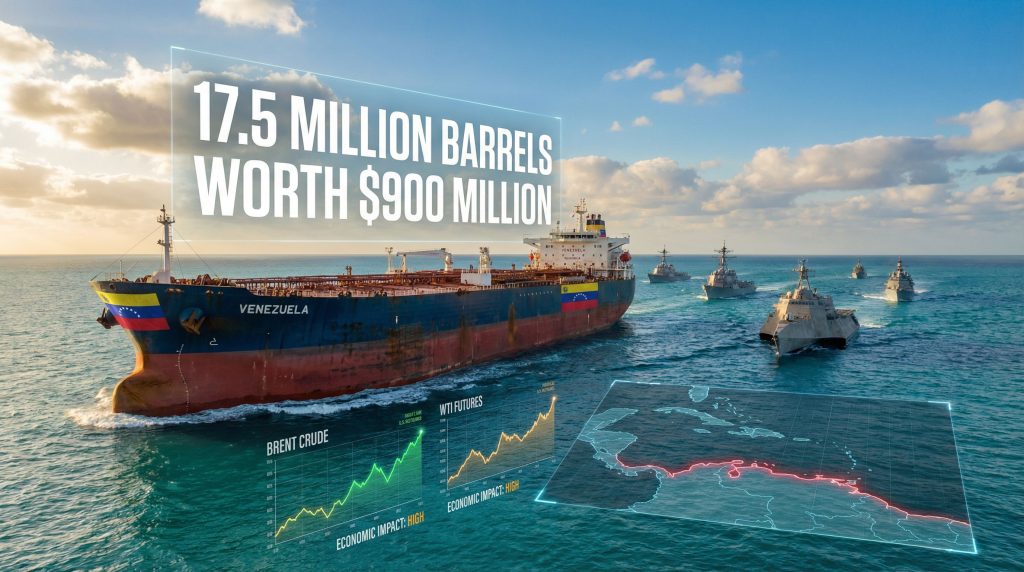
The transformation of traditional sanctions regimes into active maritime enforcement operations represents a fundamental shift in economic warfare methodology. Current intelligence indicates that approximately 17.5 million barrels worth $900 million remain immobilised aboard Venezuelan tankers, creating immediate supply chain disruptions that extend far beyond regional boundaries.
This maritime interdiction approach demonstrates how naval power projection capabilities can amplify existing financial restrictions, converting static regulatory measures into dynamic enforcement mechanisms that directly impact global energy pricing. The economic multiplier effects cascade through international markets as traders factor supply uncertainty into futures contracts, with Brent crude trading at $61.87 per barrel and WTI at $58.05 per barrel as of December 2025, both showing upward pressure correlating to enforcement announcements.
The strategic implementation of naval blockades creates dual-constraint mechanisms that simultaneously restrict physical vessel movement and maintain financial system pressure. Furthermore, this approach forces target nations to confront both immediate operational bottlenecks and long-term economic isolation, creating cascading effects throughout their energy infrastructure and fiscal capacity. The U.S. blockade on Venezuelan oil exemplifies how modern enforcement strategies contribute to broader oil price rally amid tariffs affecting global markets.
Supply Chain Vulnerability Analysis
The vulnerability of alternative maritime networks becomes apparent when examining Venezuela's reliance on approximately 80 vessels for oil transport, with roughly 40% already operating under U.S. sanctions designation. This fleet composition reveals the fragility of circumvention networks that previously enabled sanctions evasion through sophisticated operational methodologies.
Critical operational impacts include:
- Tanker utilisation rates declining as operators avoid Venezuelan territorial waters
- Insurance premium escalation for companies willing to accept sanctions exposure risks
- Alternative routing pattern emergence through extended maritime corridors
- Storage capacity constraints forcing production facility adjustments
The enforcement strategy specifically targets "dark fleet" operations that previously circumvented restrictions through flag-switching mechanisms, transponder manipulation techniques, and complex ownership structure obfuscation. These vessels historically registered under flags of convenience from Panama, Marshall Islands, and Liberia to obscure Venezuelan ownership and evade sanctions tracking systems. In addition, these enforcement actions must be considered within the broader context of tariffs' market impact on global commodity flows.
Modern enforcement combines satellite Automatic Identification System monitoring with synthetic aperture radar imaging for vessel detection independent of transponder signals, creating comprehensive surveillance capabilities that neutralise traditional evasion methodologies.
Strategic Scenario Development Framework
Escalation Pathway Analysis
The deployment of Venezuelan naval escorts to accompany commercial oil tankers would fundamentally transform economic enforcement operations into potential military engagement scenarios. This escalation pathway introduces significant miscalculation risks where ambiguous rules of engagement could trigger rapid conflict expansion without explicit hostile intent from either party.
Risk amplification factors include:
- Armed escort presence creating ambiguous threat assessment scenarios
- Enforcement zone expansion beyond territorial waters into international shipping lanes
- Third-party vessel interference generating jurisdiction complications
- Communication protocol failures during high-seas encounters
Historical precedent from Iranian naval confrontations with U.S. forces demonstrates how escort operations can trigger rapid escalation dynamics. The 2016 incidents involving Iranian Revolutionary Guard vessels and U.S. Navy destroyers illustrate how protective escort missions can quickly evolve into direct military confrontations through misinterpretation of intent or procedural miscommunication.
Economic Capitulation Mechanisms
Venezuelan production facilities face immediate operational constraints as blocked exports create storage overflow conditions that force production shutdowns. The country's oil infrastructure, historically capable of exceeding 3 million barrels per day production, currently operates at approximately 700,000-900,000 barrels daily due to years of economic decline and infrastructure deterioration.
The $900 million in stranded revenue represents immediate fiscal pressure that compounds existing debt servicing challenges facing PDVSA, Venezuela's state oil company. Oil exports historically represent 96% of Venezuelan export revenues, making export bottlenecks directly translatable to government revenue collapse and reduced capacity for social spending maintenance. However, this situation must be analysed within the broader geopolitical context of US–China trade war impact affecting global energy relationships.
| Economic Pressure Category | Immediate Effects | Long-term Consequences |
|---|---|---|
| Production Constraints | Storage overflow forcing shutdowns | Infrastructure degradation |
| Fiscal Revenue | $900M immediate loss | Debt default acceleration |
| Regional Stability | Cuba supply disruption | Migration pressure increases |
| Currency Stability | Exchange rate deterioration | Hyperinflation acceleration |
Circumvention Innovation Cycles
Alternative circumvention mechanisms theoretically include enhanced ship-to-ship transfer operations conducted in international waters, though these procedures carry significant technical risks including product loss, safety hazards, and requirement for downstream recipients willing to accept commingled crude supplies.
Overland pipeline network development to neighbouring countries would require massive capital investment, complex political agreements, and multi-year construction timelines. Existing overland capacity to Colombia, Guyana, and Brazil remains extremely limited, making this option strategically unfeasible for large-volume crude exports.
Cryptocurrency payment systems represent potential mechanisms for reducing reliance on traditional financial system access, though Venezuelan government initiatives like the Petro cryptocurrency have demonstrated significant adoption limitations and technical constraints for large-volume commodity transactions.
Regional Power Response Dynamics
Chinese Strategic Calculations
Beijing's response to the U.S. blockade on Venezuelan oil demonstrates the complex intersection of energy security, geopolitical alliance management, and economic risk assessment. Chinese military forces have reportedly conducted simulated Caribbean war scenario exercises amid enforcement actions, indicating serious strategic concern about potential template applications to future Chinese interests.
Chinese energy companies face direct financial exposure through stranded investments and disrupted supply contracts with Venezuelan state enterprises. According to BBC News, the situation forces Beijing to evaluate whether supporting Venezuelan oil flows justifies potential secondary sanctions risks that could affect broader Chinese economic interests in Western markets.
Chinese response mechanisms include:
- Diplomatic protests emphasising international law violation concerns
- Alternative energy partnership acceleration with diversified suppliers
- Strategic petroleum reserve utilisation for supply security
- Economic support package development for Venezuelan government stability
China condemned the U.S. seizure of Venezuelan oil tankers through official government statements emphasising violations of international maritime law and sovereignty principles. However, Chinese commercial entities must balance geopolitical solidarity with practical business risk management as enforcement operations continue.
Caribbean Alliance Dynamics
Regional powers throughout the Caribbean and Latin America face complex navigation between U.S. diplomatic pressure and regional solidarity principles. Countries with significant Venezuelan diaspora populations confront particular challenges as economic conditions deteriorate and migration pressures increase.
Cuba's economic dependence on Venezuelan oil flows, historically averaging approximately 100,000 barrels daily, means U.S. blockade operations create immediate secondary pressure on Cuban economic stability. This dependency relationship demonstrates how maritime enforcement creates cascading regional effects beyond the primary target nation.
Strategic considerations for regional powers:
- Energy security implications if enforcement zone expansion occurs
- Migration management capacity as Venezuelan economic crisis deepens
- Trade relationship preservation with both U.S. and Venezuelan markets
- Maritime sovereignty concerns regarding enforcement precedent establishment
Energy Market Restructuring Implications
Supply Chain Resilience Development
The enforcement actions accelerate existing market trends toward supply chain diversification and transportation route security enhancement. Energy importing nations reassess single-source dependencies whilst exporters evaluate vulnerability reduction strategies for critical transportation infrastructure. Consequently, these developments intersect with broader OPEC production impact on global market stability.
Market adaptation mechanisms include:
- Strategic petroleum reserve coordination among importing nations
- Alternative supplier relationship development and contract diversification
- Domestic production capacity investment acceleration programmes
- Transportation route security assessment and redundancy development
Insurance markets face significant repricing pressures as political risk calculations incorporate naval enforcement possibilities. Maritime insurance providers, including specialised P&I clubs, withdraw coverage from sanctioned vessel operations whilst alternative high-risk insurance mechanisms emerge at premium pricing levels.
Economic Warfare Precedent Establishment
The Venezuelan enforcement model establishes operational templates for future economic pressure applications through maritime power projection capabilities. Target nations globally must now incorporate naval interdiction risks into export strategy development and transportation security planning.
Global market implications:
- International shipping insurance markets repricing political risk exposure
- Maritime law evolution regarding economic enforcement operation legality
- Naval capability development priorities for emerging economy protection
- Alternative international payment system development acceleration
The precedent creates strategic uncertainty for nations dependent on maritime commodity exports, forcing infrastructure investment decisions that account for potential naval enforcement scenarios. This dynamic particularly affects countries with limited naval defence capabilities relative to major maritime powers.
Maritime Enforcement Effectiveness Assessment
Historical Performance Analysis
Previous naval enforcement campaigns provide mixed effectiveness indicators depending on target nation economic structure, alternative market access availability, and international coalition support levels. Iran's experience with maritime sanctions demonstrates both the potential for economic pressure and the development of sophisticated circumvention networks over extended timeframes.
Effectiveness measurement variables:
- Target nation economic diversification capacity
- International community support for enforcement legitimacy
- Alternative transportation route geographic availability
- Enforcement operation sustainability duration and resource requirements
The Venezuelan case presents unique characteristics compared to historical precedents due to geographic proximity to major naval powers, limited alternative export route options, and existing infrastructure deterioration that amplifies enforcement impact.
Investment Risk Recalibration
Energy sector investors must fundamentally recalibrate risk assessment models to account for naval enforcement possibilities affecting global energy investments. Venezuelan operations face immediate asset devaluation whilst alternative suppliers potentially benefit from market share redistribution dynamics.
Investment strategy adjustments include:
- Enhanced country risk premiums for sanctions-vulnerable jurisdictions
- Transportation route security due diligence integration
- Alternative energy investment timeline acceleration
- Geopolitical risk insurance demand expansion and premium increases
Commodity market volatility increases as trading algorithms factor supply uncertainty and potential enforcement expansion scenarios into pricing models. Oil price volatility correlates directly to enforcement announcement timing, with futures contract premiums expanding for affected supply sources whilst regional price differentials widen.
What Are The Long-term Market Response Indicators?
Market response indicators:
- Futures contract premium expansion for Venezuelan-sourced supplies
- Strategic inventory building by risk-averse commercial buyers
- Alternative commodity substitution acceleration in affected regions
- Regional price differential expansion reflecting transportation risk premiums
Furthermore, the enforcement operations generate broader systemic effects throughout global energy trading networks. As reported by Oil Price, sanctioned vessels continue attempting to load Venezuelan crude despite active enforcement measures, indicating the complexity of implementing comprehensive maritime blockades.
The U.S. blockade on Venezuelan oil represents a fundamental shift in economic warfare methodology that extends far beyond regional energy politics. Through active maritime enforcement, traditional sanctions regimes evolve into dynamic operational theaters where naval capabilities directly determine commodity flows and market pricing mechanisms.
This enforcement approach creates cascading effects throughout global energy markets, forcing supply chain diversification, insurance market repricing, and investment strategy recalibration across multiple sectors. The precedent establishment has long-term implications for international trade security and maritime law development that extend well beyond the immediate Venezuelan context.
Disclaimer: This analysis contains forward-looking assessments and speculative scenarios based on current geopolitical developments. Energy markets involve significant risks and uncertainties. Readers should conduct independent research and consult qualified professionals before making investment decisions. The effectiveness and duration of enforcement actions remain subject to changing political, economic, and military factors.
Are You Tracking Emerging Energy Market Opportunities?
The Venezuelan oil blockade demonstrates how geopolitical tensions create sudden market shifts that can impact energy commodities and related mining sectors across global markets. Discovery Alert's proprietary Discovery IQ model delivers real-time alerts on significant ASX mineral discoveries, helping investors identify actionable opportunities as market dynamics evolve and supply chain disruptions create new investment possibilities.