
August 14, 2026
Understanding the Current US-China Rare Earth Trade Impasse
Strategic resource diplomacy has evolved far beyond traditional commodity trading relationships, particularly when examining how nations weaponise critical raw materials access. The rare earth sector exemplifies this transformation, where control over processing infrastructure becomes more valuable than mineral ownership itself. Furthermore, this dynamic creates unprecedented vulnerabilities for importing nations, regardless of their economic or military power. US rare earth buyers still see China curbs despite Trump deal, highlighting the persistent challenges in securing reliable access to these essential materials.
The complexity of modern rare earth supply chains means that raw material deposits scattered across multiple continents must funnel through a single processing bottleneck. In addition, this concentration creates systemic risk that extends far beyond normal market fluctuations or trade disputes. When processing monopolies emerge in geopolitically sensitive materials, traditional economic remedies prove inadequate.
When big ASX news breaks, our subscribers know first
China's Selective Export Strategy
Recent customs data reveals the sophisticated nature of Chinese rare earth export controls. According to official Chinese statistics released December 20, 2025, magnet supplies to the United States dropped 11% in November 2025 compared to October, while overall Chinese rare earth exports increased 13% during the same period. Consequently, this divergence indicates targeted restrictions rather than supply-side constraints.
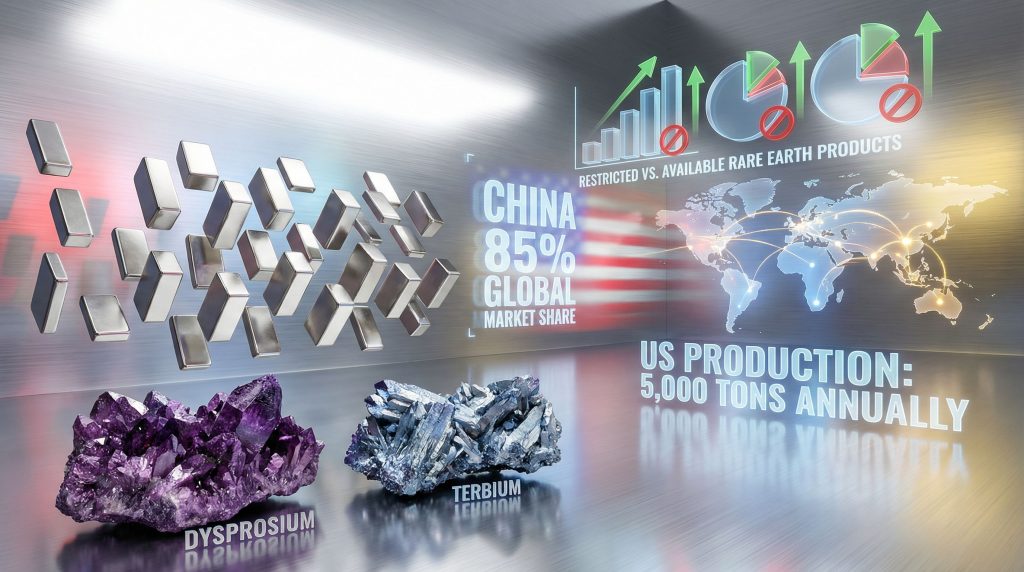
The strategic significance becomes clear when examining which materials remain accessible versus restricted. Scott Dunn, Chief Executive of Noveon Magnetics Inc., observed that US entities cannot obtain dysprosium metal or oxide despite diplomatic agreements. His assessment reveals the core challenge: "Outside of China, the world can produce 50,000 tons of magnets, but there isn't even close to the equivalent in rare earth minerals to support those tons outside of China."
Processing Infrastructure as Geopolitical Leverage
China's approach maintains control through processing monopolisation rather than resource hoarding. However, this strategy proves more effective than traditional export embargoes because it preserves global economic stability whilst preventing competitor capacity development. The October 30, 2025 agreement between Trump and Xi Jinping demonstrates this dynamic clearly.
Following the South Korea negotiations, where the US committed to tariff reductions in exchange for restored rare earth supplies, finished magnet availability improved whilst raw material access remained constrained. This selective compliance allows China to fulfil diplomatic commitments whilst preserving strategic advantages.
Why Raw Material Access Remains Restricted Despite Trade Agreements
The persistence of raw material restrictions despite diplomatic agreements reflects deliberate strategic planning rather than bureaucratic oversight. For instance, Chinese export controls operate through multiple administrative layers that function as de facto restrictions whilst maintaining plausible compliance with international commitments.
Administrative Barriers as Export Controls
The Chinese licensing system creates supply uncertainty through procedural complexity. Mark Ludwikowski, Chair of Clark Hill's International Trade Practice, noted that Chinese legal counsel recommends proceeding with licence applications before temporary permits expire, warning "They could pull the plug on this at any point if this goes south."
Six-month temporary licences approved during early summer 2025 require renewal applications around the same timeframe, creating potential administrative bottlenecks. Historical precedent from May and June 2025 shows deliberate approval delays functioning as export controls, according to industry participants cited in Bloomberg reporting.
Materials Classification Strategy
China maintains export restrictions on specific raw materials whilst allowing finished product sales:
• Dysprosium metal and oxide – Completely unavailable to US entities
• Terbium compounds – Limited access for high-temperature applications
• Raw neodymium – Restricted before processing into finished magnets
• Europium materials – Controls affecting advanced electronics applications
This selective availability pattern preserves Chinese processing monopolies whilst providing downstream manufacturers sufficient access to prevent economic disruption. Furthermore, the strategy proves particularly effective because finished magnet imports satisfy immediate market needs whilst preventing long-term supply chain independence.
Historical Pattern of Agreement Failures
Gracelin Baskaran, Director of the Critical Minerals Security Program at the Center for Strategic and International Studies, documented the pattern of non-compliance: "We reached various temporary agreements in London, in Geneva, in South Korea and they were reneged. So no agreement so far has proved to be final."
This history suggests current restrictions may persist despite diplomatic agreements. Consequently, the temporary nature of previous arrangements indicates that rare earth access serves as ongoing leverage in broader US-China strategic competition rather than a resolvable trade issue.
Strategic Implications for US Manufacturing Independence
The selective restriction of raw materials whilst maintaining finished product availability creates a strategic dependency that undermines stated US manufacturing independence objectives. In addition, this approach effectively prevents the development of domestic processing capacity necessary for true supply chain security, impacting both defence-critical materials strategies and broader industrial planning.
The Value-Chain Control Mechanism
China's strategy operates through two complementary controls:
- Upstream restriction – Limiting raw material exports prevents competitor processing development
- Downstream availability – Allowing finished product exports maintains economic stability
This dual approach proves more effective than complete export embargoes because it avoids triggering emergency response measures whilst maintaining strategic control. US manufacturers can continue production using Chinese-processed inputs, but cannot develop independent capabilities.
Defence Application Vulnerabilities
Permanent magnets utilising rare earth elements serve critical roles in defence applications, particularly missile guidance systems. However, the dependence on Chinese processing for materials essential to national security infrastructure creates vulnerabilities extending beyond commercial considerations.
Current US permanent magnet production capacity of approximately 5,000 tons annually falls far short of defence and industrial requirements. The gap between domestic needs and production capability necessitates continued reliance on foreign sources, predominantly Chinese facilities.
Investment Requirements for Independence
Achieving meaningful supply chain independence requires substantial capital investment across multiple processing stages:
| Infrastructure Type | Investment Range | Timeline | Technical Challenges |
|---|---|---|---|
| Rare earth separation facilities | $500M – $1B per facility | 5-7 years | Environmental compliance, skilled workforce |
| Magnet manufacturing plants | $100M – $300M per facility | 3-5 years | Proprietary technology access |
| Recycling systems | $50M – $200M per facility | 2-4 years | Collection infrastructure development |
The estimated $2-5 billion total investment requirement exceeds typical private sector capabilities, necessitating government support or strategic partnerships for implementation.
Market Response Strategies Among US Industrial Buyers
US manufacturers are implementing diverse risk mitigation strategies to address supply uncertainty, though none provide complete independence from Chinese sources in the near term. These approaches reflect industry recognition that diplomatic agreements alone cannot guarantee reliable access, particularly given the ongoing challenges where US rare earth buyers still see China curbs despite Trump deal.
Strategic Inventory Management
Companies are building 6-12 month inventory buffers to hedge against potential supply interruptions. This strategy requires significant working capital commitment but provides operational continuity during diplomatic tensions or administrative delays.
Inventory hedging proves particularly important given the historical pattern of licensing delays. For instance, the May-June 2025 slow-walking of approvals demonstrated how administrative processes function as supply controls, making buffer stocks essential for production planning.
Alternative Source Development
US buyers are actively developing partnerships with non-Chinese suppliers, despite higher costs and limited capacity:
• Australian producers – Lynas Rare Earths and other mining operations
• Canadian sources – Emerging processing capabilities
• Recycling infrastructure – Recovery from end-of-life electronics and defence systems
• Design optimisation – Reducing rare earth content in new products
These alternatives currently lack sufficient scale to replace Chinese sources but provide partial diversification for critical applications.
Technology Hedging Approaches
Some manufacturers are investing in rare earth-free alternatives for specific applications. Whilst complete substitution remains technologically challenging for high-performance applications, incremental improvements reduce dependency for less demanding uses.
Licensing System Complexities and Renewal Challenges
The Chinese licensing system operates through multiple administrative layers that create uncertainty even when materials are theoretically available. Furthermore, this complexity serves strategic purposes by maintaining Chinese discretionary control over supply access.
Renewal Process Vulnerabilities
The coincidental timing of licence renewals creates systemic risk for US buyers. Since most six-month temporary licences were approved during early summer 2025, renewal applications concentrate around the same period, potentially creating administrative bottlenecks.
Industry participants express concern about deliberate processing delays similar to those experienced in May-June 2025. During that period, licensing approvals were intentionally slowed as a form of export control, according to market participants cited in Bloomberg reporting.
Military End-Use Complications
Chinese licensing authority extends to extraterritorial controls on products containing Chinese rare earth inputs. Consequently, this means products manufactured outside China using Chinese materials remain subject to Chinese licensing requirements if they reach military applications.
The October 2025 policy expansion introduced comprehensive downstream controls affecting finished goods containing Chinese rare earth materials. This extraterritorial approach complicates supply chain management for companies serving both civilian and defence markets.
Administrative Discretion as Strategic Tool
The licensing system's administrative complexity provides Chinese authorities with flexible control mechanisms. However, approvals can be delayed or denied based on broader geopolitical considerations rather than specific application merits.
This discretionary authority proves particularly valuable during diplomatic negotiations, allowing China to apply pressure through supply access without formal policy changes.
The next major ASX story will hit our subscribers first
European Market Dynamics and Comparative Access
Recent developments indicate China is granting European firms preferential treatment in rare earth licensing, creating competitive disadvantages for US manufacturers. Furthermore, this differential access pattern suggests strategic favouritism based on geopolitical considerations.
EU Preferential Treatment
On December 15, 2025, the European Union announced that China began granting licences with lengthier terms to European companies, contrasting sharply with six-month temporary permits available to US firms. This differential treatment creates operational advantages for European competitors.
Extended licensing terms provide European manufacturers with greater supply security and improved production planning capabilities. In addition, the contrast with US licensing uncertainty creates competitive imbalances affecting global market positioning.
Strategic Partnership Frameworks
China's approach to European rare earth access reflects broader strategic relationships:
• Automotive sector partnerships – Reduced restrictions for European electric vehicle manufacturers
• Clean energy collaboration – Favourable access for renewable energy applications
• Technology transfer arrangements – Joint ventures receiving preferential treatment
These sectoral partnerships demonstrate how rare earth access serves as a tool for broader economic diplomacy beyond US-specific considerations.
Competitive Implications for US Industry
Differential licensing terms create structural advantages for European competitors in global markets. US manufacturers face higher input costs and supply uncertainty whilst European firms benefit from stable, long-term access arrangements.
This competitive disadvantage extends beyond direct rare earth costs to include inventory carrying costs, supply chain risk premiums, and reduced production planning efficiency.
Investment Implications for Alternative Supply Chain Development
Developing non-Chinese rare earth processing capabilities requires coordinated public and private investment across multiple infrastructure categories. However, the scale and complexity of required investments exceed typical market-driven development timelines, necessitating consideration of broader critical minerals strategy approaches.
Critical Infrastructure Investment Needs
Building alternative supply chains necessitates comprehensive infrastructure development:
Phase 1 (2025-2027): Foundation Building
• Pilot-scale separation facilities ($100-200M investment range)
• Stockpile infrastructure development
• Skilled workforce training programmes
• Environmental compliance systems
Phase 2 (2027-2030): Commercial Scale Development
• Full-scale processing facilities ($500M-1B per facility)
• Integrated magnet manufacturing capabilities
• Advanced recycling systems implementation
• Quality certification and testing infrastructure
Phase 3 (2030+): Supply Chain Independence
• Multiple processing facility operations
• Domestic supply chain integration
• Technology leadership in alternative materials
• Strategic reserve maintenance capabilities
Government Support Requirements
The investment scale and strategic importance of rare earth independence necessitates government involvement beyond typical market mechanisms:
• Direct funding – Infrastructure development grants and loans
• Risk sharing – Government guarantees for private investment
• Research support – Alternative technology development funding
• Regulatory facilitation – Streamlined environmental permitting
Private Sector Partnership Models
Successful alternative supply chain development requires innovative public-private partnerships that share risks and returns appropriately. Traditional procurement approaches prove inadequate for long-term infrastructure development needs.
Future Scenarios for US-China Rare Earth Relations
Multiple potential outcomes exist for US-China rare earth relations, each carrying different implications for supply chain development and industrial strategy. Furthermore, understanding these scenarios helps inform investment strategy insights and policy decisions.
Scenario 1: Gradual Normalisation (35% Probability)
Diplomatic progress leads to expanded licensing terms and increased raw material access over 2-3 years. This scenario requires:
• Broader US-China strategic accommodation
• Chinese confidence in maintaining processing advantages
• Reduced US pressure for complete supply chain independence
Under this scenario, US buyers would gain improved access whilst China maintains strategic control through processing monopolisation.
Scenario 2: Continued Status Quo (45% Probability)
Current restrictions persist with periodic adjustments based on diplomatic cycles. This scenario features:
• Selective access based on geopolitical conditions
• Continued administrative uncertainty for US buyers
• Gradual US alternative capacity development
This outcome requires sustained US investment in domestic capabilities whilst accepting partial Chinese dependency.
Scenario 3: Complete Strategic Decoupling (20% Probability)
Escalating tensions lead to comprehensive Chinese rare earth export restrictions affecting all US entities. Consequently, this scenario would trigger:
• Emergency US government intervention
• Accelerated alternative supply development
• Global supply chain fragmentation
• Potential military implications for defence systems
Investment Strategy Implications
Each scenario carries different risk-return profiles for alternative supply chain investment:
| Scenario | Private Investment Risk | Government Support Level | Timeline for Returns |
|---|---|---|---|
| Normalisation | Medium-High | Moderate | 5-8 years |
| Status Quo | High | High | 7-10 years |
| Decoupling | Very High | Maximum | 3-5 years |
Risk Management Strategies for Industrial Buyers
Given the complexity and uncertainty of US-China rare earth relations, industrial buyers must implement comprehensive risk management approaches that account for multiple potential scenarios whilst maintaining operational efficiency. The ongoing situation where US rare earth buyers still see China curbs despite Trump deal underscores the need for robust contingency planning.
Portfolio Diversification Approaches
Effective risk management requires balanced sourcing strategies that combine multiple supply sources:
Primary Strategy Components:
• Chinese sources (40-60%) – Maintaining necessary access whilst available
• Alternative sources (20-30%) – Australian, Canadian, and recycled materials
• Strategic inventory (10-20%) – Buffer stocks for supply disruptions
• Design alternatives (5-15%) – Rare earth-free options where technically feasible
Supply Chain Transparency Requirements
Complex rare earth supply chains require enhanced tracking capabilities to manage regulatory compliance and strategic risks:
• Origin verification – Documenting material sources through processing stages
• Processing location tracking – Understanding value-addition points
• End-use monitoring – Ensuring compliance with export control requirements
• Alternative routing options – Maintaining flexible supply configurations
Financial Risk Mitigation
Rare earth supply uncertainty creates multiple financial risks requiring specialised management approaches:
• Price volatility hedging – Forward contracts and pricing agreements
• Inventory carrying cost optimisation – Balancing security with efficiency
• Alternative source premium management – Building cost structures that accommodate higher input prices
• Scenario-based financial planning – Preparing for multiple potential outcomes
Technology Hedging Strategies
Long-term risk reduction requires investment in alternative technologies that reduce rare earth dependency:
• Material substitution research – Developing rare earth-free alternatives
• Recycling capability development – Reducing virgin material requirements
• Design optimisation – Minimising rare earth content in new products
• Advanced manufacturing techniques – Improving efficiency of rare earth utilisation
Navigating Long-Term Supply Chain Transformation
The current US-China rare earth trade situation represents a fundamental shift in how strategic materials influence international relations. Unlike traditional commodity disputes focused on price or volume, this conflict centres on maintaining technological and industrial advantages through processing control. Moreover, the situation exemplifies how the broader US-China trade war dynamics extend beyond conventional trade disputes into strategic resource competition.
The selective nature of Chinese restrictions, allowing finished magnet exports whilst limiting raw material access, demonstrates sophisticated strategic planning. Furthermore, this approach maintains global economic stability whilst preserving Chinese advantages in value-added manufacturing and preventing competitor capacity development.
Timeline Realities for Independence
Achieving meaningful rare earth supply chain independence extends well beyond typical political or economic cycles. The 2030+ timeline for substantial independence reflects technical realities rather than policy preferences:
• Infrastructure development requires 5-7 years for commercial-scale facilities
• Workforce development needs specialised technical training programmes
• Environmental compliance involves complex permitting and monitoring systems
• Technology transfer depends on developing proprietary processing knowledge
Strategic Recommendations for Stakeholders
For Government Policymakers:
• Maintain consistent long-term funding for domestic capacity development
• Coordinate international partnerships with allied nations facing similar challenges
• Develop strategic reserves to bridge transitional periods
• Create regulatory frameworks supporting rapid infrastructure deployment
For Industrial Buyers:
• Implement comprehensive risk management strategies incorporating multiple scenarios
• Invest in alternative technologies reducing rare earth dependency where possible
• Develop strategic partnerships with non-Chinese suppliers despite higher costs
• Maintain sufficient inventory buffers to manage administrative uncertainties
For Investors:
• Recognise that rare earth supply chain development requires patient capital with extended payback periods
• Focus on companies with diversified sourcing strategies and strong government relationships
• Consider the geopolitical premium in valuations for rare earth-dependent technologies
• Monitor diplomatic developments as leading indicators of supply access changes
The path toward reduced Chinese rare earth dependency requires coordinated action across government, industry, and financial sectors. Whilst complete independence may prove technically and economically challenging, strategic diversification can reduce vulnerabilities and create leverage in future negotiations.
Success depends on maintaining investment commitments through multiple political cycles whilst adapting strategies based on evolving geopolitical conditions. However, the rare earth sector exemplifies how technical complexity intersects with strategic competition, requiring responses that combine industrial policy, diplomatic engagement, and private sector innovation.
Disclaimer: This analysis involves forecasts and speculation about future geopolitical and market developments. Actual outcomes may differ significantly from scenarios presented. Investment and strategic decisions should consider multiple information sources and professional consultation. Market conditions and government policies affecting rare earth trade are subject to rapid change based on diplomatic developments and strategic considerations.
Looking to Capitalise on Critical Minerals Market Disruptions?
Supply chain uncertainties in sectors like rare earths create significant opportunities for astute investors monitoring ASX-listed mineral exploration companies. Discovery Alert's proprietary Discovery IQ model delivers instant notifications on significant mineral discoveries, helping subscribers identify actionable opportunities as strategic materials gain increasing geopolitical importance. Begin your 30-day free trial today to position yourself ahead of the market in this rapidly evolving sector.