August 5, 2026
What Does US Control of Venezuela's Oil Reserves Mean for Global Energy Security?
The prospect of American operational control over Venezuelan petroleum assets represents a fundamental shift in global energy architecture that extends far beyond immediate crude pricing dynamics. With approximately 303.8 billion barrels of proven oil reserves under potential US influence, the US removal of Maduro oil market impact could reshape international energy security calculations for decades. Furthermore, this development stands at a critical inflection point where traditional supply chains face unprecedented restructuring potential.
Strategic Assessment of Venezuela's Untapped Petroleum Potential
Venezuela's position as holder of the world's largest proven crude oil reserves creates unique strategic value for any controlling power. These reserves substantially exceed Saudi Arabia's proven reserves of approximately 268 billion barrels and represent roughly 18% of global proven reserves. However, infrastructure degradation has severely constrained production capacity from peak levels of 3.2 million barrels per day achieved in 1997-1998 to current estimates ranging from 0.75 to 1.0 million barrels per day.
The technical challenge lies in Venezuela's extra-heavy crude classification, with API gravity typically between 8-10 degrees compared to light crude at 30+ degrees. This characteristic requires specialised refining infrastructure including hydrotreating and residue fluid catalytic cracking units, limiting processing capabilities to refineries with appropriate configuration.
Processing costs increase by approximately 15-25% relative to conventional crude due to viscosity requirements necessitating dilution or heating for transportation. Oil sector investment collapsed from approximately $15 billion annually during 2011-2012 to less than $1 billion annually by 2018-2022.
This dramatic reduction in capital allocation resulted in widespread infrastructure deterioration across upstream production facilities, requiring comprehensive reconstruction of drilling, pumping, separation, and storage systems. Moreover, the US oil production decline in domestic shale operations creates additional strategic importance for Venezuelan reserves.
Geopolitical Implications of America's Expanded Energy Influence
US control over Venezuelan petroleum resources strengthens American leverage in global energy diplomacy during a period when traditional petrodollar mechanisms face increasing pressure from alternative currency arrangements. Enhanced access to heavy crude reserves provides strategic flexibility for US energy policy, particularly regarding supply security and price stability mechanisms.
The geopolitical ramifications extend to China's energy import strategy, which has historically relied on Venezuelan crude for approximately 2-3% of total Chinese petroleum imports during peak cooperation periods. Redirection of Venezuelan output toward US-aligned markets would necessitate Chinese diversification toward African and Middle Eastern suppliers, potentially increasing procurement costs and supply chain complexity.
OPEC+ production quota frameworks face potential recalibration pressures as Venezuelan supply restoration could add 1.0-3.0 million barrels per day to global markets within a 5-10 year timeframe. Traditional quota allocation mechanisms assume Venezuelan production constraints, requiring strategic adjustment to maintain price stability objectives. Additionally, US tariffs and inflation concerns could further complicate international energy relationships.
Timeline for Infrastructure Reconstruction and Production Scaling
Historical precedents provide insight into reconstruction timelines for petroleum infrastructure following major disruption. Iraqi oil sector recovery from 2003-2015 required approximately $20-25 billion in capital investment and 10-12 years to restore production from 2.5 million barrels per day to 4+ million barrels per day.
Kuwaiti restoration post-1991 required $20 billion in infrastructure reconstruction and approximately 8-9 years to return to pre-conflict production levels. Venezuela's Paraguaná Refining Complex currently operates at approximately 50,000-100,000 barrels per day capacity utilisation, down from historical 900,000+ barrels per day capacity.
Rehabilitation of this critical infrastructure represents a priority pathway for production scaling, requiring extensive technological upgrades and equipment replacement. The labour force dimension presents additional complexity, as Venezuela's skilled petroleum workforce has experienced significant emigration during economic disruption.
When big ASX news breaks, our subscribers know first
How Could Venezuelan Oil Production Recovery Impact Global Crude Prices?
Global crude oil markets operate within complex supply-demand equilibrium mechanisms where marginal changes in production capacity create disproportionate price effects. Current global crude production approximates 100-102 million barrels per day, meaning Venezuelan production restoration to historical levels could represent 2.5-3.0% of global supply additions with corresponding downward pressure on international pricing benchmarks.
Short-Term Market Volatility and Price Discovery Mechanisms
Initial market response to Venezuelan supply restoration would likely manifest through futures market repositioning as traders adjust forward expectations. WTI and Brent futures contracts trade on NYMEX and ICE respectively, with prices reflecting anticipated supply-demand balance changes. Venezuelan production recovery would progressively flatten futures curves as supply uncertainty diminishes.
Short-term price elasticity of oil demand measures approximately -0.06 to -0.08, indicating that 1% price increases correlate with 0.06-0.08% quantity demanded reductions. Conversely, supply additions creating downward price pressure would stimulate incremental demand, particularly in price-sensitive markets and applications.
Market structure shifts from backwardation (immediate supply scarcity premium) to contango (forward supply abundance) typically compress price spreads and reduce volatility. Venezuelan supply additions would contribute to these structural adjustments as markets incorporate increased supply certainty into pricing mechanisms.
Long-Term Supply Dynamics and OPEC+ Response Strategies
Historical supply shock analysis provides framework for understanding potential price impacts from Venezuelan production restoration. The Iranian Revolution resulted in loss of 2.7 million barrels per day, causing crude prices to rise from $13 per barrel to $40+ per barrel.
Gulf War disruptions removed 4.3 million barrels per day from Iraq and Kuwait combined, spiking prices from $15 to $40 per barrel. These precedents suggest that supply additions of 1-3 million barrels per day would exert meaningful downward pressure on global prices.
Conservative estimates indicate $2-5 per barrel reductions in moderate recovery scenarios and $8-15 per barrel impacts in accelerated restoration cases. Consequently, oil price rally trends could face significant disruption from Venezuelan supply restoration.
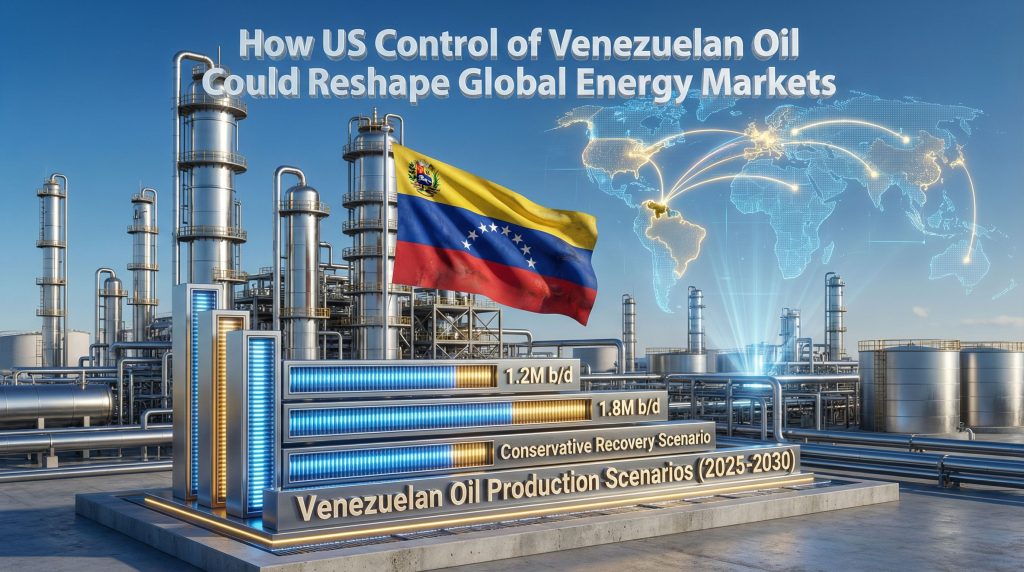
Venezuelan Oil Production Scenarios (2025-2030)
| Scenario | 2025 Output | 2027 Target | 2030 Potential | Price Impact |
|---|---|---|---|---|
| Conservative Recovery | 1.2M b/d | 1.8M b/d | 2.2M b/d | -$3-5/barrel |
| Accelerated Investment | 1.5M b/d | 2.5M b/d | 3.2M b/d | -$8-12/barrel |
| Full Infrastructure Rebuild | 1.8M b/d | 3.0M b/d | 3.8M b/d | -$15-20/barrel |
OPEC+ member response strategies would likely involve production quota adjustments to offset Venezuelan supply additions and maintain targeted price ranges. Saudi Arabia's spare capacity management and coordinated reduction mechanisms provide established frameworks for market intervention when supply abundance threatens price stability objectives.
Heavy Crude vs Light Sweet Crude Market Differentiation
Venezuelan extra-heavy crude trades at typical discounts of $2-4 per barrel relative to light sweet crude benchmarks, reflecting processing complexity and transportation requirements. This price differential creates specific opportunities for refineries configured for heavy crude processing while limiting broader market substitution effects.
US Gulf Coast refining capacity includes approximately 2.8-3.2 million barrels per day specifically configured for heavy/extra-heavy crude processing, representing optimal infrastructure for Venezuelan crude integration. Historical Gulf Coast refineries processed 40-60% of their heavy crude input from Venezuelan sources during 1995-2010, demonstrating established supply chain relationships.
Inventory buffer dynamics influence price volatility through Strategic Petroleum Reserve interactions. Current US SPR capacity totals 727 million barrels nominal, with reduced import requirements potentially allowing refilling operations that further suppress price levels through increased stockpile accumulation.
Which Global Refiners Stand to Benefit Most from Venezuelan Heavy Crude Access?
Refinery economics favour operators with existing heavy crude processing infrastructure over those requiring capital investment for configuration upgrades. Specialised processing units including hydrocracking, residue fluid catalytic cracking, and hydrotreating capacity represent 30-40% of total refinery capital investment, creating significant barriers to entry for Venezuelan crude processing.
US Gulf Coast Refinery Competitive Advantages
US Gulf Coast refining capacity totals approximately 5.0-5.2 million barrels per day, with substantial heavy crude processing specialisation providing immediate operational advantages for Venezuelan crude integration. Proximity economics create additional competitive benefits, as transportation costs from Venezuelan production facilities to US Gulf Coast refineries (approximately 1,000-1,500 nautical miles) compare favourably against East Asian routes (approximately 9,000-12,000 nautical miles).
Transportation cost differentials approximate $0.50-1.50 per barrel, creating sustained economic advantages for US refiners accessing Venezuelan feedstock. Current Gulf Coast refinery utilisation rates operate at 85-92% capacity, indicating available throughput capacity for additional Venezuelan crude processing without requiring new capital investment.
A representative Gulf Coast refinery processing 100,000 barrels per day of Venezuelan extra-heavy crude at typical $3 per barrel discounts versus light sweet crude would generate approximately $300,000 additional daily margin. This represents $110 million annually at sustained operational levels.
Gross processing margin improvements result from heavy crude feedstock discounts combined with refined product pricing at market rates. Refineries with appropriate configuration can capture these margin differentials while competitors lacking heavy crude infrastructure cannot access similar feedstock cost advantages.
Asian Refiner Market Share Redistribution
Chinese refining capacity totals 19.5 million barrels per day as of 2024, with approximately 6.5-7.0 million barrels per day configured for heavy/extra-heavy processing. Historical Chinese processing of Venezuelan crude peaked at 300,000-400,000 barrels per day during 2007-2015, representing 2-3% of Chinese crude imports during peak cooperation periods.
Market access restrictions under potential US control of Venezuelan petroleum resources would necessitate Asian refiner supply chain reconfiguration toward alternative heavy crude sources including Canadian oil sands, Mexican Maya crude, and Middle Eastern heavy grades. These alternatives typically command different pricing structures and transportation logistics, potentially increasing procurement costs for Asian operators.
Refinery configuration adjustments for enhanced heavy crude processing require substantial capital investment in hydrocracking units, RFCC systems, and supporting infrastructure. Asian refiners seeking to compensate for reduced Venezuelan crude access through alternative heavy crude processing would face $500 million to $2 billion per facility upgrade costs.
Canadian and Mexican Heavy Crude Competition Dynamics
Venezuelan crude restoration creates competitive pressure for other heavy crude producers, particularly Canadian oil sands operations and Mexican heavy crude exports. Canadian oil sands production costs typically range $40-60 per barrel while Venezuelan production costs historically approximated $10-20 per barrel before infrastructure degradation.
Mexican Maya crude serves similar refinery configurations as Venezuelan heavy grades, creating direct substitution competition. Mexico's crude production approximates 1.8-2.0 million barrels per day with significant heavy crude components, positioning Mexican exports in potential price competition with restored Venezuelan supply.
Caribbean refining operations including Curacao's Isla refinery (335,000 barrels per day capacity) and Trinidad's facilities (approximately 180,000 barrels per day capacity) historically processed Venezuelan crude through proximity advantages. Restoration of Venezuelan supply would permit capacity utilisation recovery for these regional facilities after years of reduced throughput.
How Will This Development Affect China's Energy Import Strategy?
China's energy security framework relies on diversified import sources to minimise supply disruption risks and optimise procurement costs across multiple supplier relationships. Potential restrictions on Venezuelan crude access would necessitate strategic recalibration of import portfolios and supplier relationship management. Additionally, US-China trade war effects could further complicate energy procurement strategies.
Diversification Away from Venezuelan Crude Sources
Chinese crude oil imports total approximately 10-11 million barrels per day, with Venezuelan sources representing historically modest but strategically important components of overall supply security. Loss of Venezuelan access would require replacement through expanded relationships with Middle Eastern, African, and Russian suppliers.
Middle Eastern suppliers including Saudi Arabia, Iraq, Kuwait, and UAE possess spare capacity to accommodate increased Chinese demand, though at potentially different pricing structures reflecting transportation costs, crude quality differentials, and geopolitical relationship factors.
African crude sources including Angola, Nigeria, and emerging Guyana production provide alternative heavy crude options for Chinese refineries configured for Venezuelan-grade processing. However, these sources involve longer transportation distances and different crude specifications requiring potential refinery optimisation adjustments.
Alternative Supply Chain Development in Africa and Middle East
Chinese energy companies have established significant upstream investment positions across African petroleum provinces, including Angola, Nigeria, Chad, and Sudan. These existing relationships provide foundation for expanded crude procurement to offset potential Venezuelan supply restrictions.
Russian crude exports to China have increased substantially following Western sanctions implementation, with pipeline and seaborne deliveries totaling approximately 1.8-2.0 million barrels per day. Enhanced Russian supply relationships could partially compensate for Venezuelan crude access limitations, though transportation infrastructure and pricing mechanisms differ significantly.
Middle Eastern supplier relationships offer the greatest volumetric replacement potential, with Saudi Arabia alone possessing 2-3 million barrels per day spare production capacity available for market allocation. Chinese procurement strategy would likely emphasise long-term supply agreements to secure reliable access at predictable pricing structures.
Strategic Petroleum Reserve Implications for Beijing
China's Strategic Petroleum Reserve programme targets approximately 90-100 days of import coverage, requiring continuous inventory management and supplier relationship optimisation. Reduced Venezuelan crude access would necessitate SPR sourcing adjustments and potentially accelerated reserve accumulation from alternative suppliers.
SPR fill strategies typically emphasise cost optimisation and supply security through diversified sourcing across multiple suppliers and crude specifications. Venezuelan crude restrictions would require replacement with alternative heavy crude grades or refinery configuration adjustments to accommodate lighter crude specifications.
Inventory turnover management becomes more complex with reduced supplier diversity, as Chinese SPR operations must balance cost optimisation, quality specifications, and strategic security objectives across a narrower supplier base.
What Are the Investment Implications for International Oil Companies?
Major international oil companies face strategic positioning decisions regarding Venezuelan petroleum asset participation, infrastructure investment priorities, and competitive positioning relative to US-aligned operational frameworks. The US removal of Maduro oil market impact creates substantial opportunities for energy sector investment realignment.
Chevron, ENI, and Repsol Expansion Opportunities
Chevron Corporation maintains established Venezuelan operational experience and existing infrastructure relationships that position the company favourably for expanded operations under US control scenarios. Historical Chevron investment in Venezuelan heavy crude projects provides technical expertise and operational knowledge for accelerated development programmes.
ENI and Repsol face more complex positioning decisions as European companies potentially operating within US-controlled frameworks. Previous investment relationships and technical capabilities in heavy crude development provide operational advantages, though geopolitical alignment factors may influence access and partnership structures.
Capital allocation decisions for Venezuelan projects would compete with alternative international investment opportunities, requiring return profile analysis across different jurisdictional and operational risk frameworks. Venezuelan projects offer substantial reserve access but involve infrastructure reconstruction requirements and political risk considerations.
US Shale Producer Response to Increased Global Supply
US shale oil production totals approximately 12-13 million barrels per day, representing significant global market share that could face competitive pressure from increased Venezuelan supply. Shale production costs typically range $35-55 per barrel depending on basin characteristics and operational efficiency levels.
Venezuelan production restoration creating $5-15 per barrel downward price pressure would potentially impact shale producer economics, particularly for higher-cost operations and marginal acreage positions. However, Venezuelan heavy crude serves different refinery configurations than light tight oil from shale operations, limiting direct substitution competition.
Shale producer hedging strategies and operational flexibility provide adaptation mechanisms for changing price environments. Short-cycle development timelines permit rapid production adjustments in response to market conditions, offering competitive advantages over long-lead-time conventional projects. Recent political and economic developments suggest significant investment opportunities for major oil companies in Venezuelan operations.
Capital Allocation Shifts in Latin American Energy Sector
Regional energy investment patterns would likely shift toward Venezuelan infrastructure development and away from competing Latin American petroleum projects. Brazilian pre-salt development, Argentinian shale programmes, and Guyanese offshore development face potential capital reallocation pressures as Venezuelan opportunities capture investor attention.
Infrastructure investment requirements for Venezuelan production restoration total an estimated $15-25 billion based on historical precedents from comparable post-conflict petroleum sector reconstruction programmes. This capital requirement represents substantial allocation that could otherwise support alternative regional development projects.
Service company positioning becomes crucial as drilling, completion, and infrastructure service providers evaluate Venezuelan market entry strategies versus continued focus on established operations in Brazil, Argentina, and other regional markets.
Could This Move Strengthen the Petrodollar System?
Dollar-denominated oil trading arrangements face increasing pressure from alternative currency frameworks and bilateral trade agreements bypassing traditional USD mechanisms. US control over Venezuelan petroleum resources provides strategic leverage for reinforcing dollar-based energy commerce during a period of monetary system evolution.
Dollar-Denominated Oil Trade Reinforcement Mechanisms
Venezuelan crude sales conducted through US-controlled frameworks would likely operate within established dollar-denominated trading systems, supporting Federal Reserve monetary policy transmission mechanisms and international dollar demand. Annual Venezuelan crude export values could total $30-60 billion at restored production levels, representing meaningful dollar transaction volume.
Banking infrastructure for Venezuelan crude transactions would likely operate through US financial institutions and established correspondent banking relationships. This reinforces dollar-based settlement systems and reduces alternative currency experimentation incentives for global crude purchasers.
International crude buyers accessing Venezuelan supply through US-controlled channels would operate within established dollar liquidity frameworks. This supports broader petrodollar system stability and reduces pressure for alternative currency arrangements.
Challenge to Alternative Currency Oil Trading Arrangements
Chinese yuan-denominated oil trading initiatives face reduced growth potential as Venezuelan crude access restrictions limit available supply for alternative currency experimentation. Russian and Iranian crude remain primary targets for yuan-based transactions, though these sources involve greater geopolitical complexity and transaction risk.
European energy companies seeking Venezuelan crude access would likely operate within established dollar-based frameworks rather than experimenting with euro-denominated alternatives. This reduces pressure for European currency energy trading development.
Bilateral trading arrangements between Venezuela and non-US aligned countries would face structural limitations under US operational control. This reduces opportunities for local currency settlement mechanisms and barter arrangements that bypass dollar systems.
Federal Reserve Policy Implications for Energy Markets
Enhanced US control over global energy supply through Venezuelan resources provides Federal Reserve policy makers with additional economic leverage during monetary policy implementation. Energy market dynamics influence inflation expectations and monetary transmission mechanisms across domestic and international markets.
Dollar strength benefits from increased energy trade settlement in USD, supporting Federal Reserve balance sheet management and international monetary policy coordination objectives. Reduced alternative currency energy trading limits pressure on dollar reserve status and international monetary system stability.
Interest rate policy transmission improves with enhanced dollar-based energy trading volume, as international dollar demand supports exchange rate stability. This reduces external monetary policy constraints during domestic economic management.
The next major ASX story will hit our subscribers first
What Are the Potential Risks to This Energy Market Transformation?
Energy market transformation initiatives involve substantial operational, political, and financial risks that could disrupt anticipated supply restoration timelines and economic benefits. Comprehensive risk assessment requires evaluation across multiple dimensions of potential disruption sources. Furthermore, oil price trade war impact scenarios could complicate market stability projections.
Political Instability and Production Disruption Scenarios
Venezuelan domestic political dynamics remain volatile despite leadership changes, with potential for civil unrest, labour disruptions, and infrastructure sabotage affecting petroleum operations. Historical precedents from Iraq, Libya, and other post-conflict petroleum sectors demonstrate vulnerability to ongoing security challenges.
Regional geopolitical responses from neighbouring countries and international actors could create operational complexity for Venezuelan petroleum development. Brazilian, Colombian, and Caribbean nation relationships with US-controlled Venezuelan operations require careful diplomatic management to maintain regional stability.
International legal challenges regarding sovereignty, asset ownership, and commercial contract enforcement create potential disruption sources that could delay or complicate petroleum sector restoration efforts. Existing Chinese, Russian, and European commercial relationships require resolution through legal or diplomatic mechanisms.
Infrastructure Investment Requirements and Timeline Challenges
Petroleum infrastructure reconstruction involves complex logistical challenges including equipment procurement, skilled labour availability, and coordinated development across upstream, midstream, and downstream operations. Venezuelan infrastructure degradation affects production, refining, transportation, and export capabilities requiring simultaneous rehabilitation.
Technology transfer restrictions and international sanctions create potential complications for equipment procurement and technical service provision. Specialised petroleum equipment often involves international suppliers and service companies requiring clear regulatory frameworks for Venezuelan operations.
Environmental remediation requirements add substantial cost and timeline complexity to infrastructure restoration programmes. Years of deferred maintenance and operational constraints have created environmental liabilities requiring comprehensive assessment and remediation before normal operations resume.
Environmental and Regulatory Compliance Considerations
US environmental standards application to Venezuelan petroleum operations would require substantial compliance investment and operational modifications. Historical Venezuelan environmental practices may not meet US regulatory requirements, necessitating comprehensive remediation and operational upgrade programmes.
International environmental monitoring and compliance frameworks create additional oversight requirements that could affect operational timelines and cost structures. Climate change policy considerations influence long-term investment decisions and operational sustainability planning.
Water resource management presents particular challenges in Venezuelan petroleum regions, where years of operational disruption have affected water treatment, contamination remediation, and sustainable water supply management for ongoing operations.
How Do Market Participants Position for Long-Term Venezuelan Supply Integration?
Strategic positioning for Venezuelan supply integration requires comprehensive evaluation of operational capabilities, market access frameworks, and competitive positioning across multiple time horizons and scenario outcomes. Market participants must consider various approaches to capitalise on potential opportunities whilst managing associated risks.
Futures Market Positioning and Hedging Strategies
Professional commodity traders and energy companies utilise futures markets to manage price exposure and operational risk related to Venezuelan supply restoration. Forward curve positioning reflects market expectations for supply timing, volume ramp-up rates, and price impact scenarios.
Options strategies provide asymmetric risk management for uncertain Venezuelan supply restoration timelines. Purchasing downside price protection through put options while selling upside calls creates collar structures that limit price exposure range whilst reducing hedge costs.
Calendar spread trading between near-term and deferred crude contracts offers positioning opportunities related to Venezuelan supply timing uncertainty. Backwardation to contango transitions typically accompany major supply additions, creating spread trading opportunities for sophisticated market participants.
Refinery Configuration Adjustments for Heavy Crude Processing
Refinery investment decisions require evaluation of Venezuelan heavy crude processing capabilities versus alternative feedstock options and capital allocation priorities. Hydrocracking unit additions, RFCC capacity expansions, and hydrotreating capability enhancement represent major capital commitments requiring long-term supply security assurance.
Operational flexibility through dual-feed capabilities allows refineries to process Venezuelan heavy crude when available whilst maintaining alternative feedstock options during supply disruptions or price optimisation opportunities. This flexibility requires additional capital investment but provides operational security and optimisation capabilities.
Refinery maintenance scheduling and turnaround planning incorporate Venezuelan crude availability expectations and processing requirement adjustments. Heavy crude processing creates different equipment wear patterns and maintenance requirements compared to light crude operations.
Transportation and Storage Infrastructure Development Needs
Pipeline infrastructure connecting Venezuelan production facilities to export terminals and refineries requires substantial rehabilitation and potential expansion to accommodate restored production levels. Existing pipeline capacity designed for historical production levels may require upgrade or parallel development.
Marine terminal modifications support increased Venezuelan crude export capacity through enhanced loading capabilities, storage capacity expansion, and navigation infrastructure improvements. Deep-water terminal access supports efficient tanker loading for international crude distribution.
Storage capacity development provides operational flexibility for production optimisation, market timing management, and supply security enhancement. Strategic storage locations near major refining centres reduce transportation costs and provide inventory management capabilities.
What Does This Mean for Global Energy Market Competition?
Global energy market competitive dynamics face significant restructuring as Venezuelan supply restoration alters established supply-demand relationships, price formation mechanisms, and strategic positioning across international energy markets. The US removal of Maduro oil market impact extends across multiple competitive dimensions.
OPEC+ Production Quota Recalibration Pressures
OPEC+ coordination mechanisms assume Venezuelan production constraints within current quota allocation frameworks. Production restoration to 2.0-3.0 million barrels per day levels would require fundamental quota structure adjustment to maintain targeted price ranges and market balance objectives.
Saudi Arabian spare capacity management provides primary mechanism for market intervention during supply abundance periods. Current Saudi spare capacity approximates 2-3 million barrels per day, creating potential for coordinated production reductions to offset Venezuelan supply additions.
Russian participation in OPEC+ coordination faces additional complexity under current geopolitical circumstances, potentially limiting coordinated response capability when Venezuelan supply restoration creates market oversupply conditions.
Russian and Iranian Oil Market Share Implications
Russian crude export strategies face enhanced competition from Venezuelan supply restoration, particularly in Asian markets where both suppliers compete for Chinese and Indian refinery demand. Price competition between Russian Urals crude and Venezuelan heavy grades could compress margins for both suppliers.
Iranian crude exports currently operate under various sanction restrictions, limiting direct market competition with Venezuelan supply. However, potential Iranian supply restoration combined with Venezuelan production recovery could create substantial downward pressure on global crude prices.
Alternative supplier positioning becomes crucial as traditional market share arrangements face disruption from Venezuelan supply additions. West African producers including Angola and Nigeria compete for similar heavy crude market segments served by Venezuelan exports.
Renewable Energy Transition Timeline Considerations
Enhanced global petroleum supply availability through Venezuelan production restoration potentially affects renewable energy transition economics and policy timeline implementation. Lower crude prices reduce competitive pressure on renewable energy cost structures and deployment incentives.
Energy security considerations may shift toward petroleum supply abundance rather than diversification imperatives. This could potentially slow renewable energy adoption in some markets where energy independence drives policy decisions.
Carbon pricing and climate policy implementation face different economic conditions when petroleum prices decline due to increased supply availability. Lower energy costs affect industrial competitiveness calculations for carbon-intensive versus renewable energy alternatives.
Strategic Outlook: Reshaping Global Energy Architecture
Venezuelan petroleum sector restoration under US operational control represents a fundamental shift in global energy market architecture with implications extending across supply security, price formation, geopolitical relationships, and long-term energy system evolution. Recent global market developments highlight the strategic importance of these changes.
Multi-Year Supply Chain Reconfiguration Projections
Supply chain adaptation to Venezuelan crude availability requires 3-5 year adjustment periods for refinery configuration optimisation, transportation infrastructure development, and commercial relationship establishment. Initial supply integration operates through existing infrastructure with gradual capacity expansion over time.
International crude trading patterns face permanent restructuring as Venezuelan supply displaces alternative sources and creates new supply-demand equilibrium points. Asian importers particularly require strategic adjustment as traditional supplier relationships face potential disruption.
Technology transfer and operational efficiency improvements accelerate Venezuelan production restoration beyond historical levels through modern extraction techniques, enhanced recovery methods, and digital optimisation technologies unavailable during previous operational periods.
Geopolitical Alliance Shifts in Energy Trading Relationships
Energy diplomacy realignment reflects changing supplier-consumer relationships as Venezuelan crude access requires alignment with US strategic objectives. Traditional non-aligned energy trading relationships face pressure toward US-allied frameworks for supply security.
Regional energy integration accelerates as Caribbean and Latin American countries adjust to Venezuelan supply availability and US operational control. Regional refining cooperation and infrastructure coordination create new economic integration opportunities.
International energy organisation dynamics evolve as OPEC, IEA, and other multilateral frameworks adapt to changed supply patterns and geopolitical alignments affecting global energy governance structures.
Technology Transfer and Operational Efficiency Improvements
Modern petroleum extraction and processing technologies provide potential for Venezuelan production to exceed historical levels through enhanced oil recovery, horizontal drilling, and advanced reservoir management techniques. These technologies were unavailable during previous Venezuelan production peaks.
Digital optimisation and artificial intelligence applications support operational efficiency improvements across production, refining, and distribution operations. Smart field technologies and predictive maintenance systems enhance reliability and reduce operational costs compared to historical operations.
Environmental technology integration addresses historical environmental liabilities whilst meeting modern regulatory standards. Advanced water treatment, emissions control, and waste management systems support sustainable operations and regulatory compliance.
"The transformation of Venezuelan petroleum operations under US control creates unprecedented opportunities for global energy market reconfiguration whilst introducing substantial risks and uncertainties requiring careful strategic planning and risk management across all market participants."
The transformation of Venezuelan petroleum operations under US control creates unprecedented opportunities for global energy market reconfiguration whilst introducing substantial risks and uncertainties requiring careful strategic planning and risk management across all market participants. Success depends on coordinated investment, political stability, and effective international cooperation across multiple stakeholder groups and geographic regions.
Ready to Capitalise on Global Energy Market Shifts?
Discovery Alert's proprietary Discovery IQ model delivers real-time alerts on significant ASX energy and mineral discoveries, helping investors identify actionable opportunities ahead of major market movements. With global energy dynamics rapidly shifting, securing early insights into ASX discoveries could position you advantageously in this evolving landscape. Begin your 30-day free trial today to stay ahead of market-changing developments.