
August 21, 2026
The Anatomy of a Copper Market Under Pressure
Every few decades, a commodity market encounters a structural inflection point where trade policy, national security doctrine, and physical supply dynamics collide simultaneously. Copper is living through one of those moments right now. The debate surrounding US copper tariffs on refined imports is not simply a customs question — it is a test of whether industrial policy can reshape a globally integrated supply chain that has operated on largely free-market principles for generations.
Understanding what is actually at stake requires separating the mechanics of the existing tariff framework from the proposed extension that has markets repositioning ahead of a critical mid-2026 deadline. Furthermore, the copper supply crunch trends emerging across global markets add another layer of complexity to an already pressured system.
When big ASX news breaks, our subscribers know first
What the Current Tariff Framework Actually Covers
A fundamental distinction is being overlooked in much of the public commentary on this topic. The 50% tariff already in force applies to semi-finished copper products and fabricated copper goods, not to refined copper in its primary forms. Cathodes, anodes, copper mattes, and concentrates currently remain outside the tariff perimeter.
This two-tier architecture reflects the legal instrument behind the policy: the Section 232 national security investigation framework, which allows the Commerce Department to recommend trade restrictions where imports are judged to threaten domestic industrial capacity essential to national defence. The question of whether refined copper meets that threshold is precisely what the Commerce Secretary is required to resolve and report to the President by June 30, 2026.
The phased structure under active consideration would introduce:
- A 15% tariff on refined copper imports beginning January 2027
- An escalation to 30% from January 2028
- A review mechanism tied to domestic smelting capacity development
The logic of the phased approach is to provide price signals that incentivise domestic investment while cushioning immediate downstream cost impacts. Whether that logic holds up against market realities is a separate question entirely.
Structural Constraint: The United States currently operates only two primary copper smelters, and there are no confirmed plans to build or expand domestic primary smelting capacity in the near term. This physical bottleneck fundamentally limits how quickly tariffs can translate into domestic supply growth, regardless of the price signals they generate.
The US Import Dependency Paradox
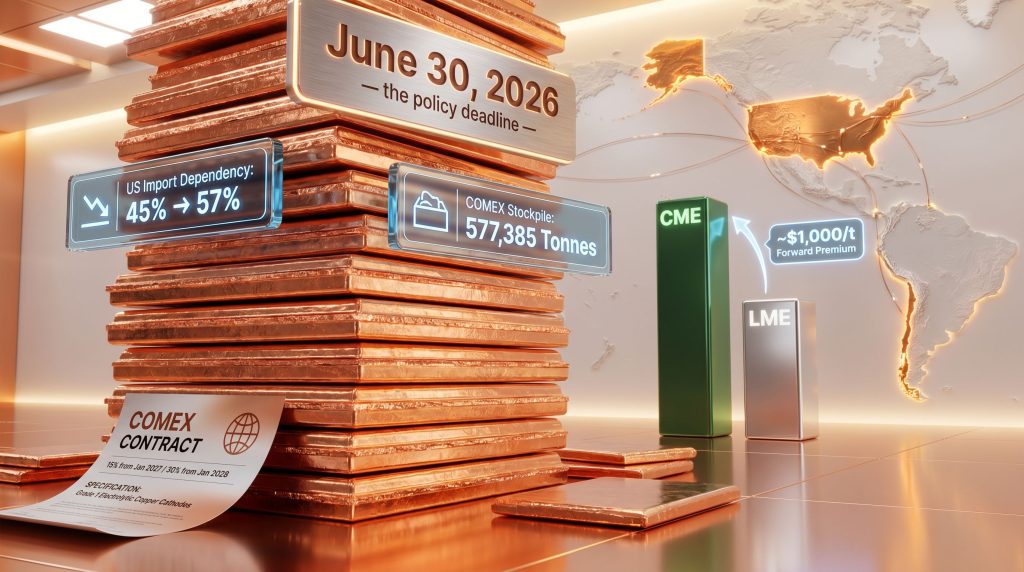
One of the more striking features of the current situation is the apparent contradiction between the scale of copper stockpiles the US has accumulated and its simultaneous deepening of import reliance. According to the United States Geological Survey, US import dependency for copper rose from 45% in 2024 to 57% in 2025 — a sharp deterioration in a single year driven partly by the very tariff-anticipation dynamics that are now repeating themselves.
This paradox deserves careful unpacking. The stockpile build is a precautionary response to tariff risk, not evidence of structural supply adequacy. Companies pulling metal forward to avoid potential duties are borrowing from future import flows, not reducing reliance on them. Indeed, the US tariff impact on copper supply has been profound, accelerating import front-loading behaviour across major trading partners.
Which Exporting Nations Face the Greatest Exposure?
| Exporting Region | Exposure Level | Key Risk Factor |
|---|---|---|
| Chile | High | World's largest refined copper exporter |
| China | High | Major cathode producer; geopolitical sensitivity |
| Canada | Moderate | USMCA status may offer partial protection |
| Europe | Moderate | Smaller volumes but premium product mix |
| DRC / Zambia | Emerging | Growing refined output; no preferential trade access |
A 15–30% tariff would fundamentally alter trade flows. Metal currently destined for the US would redirect toward European and Asian buyers, tightening ex-US availability and pushing LME prices higher in markets that currently benefit from relatively accessible supply. The knock-on effects for buyers in Japan, Germany, and South Korea — all significant refined copper consumers — could be substantial.
How the CME-LME Arbitrage Functions as a Policy Barometer
For those unfamiliar with the mechanics, the COMEX (CME) copper contract reflects US duty-paid pricing while the London Metal Exchange (LME) contract serves as the international benchmark. When tariff risk rises, the forward premium for COMEX delivery widens as traders price in the cost of potential duties before they are formally announced. This arbitrage spread is effectively a real-time market vote on the probability of tariff imposition.
Current conditions tell a clear story:
- The spot CME premium over LME stands at approximately 3% of the LME price — modest but directionally significant
- The March 2027 forward premium has approached $1,000 per metric ton, equivalent to roughly 7% of the LME price
- Given the proposed 15% phased tariff starting January 2027, the forward market is already pricing in a meaningful portion of the anticipated duty
The 2025 Arbitrage Collapse and Its Lessons
The current situation echoes events from mid-2025 with important differences. At that point, traders had positioned heavily for a 50% tariff on refined copper, consistent with duties already imposed on aluminium and steel. When the copper rally on tariff fears subsided following the July 2025 announcement that exempted refined metal entirely, the CME premium imploded.
The arbitrage briefly inverted, with the LME commanding a premium over COMEX in early 2026 — an unusual configuration that signalled widespread position liquidation and forced repricing. According to tariff-driven import data, tariff fears drove US refined copper imports to a record high in July of that cycle, underscoring just how powerfully policy expectations can distort physical flows.
That episode carries an important lesson for market participants: policy outcomes in this space have repeatedly confounded consensus positioning. The current re-widening of the CME premium suggests traders are rebuilding tariff hedges, but the July 2025 precedent means many are doing so with greater caution and more explicit scenario frameworks than in the prior cycle.
Market Psychology Insight: The 2025 arbitrage collapse created a generation of copper traders with acute awareness of binary policy risk. The current premium widening reflects not just tariff probability pricing but also the cost of being wrong in the opposite direction — a more sophisticated risk framework than existed twelve months ago.
The Strategic Stockpile: Scale, Significance, and the Questions It Raises
The physical copper accumulation underway in the United States has reached a scale that warrants its own analysis. Consider the following data points:
- US inbound copper shipments more than doubled year-on-year in Q1 2026, reaching 533,000 tonnes (World Bureau of Metal Statistics)
- COMEX warehouse stocks total approximately 577,385 tonnes, representing 44% of total global exchange inventory
- An additional 222,000 tonnes of LME-registered and off-warrant copper is held at US ports awaiting customs clearance
- Combined on- and off-exchange holdings suggest the US strategic copper stockpile has exceeded 1 million tonnes
Comparing US Copper Holdings to Global Benchmarks
| Entity | Estimated Copper Holdings | Notes |
|---|---|---|
| United States | ~1 million+ tonnes | Accumulated via tariff-driven import surge |
| China (State Reserves Bureau) | Larger than US | Managed through state stockpile authority |
| All other nations | Significantly smaller | No comparable strategic accumulation |
The cancellation of 33,275 tonnes at New Orleans in late May 2026 signals that metal is being actively prepared for customs clearance — meaning the stockpile build is ongoing, not plateauing. This matters for the Commerce Department's review because a supply stockpile of this magnitude arguably weakens the near-term national security justification for tariffs on refined metal, even as the import dependency statistics point in the opposite direction.
How US Accumulation Is Tightening Global Availability
The macroeconomic spillover effect of the US stockpile build deserves attention. Metal moving into the US is simultaneously being removed from globally accessible exchange inventory. This creates a self-reinforcing dynamic:
- Tariff risk drives US-bound arbitrage flows
- Global LME stocks outside the US decline
- Tighter ex-US availability lifts the LME price
- A higher LME price widens the CME premium further
- A wider CME premium generates more arbitrage incentive to ship to the US
European and Asian manufacturers are already experiencing tighter spot availability as a direct consequence of this feedback loop — even though the tariff causing the disruption has not yet been formally announced.
Downstream Industries Facing the Greatest Cost Exposure
If US copper tariffs on refined imports are imposed at the proposed rates, the cost transmission to downstream US industries will be both direct and significant. The sectors most exposed include:
- Electrical grid infrastructure: Transmission and distribution systems are copper-intensive, and grid modernisation programmes are already straining against tight supply
- Electric vehicle manufacturing: A single EV contains roughly 2.5 to 4 times more copper than a conventional internal combustion vehicle, making EV producers particularly sensitive to refined copper price increases
- Residential and commercial construction: Plumbing, HVAC, and electrical wiring represent major copper demand centres that cannot easily substitute alternative materials
- Defence and aerospace electronics: Military communication and navigation systems rely on high-purity copper products — the sector most directly relevant to Section 232 framing
Modelling the Cost Impact Across Tariff Scenarios
| Tariff Scenario | Additional Cost per Tonne | Annual Cost Increase (est. 500,000t import base) |
|---|---|---|
| No tariff (baseline) | $0 | $0 |
| 15% from January 2027 | ~$1,400–$1,600/t | ~$700M–$800M |
| 30% from January 2028 | ~$2,800–$3,200/t | ~$1.4B–$1.6B |
Strategic Warning: Manufacturers relying on imported refined copper face a narrow window to lock in forward supply contracts or restructure procurement before a formal tariff announcement triggers another disruptive price dislocation. The 2025 episode demonstrated how quickly conditions can shift once a policy decision lands.
The next major ASX story will hit our subscribers first
The Policy Decision Matrix: Arguments on Both Sides
The Case for Imposing Tariffs
- Import dependency accelerating from 45% to 57% in a single year strengthens the Section 232 national security argument on paper
- Political consistency with existing aluminium and steel tariff architecture creates internal policy logic for extending the framework to copper
- A price signal is arguably necessary to justify the decade-long capital investment required to build new primary smelting capacity
The Case Against Imposing Tariffs
- A strategic stockpile exceeding 1 million tonnes means near-term supply security is not at genuine risk
- With only two domestic primary smelters and no confirmed expansion plans, tariffs cannot create new capacity within any commercially relevant timeframe
- Higher copper input costs flow directly to US manufacturers across EVs, defence, and infrastructure, undermining the competitiveness of the very industries the policy claims to protect
- Retaliatory measures from major trading partners, particularly Chile and Canada, could complicate broader bilateral trade frameworks
The structural absence of new domestic smelting investment is perhaps the most important and underappreciated dimension of this debate. Furthermore, analysts at CSIS examining copper tariff strategy have argued that primary copper smelting requires capital expenditure in the billions, environmental permitting timelines measured in years, and sustained price certainty that tariff-on, tariff-off policy cycles actively undermine. A tariff imposed in January 2027 is unlikely to result in a new operational smelter before the mid-2030s at the earliest.
In addition, the broader copper tariff trade impacts extend well beyond the US domestic market, reshaping investment decisions and trade flows across multiple continents simultaneously. Consequently, the trade war and copper prices dynamic remains a persistent undercurrent influencing how governments and corporations alike are approaching long-term supply agreements.
Frequently Asked Questions: US Copper Tariffs on Refined Imports
Is refined copper currently subject to US tariffs?
No. As of mid-2026, refined copper in primary forms, including cathodes, anodes, and concentrates, remains excluded from the existing 50% tariff framework, which applies only to semi-finished and fabricated copper products.
What is the timeline for the refined copper tariff decision?
The Commerce Department must complete its Section 232 review and report to the President by June 30, 2026. Any tariff, if imposed, would operate as a phased measure starting at 15% in January 2027 and rising to 30% in January 2028.
Why is the CME copper price trading above the LME price?
The COMEX premium reflects market expectations that tariffs may be imposed on refined copper imports. Traders are paying a forward premium for US-delivered copper to hedge against the risk of duties being announced before existing supply arrangements can be renegotiated.
How much copper has the US accumulated?
Including both exchange-registered inventory and off-warrant holdings at US ports, the US strategic copper stockpile is estimated to have surpassed 1 million tonnes, making it the largest national reserve outside China's state-managed holdings.
What happened in July 2025 when the last copper tariff decision was made?
The administration imposed a 50% tariff on fabricated copper products but explicitly exempted refined metal — a decision that caught markets off guard. Traders who had positioned for duties on refined copper were forced to unwind, causing the CME premium to collapse and the arbitrage to briefly invert.
Which industries face the highest cost exposure from refined copper tariffs?
Electrical grid infrastructure, electric vehicle manufacturing, residential and commercial construction, and defence electronics are the highest-impact sectors, all of which depend heavily on refined copper as a primary production input.
Key Takeaways for Market Participants
The June 30, 2026 deadline represents a genuine binary risk event for copper markets. The outcome will either validate the current CME forward premium or trigger another round of forced position unwinding comparable to the July 2025 episode.
Several dynamics are worth holding simultaneously:
- The US has accumulated an unprecedented copper stockpile while simultaneously deepening import dependency — a paradox that creates genuine uncertainty about which metric will dominate the Commerce Department's recommendation
- Physical traders, downstream manufacturers, and financial market participants are all repositioning ahead of the deadline, creating self-reinforcing price dynamics that affect LME markets globally
- The structural deficit in domestic smelting capacity means tariffs, if imposed, will raise production costs for US manufacturers without meaningfully reducing import reliance within any commercially relevant timeframe
- Policy unpredictability remains the defining feature of this market cycle — participants who experienced the July 2025 reversal are now approaching the June 2026 deadline with explicit scenario planning rather than a single base case
This article is intended for informational purposes only and does not constitute financial or investment advice. Commodity markets involve significant risk, and forward-looking projections are inherently uncertain. Readers should conduct independent research and consult qualified advisers before making investment or procurement decisions based on tariff scenarios.
Want To Stay Ahead of the Next Major ASX Copper Discovery?
Discovery Alert's proprietary Discovery IQ model scans ASX announcements in real time, instantly identifying significant copper and mineral discoveries before the broader market reacts — explore historic discovery returns to understand the magnitude of opportunity, or start your 14-day free trial today to position yourself ahead of the next major find.