June 17, 2026
Global supply chains face unprecedented vulnerability as strategic mineral dependencies threaten economic stability across multiple sectors. The concentration of critical mineral production in single geographic regions creates systemic risks that extend far beyond traditional commodity markets, affecting everything from defence capabilities to technological innovation. The U.S. critical minerals reserve against China represents a fundamental shift in how nations approach resource security, moving beyond traditional market mechanisms to establish strategic independence through comprehensive stockpiling and alternative supply development.
Strategic Mineral Dependencies Create National Security Imperatives
The concept of critical minerals encompasses far more than simple commodity scarcity. These materials form the backbone of modern technological infrastructure, from semiconductor manufacturing to advanced defence systems. The U.S. Geological Survey identifies 50 mineral commodities as critical to national security and economic stability, with the United States maintaining 100% import dependency for 17 of these essential materials.
Defence applications demonstrate the strategic nature of these dependencies most clearly. Modern fighter aircraft require 400-600 kilograms of rare earth elements per unit for electromagnetic systems, optical targeting, and communication equipment. A single DDG-51 class guided-missile destroyer incorporates approximately 1-2 metric tons of rare earth oxides in its phased-array radar systems alone.
The vulnerability extends beyond direct military applications into the broader industrial base supporting defence capabilities. Semiconductor manufacturing for military systems relies on germanium for high-frequency integrated circuits used in radar and satellite communications. Furthermore, gallium becomes essential for gallium arsenide semiconductor production in military communications and missile guidance systems.
These dual-use applications create complex interdependencies where civilian supply disruptions can compromise defence readiness. Economic impact assessments reveal the scale of potential disruption, with rare earth supply chain constraints potentially costing the U.S. economy between $2.5-$4.3 billion annually according to 2023 analysis.
This economic vulnerability stems from the technical complexity and capital intensity required to establish alternative processing capabilities. The USGS classification framework evaluates minerals based on three critical criteria: importance to the U.S. economy, supply vulnerability, and recycling availability. However, current recycling recovery rates for rare earth elements remain below 1% of global supply, demonstrating limited near-term viability of circular economy solutions.
When big ASX news breaks, our subscribers know first
China's Processing Dominance Creates Asymmetric Leverage
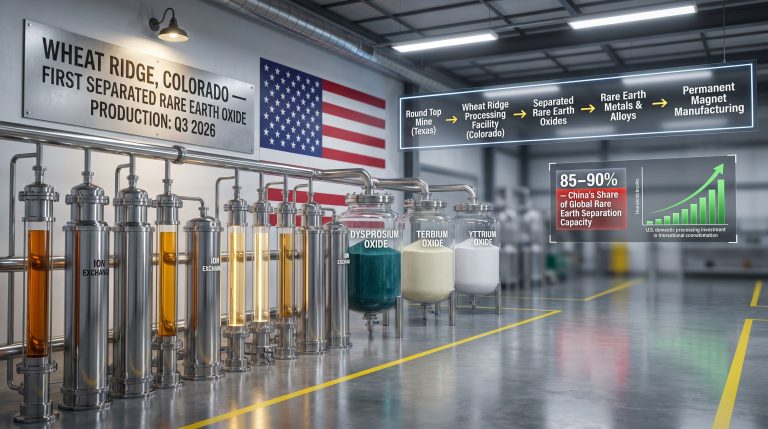
Beijing's control over critical mineral supply chains extends far beyond raw material extraction into the more strategically significant downstream processing capabilities. While China extracts approximately 70% of global rare earth elements, producing roughly 380,000 metric tons of rare earth oxide equivalent in 2024, its processing dominance reaches 90% of global refining capacity. This processing monopoly represents the true strategic chokepoint in global supply chains.
The technological barriers to establishing alternative processing capabilities create long-term strategic dependencies. Rare earth separation requires hydrometallurgical or pyrometallurgical processes demanding $500 million to $2 billion investments for greenfield facilities. These operations generate radioactive byproducts from thorium and uranium-bearing ores, creating environmental compliance challenges that have historically favoured Chinese production locations.
Recent China export controls demonstrate how Beijing weaponizes this processing dominance for geopolitical leverage. The August 2023 implementation of export quotas on gallium and germanium created immediate market disruptions, with germanium prices surging from approximately $330 per kilogram in early 2023 to peak prices exceeding $1,100 per kilogram by late 2024.
These restrictions specifically targeted semiconductor-critical materials, impacting U.S. military thermal imaging system production timelines. The September 2024 announcement of new rare earth export restrictions, coupled with processing technology export controls, demonstrated China's willingness to escalate supply chain pressure. Consequently, antimony export restrictions contributed to antimony trioxide prices approximately doubling over 12 months.
| Mineral | China's Market Share | U.S. Import Dependency | Strategic Applications |
|---|---|---|---|
| Rare Earths | 70% mining, 90% processing | 80% | Fighter jets, radar systems |
| Germanium | 60% production | 50% | Semiconductor manufacturing |
| Antimony | 48% production | 85% | Military ammunition, electronics |
Industry analysts noted that procurement volumes for bismuth and indium represent quantities sufficiently significant to potentially constrain supplies outside Chinese production networks. This assessment reflects the limited alternative supplier capacity available, with non-Chinese rare earth processing totaling approximately 30,000-40,000 metric tons annually versus global demand exceeding 380,000 metric tons.
The automotive sector experienced direct impact from Chinese export restrictions. Following September 2024 limitations, major manufacturers reported 6-12 month lead time extensions for permanent magnet motor supplies, demonstrating vulnerability in civilian industrial supply chains dependent on rare earth materials.
Pentagon Accelerates Strategic Reserve Accumulation
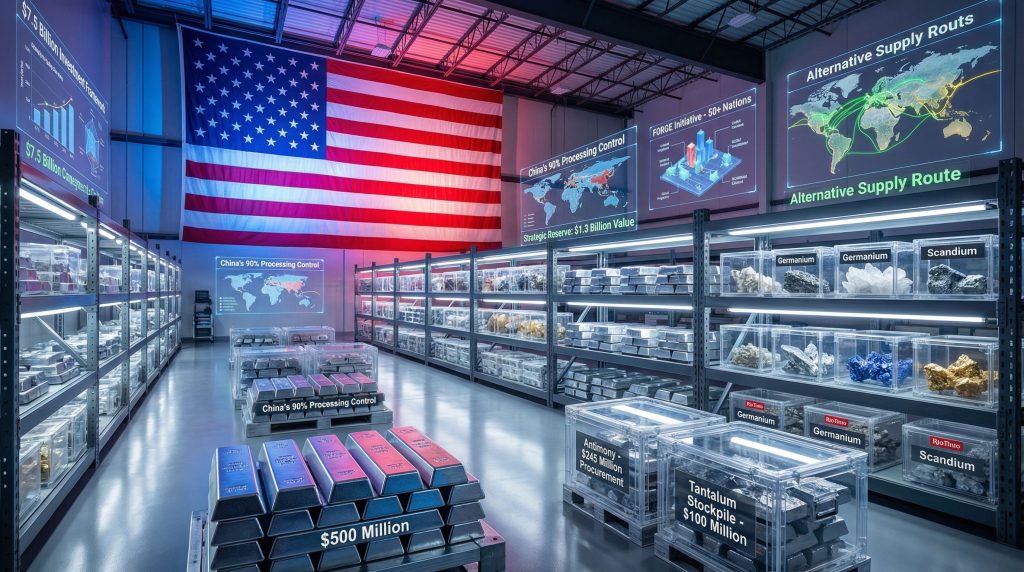
The U.S. critical minerals reserve against China strategy centres on a comprehensive $1 billion procurement programme representing the largest peacetime mineral stockpiling effort since the Cold War era. This initiative expands the Defence Logistics Agency's existing $1.3 billion stockpile by approximately 77%, signifying accelerated accumulation beyond normal operational requirements.
The strategic antimony loan exemplifies targeted procurement efforts focused on domestic supply chain development. Procurement allocations reveal strategic prioritisation across critical supply chains:
- Cobalt reserves: $500 million for battery applications in military vehicles and portable systems
- Antimony: $245 million from US Antimony Corporation, emphasising domestic sourcing
- Tantalum: $100 million from unidentified U.S. suppliers meeting military-grade specifications
- Scandium: $45 million through combined contracts with Rio Tinto and APL Engineered Materials
- Other strategic materials: ~$110 million including bismuth, indium, and specialty metals
Volume specifications demonstrate strategic intent beyond operational consumption. The DLA procurement target of 222 metric tons of indium ingots substantially exceeds U.S. annual consumption of approximately 250 metric tons of refined indium. Similarly, bismuth procurement volumes exceed typical annual consumption patterns, indicating multi-year strategic reserve intentions.
Market participants expressed surprise at procurement scales exceeding both annual U.S. production levels and typical import volumes in multiple mineral categories. The 3,000 metric tons of antimony under consideration represents approximately 12-15 months of consumption, sufficient for sustained military industrial mobilisation during national emergency scenarios.
Pricing strategies reflect strategic premiums over commodity market valuations. The U.S. aims to launch a $17 billion critical minerals stockpile as part of broader strategic independence efforts. Scandium contracts with Rio Tinto for approximately 6 metric tons of scandium oxide were structured at pricing levels exceeding market expectations.
The reserve expansion operates under strict release protocols limited to wartime or national defence emergencies, distinguishing these stockpiles from commercial or economic stabilisation reserves. Integration with existing strategic petroleum reserve infrastructure provides operational frameworks for rapid deployment during crisis scenarios.
Legislative Framework Supports Long-Term Strategic Independence
The One Big Beautiful Bill (OBBA) provides comprehensive legislative support for critical mineral independence through a $7.5 billion investment framework extending through 2027. This allocation divides into three strategic components: $2 billion for national reserve expansion, $5 billion for supply chain infrastructure development, and $500 million for Pentagon credit programmes incentivising private sector participation.
Government equity stakes in domestic mining operations represent a fundamental shift toward strategic industrial policy. These partnership models combine Defence Production Act invocation for project acceleration with risk-sharing mechanisms for critical mineral exploration. In addition, private sector engagement receives support through government-backed financing for domestic projects, addressing the capital intensity barriers that historically favoured overseas production.
The defence materials strategy influences allied cooperation frameworks. The Forum on Resource Geostrategic Engagement (FORGE) initiative develops alternative trading relationships with 50+ allied nations, creating price floor mechanisms to prevent Chinese market manipulation. Bilateral mineral security agreements establish preferential access arrangements while developing collective bargaining power against dominant suppliers.
Seabed mining exploration represents a longer-term strategic option for accessing Pacific Ocean deposits rich in nickel, cobalt, copper, and manganese. Environmental assessment protocols for deep-sea extraction must balance resource access needs against ecological preservation, while international waters jurisdiction frameworks require multilateral cooperation for mining rights allocation.
Innovation-based competitive advantages focus on waste-based mineral recovery technology and advanced recycling infrastructure for electronic components. These domestic processing capabilities reduce Chinese dependency while creating circular economy opportunities from existing mineral stocks embedded in end-of-life products.
What Role Do Allied Nations Play in Strategic Mineral Security?
Allied nations are working together to weaken China's grip on critical minerals through coordinated procurement and development programmes. The FORGE initiative demonstrates how multilateral cooperation can create alternative supply networks outside Chinese control.
Allied partnerships focus on three key areas: joint procurement for strategic reserves, technology sharing for processing capabilities, and coordinated investment in alternative supplier development. Furthermore, these partnerships create redundancy in supply chains while distributing strategic risks across multiple nations.
Market Sectors Face Differentiated Supply Chain Risks
Defence industry vulnerabilities concentrate in high-technology applications requiring specialised mineral inputs. Fighter aircraft production depends on rare earth permanent magnets for targeting systems and precision-guided munitions. Radar system manufacturing faces bottlenecks in semiconductor-grade germanium supplies, whilst communications equipment requires tantalum-based capacitors meeting military specifications.
Technology sector exposure spans consumer electronics and infrastructure applications. Smartphone component supply chains rely on rare earth elements for displays and speakers. Semiconductor manufacturing inputs include gallium for compound semiconductors and germanium for high-frequency applications. However, electric vehicle battery materials create new dependencies on cobalt and rare earth permanent magnets for motor applications.
Infrastructure and energy applications demonstrate growing criticality as renewable energy deployment accelerates. Wind turbine permanent magnet requirements use neodymium and dysprosium rare earth elements. Solar panel manufacturing depends on silver and germanium inputs. Moreover, grid-scale energy storage systems incorporate cobalt and rare earth materials in battery technologies.
The broader critical minerals strategy encompasses multiple industrial sectors facing supply chain vulnerabilities. Risk assessment frameworks now incorporate geopolitical factors beyond traditional supply-demand analysis. Strategic value weighting supplements pure economic optimisation in sourcing decisions.
Long-term supply security becomes an investment criterion equal to cost considerations, fundamentally altering procurement practices across strategic industries. For instance, defence contractors increasingly factor supply chain resilience into project planning and vendor selection processes.
Global Commodity Markets Respond to Strategic Stockpiling
Price volatility across critical mineral markets reflects both supply constraints and strategic demand from government stockpiling programmes. Germanium experienced a 145% price surge within three months following Chinese export restrictions, demonstrating market sensitivity to supply disruptions. Antimony trioxide near-doubling over 12 months illustrates sustained price pressure from both restricted exports and strategic demand.
Supply-demand rebalancing accelerates investment capital flows toward alternative producers outside Chinese control. African mineral resources become battlegrounds for access rights between Chinese and Western interests. Australia's role as alternative supplier gains strategic importance through processing capability development and bilateral agreements with consuming nations.
The U.S. critical minerals reserve against China strategy directly influences global commodity pricing dynamics. Strategic procurement creates price floors in key mineral markets, whilst signalling long-term demand commitments to alternative suppliers. Consequently, investment patterns shift toward non-Chinese production capabilities.
Canada's critical mineral strategy aligns with U.S. objectives through integrated North American supply chains. Technology transfer and innovation competition focus on developing processing capabilities outside Chinese control. Intellectual property protection for mineral extraction innovations becomes essential for maintaining technological advantages in alternative supply development.
These energy security minerals play crucial roles in renewable energy infrastructure development. Capital allocation shifts reflect changed risk assessment frameworks incorporating geopolitical stability alongside traditional economic factors. Private equity interest in non-Chinese mineral assets increases as strategic value premiums offset higher operational costs.
Infrastructure development in alternative producing regions receives government support through development finance institutions and export credit agencies. Risk assessment frameworks evolve to weight long-term supply security equal to short-term cost optimisation, fundamentally altering the economics of mineral development.
The next major ASX story will hit our subscribers first
Strategic Implications for Global Resource Security
The transformation of global mining investment flows demonstrates how strategic competition reshapes commodity markets beyond pure economic fundamentals. Government-backed financing for domestic projects creates competitive alternatives to market-based allocation mechanisms. Furthermore, the U.S. critical minerals reserve against China establishes precedents for resource nationalism across multiple industrial economies.
International trade relationships evolve as nations prioritise supply security over cost efficiency. Bilateral agreements increasingly incorporate mineral security provisions, whilst multilateral frameworks develop collective bargaining power against dominant suppliers. These arrangements fundamentally alter the landscape of international resource diplomacy.
"The strategic competition over critical minerals represents a fundamental shift in how nations approach resource security, moving beyond traditional market mechanisms to establish comprehensive independence through stockpiling and alternative supply development."
Technology innovation becomes central to achieving strategic mineral independence. Advanced recycling capabilities, alternative material development, and processing efficiency improvements offer pathways to reduced dependency on Chinese supply chains. Investment in research and development accelerates as governments recognise technology as the ultimate solution to resource vulnerabilities.
The success of strategic stockpiling efforts depends on sustained political commitment across multiple electoral cycles. Long-term infrastructure investments require bipartisan support and international coordination to achieve meaningful supply chain independence. However, early indicators suggest broad consensus on the strategic necessity of reducing critical mineral dependencies on potentially adversarial nations.
Ready to Capitalise on Critical Minerals Investment Opportunities?
Discovery Alert's proprietary Discovery IQ model delivers real-time alerts on significant ASX mineral discoveries, instantly empowering subscribers to identify actionable opportunities ahead of the broader market. Begin your 14-day free trial today and secure your market-leading advantage in this rapidly evolving strategic sector.