
June 30, 2026
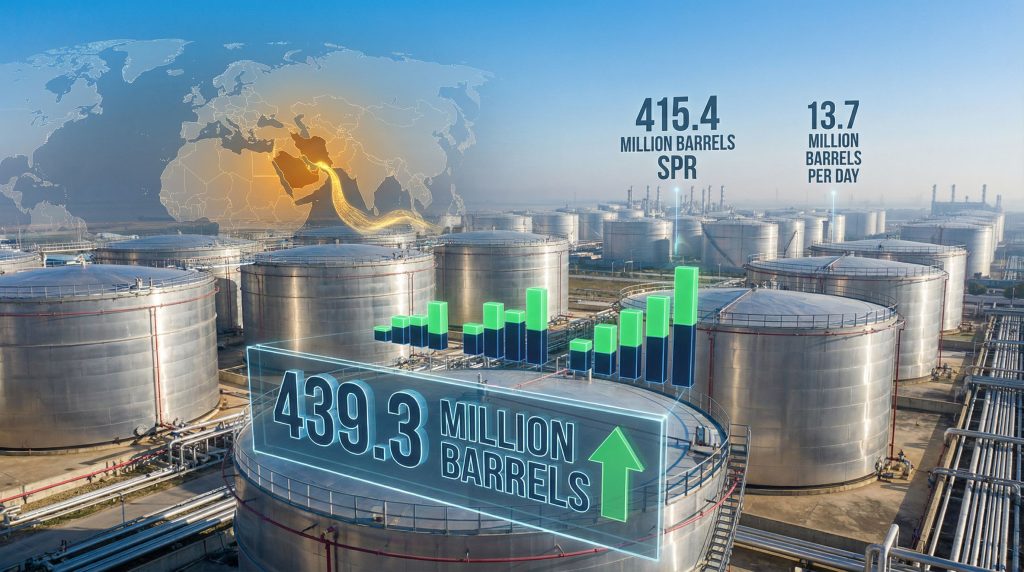
Global financial markets increasingly exhibit heightened sensitivity to supply chain disruptions, with petroleum stockpile management serving as a critical buffer against economic volatility. The intricate relationship between US crude oil inventories and Iran war scenarios demonstrates how geopolitical tensions reshape fundamental market dynamics across multiple asset classes and economic sectors.
Strategic Reserve Architecture in Crisis Management Framework
Modern energy security infrastructure relies on sophisticated reserve management systems designed to absorb supply shocks from international conflicts. The Strategic Petroleum Reserve currently maintains approximately 415.4 million barrels, representing roughly 58% of its total authorized capacity of 713.5 million barrels established under the Energy Policy and Conservation Act of 1975.
This reserve level provides substantial defensive positioning during regional disruptions, with release mechanisms capable of deploying up to 4.4 million barrels per day at maximum capacity. However, sustained operations typically target 1-2 million barrels daily to maintain system integrity and operational flexibility.
Strategic Reserve Deployment Capabilities:
- Maximum daily release: 4.4 million barrels
- Sustainable operation: 1-2 million barrels daily
- Coverage duration: Approximately 20 days of total consumption
- Historical precedent: 180 million barrel release in 2022
Furthermore, the complexity of emergency coordination requires unprecedented cooperation between commercial operators, government agencies, and international partners. Recent discussions regarding potential G7 coordinated releases of up to 400 million barrels would represent historically significant intervention levels, though such coordination faces logistical and political challenges.
When big ASX news breaks, our subscribers know first
Commercial Inventory Dynamics Under Geopolitical Stress
US crude oil inventories currently stand at 439.3 million barrels, positioning approximately 3% below five-year seasonal averages. This inventory positioning reflects sophisticated market mechanisms where domestic production increases of 13.7 million barrels daily help offset potential overseas supply disruptions.
Weekly inventory builds of 3.475 million barrels indicate active market management strategies, with operators maintaining specific reserve levels based on futures curve patterns and geopolitical risk assessments. In addition, the distribution across critical storage hubs reveals strategic positioning for various supply scenarios.
Current Inventory Distribution Analysis:
| Storage Location | Capacity (Million Barrels) | Strategic Importance |
|---|---|---|
| Cushing, Oklahoma | 76 | WTI pricing hub |
| Gulf Coast terminals | 180+ | Refinery access |
| East Coast facilities | 85 | Import distribution |
| West Coast storage | 65 | Pacific trade routes |
Gasoline inventory drawdowns of 1.7 million barrels alongside distillate builds of 0.429 million barrels reveal underlying consumption patterns amid economic uncertainty. These product-specific movements indicate robust domestic demand continues despite elevated price volatility.
However, the relationship between inventory levels and production sustainability requires understanding that shale production decline rates necessitate continuous investment. Unconventional wells decline 5-8% annually without new completions, and at current production levels near historical peaks, maintaining output requires sustained capital deployment across multiple basin formations.
Maritime Chokepoint Crisis and Supply Chain Resilience
The Strait of Hormuz crisis exemplifies how single geographic bottlenecks can reshape global energy economics within days. Daily vessel traffic plummeting from 138 ships to merely 2 represents a 98% reduction in throughput capacity through the world's most critical oil transit point.
Under normal conditions, approximately 21-22 million barrels per day of crude oil transit through Hormuz, representing roughly 21% of global petroleum trade. Consequently, the current disruption forces complex rerouting decisions that add 10-15 additional transit days and substantially higher insurance costs.
Alternative Routing Economics:
- Suez Canal route: Additional 3,000+ nautical miles
- Cape of Good Hope: Additional 6,000+ nautical miles
- Pipeline alternatives: Limited to 1.65 million barrels daily
- Insurance premium increases: 300-500% during crisis periods
Geographic constraints of the Strait, measuring only 33-56 miles wide with traffic lanes compressed to 2-3 miles in each direction, create natural vulnerability points. Current shipping insurance rates have reportedly increased dramatically as maritime operators assess war-risk exposure levels.
For instance, the cascading effects extend beyond crude oil transportation to refined product distribution, bunker fuel availability, and regional price arbitrage opportunities. When shipping costs increase by $2-4 per barrel due to rerouting requirements, temporary decoupling of regional crude pricing mechanisms occurs.
Price Discovery Mechanisms Under Market Stress
Energy futures markets demonstrate extreme sensitivity to geopolitical headlines, with algorithmic trading systems responding rapidly to diplomatic developments and conflict escalation. Current WTI crude pricing at $88.39 per barrel, showing a +$4.94 daily gain, reflects ongoing uncertainty despite diplomatic signals suggesting potential conflict resolution.
The unusual Brent-WTI spread inversion, where WTI trades approximately $0.59 above Brent crude at $87.80, indicates US-centric pricing dynamics potentially linked to expectations of Strategic Petroleum Reserve releases moderating domestic prices relative to global markets.
Recent presidential statements regarding potential conflict resolution triggered significant market volatility, demonstrating how diplomatic communications directly impact price discovery mechanisms. Market participants actively monitor shipping data, satellite imagery, and intelligence reports to assess risk premiums in real-time, particularly in relation to oil price rally dynamics.
Volatility Pattern Analysis:
- Risk premium component: $8-15 per barrel during active conflict
- Diplomatic response sensitivity: $30+ intraday swings possible
- Historical precedent: 1973 embargo caused 300% price increases
- Current market positioning: Elevated but manageable levels
Furthermore, energy traders utilise sophisticated algorithms incorporating multiple data streams to price geopolitical risk premiums accurately. The integration of shipping tracking data, diplomatic intelligence, and satellite monitoring creates complex pricing models that adjust continuously to changing conditions.
How Do Sanctions Policies Influence Market Dynamics?
Presidential statements regarding potential Russian oil sanction waivers indicate flexible policy approaches during supply crises. Such measures could theoretically add 2-3 million barrels daily to global markets, though implementation faces complex logistical and political considerations.
The strategic coordination of sanction relief policies with allied nations requires balancing immediate supply concerns against longer-term geopolitical objectives. Current sanctions affect Venezuela, Iran, and Russia, with Venezuela already under modified arrangements following recent political developments, similar to the OPEC production impact considerations.
Alternative supply activation from Canada, Norway, and enhanced US shale production could offset Middle Eastern disruptions within 60-90 days, though transportation infrastructure limitations may constrain rapid deployment capabilities.
Supply Replacement Timeline:
- Canadian oil sands: 30-45 days for increased throughput
- Norwegian offshore: 45-60 days for enhanced production
- US shale acceleration: 60-90 days for significant volumes
- Pipeline infrastructure: Potential 6-12 month constraints
In addition, the complexity of coordinating multiple supply sources while managing existing contractual obligations demonstrates the sophisticated nature of modern energy security planning. Emergency protocols established through international agreements provide frameworks for rapid response coordination.
Economic Impact Assessment and Recession Risk Modeling
Extended oil price elevation above $100 per barrel historically correlates with economic recession probabilities exceeding 40%, though current inventory buffers provide temporary insulation against such outcomes. Manufacturing sectors typically reduce energy consumption when crude prices exceed $95 per barrel for sustained periods.
Industrial demand destruction thresholds become critical factors in assessing overall economic impact scenarios. Current inventory management strategies suggest these thresholds remain manageable in the short term, though extended disruption could trigger broader economic adjustments related to trade war oil impact.
Supply chain resilience requires understanding lead times for activating dormant production capacity versus developing entirely new resources. Existing wells can typically return to production within 6-12 months, while new development projects require 24-36 months for meaningful contribution.
Economic Scenario Framework:
- Base case: $85-95 WTI with managed disruption
- Stress scenario: $100-120 WTI with extended conflict
- Crisis scenario: $120+ WTI with broader regional escalation
- Recovery timeline: 6-18 months depending on resolution speed
However, the interaction between energy price shocks and broader economic stability demonstrates why strategic reserve management extends beyond simple supply replacement to encompass comprehensive economic security considerations.
What Are the Key Investment Implications?
Energy sector investment strategies increasingly emphasise inventory management and supply chain resilience rather than pure production expansion. This strategic shift reflects lessons learned from previous geopolitical disruptions and changing market dynamics.
Infrastructure vulnerability assessments reveal that pipeline networks, refinery capacity, and storage facilities represent critical investment priorities as geopolitical risks reshape energy security requirements. The integration of domestic production capabilities with strategic reserve management creates foundation elements for reduced Middle Eastern energy dependence, potentially affecting Saudi exploration licenses and regional dynamics.
Nevertheless, complete decoupling remains economically challenging given global market integration and the fungible nature of crude oil as a commodity. Investment strategies must balance domestic security objectives with economic efficiency considerations in globally integrated markets, particularly when considering potential oil price crash analysis scenarios.
Strategic Investment Priorities:
- Storage capacity expansion: $2-4 billion potential investment
- Pipeline redundancy development: $8-12 billion estimated costs
- Refinery flexibility enhancement: $5-7 billion modernisation needs
- Emergency response infrastructure: $1-3 billion coordination systems
The next major ASX story will hit our subscribers first
Future Outlook and Strategic Considerations
The intersection of US crude oil inventories and Iran war dynamics reveals complex macroeconomic relationships where strategic planning, market mechanisms, and geopolitical realities converge to shape energy security outcomes. Understanding these interconnected systems becomes essential for navigating uncertain global energy markets while maintaining economic stability and strategic flexibility.
As experts warn, oil markets could face catastrophic consequences if regional conflicts escalate further. Consequently, policy coordination requirements extend beyond immediate crisis management to encompass long-term energy independence trajectory planning.
Current US positioning suggests adequate preparation for extended disruptions, though the evolving nature of global energy markets requires continuous strategic adaptation and investment in resilience infrastructure. The relationship between US crude oil inventories and Iran war scenarios will continue to influence market dynamics, requiring sophisticated risk management approaches across both public and private sectors.
Looking to Stay Ahead of Energy Market Volatility?
Discovery Alert's proprietary Discovery IQ model delivers real-time alerts on significant ASX mineral discoveries, helping subscribers identify actionable opportunities in energy and resource sectors during periods of geopolitical uncertainty. With global energy markets facing unprecedented volatility, securing immediate insights into emerging resource opportunities can provide crucial portfolio diversification—begin your 14-day free trial today to position yourself ahead of market movements.