August 14, 2026
The global energy landscape faces unprecedented challenges as technological innovation collides with market volatility. Across major oil-producing nations, the delicate balance between production capacity and economic viability continues to evolve. Advanced drilling techniques have transformed extraction capabilities, yet commodity price fluctuations create complex investment decisions for energy companies worldwide.
In this environment, understanding how production forecasts align with economic fundamentals becomes critical for stakeholders across the energy value chain. Furthermore, the interplay between technological efficiency and capital allocation strategies will determine whether major producing regions can maintain output levels while preserving profitability margins.
What Economic Forces Are Reshaping America's Energy Production Landscape?
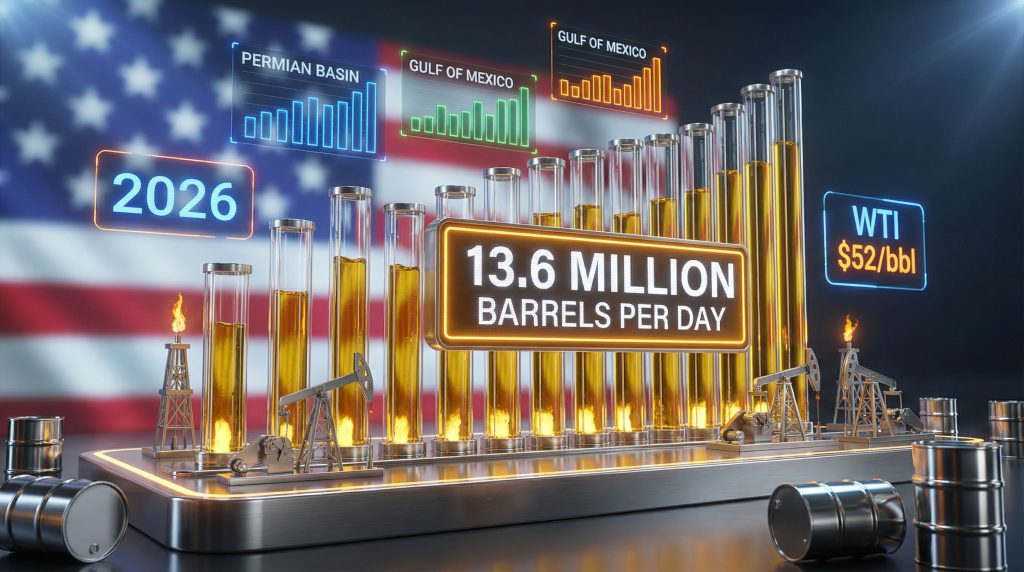
The U.S. crude oil production forecast 2026 reveals a complex economic equation where technological advancement meets price pressure resistance. Current market dynamics demonstrate how commodity pricing directly influences drilling activity, with West Texas Intermediate crude oil prices projected to average $52 per barrel in 2026 and $50 per barrel in 2027, representing a significant decline from the $65 per barrel average in 2025.
This 20% price decline creates immediate operational challenges across major producing basins. Breakeven analysis indicates that Permian Basin operations require prices in the low-$60 per barrel range to maintain economic viability, positioning current forecasts below optimal profitability thresholds. Consequently, when commodity prices fall below breakeven levels, operators face difficult choices between maintaining production through increased efficiency or reducing capital expenditure commitments.
Capital Discipline and Investment Allocation Patterns
The current market environment reflects a fundamental shift in capital allocation strategies. Energy companies now prioritise portfolio high-grading techniques, focusing resources on their most productive assets while deferring development of marginal properties. This strategic pivot requires sophisticated analysis of reservoir quality, infrastructure access, and operational cost structures.
Modern operators implement hedging programme optimisation to manage commodity price volatility. These financial instruments allow companies to lock in minimum revenue levels, providing cash flow stability during periods of market uncertainty. However, hedging strategies also limit upside potential when prices recover, creating strategic trade-offs between security and growth opportunities.
Productivity Versus Activity Trade-offs
Current industry analysis reveals that drilling efficiency improvements cannot fully offset reduced rig counts driven by lower commodity pricing. Historical data shows drilling productivity measured in barrels per rig per day has increased from approximately 2,200 in the 2022-2024 period to projected levels of 2,350 in 2025-2026.
| Metric | 2020-2021 | 2022-2024 | 2025-2026F | 2027F |
|---|---|---|---|---|
| Average Production (MMbpd) | 11.2 | 12.8 | 13.6 | 13.3 |
| WTI Average Price ($/bbl) | $39 | $78 | $52 | $50 |
| Active Rig Count | 318 | 625 | 580* | 520* |
| Drilling Productivity (bbl/rig/day) | 1,850 | 2,200 | 2,350* | 2,400* |
*Projected estimates based on current market trends
These productivity improvements stem from advanced hydraulic fracturing techniques, AI drilling optimization in drilling operations, and enhanced completion designs that maximise reservoir contact. However, the rate of technological improvement appears to be decelerating, suggesting that easy efficiency gains have already been captured.
Service Sector Capacity and Cost Inflation
The oil service industry faces unique challenges in the current environment. Equipment utilisation rates fluctuate with drilling activity levels, creating capacity planning difficulties. Service companies must balance maintaining skilled workforces during downturns while positioning for rapid deployment when market conditions improve.
Pricing strategy development for specialised services becomes critical when operators focus on high-value, technically complex projects. Premium services that deliver measurable productivity improvements can command higher margins, even in constrained price environments.
When big ASX news breaks, our subscribers know first
Which Regional Production Centres Will Drive 2026 Output Levels?
Regional production dynamics reveal significant geographical divergence in the U.S. crude oil production forecast 2026. Different basins respond uniquely to commodity price pressures based on their geological characteristics, infrastructure development, and operational cost structures.
Permian Basin: The Strategic Cornerstone
The Permian Basin maintains its position as America's production powerhouse, accounting for approximately 48.5% of total U.S. crude oil production. Production forecasts indicate the basin will average about 6.6 million barrels per day in 2026, essentially unchanged from 2025 levels, before declining slightly to 6.5 million barrels per day in 2027.
This production plateau represents a fundamental shift from the basin's historical growth trajectory. The transition from expansion to maintenance mode reflects several converging factors:
- Tier 1 acreage depletion: Prime drilling locations with optimal geological characteristics become increasingly scarce
- Infrastructure bottlenecks: Midstream transportation and processing capacity constraints limit production growth
- Economic thresholds: Current commodity pricing approaches or falls below breakeven levels for many operations
- Capital allocation discipline: Operators prioritise shareholder returns over aggressive expansion
Drilling inventory depth analysis reveals that operators face increasingly difficult decisions about acreage development timing. Premium locations that generate strong returns at current prices are finite, while second-tier prospects require higher commodity prices to justify development costs.
Gulf of Mexico: Offshore Growth Engine
The Federal Gulf of Mexico presents a contrasting dynamic to onshore operations. Offshore production is expected to increase from 1.9 million barrels per day in 2025 to approximately 2.0 million barrels per day in 2026, representing a 5.3% year-over-year growth rate.
This growth pattern depends entirely on new field developments offsetting natural decline curves from existing producing fields. Unlike onshore shale operations that can respond rapidly to price changes, offshore projects require multi-year development timelines and substantial capital commitments that create production momentum regardless of short-term price fluctuations.
Deepwater Development Economics
Gulf of Mexico projects typically feature:
- Higher upfront capital requirements ranging from $1-5 billion per development
- Longer production plateau periods extending 10-20 years
- Lower operating cost per barrel once production begins
- Greater geological risk requiring extensive seismic analysis and appraisal drilling
Subsea infrastructure expansion creates opportunities for tie-back developments that leverage existing production systems. These projects require lower capital investment than standalone developments while accessing proven reservoir resources.
Alaska: The Resurgence Story
Alaska's production trajectory represents the most dramatic reversal among major U.S. producing regions. Production is forecast to increase from about 0.4 million barrels per day in 2025 to roughly 0.5 million barrels per day in 2027, marking the first sustained growth in Alaska production since 2017.
This 25% production increase over two years stems from specific named development projects including Nuna and Pikka. These projects reverse decades of natural production decline from North Slope fields, demonstrating how targeted investment can revitalise mature producing regions.
The Trans-Alaska Pipeline System (TAPS) creates unique operational considerations for Alaska production. The pipeline system was designed for much higher throughput volumes, creating economies of scale opportunities as production increases. Reduced per-barrel transportation costs improve project economics as utilisation rates increase.
Arctic drilling technology advancements enable year-round operations in challenging environmental conditions. Extended-reach drilling techniques allow access to offshore reserves from onshore locations, reducing development costs and environmental impact.
What Production Scenarios Should Energy Stakeholders Prepare For?
The U.S. crude oil production forecast 2026 encompasses multiple potential outcomes based on commodity pricing, technological developments, and regulatory changes. Strategic planning requires understanding various scenarios and their probability assessments, especially considering oil price rally trends and oil price stagnation factors that could materialise.
Base Case: Plateau Maintenance Strategy
The baseline forecast projects U.S. crude oil production averaging 13.6 million barrels per day in 2026, essentially maintaining 2025 record levels. This scenario assumes:
- Commodity prices stabilising around $52 per barrel WTI
- Drilling activity declining but offset by productivity improvements
- Regional production shifts with Gulf of Mexico and Alaska growth offsetting Lower 48 declines
- Capital expenditure optimisation focusing on highest-return projects
Production sustainability metrics under this scenario require operators to achieve approximately 2,350 barrels per rig per day productivity levels, representing continued technological advancement but at a decelerating pace.
Service sector capacity constraints become more pronounced as the industry operates with reduced rig counts while maintaining production levels. This dynamic creates potential cost inflation pressures for specialised drilling and completion services.
Downside Risk: Accelerated Decline Trajectory
Adverse scenario planning considers potential production declines exceeding current forecasts. Key risk factors include price-driven activity reduction: if WTI prices fall below $45 per barrel, extensive drilling deferrals would occur across multiple basins. Well completion postponements could create immediate production shortfalls as natural decline curves accelerate without offset from new production.
Financial stress indicators among independent producers could trigger:
- Asset liquidation programmes as companies prioritise debt reduction
- Joint venture restructuring to share development costs and risks
- Capital access limitations from debt and equity markets
- Workforce reductions affecting operational efficiency
Shale decline curve acceleration under reduced maintenance drilling presents particular risks. Unlike conventional reservoirs, shale wells experience rapid initial decline rates requiring continuous drilling activity to maintain production levels.
Upside Potential: Technology-Driven Outperformance
Favourable scenarios involve technological breakthroughs or market developments that exceed baseline forecasts. Enhanced oil recovery implementation across mature fields could unlock additional reserves without proportional capital increases. Artificial intelligence optimisation in drilling and completion design continues improving operational efficiency.
Carbon capture integration creates potential new revenue streams that improve project economics independent of commodity prices. Export infrastructure expansion could enable access to premium international markets, supporting higher realised pricing.
Advanced technologies showing promise include:
- Machine learning algorithms for reservoir characterisation and development optimisation
- Autonomous drilling systems reducing operational costs and improving safety
- Enhanced proppant technologies increasing fracture conductivity and productivity
- Real-time production optimisation systems maximising reservoir recovery rates
How Do Current Market Fundamentals Compare to Historical Cycles?
Understanding the U.S. crude oil production forecast 2026 requires historical context regarding previous commodity cycles and industry responses. Current market conditions exhibit both familiar patterns and unique characteristics that distinguish this cycle from previous downturns.
Production Cycle Evolution
Historical analysis reveals distinct phases in U.S. production development:
2020-2021 Recovery Period: Production averaged 11.2 million barrels per day with WTI prices averaging $39 per barrel. This period demonstrated the industry's ability to maintain significant output even during severe price stress.
2022-2024 Growth Phase: Production increased to 12.8 million barrels per day average as WTI prices recovered to $78 per barrel. This phase showcased the rapid scalability of U.S. shale operations when economic incentives aligned.
2025-2026 Plateau Period: The transition to 13.6 million barrels per day with declining prices to $52 per barrel represents a new equilibrium between production capacity and economic viability.
Investment Climate Transformation
Current investment patterns differ significantly from previous cycles. Capital allocation priorities now emphasise:
- Shareholder return programmes including dividends and share repurchases
- Debt reduction initiatives improving balance sheet strength
- ESG compliance investments meeting environmental and governance standards
- Technology development funding for long-term competitive advantages
Private equity involvement has increased substantially, providing alternative capital sources when public markets become restrictive. These investors typically focus on operational efficiency improvements and portfolio optimisation rather than aggressive expansion.
Debt market conditions for energy sector financing have evolved significantly. Credit facility terms now include ESG performance metrics alongside traditional financial covenants. Hedging requirements mandate minimum commodity price protection levels to secure financing.
Equity market valuation methodologies have shifted toward cash flow generation rather than production growth metrics. This fundamental change influences operator behaviour and capital allocation decisions across the industry.
What Strategic Implications Emerge for Energy Market Participants?
The U.S. crude oil production forecast 2026 creates specific strategic considerations for different participant categories within the energy ecosystem. Each stakeholder group faces unique challenges and opportunities based on their position in the value chain.
For Upstream Operators
Portfolio high-grading strategies become essential for maintaining profitability in constrained price environments. Operators must identify and prioritise assets that generate acceptable returns at $52 per barrel WTI pricing levels. This analysis requires sophisticated reservoir modelling and economic optimisation techniques.
Hedging programme development takes on increased importance as commodity price volatility persists. Collar strategies that provide downside protection while preserving upside participation offer balanced risk management. Calendar spread hedging can protect against seasonal price variations that affect cash flow timing.
Joint venture structures facilitate development cost sharing and risk distribution across multiple participants. These partnerships prove particularly valuable for high-capital offshore projects and technically challenging onshore developments.
Technology investment priorities should focus on:
- Digital optimisation platforms improving operational efficiency
- Predictive maintenance systems reducing unplanned downtime
- Enhanced completion techniques maximising initial production rates
- Environmental compliance technologies meeting regulatory requirements cost-effectively
For Service Companies
Equipment utilisation forecasting becomes critical for capacity planning decisions. Service companies must balance workforce maintenance during reduced activity periods with rapid deployment capability when market conditions improve.
Pricing strategy differentiation allows specialised service providers to maintain margins through value-based pricing models. Services that deliver measurable productivity improvements can command premium rates even in constrained markets.
Geographic repositioning strategies help service companies follow drilling activity migration across different producing basins. Mobile equipment deployment and regional expertise development create competitive advantages.
Innovation investment focus should prioritise:
- Automation technologies reducing labour requirements and improving safety
- Data analytics platforms optimising service delivery efficiency
- Environmental monitoring systems supporting operator compliance requirements
- Predictive performance modelling improving service reliability and effectiveness
How Might Regulatory and Policy Changes Influence Production Trajectories?
The U.S. crude oil production forecast 2026 operates within an evolving regulatory framework that creates both opportunities and constraints for industry participants. Understanding potential policy changes helps stakeholders prepare for various operating scenarios, particularly considering global tariff impacts and the US‑China trade war impact on energy markets.
Federal Land Access and Permitting
Lease sale scheduling directly impacts long-term drilling inventory availability. Delays or reductions in federal lease offerings constrain future development options, particularly in Gulf of Mexico deepwater regions and Alaska offshore areas.
Environmental review processes affect project development timelines and costs. Streamlined permitting procedures could accelerate development schedules, while enhanced environmental assessments may extend approval timelines and increase compliance costs.
Methane emission regulations impose new monitoring and reduction requirements across producing operations. Compliance costs vary significantly based on:
- Facility age and design characteristics
- Geographic location and infrastructure access
- Production volume and operational complexity
- Available reduction technologies and implementation costs
Infrastructure development permitting affects midstream capacity expansion needed to support production growth. Pipeline approval processes and export terminal development create potential bottlenecks for market access.
State-Level Policy Variations
Texas regulatory environment remains generally supportive of production activities, with Railroad Commission policies focused on resource conservation and operational safety. Proration considerations could become relevant if production exceeds transportation capacity.
New Mexico environmental regulations create operational complexity for Permian Basin operations crossing state boundaries. Air quality standards and water usage restrictions affect development planning and operational costs.
North Dakota flaring reduction requirements mandate natural gas capture infrastructure development. Associated gas handling becomes a critical component of well completion economics and environmental compliance.
Alaska state tax policies significantly influence project development economics for North Slope operations. Production tax structures and property tax assessments affect long-term project viability and investment returns.
The next major ASX story will hit our subscribers first
What Does This Mean for Global Energy Security and Market Balance?
The U.S. crude oil production forecast 2026 has significant implications for international energy markets and global supply chain stability. America's role as a major oil producer creates ripple effects across worldwide energy systems.
U.S. Role in International Markets
Export capacity utilisation determines America's influence on global pricing dynamics. Current export terminal capacity exceeds domestic production surplus, providing operational flexibility for destination market diversification.
According to the U.S. Energy Information Administration's latest outlook, American production levels significantly affect global supply balances. Strategic petroleum reserve policies affect both domestic supply security and international market stability.
OPEC+ production coordination responds dynamically to U.S. output levels. American production stability around 13.6 million barrels per day influences OPEC+ quota adjustments and spare capacity management strategies.
Supply Chain Resilience Considerations
Critical mineral dependencies for drilling and completion operations create potential vulnerability points. Steel availability for casing and tubing, rare earth elements for downhole electronics, and specialised chemicals for hydraulic fracturing require diverse supplier networks.
Equipment manufacturing capacity must align with industry activity levels. Domestic production capability for drilling rigs, completion equipment, and production infrastructure affects industry response times and cost structures.
Skilled workforce availability across key producing regions determines operational efficiency and safety performance. Training programme development and workforce retention strategies become critical for maintaining production capability.
Transportation infrastructure adequacy includes pipeline networks, rail transportation capacity, and marine terminal facilities. Infrastructure maintenance and capacity expansion projects require long-term planning and substantial capital investment.
Industry experts note that oil markets are likely to remain oversupplied in 2026, creating additional pressure on producers to maintain cost discipline while optimising production efficiency.
Risk Management Framework
Energy market participants should develop comprehensive scenario planning capabilities that account for multiple potential outcomes. Commodity price volatility, regulatory changes, and technology developments create interconnected risks requiring integrated management approaches.
Financial resilience strategies should emphasise cash flow stability over aggressive growth targets. Diversified revenue streams, operational efficiency improvements, and strategic partnership development provide stability during uncertain market conditions.
The U.S. crude oil production forecast 2026 ultimately reflects an industry adapting to new economic realities while maintaining its role as a critical component of domestic and international energy security. Success requires balancing technological advancement, environmental responsibility, economic efficiency, and market adaptability in an increasingly complex operating environment.
"The 2026 U.S. crude oil production landscape represents a fundamental transition where technological innovation must compensate for reduced drilling activity driven by commodity price constraints. Industry success depends on optimising capital allocation while navigating complex regulatory requirements and evolving market dynamics. Operators who master this balance will maintain competitive advantages during the current cycle and position themselves for future growth opportunities."
Looking to Capitalise on Energy Market Opportunities?
Discovery Alert's proprietary Discovery IQ model delivers real-time notifications on significant ASX mineral discoveries, including energy and resource sectors that could benefit from America's evolving production landscape. Gain immediate access to historic discovery returns and begin your 30-day free trial today to secure your market-leading advantage in the commodities sector.