June 5, 2026
The evolving landscape of U.S. deep-sea mining permits reflects broader supply chain vulnerabilities and technological advancement patterns that could fundamentally reshape global resource security frameworks. As terrestrial deposits face increasing extraction complexity and geopolitical constraints, underwater resources present alternative pathways for critical material acquisition that bypass traditional supply chain dependencies, highlighting the growing importance of polymetallic nodules benefits.
Understanding Deep-Sea Permitting Evolution
The modernisation of America's deep-sea mineral extraction framework represents a significant departure from conventional regulatory approaches. The National Oceanic and Atmospheric Administration's recent consolidation of licensing procedures eliminates the previously required dual-submission structure, creating a unified review pathway for companies seeking to extract underwater resources.
This regulatory evolution stems from the Deep Seabed Hard Mineral Resources Act of 1980, which established federal jurisdiction over ocean floor mineral rights in waters beyond the 200-nautical-mile exclusive economic zone. Furthermore, the contemporary streamlined approach allows simultaneous submission of exploration and commercial recovery applications, reducing administrative complexity that previously deterred investment in underwater mining ventures.
The transformed process incorporates mandatory environmental impact documentation, public consultation phases, and stakeholder engagement protocols. These requirements ensure that accelerated permitting maintains environmental oversight whilst reducing bureaucratic delays that historically extended project development timelines by years, though concerns about deep‐sea mining concerns continue to influence the debate.
| Regulatory Component | Traditional Process | Streamlined Framework |
|---|---|---|
| Application Structure | Sequential submissions | Simultaneous filing |
| Review Authority | Multiple agencies | NOAA centralised |
| Public Engagement | Limited consultation | Enhanced stakeholder input |
| Environmental Assessment | Phased evaluations | Integrated impact analysis |
When big ASX news breaks, our subscribers know first
Critical Mineral Composition Driving Investment Interest
Polymetallic nodules scattered across abyssal ocean floors contain concentrated deposits of materials essential for modern technological infrastructure. These potato-sized formations accumulate over millions of years, incorporating cobalt, nickel, copper, and manganese in commercially viable concentrations.
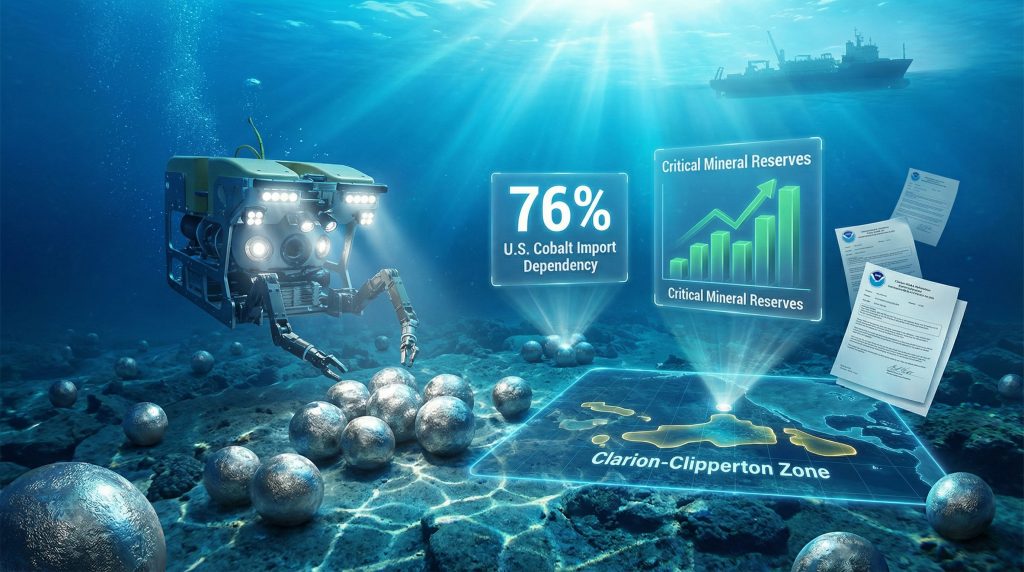
Cobalt concentrations in these underwater deposits directly support battery manufacturing supply chains, particularly for electric vehicle production and energy storage systems. Current U.S. import dependency for cobalt reaches approximately 76%, creating strategic vulnerabilities that underwater extraction could potentially mitigate.
Nickel content within polymetallic nodules serves electric vehicle battery cathode production, where demand projections indicate substantial supply gaps emerging throughout the 2030s. Traditional nickel mining operations face increasing environmental restrictions and community opposition, making ocean floor alternatives increasingly attractive to manufacturers.
Copper deposits embedded within these formations support renewable energy infrastructure development, including solar panel systems, wind turbine components, and electrical grid expansion projects. Each megawatt of renewable energy capacity requires substantial copper inputs, creating sustained demand growth that terrestrial mining struggles to satisfy.
Manganese reserves found in nodule formations serve dual purposes in steel production and emerging energy storage technologies. Advanced battery chemistries increasingly incorporate manganese compounds, expanding demand beyond traditional metallurgical applications.
Strategic Resource Security Implications
The concentration of critical mineral processing capabilities within specific geographic regions creates systemic supply chain risks that underwater extraction could help address. China's dominance in rare earth processing, combined with limited alternative sources, highlights the strategic importance of developing independent mineral supply pathways.
National defence applications require secure supply chains for specialised alloys, electronic components, and advanced materials systems. Military equipment manufacturing depends heavily on these critical minerals, making supply diversification a national security priority rather than merely an economic consideration, particularly as nations work to establish their own critical minerals reserve.
Research conducted by Canada's Infrastructure Bank identifies similar challenges affecting North American critical minerals development, including limited financing access, market pricing transparency issues, and regulatory complexity. These barriers illustrate why streamlined permitting approaches gain political support across different jurisdictions.
Operational Framework for Underwater Extraction Permits
The consolidated application procedure enables companies to submit comprehensive development proposals covering both exploration phases and commercial recovery operations. This approach reduces regulatory uncertainty by providing clarity about long-term operational expectations from project inception, though companies must still navigate the complex permitting process insights that govern such operations.
Environmental documentation requirements include marine ecosystem baseline surveys, biodiversity impact assessments, sediment plume modelling, and carbon sequestration impact studies. These evaluations must demonstrate that extraction operations maintain acceptable environmental standards whilst achieving commercial objectives.
Public hearing protocols scheduled for late January 2026 will establish precedents for community engagement in underwater mining decisions. These consultations provide opportunities for environmental groups, fishing industry representatives, and scientific communities to influence permitting outcomes.
Jurisdictional authority extends throughout the Clarion-Clipperton Zone, a 6-million-square-kilometre region in the North Pacific Ocean between Hawaii and Mexico. This area contains the world's highest concentrations of polymetallic nodules, making it the primary target for commercial underwater extraction operations.
The regulatory framework also encompasses potential development sites within American territorial waters, including regions adjacent to American Samoa and areas off the Virginia Coast, though these locations may refer to onshore processing facilities rather than extraction zones.
Economic Drivers Behind Regulatory Acceleration
Investment capital requirements for underwater mineral extraction significantly exceed traditional terrestrial mining projects due to specialised equipment needs, remote operational challenges, and technological complexity. However, these costs must be evaluated against potential revenue streams from critical mineral sales and strategic supply chain security benefits.
Market opportunity assessments indicate that global polymetallic nodule reserves could supply decades of critical mineral demand, potentially generating substantial revenue streams for early commercial operators. The absence of traditional mining challenges, such as community displacement or land use conflicts, creates different risk-return profiles that attract specific investor categories.
Capital intensity comparisons between ocean floor and terrestrial extraction reveal trade-offs between upfront technology investments and ongoing operational expenses. Underwater operations require specialised remotely operated vehicles, collection systems, and processing platforms, but eliminate traditional mining costs such as waste rock handling, tailings management, and extensive workforce deployment.
Recent project economics from established mining operations provide context for investment decision-making. Centerra Gold's Kemess copper-gold project demonstrates typical capital requirements, with initial costs of US$771 million supporting 15-year operations producing 171,000 ounces of gold and 61 million pounds of copper annually, generating an after-tax net present value of US$1.1 billion.
Government incentive structures supporting domestic mineral production create additional economic advantages for underwater extraction ventures. These programmes recognise that supply chain independence requires initial investment support to overcome market entry barriers and technology development costs.
Commercial Entities Pursuing Underwater Mining Rights
The Metals Company represents the primary applicant currently navigating the streamlined U.S. deep-sea mining permits process, with exploration licence applications targeting specific regions within international waters. Their December 2025 submission details comprehensive development plans spanning exploration phases through commercial recovery operations.
Technology partnerships between mining companies and specialised equipment manufacturers drive innovation in underwater extraction systems. These collaborations develop remotely operated collection vehicles, nodule processing systems, and environmental monitoring technologies essential for commercial operations, reflecting broader mining technology innovations transforming the sector.
Financing structures increasingly involve partnerships between traditional mining investors and technology venture funds, reflecting the hybrid nature of underwater extraction operations. These arrangements provide both industry expertise and technological innovation capabilities required for successful project development.
Supply chain integration agreements connect underwater mining operations with downstream mineral processing facilities, battery manufacturers, and renewable energy companies. These arrangements provide revenue certainty that supports project financing whilst ensuring end-user access to critical materials.
Environmental Considerations and Regulatory Oversight
Marine ecosystem impact assessments focus on biodiversity disruption within abyssal plain environments, where extraction operations could affect species adapted to stable deep-ocean conditions. Scientific understanding of these ecosystems remains limited, creating challenges for comprehensive impact evaluation.
Carbon sequestration capacity of ocean floor sediments represents a significant environmental consideration, as underwater extraction could potentially disrupt natural carbon storage processes. These impacts require evaluation within broader climate change mitigation strategies.
Long-term ecological recovery potential following extraction operations remains scientifically uncertain due to limited research on deep-sea ecosystem resilience. This uncertainty complicates environmental risk assessments and mitigation strategy development.
Environmental monitoring technologies under development include real-time ecosystem impact assessment systems, sediment plume tracking capabilities, and biodiversity preservation monitoring protocols. These tools aim to provide continuous oversight of extraction operations whilst identifying potential environmental concerns before they become significant problems.
Environmental advocacy organisations express concerns that expedited permitting procedures may inadequately address complex marine ecosystem protection requirements, particularly given scientific knowledge gaps about deep-sea environments.
The next major ASX story will hit our subscribers first
International Legal Framework Complications
The United States' non-ratification of the United Nations Convention on the Law of the Sea creates potential conflicts with international regulatory authorities overseeing underwater mineral extraction. The International Seabed Authority, established under UNCLOS, claims jurisdiction over deep-sea mining in international waters.
Jurisdictional disputes may arise when U.S.-permitted operations conflict with ISA-approved extraction activities in overlapping areas. These conflicts could create legal uncertainties for investors and operational challenges for mining companies.
High Seas Treaty implementation scheduled for January 2026 introduces additional marine protected area designations that could restrict underwater mining access to specific regions. These conservation measures may conflict with existing exploration licences and commercial development plans.
Diplomatic implications of independent U.S. permitting could strain relationships with UNCLOS signatory nations and complicate broader ocean governance negotiations. International cooperation on marine resource management becomes more complex when major powers pursue unilateral regulatory approaches.
The recent NOAA announcement regarding accelerated permitting timelines demonstrates the federal government's commitment to streamlining these processes, though critics argue this approach may overlook crucial environmental and diplomatic considerations.
Opposition Movements and Legislative Responses
Environmental advocacy groups, including the Surfrider Foundation and Deep Sea Conservation Coalition, actively campaign for moratoriums on commercial underwater mining operations. These organisations argue that environmental risks outweigh potential economic benefits, particularly given scientific uncertainties about deep-sea ecosystem impacts.
Legislative proposals such as the American Seabed Protection Act and International Seabed Protection Act seek to restrict or prohibit U.S. involvement in underwater mining activities. These bills reflect congressional concerns about environmental protection and international legal compliance.
State-level restrictions in Pacific coastal jurisdictions could limit onshore processing facilities and support infrastructure for underwater mining operations. California and other states have enacted policies discouraging deep-sea mining activities within their jurisdictions.
Scientific community concerns centre on premature commercialisation of underwater extraction technologies before comprehensive environmental impact research completion. Many researchers advocate for extended study periods and enhanced international coordination before large-scale commercial operations begin.
However, as noted in recent analysis of regulatory challenges, the political and environmental implications of rushing these permits remain contentious among stakeholders.
Geopolitical Competition and Strategic Positioning
China's advancing deep-sea mining capabilities and territorial claims in disputed maritime areas create competitive pressures influencing U.S. regulatory decisions. Independent American permitting processes represent efforts to maintain strategic autonomy in critical mineral supply chains.
European Union regulatory approaches to underwater extraction emphasise environmental protection and international cooperation, contrasting with accelerated U.S. permitting procedures. These different philosophical approaches could complicate international coordination efforts.
Pacific Island nation sovereignty concerns arise when underwater extraction operations occur near territorial waters or affect marine resources important to local communities. These diplomatic sensitivities require careful navigation to maintain regional stability.
Regional security implications extend beyond resource extraction to broader maritime domain awareness and ocean governance frameworks. Underwater mining operations require significant naval and technological capabilities that influence broader strategic balance considerations.
Technology Development and Operational Innovation
Extraction equipment advancement focuses on remotely operated vehicle capabilities, autonomous nodule collection systems, and shipboard mineral processing technologies. These innovations must operate reliably in extreme deep-ocean environments whilst maintaining economic efficiency.
Collection system efficiency improvements target higher nodule recovery rates whilst minimising sediment disturbance and environmental impact. Advanced designs incorporate selective harvesting capabilities that preserve sensitive ecosystem areas.
Processing vessel designs for at-sea mineral concentration reduce transportation costs and environmental impacts by eliminating the need to transport raw materials to onshore facilities. These floating processing platforms represent significant technological and logistical innovations.
Environmental monitoring technologies integrate with extraction operations to provide real-time ecosystem impact data, enabling adaptive management approaches that respond to changing environmental conditions during operations.
Future Projections for Underwater Mining Development
2026 Industry Outlook suggests increased permit application volumes as regulatory uncertainty decreases and technology capabilities mature. Multiple companies are expected to pursue exploration licences following the streamlined permitting precedent.
Commercial production timelines indicate that large-scale underwater mineral extraction could begin within the next decade, subject to successful technology deployment and environmental compliance demonstration. Market price volatility for critical minerals will significantly influence project viability and investment decisions.
Long-term strategic positioning involves achieving meaningful reductions in U.S. critical mineral import dependency whilst maintaining environmental protection standards. Success requires balancing economic objectives with ecosystem preservation and international cooperation requirements.
International regulatory framework evolution will likely influence American underwater mining policies as global standards develop through ongoing negotiations. In addition, technology transfer opportunities with allied nations could enhance operational capabilities whilst strengthening strategic partnerships in critical mineral supply chain development.
Consequently, the development of U.S. deep-sea mining permits represents a pivotal moment in American resource strategy, balancing immediate economic needs against long-term environmental and diplomatic considerations. The outcome of these regulatory changes will likely influence global approaches to underwater mineral extraction for decades to come.
Disclaimer: Deep-sea mining involves significant environmental, technological, and regulatory uncertainties. Investment decisions should consider comprehensive risk assessments including potential changes to international regulations, environmental requirements, and market conditions. This analysis is based on publicly available information and should not be construed as investment advice.
Looking to Position Yourself in Critical Minerals Opportunities?
Discovery Alert's proprietary Discovery IQ model delivers real-time alerts on significant ASX mineral discoveries, instantly empowering subscribers to identify actionable opportunities ahead of the broader market as supply chain vulnerabilities create new investment landscapes. Understand why major mineral discoveries can lead to substantial market returns by exploring Discovery Alert's dedicated discoveries page, showcasing historic examples of exceptional outcomes, and begin your 30-day free trial today to secure your market-leading advantage.