August 6, 2026
Economic sanctions represent one of the most complex enforcement mechanisms in modern international relations, where financial pressure intersects with geopolitical strategy to reshape global energy markets. Within this framework, the petroleum sector often becomes both the target and the weapon, creating cascading effects that extend far beyond immediate political objectives. Understanding how u.s. economic tariffs interact with sanctions frameworks and how oil price movements respond to regulatory architectures requires examining not just the legal mechanisms themselves, but the intricate web of enforcement, compliance, and market adaptation that emerges when sanctions meet operational reality.
How Regulatory Frameworks Shape Venezuelan Oil Market Access
The architecture governing U.S. sanctions impact on Venezuelan oil exports operates through multiple interconnected legal mechanisms that create comprehensive market exclusion. These regulatory structures extend beyond simple prohibitions to encompass sophisticated monitoring, enforcement, and penalty systems designed to maximise compliance across global financial and shipping networks.
Primary Legislative Foundation and Executive Authority
The legal framework governing Venezuelan petroleum sanctions derives its authority from foundational statutes that grant extraordinary presidential powers during declared national emergencies. The International Emergency Economic Powers Act (IEEPA), codified in 50 U.S.C. § 1705, provides the statutory foundation enabling comprehensive economic sanctions against foreign entities deemed threats to U.S. national security or foreign policy interests.
Executive Order 13884, issued August 5, 2019, represents the most comprehensive expansion of Venezuelan petroleum sector sanctions, establishing a complete prohibition on transactions with the Government of Venezuela. This order built upon Executive Order 13850 from November 1, 2018, which initially targeted PDVSA specifically, demonstrating the progressive escalation of sanctions architecture over time.
The Treasury Department's Office of Foreign Assets Control (OFAC) maintains operational control over sanctions implementation through the Specially Designated Nationals (SDN) List, a dynamic database that currently includes extensive Venezuelan petroleum sector designations. While exact current counts require real-time verification, the scope encompasses major state oil companies, subsidiary entities, trading intermediaries, and supporting financial institutions.
Maritime Enforcement Protocols and Vessel Interdiction
Naval enforcement operations represent the physical manifestation of sanctions policy, where legal authorities translate into operational maritime control. According to recent reporting from Reuters, U.S. enforcement activities have significantly reduced Venezuelan oil export capacity, with current levels approximately half of November 2024 volumes.
The enforcement mechanism operates through multiple layers:
• U.S. Coast Guard patrol operations in Caribbean shipping lanes
• Vessel tracking and identification systems monitoring sanctioned cargo
• Boarding and seizure protocols for violations of U.S. sanctions law
• Port state control measures preventing sanctioned vessels from accessing facilities
Recent data indicates that floating storage near Venezuelan terminals has increased to approximately 16 million barrels, with nearly two dozen vessels visible near the Jose terminal alone, suggesting enforcement pressure is creating significant logistical bottlenecks.
Banking System Integration and Financial Controls
Financial sector compliance mechanisms form the backbone of sanctions effectiveness, operating through both technological screening systems and regulatory requirements imposed on financial institutions. The SWIFT messaging system incorporates OFAC screening protocols that automatically flag transactions involving designated Venezuelan entities.
Correspondent banking relationships face particular scrutiny, as international banks must maintain filtering systems capable of identifying and blocking Venezuelan oil transaction payment flows. Furthermore, violations of OFAC sanctions can result in civil penalties up to $250,000 per violation or twice the transaction value, whichever is greater, while criminal penalties can include up to 20 years imprisonment and fines up to $1 million.
When big ASX news breaks, our subscribers know first
Current Enforcement Scope and Exemption Mechanisms
The practical implementation of Venezuelan oil sanctions reveals a complex landscape where comprehensive prohibitions coexist with specific exemptions designed to serve U.S. strategic interests. Understanding this dual structure requires examining both the breadth of restrictions and the carefully crafted exceptions that allow certain activities to continue.
Chevron's Unique Licensing Arrangements
Chevron Corporation operates under a specific OFAC licence that permits continued Venezuelan oil operations and exports to U.S. Gulf Coast refineries. This arrangement represents a significant exception to comprehensive sanctions, designed to maintain access to heavy crude feedstocks required by complex U.S. refineries specifically configured for Venezuelan petroleum processing.
Current reporting indicates that Chevron-shipped cargoes represent the only Venezuelan oil exports reaching international markets without enforcement interference. This carve-out serves multiple strategic purposes:
• Maintaining domestic refining capacity dependent on heavy crude inputs
• Preventing supply disruptions to U.S. energy infrastructure
• Preserving corporate assets and operational capabilities for potential future expansion
The licensing arrangement demonstrates how sanctions policy balances comprehensive pressure with practical energy security considerations, though specific operational parameters remain confidential within OFAC licensing documentation.
Third-Party Liability and International Shipping Risks
International shipping companies face significant compliance risks when operating in Venezuelan waters or handling potentially sanctioned cargo. Recent enforcement actions have demonstrated that U.S. authorities will pursue vessels and companies based on limited jurisdictional connections, creating broad deterrent effects across the global shipping industry.
Risk factors affecting international operators include:
• Asset freezing for vessels entering U.S. jurisdiction after sanctioned activities
• Insurance coverage exclusions from Protection and Indemnity providers
• Banking relationship termination for companies facilitating prohibited transactions
• Secondary sanctions exposure for non-U.S. entities conducting sanctioned business
These risks have prompted widespread behavioural changes, with vessel tracking data showing numerous tankers turning back or rerouting mid-voyage when enforcement activities intensify in Venezuelan waters.
Humanitarian Exemption Limitations
OFAC maintains procedures for licensing humanitarian goods transactions, though practical implementation faces significant limitations in the Venezuelan context. The humanitarian exemption framework operates through a complex application process requiring detailed documentation of goods, recipients, and distribution mechanisms.
Practical constraints affecting humanitarian exemptions include:
• Lengthy approval processes that can exceed operational timeframes
• Restrictive interpretation of what constitutes legitimate humanitarian goods
• Financial institution reluctance to process even licenced transactions
• Limited infrastructure for monitoring goods distribution in Venezuela
Production Capacity and Export Infrastructure Analysis
Venezuelan oil production capacity has experienced dramatic degradation since comprehensive sanctions implementation, reflecting both direct enforcement pressure and systemic infrastructure deterioration. Current production levels represent less than half of pre-sanctions output, with export capacity suffering even more severe constraints.
Historical Production Decline and Current Status
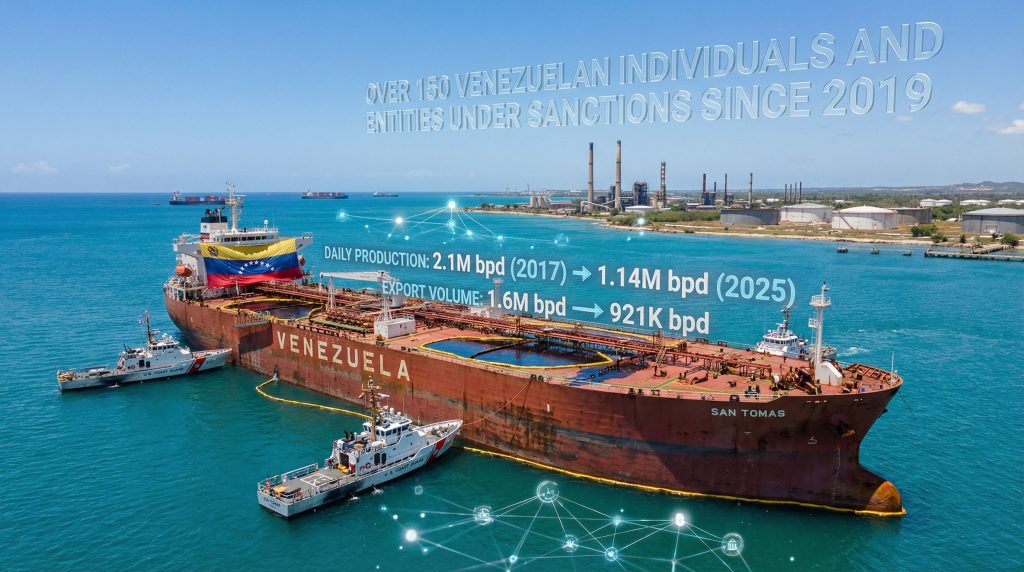
Venezuelan crude production in 2017 reached approximately 2.1 million barrels per day, representing the baseline before comprehensive sanctions implementation. Current production estimates suggest output has declined to approximately 1.14 million barrels per day, representing a 45.7% reduction from pre-sanctions levels.
Export volume analysis reveals even steeper declines:
| Metric | Pre-Sanctions (2017) | Current (2025) | Percentage Change |
|---|---|---|---|
| Daily Production | 2.1 million bpd | 1.14 million bpd | -45.7% |
| Export Volume | 1.6 million bpd | 921,000 bpd | -42.4% |
| Operational Rigs | 68 | 23 | -66.2% |
Note: Current figures require verification against official sources including EIA reports and OPEC data
Infrastructure Degradation and Operational Challenges
Venezuelan petroleum infrastructure faces multiple degradation factors that compound sanctions-related constraints. Deferred maintenance has become endemic across the production system, particularly affecting the Orinoco Belt heavy crude operations that require sophisticated technology and ongoing capital investment.
Recent reporting indicates that PDVSA operations face additional complications from cyberattacks that have disrupted administrative systems, leading to slower loading and unloading operations at key terminals. This operational degradation contributes to the growing floating storage accumulation observed in Venezuelan waters.
Critical infrastructure challenges include:
• Diluent shortage affecting heavy crude transportation through pipeline systems
• Power grid instability impacting pumping and processing operations
• Equipment failure due to limited access to replacement parts and technical services
• Workforce exodus creating technical expertise gaps across operational systems
Orinoco Belt Production Constraints
The Orinoco Belt contains the world's largest proven heavy crude reserves but requires specialised infrastructure and ongoing technical support for sustained production. Sanctions-related constraints have particularly affected this region due to its dependence on imported diluent and sophisticated extraction technology.
Current reports suggest that PDVSA has begun shutting wells in the Orinoco Belt as storage capacity fills and diluent imports face increasing restrictions. This represents a critical development, as Orinoco Belt production constitutes the majority of Venezuelan crude output and provides the heavy crude grades preferred by certain international refineries.
International Partnership Navigation Under Sanctions Constraints
Global energy companies and international partners face complex compliance challenges when evaluating any involvement with Venezuelan petroleum operations. The extraterritorial nature of U.S. sanctions creates risk exposure that extends far beyond direct business relationships, affecting financing, insurance, transportation, and processing activities across multiple jurisdictions.
Chinese Commercial Engagement and Risk Management
Chinese state-owned enterprises have maintained some engagement with Venezuelan petroleum through carefully structured arrangements designed to minimise sanctions exposure. These arrangements typically involve oil-for-debt mechanisms that convert existing loan obligations into crude shipments rather than creating new commercial relationships.
Recent vessel tracking data indicates that several tankers arriving at Venezuelan terminals are associated with long-standing debt arrangements that send Venezuelan crude to China as payment on billions of dollars in outstanding loans. This structure provides limited immediate revenue for Venezuela while allowing Chinese entities to recover some value from distressed investments.
Chinese risk management strategies include:
• Non-dollar transaction structures to avoid direct U.S. financial system exposure
• Modified shipping routes to minimise transit through U.S.-controlled waters
• State-owned enterprise coordination to distribute compliance risks
• Alternative payment mechanisms bypassing traditional correspondent banking
However, Chinese patience appears increasingly limited, with reports indicating that Beijing has spent years distancing itself financially from Venezuela following unpaid bills and disappointing investment returns.
European Union Coordination Challenges
European approaches to Venezuelan sanctions demonstrate the complexities of multilateral coordination when sanctions regimes diverge between allied nations. While the EU maintains its own Venezuela-related sanctions, these measures operate under different legal frameworks and enforcement mechanisms than U.S. sanctions.
Key coordination challenges include:
• Jurisdictional conflicts over extraterritorial enforcement of U.S. sanctions
• Refinery exposure assessments for facilities configured for Venezuelan heavy crude
• Corporate compliance costs for multinational companies operating across jurisdictions
• Diplomatic tensions over unilateral enforcement affecting European commercial interests
European refineries face particular challenges due to their historical dependence on Venezuelan heavy crude for certain product specifications. The loss of this supply source has required significant operational adjustments and alternative sourcing arrangements.
Market Response Dynamics and Global Price Implications
Venezuelan sanctions have created substantial ripple effects across global petroleum markets, influencing price structures, supply chain relationships, and strategic planning for energy companies worldwide. Moreover, understanding these market dynamics requires examining both immediate price impacts and longer-term structural adjustments in global crude trading patterns.
Heavy Crude Pricing and Discount Spreads
Venezuelan heavy crude historically traded at significant discounts to benchmark prices due to its high sulfur content and transportation requirements. Sanctions have exacerbated these discounts while simultaneously creating supply constraints that affect global heavy crude availability.
Current market conditions show Venezuelan crude trading at steeply discounted prices when transactions do occur, reflecting both quality considerations and the additional risks associated with sanctions exposure. These discount spreads have widened substantially compared to historical norms, though precise current pricing requires real-time market data verification.
Alternative Supply Source Development
The removal of significant Venezuelan supply from global markets has accelerated development and expansion of alternative heavy crude sources. Canadian oil sands production has benefited from reduced Venezuelan competition, while Middle Eastern heavy crude producers have captured market share previously held by Venezuelan exports.
Supply reallocation patterns include:
• Canadian oil sands expansion driven by reduced Venezuelan competition
• Middle Eastern heavy crude market share increases
• Latin American production growth in Colombia and Brazil
• U.S. shale oil quality considerations for refinery feedstock replacement
Regional refineries previously dependent on Venezuelan supply have been forced to reconfigure operations or develop alternative sourcing relationships, creating permanent structural changes in global crude trading patterns.
Strategic Petroleum Reserve Considerations
The loss of Venezuelan heavy crude from global markets has implications for strategic petroleum reserve policies, particularly for countries whose reserves were partially composed of Venezuelan crude grades. The U.S. Strategic Petroleum Reserve historically included some Venezuelan crude, though recent releases and acquisitions have focused on domestic light crude varieties.
Enforcement Effectiveness and Compliance Mechanisms
The practical effectiveness of Venezuelan oil sanctions depends on sophisticated enforcement mechanisms that operate across multiple domains, from naval interdiction to financial monitoring. Recent data suggests these mechanisms have achieved substantial success in reducing Venezuelan export capacity, though complete elimination remains elusive.
Naval Operations and Maritime Enforcement
U.S. naval operations in Caribbean waters have significantly increased since comprehensive sanctions implementation, with patrol frequency designed to create visible deterrent effects for potential sanctions violators. Current reporting indicates that these operations have successfully seized multiple oil tankers and created sufficient enforcement pressure to cut Venezuelan exports roughly in half from recent peak levels.
The enforcement approach operates through multiple mechanisms:
• Visible patrol presence creating deterrent effects for potential violators
• Vessel seizure operations targeting ships carrying sanctioned cargo
• Port state control coordination with allied nations
• Intelligence sharing with international maritime security partners
Enforcement statistics from recent operations indicate that U.S. authorities have designated over 150 Venezuelan individuals and entities under sanctions programmes, though precise current figures require verification against official OFAC databases.
Financial System Monitoring and Transaction Controls
Financial sector compliance represents perhaps the most effective component of sanctions enforcement, operating through automated screening systems that monitor global transaction flows for Venezuelan-related activity. SWIFT messaging protocols incorporate real-time OFAC screening that can identify and block prohibited transactions before completion.
The financial enforcement mechanism creates multiple pressure points:
• Correspondent banking restrictions limiting Venezuelan access to global financial systems
• Insurance market exclusions preventing coverage for sanctioned cargo shipments
• Trade financing limitations restricting working capital access for petroleum operations
• Secondary sanctions threats against international financial institutions
The next major ASX story will hit our subscribers first
Geopolitical Implications and Regional Security Effects
Venezuelan oil sanctions create consequences that extend far beyond petroleum markets, influencing regional security dynamics, migration patterns, and great power competition across Latin America. Understanding these broader implications requires examining how economic pressure translates into political and social outcomes, particularly in the context of trade war strategies and their regional effects.
Regional Migration and Economic Displacement
Economic collapse linked to reduced oil revenues has accelerated Venezuelan migration to neighbouring countries, creating substantial humanitarian and political challenges across Latin America. Current estimates suggest millions of Venezuelans have left the country since sanctions intensification, placing pressure on Colombia, Peru, Ecuador, and other regional nations.
Regional security implications include:
• Economic refugee flows straining neighbouring country resources
• Drug trafficking route modifications as traditional governance structures weaken
• Border security challenges for countries receiving Venezuelan migrants
• Social tension in host communities facing increased competition for resources
Great Power Competition Dynamics
Venezuelan sanctions have become a focal point for broader great power competition, with Russia and China maintaining engagement despite U.S. pressure. This dynamic creates complex geopolitical tensions that extend beyond bilateral U.S.-Venezuela relations to encompass broader questions about spheres of influence and economic coercion.
Russian engagement includes military cooperation, energy sector support, and financial arrangements designed to circumvent sanctions pressure. Chinese involvement focuses primarily on protecting existing investments and loan arrangements, though with apparent declining enthusiasm for new commitments.
The sanctions regime thus serves multiple strategic purposes beyond immediate Venezuela policy, including testing international responses to economic coercion and establishing precedents for future sanctions applications.
Future Policy Scenarios and Long-term Strategic Considerations
The sustainability and ultimate effectiveness of Venezuelan oil sanctions depend on evolving political conditions, international cooperation levels, and the target country's capacity for adaptation. Future policy scenarios must consider multiple potential pathways, from sanctions escalation to negotiated resolution frameworks.
Potential Sanctions Relief Mechanisms
Future sanctions relief would likely require democratic transition indicators and specific performance benchmarks related to governance, human rights, and international cooperation. Historical precedents suggest that sanctions relief typically occurs through graduated mechanisms rather than comprehensive elimination.
Potential relief frameworks might include:
• Conditional licensing for specific petroleum sector activities
• Performance-based escalation tied to measurable political reforms
• International monitoring of compliance with relief conditions
• Reconstruction financing coordination with multilateral institutions
Climate Policy Intersections and Energy Transition
Venezuelan sanctions intersect with broader climate policy objectives in complex ways, creating tensions between short-term geopolitical goals and long-term energy transition strategies. The exclusion of Venezuelan heavy crude from global markets may accelerate development of higher-carbon alternative sources, potentially undermining climate objectives.
Energy transition considerations include:
• Alternative supply development that may have higher carbon footprints
• Stranded asset implications for Venezuelan petroleum infrastructure
• Just transition considerations for petroleum-dependent populations
• Renewable energy development opportunities in post-sanctions scenarios
"The loss of Russian and Venezuelan oil represents a drop in the ocean for the world's crude glut," according to recent analysis, highlighting how global markets have adapted to sanctions-related supply constraints.
Lessons for Future Sanctions Policy Design
Venezuelan oil sanctions provide valuable insights for future economic coercion strategies, demonstrating both the capabilities and limitations of comprehensive petroleum sector targeting. These lessons have implications for tariffs and investment impact considerations and sanctions design across multiple contexts and target countries.
Effectiveness Assessment and Policy Objectives
Measuring sanctions effectiveness requires clear definition of policy objectives and realistic timelines for achievement. Venezuelan sanctions appear successful in reducing petroleum export capacity and limiting government revenues, but have not achieved stated regime change objectives within initial timeline expectations.
Key assessment criteria include:
• Quantifiable economic impacts on target sector operations
• Political behaviour modification in response to economic pressure
• International cooperation levels affecting enforcement effectiveness
• Unintended consequences for civilian populations and regional stability
Multilateral Coordination Requirements
The Venezuelan experience demonstrates that unilateral sanctions face significant limitations when target countries can access alternative partners and financial systems. Future sanctions design must prioritise international coordination and multilateral enforcement mechanisms to maximise effectiveness.
Best practices for coordination include:
• Harmonised legal frameworks across allied jurisdictions
• Information sharing protocols for enforcement activities
• Joint designation procedures for sanctioned entities
• Coordinated exemption policies to prevent sanctions arbitrage
What Have Been the Key Challenges in Implementation?
Implementation challenges have revealed important gaps between policy design and operational reality. The U.S. sanctions impact on Venezuelan oil exports has faced particular difficulties in preventing circumvention through third-country transactions and alternative financial mechanisms.
Primary implementation challenges include:
• Shell company proliferation obscuring beneficial ownership of sanctioned entities
• Flag-of-convenience shipping arrangements complicating vessel identification
• Barter transaction mechanisms bypassing traditional financial monitoring
• Regional enforcement gaps in areas beyond direct U.S. jurisdiction
How Have Markets Adapted to Sanctions Pressure?
Market adaptation has demonstrated remarkable resilience and creativity in circumventing restrictions. The oil price crash analysis reveals how global petroleum markets have adjusted to the removal of Venezuelan supply while accommodating continued limited trading through various mechanisms.
Market adaptation strategies include:
• Alternative payment systems denominated in non-dollar currencies
• Ship-to-ship transfers in international waters to obscure cargo origins
• Blending operations mixing Venezuelan crude with other sources
• Extended storage periods waiting for enforcement pressure to decrease
The Venezuelan case study ultimately illustrates how U.S. sanctions impact on Venezuelan oil exports operates through complex, interconnected mechanisms that extend far beyond simple trade prohibitions. Success in achieving policy objectives depends on sustained political will, international cooperation, and adaptation to evolving circumvention strategies. As global energy markets continue evolving and geopolitical tensions intensify, the lessons learned from Venezuelan sanctions implementation will likely influence future economic statecraft strategies across multiple contexts and target countries.
Looking to Navigate Complex Geopolitical Risks in Your Investment Portfolio?
The intricate relationship between sanctions, regulatory frameworks, and global commodity markets highlights the critical importance of timely market intelligence for investors. Discovery Alert's proprietary Discovery IQ model delivers real-time alerts on significant ASX mineral discoveries, enabling subscribers to identify actionable opportunities whilst navigating the complex geopolitical landscape affecting global resource markets.