
June 12, 2026
## Why the Fed pauses when energy shocks blur the outlook
Monetary policy becomes most difficult when inflation risk and growth risk rise at the same time. That is the backdrop for the latest US Fed holds target rate steady on oil decision, where policymakers chose not to move even after a prior easing cycle had already begun.
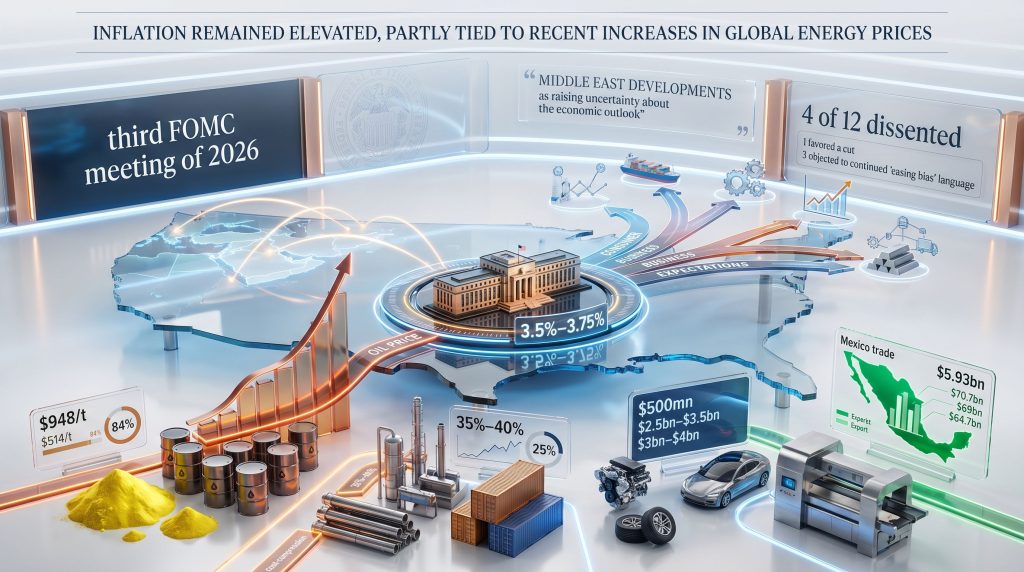
In the third FOMC meeting of 2026, the Federal Reserve kept the federal funds target range at 3.5% to 3.75%. The federal funds rate influences short-term borrowing costs across the financial system, shaping everything from corporate credit to mortgage pricing and broader financial conditions.
The short answer is simple:
The Fed may keep rates unchanged when oil rises because higher energy prices can lift inflation, unsettle inflation expectations, and reduce confidence that price pressures are truly contained. Even if growth looks softer, policymakers often prefer to wait until they know whether the oil move is temporary or likely to spread through the wider economy.
This was not a routine hold. It came after three quarter-point cuts in September, October, and December of the prior year, and it included a notable split inside the committee. Out of 12 voting members, 4 dissented. One favoured a rate cut, while three objected to keeping easing bias language in the statement.
The Fed also said inflation stayed elevated and linked part of that persistence to recent increases in global energy prices. Furthermore, it pointed to Middle East developments as a major source of uncertainty for the economic outlook. According to CNBC’s coverage of the April Fed decision, officials stressed a cautious approach as inflation risks remained difficult to judge.
## What the policy statement really means
The FOMC, or Federal Open Market Committee, sets US monetary policy with a dual mandate: support maximum employment and maintain price stability. In practice, that means the Fed must weigh inflation risk against labour market and growth risk.
When oil rises, that balance gets harder because an energy shock can hit both sides of the mandate at once:
- It can raise inflation through fuel, freight, chemicals, utilities, and transport costs.
- It can also slow growth by reducing household spending power and pressuring corporate margins.
- In addition, it can tighten market sentiment as investors move towards a risk-off stance.
The challenge is not just the first-round jump in fuel prices. The deeper issue is inflation pass-through. That is the process through which higher energy prices move into other categories, including goods, services, logistics, and wages.
### Headline inflation vs core inflation
Central banks often focus on core inflation, which strips out food and energy because those categories can be volatile. However, headline inflation still matters because energy shocks often show up there first.
If the shock lasts, it can create second-round effects, where businesses raise prices more broadly and workers seek higher wages to preserve purchasing power. That is why the Fed cannot ignore oil even if its preferred inflation measures place more weight on underlying trends. For broader context, the Jerome Powell inflation outlook helps explain why policymakers remain highly sensitive to renewed price pressure.
## How oil feeds into the real economy beyond the pump
An oil-driven rate hold is easier to understand when the transmission channels are laid out clearly.
### Oil shock transmission into the real economy
- Consumer channel: higher petrol and utility bills can reduce discretionary spending.
- Business channel: higher fuel, power, freight, and input costs can squeeze margins.
- Expectations channel: households and firms may assume inflation will stay elevated.
- Financial conditions channel: bond yields, the dollar, and credit spreads can reprice.
A key term here is imported inflation. That means domestic prices rise because globally traded inputs become more expensive. Oil is the obvious example, but not the only one. Freight, petrochemicals, fertiliser chain inputs, and industrial reagents can all relay the shock.
Another term worth understanding is term premium. This is the extra yield investors demand to hold longer-dated bonds. If markets believe inflation risk is harder to predict, that premium can rise, lifting longer-term borrowing costs even when the policy rate does not change.
## Why the split vote matters to markets
The headline decision was a hold, but the voting pattern revealed internal strain.
A 4-in-12 dissent count is significant because it shows the committee is not unified on either the direction of the next move or the language used to guide markets. One official still wanted a cut. Three others were uncomfortable with retaining a dovish tone through the easing bias language.
That distinction matters because forward guidance can move markets almost as much as a rate change.
### What is easing bias?
Easing bias is policy language that suggests future rate cuts are more likely than rate hikes, even if the Fed does nothing at the current meeting.
If part of the committee wants that language toned down, markets may infer that cuts could arrive later than expected. Consequently, financial conditions can tighten indirectly through:
- Higher Treasury yields
- Wider credit spreads
- A firmer US dollar
- Lower equity risk appetite in rate-sensitive sectors
So the message is not merely that the Fed stayed still. It is that policy confidence has become more fractured under energy uncertainty. A similar interpretation appears in Argus Media’s report on the Fed holding rates steady, which links the decision directly to oil-related inflation concerns.
## Is this stagflation, noise, or something in between?
Calling every oil shock stagflation is a mistake. A better approach is scenario analysis.
- A rate hold during an energy shock does not automatically mean full stagflation. The bigger issue is whether higher oil prices spread into broader costs, wages, and inflation expectations.*
This is where US Fed holds target rate steady on oil becomes more than a headline. It reflects an uncomfortable middle ground between temporary disruption and something more persistent.
### Scenario framework
- Contained spike: oil jumps, then stabilises; inflation rises briefly and the Fed may cut later.
- Sticky cost shock: oil stays elevated for months; pass-through reaches core inflation and delays cuts.
- Broad supply disruption: energy, freight, metals, and chemicals rise together; the Fed may stay restrictive for longer.
That is why the latest policy outcome sits in an awkward zone. It is not yet a clear stagflation call, but it is also not a standard wait-and-see pause.
## Knock-on effects for metals, manufacturing, and supply chains
Energy shocks rarely stay confined to crude. They ripple through the commodity cost curve, meaning the marginal cost of producing metals, chemicals, and processed materials rises across linked industries. This is especially relevant when considering commodity market volatility across energy-sensitive sectors.
One of the clearest recent examples is sulphur, a critical industrial input for acid production and HPAL, a process widely used in laterite nickel processing.
### Why sulphur matters
In Indonesia, sulphur prices reached $948 per tonne on 23 April, up $434 per tonne from $514 per tonne on 26 February. That is an 84% increase in less than two months.
For HPAL operations, sulphur now accounts for roughly 35% to 40% of operating costs, versus a more typical 25%. Indonesia is especially exposed because it sourced about 75% of its 5.34 million tonnes of sulphur imports from the Middle East last year.
That concentration highlights geopolitical supply risk across minerals processing chains, not just oil markets. It also reinforces why critical minerals demand remains vulnerable to shocks in energy and logistics.
### How an oil shock spreads beyond crude
- Freight rates tend to rise
- Chemical intermediates can become more expensive
- Metal refining and smelting costs can climb
- Battery materials margins come under pressure
- Producers may delay expansions
- End-user demand can soften if financing stays expensive
This two-sided squeeze is important for investors in mining and industrial names. In addition, pressure on tariffs and supply chains can amplify the effect.
## Autos, trade, and the wider industrial signal
Corporate commentary is already showing how war-linked inflation reaches operating statements.
General Motors said it expects a $500 million tariff refund, which would reduce its projected 2026 tariff bill to $2.5 billion to $3.5 billion from a prior $3 billion to $4 billion estimate. However, it also said higher energy, metals, and freight costs linked to conflict are adding roughly $500 million in expected costs this year.
Its first-quarter figures illustrate the pressure:
- Vehicle sales of 1.3 million, down 11% year on year
- US sales of 626,000, down 10%
- Profit of $2.6 billion, down from $2.8 billion
Mexico offers a useful macro contrast. In March, its trade balance swung to a $5.93 billion surplus, from a $463 million deficit in February and a $6.48 billion deficit in January. That was far above a $1.03 billion surplus forecast by Banorte.
The takeaway is important: non-oil manufacturing can remain resilient even when petroleum-related balances worsen. For the Fed, that creates mixed signals rather than a simple recession warning.
## What it means for households, companies, and investors
For consumers, the pain point is straightforward: expensive fuel plus expensive credit. For companies, the key dividing line is pricing power. Firms that can pass on cost increases may protect margins. Those that cannot may see earnings pressure build quickly.
For investors, the practical lesson is to track cross-market confirmation rather than reacting to the policy decision alone. In periods like this, interest often returns to gold as a safe haven as markets reassess inflation and geopolitical risk.
## What to watch before the next FOMC meeting
Use this checklist after any future Fed rate hold tied to energy prices.
### Data tracker
- Brent and WTI crude — do prices stabilise or rise again?
- Headline CPI vs core CPI — is oil remaining isolated or spreading?
- Inflation expectations — are expectations still anchored?
- Freight and industrial input costs — is cost pressure broadening?
- Fed speeches and dissent patterns — is internal resistance to cuts growing?
### Policy watch points
- Whether the Fed keeps or drops dovish language
- Whether energy inflation spreads into services and core goods
- Whether labour market resilience offsets the growth drag
- Whether Middle East disruption stays localised or widens
- Whether financial conditions tighten further without a formal hike
## Final takeaway
The real significance of this US Fed holds target rate steady on oil moment is not the pause itself. It is the reminder that energy-linked inflation can delay easier monetary policy even when uncertainty is rising.
A committee divided over both action and language, a policy rate still at 3.5% to 3.75%, and evidence of cost pressure spreading into metals, freight, chemicals, and autos all point to a more fragile macro setting than a typical holding pattern.
If oil stabilises, this may look like a manageable interruption in the easing cycle. However, if higher energy prices keep feeding into industrial inputs, household budgets, and inflation expectations, the path to further cuts could be pushed back longer than markets want. In that sense, US Fed holds target rate steady on oil is both a policy choice and a warning signal.
This article is for informational and educational purposes only and should not be treated as investment advice, trading advice, or a recommendation to buy or sell any security, commodity, or currency. Scenario analysis involves uncertainty, and forward-looking interpretations may change quickly as new economic and geopolitical data emerges.
Looking For The Next Market-Moving Discovery?
In volatile markets shaped by inflation, energy shocks, and shifting commodity costs, Discovery Alert provides real-time ASX mineral discovery alerts powered by its proprietary Discovery IQ model, helping investors identify actionable opportunities before the broader market reacts. To see how major discoveries have historically delivered exceptional returns, explore Discovery Alert’s discoveries page and begin a 14-day free trial today.