
June 25, 2026
The us fertilizer market scrutiny represents a culmination of decades-long concerns about agricultural input concentration and its impact on farming operations across the United States. Market dynamics within this sector reflect complex interactions between regulatory oversight, industry consolidation, and geopolitical supply chain vulnerabilities that have intensified scrutiny from federal agencies. Furthermore, recent pricing pressures and supply constraints have elevated political attention to unprecedented levels, creating comprehensive examination frameworks spanning multiple enforcement authorities.
What Regulatory Forces Are Driving Fertilizer Market Scrutiny?
Antitrust enforcement in agricultural markets has evolved from traditional trade policy approaches toward comprehensive domestic competition examination. The institutional framework now integrates multiple federal agencies to address input cost concerns that directly affect farming operations across the United States. However, this shift represents more than traditional enforcement escalation.
Department of Justice Antitrust Enforcement Framework
The DOJ's Chicago division initiated formal investigation protocols in September 2025 through a coordinated agreement with the USDA, establishing joint oversight mechanisms for examining market concentration in nitrogen, phosphate, and potash segments. This institutional coordination represents a significant departure from previous regulatory approaches that treated agricultural policy and antitrust enforcement as separate domains.
Investigation parameters encompass both civil and criminal violation assessment, examining whether producers engaged in price coordination schemes, supply restriction methodologies during peak demand periods, or market allocation arrangements that violate Sherman Act provisions. The probe targets market behavior dating back to January 2020, providing a six-year examination window for potential anticompetitive conduct.
Agricultural Market Competition Policy Evolution
Regulatory characterisation of the fertiliser landscape has shifted dramatically, with USDA Deputy Secretary Stephen Vaden officially describing North American fertiliser production as operating within a duopoly structure. This assessment indicates that limited competition allows producers to exercise substantial pricing authority over agricultural input costs, particularly during supply disruption periods.
Congressional oversight has intensified through coordinated pressure campaigns, including Senator Josh Hawley's correspondence initiative requesting detailed market behaviour documentation from major producers. More than 60 US grower associations submitted letters to the Department of Commerce urging elimination of countervailing duties on phosphate imports from Morocco and Russia.
Presidential intervention occurred through direct social media warnings about price gouging from what Trump characterised as the fertiliser monopoly. These executive regulatory actions reflect heightened political concern regarding farmer input costs during geopolitical supply disruptions.
When big ASX news breaks, our subscribers know first
How Concentrated Is the US Fertilizer Production Landscape?
Market structure analysis reveals extreme concentration levels that exceed typical antitrust scrutiny thresholds established by federal competition authorities. The fertiliser industry exhibits characteristics of natural monopoly in certain segments due to geological resource limitations and capital-intensive production requirements. Consequently, these structural barriers create environments where industry consolidation trends have accelerated over recent decades.
Market Share Distribution Analysis
| Fertiliser Type | Leading Companies | Combined Market Share | Competitive Characteristics |
|---|---|---|---|
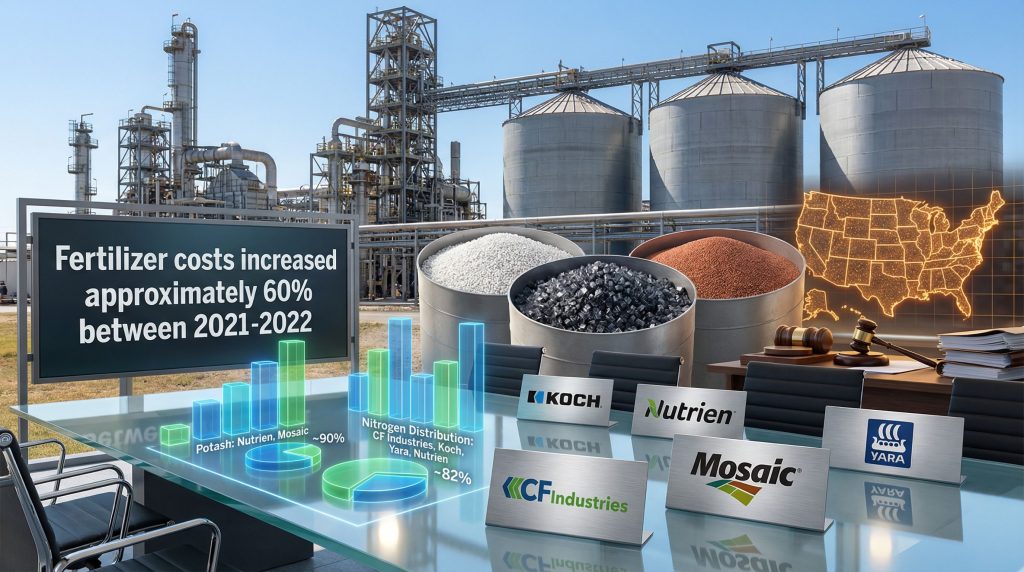
| Potash | Nutrien, Mosaic | ~90% | Duopoly with geographic concentration |
| Phosphate | Nutrien, Mosaic | ~90% | Duopoly with vertical integration |
| Nitrogen Distribution | CF Industries, Koch, Yara, Nutrien | ~82% | Oligopoly with import competition |
Potash Segment Concentration:
Nutrien operates as the world's largest potash producer with vertically integrated distribution networks, while Mosaic controls significant capacity through Carlsbad, New Mexico operations and Canadian partnerships. This 90% combined market share reflects natural geographic monopoly characteristics, as potash production requires specialised geological formations concentrated in Saskatchewan, Canada and New Mexico.
Phosphate Market Dynamics:
Mosaic operates as the single largest US phosphate producer through integrated Florida mining and processing operations, while Nutrien maintains substantial phosphate capacity through partnerships and competitive positioning. Geographic concentration in Florida creates bottlenecks for alternative suppliers seeking market entry.
Nitrogen Market Structure:
CF Industries leads nitrogen production through ammonia synthesis facilities across North America, Koch Industries maintains significant distribution infrastructure, Yara operates international production with North American distribution, and Nutrien maintains smaller nitrogen operations. Despite greater fragmentation compared to potash and phosphate, the 82% concentration level indicates substantial oligopolistic market power.
Geographic Production Concentration Patterns
Production capacity utilisation data reveals supply bottlenecks that limit competitive responses during demand surges. Florida phosphate mining represents the primary North American production hub, creating transportation and processing constraints that affect pricing flexibility.
Potash production concentrates in geological formations that cannot be replicated in alternative locations, establishing permanent geographic advantages for existing operators. Nitrogen production occurs at multiple locations through ammonia synthesis facilities, yet requires substantial natural gas inputs.
Market Concentration Impact: The 90% combined market share in potash and phosphate segments significantly exceeds Department of Justice Herfindahl-Hirschman Index guidelines for presumptive antitrust concern in concentrated markets.
Which Companies Face Federal Antitrust Scrutiny?
Five major corporations constitute the primary targets of federal investigation, each facing distinct regulatory risk profiles based on market position, vertical integration strategies, and recent market behaviour during supply constraints. In addition, this us fertilizer market scrutiny extends beyond individual company actions to examine systemic coordination patterns.
Primary Investigation Targets
Nutrien Ltd.: As the global potash leader with approximately 50% of North American market share, Nutrien faces examination regarding pricing coordination with Mosaic and supply allocation during constrained periods. The company's vertically integrated model combining production, distribution, and retail operations creates potential examination of foreclosure strategies.
Mosaic Co.: The largest US phosphate producer faces intensified scrutiny regarding Q1 2026 export prioritisation during domestic supply constraints. Customer statements indicate the company prioritised higher profits overseas and contract holders over spot buyers while delaying barge releases ahead of spring planting season.
CF Industries Holdings Inc.: Leading US nitrogen producer with substantial ammonia capacity faces examination regarding pricing coordination with international suppliers and potential vertical integration foreclosure strategies limiting independent distributor market access.
Koch Industries: Private company with integrated agricultural input distribution faces investigation of vertical integration foreclosure, specifically whether distribution networks restrict access to independent retailers or preferentially serve Koch-affiliated channels.
Yara International ASA: International nitrogen producer with North American operations faces examination regarding export prioritisation during elevated domestic pricing periods, similar to analysis applied to Mosaic's phosphate export behaviour.
Regulatory Risk Assessment Framework
Criminal liability investigation requires evidence of explicit price coordination agreements, documented communications demonstrating conspiracy intent, or meeting records indicating market allocation schemes. Civil violation assessment examines market power abuse through supply restrictions, discriminatory pricing, or exclusionary distribution practices.
Potential enforcement outcomes range from consent decrees requiring behavioural modifications to structural remedies including divestiture requirements or vertical integration separation. Individual executive liability under Sherman Act provisions represents the most severe enforcement scenario.
What Evidence Supports Price Manipulation Claims?
Statistical analysis of pricing movements, export behaviour during supply constraints, and customer feedback provides multiple evidence streams that regulators can examine for anticompetitive conduct patterns. Furthermore, the connection between these patterns and broader tariffs and market impact considerations adds complexity to the investigation.
Statistical Price Movement Analysis
DAP and MAP prices in New Orleans reached $770 per short ton FOB during the week of April 7-13, 2026, representing the highest levels since September 2022. This pricing approached international CFR pricing for Indian importers at $865/t, reducing traditional geographic arbitrage margins.
Fertiliser costs increased approximately 60% between 2021-2022, imposing an estimated $128,000 in additional expenses per farm operation according to agricultural economic analysis. These cost increases occurred before current Middle East geopolitical disruptions, suggesting structural pricing pressures.
Market Behaviour Pattern Examination
Export Prioritisation During Supply Constraints:
Mosaic exported approximately 201,000 metric tons of DAP and MAP from January through March 2026, representing an increase of at least 85,700 metric tons compared to combined DAP and MAP exports from the entire United States during the same quarter in 2025.
This export surge occurred during domestic supply constraints and elevated pricing, creating regulatory concern regarding profit-maximising strategies that prioritise international markets over domestic farmer accessibility. The timing correlation provides evidence patterns consistent with market power abuse.
Customer Feedback Documentation:
Multiple Mosaic customers publicly stated that the producer appeared to prioritise higher profits overseas while delaying barge releases and limiting spot market availability ahead of spring planting season. This customer testimony creates informal evidence of supply allocation strategies potentially consistent with discriminatory pricing.
Price Coordination Timing:
Regulatory examination focuses on whether price movements across competing producers demonstrate coordination patterns rather than independent competitive responses to market conditions. Synchronised pricing increases during supply disruptions create evidence patterns requiring investigation.
How Are Class Action Lawsuits Reshaping Industry Accountability?
Legal proceedings initiated in March 2026 establish comprehensive framework for examining industry conduct and potential farmer compensation mechanisms. These lawsuits provide alternative enforcement pathways that complement federal antitrust investigation, particularly given broader concerns about agricultural market disruption.
March 2026 Federal Lawsuit Framework
Class action litigation alleges six-company conspiracy dating to January 2020, encompassing nitrogen, phosphate, and potassium price-fixing claims. The lawsuit framework establishes legal mechanisms for quantifying farmer economic damages and pursuing compensation through civil proceedings.
Conspiracy allegations focus on supply restriction methodologies, price coordination timing across competing producers, and market allocation schemes that artificially elevated input costs for agricultural operations. Legal discovery processes will examine internal company communications and pricing decision documentation.
Legal Precedent and Settlement Projections
Historical agricultural antitrust cases provide precedent frameworks for potential settlement structures and compensation methodologies. Previous fertiliser industry litigation established damages calculation models based on price differential analysis compared to competitive market pricing benchmarks.
Settlement projections must account for industry-wide participation, damages quantification complexity, and regulatory coordination with ongoing federal investigation. Potential compensation structures could include direct farmer payments, input cost reduction mechanisms, or structural industry modifications.
Compliance Cost Implications:
Industry participants face substantial legal defence costs, potential settlement exposure, and ongoing compliance monitoring requirements regardless of litigation outcomes. These costs create additional pressure for negotiated resolution rather than extended legal proceedings.
What Role Does Geopolitical Disruption Play in Scrutiny Timing?
Middle East conflict and Strait of Hormuz closure effects amplify existing market concentration concerns by demonstrating vulnerability of oligopolistic market structures to supply disruptions. Moreover, these geopolitical factors intersect with broader Trump tariff implications for agricultural input costs.
Middle East Conflict Impact Assessment
The effective closure of the Strait of Hormuz disrupted approximately 35% of global seaborne urea transit, 20-25% of ammonia trade, 50% of sulphur shipments, and 19% of DAP and MAP trade flows. These disruptions created supply constraints that highlighted domestic market concentration vulnerabilities.
Saudi Arabia serves as a leading DAP and MAP supplier to the US market, while Qatar provides substantial urea imports. The geopolitical disruption of these supply chains increased reliance on domestic production capacity controlled by concentrated market participants.
Export Policy Versus Domestic Supply Balance
Political pressure intensified when domestic producers prioritised international sales during periods of constrained domestic supply and elevated pricing. This behaviour pattern raised questions about producer obligations to serve domestic markets versus profit-maximising export strategies.
Presidential Response Timing:
Executive-level criticism occurred specifically during peak planting season when farmers faced maximum vulnerability to input cost increases. The timing correlation between geopolitical supply disruption and domestic market concentration scrutiny reflects political sensitivity to agricultural sector economic stress.
Congressional Mobilisation:
Democratic lawmakers coordinated letters to USDA urging cost reduction measures directly attributable to Iran-related disruptions, while farmer organisations lobbied for elimination of import barriers that exacerbate supply constraints during international crisis periods.
The next major ASX story will hit our subscribers first
How Are Policymakers Responding to Market Concentration Concerns?
Policy responses encompass trade barrier modification, regulatory investigation coordination, and congressional oversight initiatives designed to address both immediate supply constraints and structural market concentration issues. Additionally, these responses intersect with broader US economy tariffs considerations affecting agricultural competitiveness.
Congressional Oversight Initiatives
Senator Josh Hawley's CEO correspondence campaign requested detailed market behaviour documentation from major fertiliser producers, creating formal record of company responses to concentration allegations. This correspondence creates evidentiary foundation for potential legislative action or regulatory referrals.
Bipartisan farmer association lobbying efforts coordinate more than 60 organisations urging countervailing duty elimination on Moroccan and Russian imports. These lobbying campaigns reflect grassroots pressure for policy modifications that increase competitive alternatives to domestic oligopolistic pricing.
Democratic congressional coordination produces systematic USDA correspondence urging administrative action to reduce farmer input costs during geopolitical disruption periods. This coordination establishes political pressure for executive branch enforcement action.
Trade Policy Intervention Options
Import Barrier Reduction:
Ongoing five-year sunset review of countervailing duties on phosphate imports from Morocco and Russia provides immediate policy intervention opportunity. Elimination of these duties could increase competitive pressure on domestic producers while providing farmers alternative supply sources.
Shipping Restriction Modifications:
Jones Act shipping restriction temporary waivers reduce transportation costs for domestic fertiliser distribution. These modifications address infrastructure bottlenecks that compound market concentration effects.
Alternative Supplier Development:
Venezuelan nitrogen import barrier elimination provides additional competitive supply sources. These policy changes reduce dependence on concentrated domestic production capacity during supply disruption periods.
What Compliance Frameworks Are Emerging for Fertilizer Producers?
Regulatory development encompasses monitoring requirements, transparency mandates, and market competition enhancement strategies designed to prevent future anticompetitive conduct. In particular, these frameworks respond to federal investigations into pricing practices that have intensified throughout 2026.
Antitrust Monitoring Requirements
Price coordination prevention protocols require documentation of independent pricing decision-making processes, elimination of competitor communication regarding pricing or supply allocation, and establishment of compliance monitoring systems. These protocols ensure transparency in pricing methodologies across major producers.
Supply allocation transparency mandates establish reporting requirements for export versus domestic sales ratios, capacity utilisation disclosure, and advance notification of supply allocation modifications during constraint periods. Such transparency mechanisms enable regulatory oversight of market behaviour.
Export notification and approval processes create regulatory oversight of international sales during periods of domestic supply constraints or elevated pricing. These mechanisms balance profit-maximising export strategies with domestic market service obligations.
Market Competition Enhancement Strategies
Import Facilitation Mechanisms:
Streamlined approval processes for international fertiliser imports reduce barriers for alternative suppliers seeking US market access. These mechanisms increase competitive pressure on domestic concentrated producers through enhanced supply chain diversification.
Independent Distribution Support:
Regulatory frameworks supporting independent fertiliser distribution networks reduce vertical integration advantages that foreclose competitive alternatives. These initiatives enhance market access for farmers seeking competitive input sources.
Production Capacity Diversification:
Policy frameworks encouraging domestic production capacity expansion by new market entrants create competitive alternatives to existing concentrated market structure. However, geological and capital constraints limit effectiveness of such initiatives.
How Will Regulatory Outcomes Transform Industry Structure?
Enforcement scenarios range from behavioural modification requirements to structural industry reorganisation, each creating distinct competitive dynamics and farmer cost implications. Consequently, the us fertilizer market scrutiny will likely produce lasting changes regardless of specific enforcement outcomes.
Potential Divestiture Scenarios
Vertical integration separation requirements could mandate divestiture of production, distribution, or retail operations to eliminate foreclosure strategies. Such separation would create independent competitive entities serving different supply chain functions.
Regional production asset redistribution might require capacity divestiture to new market entrants, reducing geographic concentration and creating competitive alternatives in historically monopolised regions. Nevertheless, geological constraints limit feasibility of such redistributions in potash and phosphate segments.
Independent distribution network development could mandate access requirements for competing distributors, eliminating exclusive dealing arrangements that foreclose competitive alternatives. These requirements would enhance farmer access to competitive pricing options.
Long-term Market Competition Projections
New Entrant Facilitation:
Regulatory frameworks reducing barriers to entry could encourage international producers to establish North American operations, increasing competitive pressure through capacity expansion and technological innovation.
Price Transparency Systems:
Real-time pricing disclosure requirements eliminate information asymmetries that enable coordinated pricing behaviour while providing farmers enhanced market intelligence for procurement decisions.
Farmer Cooperative Development:
Policy support for farmer cooperative purchasing arrangements increases buyer market power, creating competitive balance against concentrated seller market structure. These arrangements leverage collective bargaining to reduce input costs.
What Monitoring Systems Will Prevent Future Market Manipulation?
Surveillance infrastructure development encompasses real-time pricing monitoring, international coordination frameworks, and early warning systems designed to detect anticompetitive behaviour patterns. Furthermore, these systems integrate with broader agricultural market oversight mechanisms.
Real-time Price Surveillance Infrastructure
DOJ-USDA joint monitoring protocols establish ongoing market surveillance capabilities examining pricing patterns, supply allocation decisions, and competitive behaviour indicators. These systems create continuous oversight replacing episodic investigation approaches.
Industry reporting standardisation requirements mandate uniform disclosure of pricing methodologies, capacity utilisation data, and supply allocation criteria. Standardised reporting enables regulatory comparison across producers and identification of coordination patterns.
Early warning system development identifies price anomalies, supply constraint patterns, or market behaviour indicators suggesting potential anticompetitive conduct. These systems enable proactive intervention rather than reactive investigation following market manipulation.
International Coordination Frameworks
Cross-border antitrust enforcement cooperation facilitates coordination with Canadian and international competition authorities examining global fertiliser market concentration. International cooperation prevents regulatory arbitrage and ensures comprehensive market oversight.
Global fertiliser market stability mechanisms coordinate international response to supply disruptions, reducing vulnerability to market manipulation during geopolitical crisis periods. These frameworks balance domestic market protection with international trade obligations.
Strategic reserve policy development considers government stockpiling mechanisms that provide market stability during supply disruption periods while reducing producer market power during crisis situations. However, storage costs and product degradation limit practical implementation.
This analysis is based on public regulatory filings, congressional correspondence, and market data as of April 2026. Readers should consult legal and financial advisors regarding specific compliance requirements and investment decisions related to fertiliser market developments.
Ready to Capitalise on Agricultural Market Disruptions?
Discovery Alert's proprietary Discovery IQ model delivers real-time alerts on significant ASX mineral discoveries, including critical agricultural inputs like potash and phosphate that are driving current market volatility. Understand why major discoveries can lead to substantial returns during periods of market concentration and supply chain disruption, then begin your 14-day free trial today to position yourself ahead of emerging opportunities.