August 14, 2026
The Waterway That Moves the World: Inside the US Military Action Against Iranian Tankers in the Strait of Hormuz
Every barrel of oil that defines the economic rhythms of Asia, every LNG cargo that heats homes across South Korea and Japan, and every petrochemical shipment feeding industrial supply chains across the Indo-Pacific region passes through a corridor barely 33 kilometres wide at its narrowest point. The Strait of Hormuz is not simply a geographic fact on a map. It is the compressed artery through which the global economy breathes, and US fires on Iranian tankers in the Strait of Hormuz has now placed that artery under acute pressure.
When military force enters that space, the consequences are not contained to the vessels involved. They cascade across commodity markets, diplomatic back-channels, and the energy security calculus of nations thousands of kilometres away. Furthermore, the crude oil price volatility that follows such events can reshape entire regional economies within days.
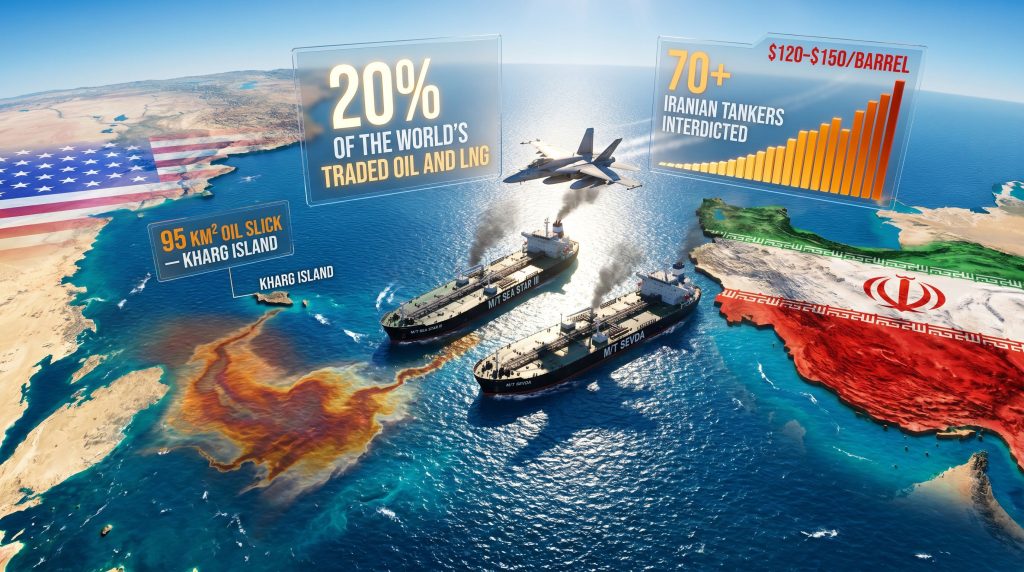
On May 8, 2026, US forces fired on and disabled two Iranian oil tankers, the M/T Sea Star III and the M/T Sevda, in what US Central Command described as enforcement of its naval blockade of Iranian ports. The action followed overnight exchanges of fire in the strait and US strikes on Iranian military facilities at Qeshm Island, Khamir, and Sirik. What was already one of the most consequential maritime confrontations in recent history took on new dimensions of complexity, urgency, and risk.
When big ASX news breaks, our subscribers know first
Why the Strait of Hormuz Cannot Be Replaced or Rerouted
The strategic weight of the Strait of Hormuz is built on a simple and irreplaceable geographic reality. There is no alternative passage of comparable capacity. Alternative routes such as the Suez Canal or rounding the Cape of Good Hope add thousands of nautical miles to journey times, dramatically increasing freight costs and straining tanker fleet capacity.
Under normal operating conditions, the volume of energy transiting the strait is staggering:
- Approximately 17 to 21 million barrels of crude oil transit the strait daily
- The waterway accounts for roughly 20% of all globally traded oil and liquefied natural gas
- Saudi Arabia, Iraq, Kuwait, the UAE, and Iran all depend on the strait as their primary export corridor
- Key commodity categories at risk include crude oil, LNG, refined petroleum products, fertilisers, and petrochemicals
The exposure is not evenly distributed across importing nations. South Korea provides perhaps the starkest illustration of strait dependency. In 2025, more than 60% of the country's crude oil imports transited the Strait of Hormuz. A single tanker arriving off the South Korean coast in mid-April 2026, having successfully transited the strait despite Iran's effective closure, carried approximately 1 million barrels of crude, representing a cargo valued at roughly USD $70 to $80 million at prevailing market prices.
How a Blockade Differs from an Armed Skirmish
Understanding the current situation requires distinguishing between two overlapping but legally distinct forms of military action unfolding simultaneously in the same waterway.
| Feature | Naval Blockade | Armed Skirmish |
|---|---|---|
| Legal Classification | Act of war under international law | Tactical military engagement |
| Duration | Sustained over time | Episodic |
| Economic Impact | Systemic disruption to trade | Localised damage |
| Diplomatic Threshold | Requires formal justification | Often managed bilaterally |
| Current US-Iran Status | Active (US blockade of Iranian ports) | Active (ongoing exchanges of fire) |
The current US-Iran confrontation combines both categories simultaneously, creating one of the most legally and strategically layered maritime conflicts in modern history. This dual nature complicates both legal classification and diplomatic resolution.
The Escalation Timeline: From Campaign Launch to Tanker Strikes
The events of May 8 and 9, 2026 did not emerge spontaneously. They represent the latest chapter in a rapidly escalating sequence that began more than two months earlier. Understanding the chronological architecture of this conflict is essential to assessing where it may go next. Indeed, the broader geopolitical risk landscape across the region has been shifting dramatically since early 2026.
- February 28, 2026 – A coordinated US-Israel military campaign against Iran is launched, triggering Iran's effective closure of the Strait of Hormuz to non-allied shipping and producing an immediate global fuel price spike
- Mid-April 2026 – Despite the closure, at least one tanker successfully transits the strait, arriving off South Korea's coast carrying 1 million barrels of crude
- Early May 2026 – Iran establishes the Persian Gulf Strait Authority, a government agency designed to vet vessels and levy fees on those seeking passage through the strait, prompting sharp US condemnation from Secretary of State Marco Rubio
- May 7, 2026 (Thursday night) – Iran allegedly launches coordinated missile, drone, and small boat attacks against three US Navy destroyers in the strait; the US responds with strikes on Iranian military facilities
- May 8, 2026 (Friday) – CENTCOM confirms US forces fired on and disabled the M/T Sea Star III and M/T Sevda to prevent them from docking at an Iranian port on the Gulf of Oman
- May 9, 2026 – The UAE reports a separate Iranian attack involving two ballistic missiles and three drones; three people are wounded after air defence systems engage the projectiles
What It Means to "Disable" a Tanker Rather Than Sink It
A critical and often overlooked distinction in the May 8 US strikes is the specific methodology employed. Rather than sinking the targeted vessels outright, which would represent a dramatically sharper escalation under international maritime law, US forces applied what military analysts describe as a graduated force doctrine.
Pentagon-released video footage showed F/A-18 jets conducting precision strikes on specific components:
- Smokestacks were targeted to disable propulsion systems
- Rudders were struck to eliminate navigational control
This approach renders vessels immobile without destroying them entirely, preserving what strategists call diplomatic off-ramps. It is a deliberate signal of capability and intent without crossing the threshold of outright vessel destruction. The graduated nature of the force also serves a legal function, distinguishing interdiction from acts of war under the UN Convention on the Law of the Sea.
As of May 9, 2026, CENTCOM reported that more than 70 Iranian tankers had been blocked from entering or leaving Iranian ports under the US naval blockade. This figure represents the cumulative economic weight of the interdiction campaign against Tehran's energy export infrastructure.
Iran's Persian Gulf Strait Authority: A Bid to Institutionalize Control
Among the most strategically significant developments of the past week is one that has received comparatively less attention than the tanker strikes themselves. Iran's establishment of the Persian Gulf Strait Authority, first reported by Lloyd's List Intelligence, represents an attempt to transform de facto military control over the waterway into a formal bureaucratic and legal framework.
What the Persian Gulf Strait Authority does in practice:
- Vets commercial vessels seeking transit rights through the strait
- Levies passage fees on non-allied shipping
- Creates an institutional structure that legitimises Iranian sovereignty claims over an internationally recognised waterway
- Positions Iran to extract revenue from global commerce even under conditions of military conflict
Secretary of State Marco Rubio characterised the arrangement as unacceptable, framing the core question in stark terms: whether the international community would allow a single nation to effectively privatise passage through one of the world's most critical maritime corridors. Hundreds of commercial vessels are now reported to be bottled up inside the Persian Gulf, unable to reach open sea routes. The human and commercial cost of this backlog is compounding daily.
Global Energy Markets Under Strain: Which Economies Face the Greatest Exposure?
The effective closure of the Strait of Hormuz since late February 2026 has produced measurable disruptions across global energy markets. The first major supply shock of this magnitude since the 2019 Abqaiq-Khurais attacks in Saudi Arabia has forced importing nations to implement emergency measures. Consequently, the oil price shock reverberating through this disruption is being felt from Seoul to Rotterdam.
| Region or Country | Strait of Hormuz Dependency | Immediate Policy Response |
|---|---|---|
| South Korea | Over 60% of crude imports | Fuel price caps on gasoline and petroleum products |
| China | Significant (continues Iran oil imports) | Diplomatic concern expressed; ongoing imports |
| India | Major Gulf crude importer | Situation monitored closely |
| Europe | Moderate (diversified supply base) | Watching LNG market impact |
| UAE | Located within the Persian Gulf | Air defence activation; three casualties reported |
China's position deserves particular scrutiny. Despite the effective closure of the strait and the US naval blockade, Beijing has continued importing Iranian crude oil. A Chinese-crewed tanker registered in the Marshall Islands was attacked near the strait, prompting China's Foreign Ministry to express concern while confirming no casualties were reported.
China's continued engagement with Iranian oil markets simultaneously undermines the economic pressure logic of the US naval blockade and creates potential friction points between Washington and Beijing. In addition, the wider global trade tensions between the two powers add another layer of complexity to an already fraught situation.
The Environmental Crisis Unfolding Beneath the Headlines
Layered beneath the geopolitical confrontation is an emerging environmental emergency that has received insufficient attention relative to its potential consequences.
Satellite imagery reviewed by the Associated Press revealed an oil slick of approximately 95 square kilometres (36 square miles) in the Persian Gulf, appearing to originate from the western side of Kharg Island, Iran's primary crude export terminal. The key facts as currently understood:
- The slick was first detected in satellite imagery taken on Tuesday, May 6, 2026
- Maritime intelligence data indicated the slick was spreading southwest at approximately 2 kilometres (1.2 miles) per hour at the time of detection
- Greenpeace Germany's international crisis operations expert Nina Noelle warned that ecologically sensitive and protected marine areas in the Gulf face contamination risks if the slick continues drifting southward
- The Pentagon has declined to confirm whether US military strikes contributed to the spill or whether recent strikes targeted Kharg Island
Based on the timing of satellite imagery, the spill appears to have begun before the most recent round of US strikes, though the full causal chain remains unclear. The intersection of military conflict and environmental disaster adds a humanitarian dimension to an already acute geopolitical crisis.
The Diplomatic Race: US Demands, Iranian Conditions, and Pakistan's Mediation
Even as military exchanges continue, a parallel diplomatic track remains active. Washington has presented Tehran with a framework proposal built around three core demands:
- Reopening the Strait of Hormuz to international commercial shipping without Iranian interference or taxation
- Dissolving the Persian Gulf Strait Authority and abandoning Iranian claims to institutional control over the waterway
- Rolling back Iran's nuclear programme, a longstanding strategic objective shared by the US and Israel
Iran's Foreign Minister Abbas Araghchi publicly condemned ongoing US military action as a violation of the existing ceasefire, arguing that Washington repeatedly opts for military escalation whenever a diplomatic solution appears within reach. Pakistani Prime Minister Shehbaz Sharif confirmed that Islamabad has maintained continuous contact with both Washington and Tehran in an effort to facilitate a negotiated settlement and extend the ceasefire framework.
President Trump has maintained publicly that the ceasefire remains in effect while simultaneously threatening to resume full-scale bombing if Iran rejects the US proposal. The simultaneous prosecution of military operations and ceasefire claims by both sides reflects a fundamental instability in the current framework, one with no formal verification mechanism and no neutral enforcement body.
The next major ASX story will hit our subscribers first
Three Scenarios: Where This Confrontation Could Go Next
The following scenario projections are analytical frameworks based on available information and should not be interpreted as predictions. Geopolitical situations of this complexity carry significant uncertainty, and outcomes may diverge substantially from any modelled pathway.
Scenario 1: Negotiated De-escalation (Moderate Probability)
Iran accepts a modified version of the US proposal. The strait reopens under some form of international monitoring arrangement. The US lifts the blockade in phases while nuclear talks resume in a parallel track. Market impact would likely include rapid oil price normalisation and resumption of commercial shipping within weeks.
Scenario 2: Frozen Conflict (High Probability Near-Term)
The ceasefire nominally holds but episodic military exchanges continue. Diplomatic talks stall without a breakthrough. The strait remains partially closed and commercial shipping increasingly reroutes via the Cape of Good Hope, adding weeks to journey times and substantially increasing freight costs. Furthermore, the LNG supply outlook for Asian import-dependent economies would deteriorate considerably under this scenario.
Scenario 3: Full Escalation (Lower Probability, High Consequence)
Iran formally rejects the US proposal and Trump authorises a resumed bombing campaign. Iran responds with a comprehensive strait closure and regional missile strikes. Gulf Arab states are drawn deeper into the conflict. Market impact could include oil prices reaching the USD $120 to $150 per barrel range and an acute LNG supply crisis across Asian import-dependent economies.
Frequently Asked Questions: Understanding the US-Iran Strait of Hormuz Conflict
What is the Strait of Hormuz and why does it matter globally?
The Strait of Hormuz is a narrow maritime corridor between Iran and the Arabian Peninsula through which approximately 20% of the world's oil and LNG passes daily. Its disruption has immediate consequences for global energy prices and supply chains across Asia, Europe, and beyond.
Why did US forces fire on the Iranian tankers?
CENTCOM reported that US forces targeted and disabled the M/T Sea Star III and M/T Sevda after the vessels attempted to breach the US naval blockade of Iranian ports. The action was framed as blockade enforcement rather than an offensive strike, with graduated force used to immobilise rather than sink the tankers.
Is there an active ceasefire between the US and Iran?
A ceasefire has been nominally in effect for approximately one month as of May 9, 2026, but both sides accuse the other of violations. Military exchanges have continued throughout the ceasefire period, and the framework lacks any formal verification mechanism.
How many Iranian tankers has the US interdicted?
CENTCOM reported that more than 70 Iranian tankers had been prevented from entering or leaving Iranian ports under the US naval blockade as of May 9, 2026.
What is the Persian Gulf Strait Authority?
It is a newly established Iranian government agency that vets and taxes commercial vessels seeking passage through the Strait of Hormuz. US officials have characterised it as an illegal attempt to exert sovereign control over an internationally recognised maritime corridor.
Which countries face the greatest energy supply risk?
South Korea, with over 60% crude import dependency through the strait, faces the most acute near-term exposure. China, India, Japan, and European LNG importers face significant but varying levels of vulnerability depending on their supply diversification and strategic reserve levels.
Key Facts at a Glance
- US fires on Iranian tankers in the Strait of Hormuz marked a significant escalation, with the M/T Sea Star III and M/T Sevda disabled using graduated force targeting propulsion and navigation systems
- More than 70 Iranian tankers have been interdicted under the US naval blockade since the conflict began in late February 2026
- A 95 square kilometre oil slick near Kharg Island represents an emerging environmental crisis running parallel to the geopolitical one
- Iran's Persian Gulf Strait Authority marks a significant attempt to institutionalise control over a globally critical waterway through formal bureaucratic structures
- South Korea has implemented domestic fuel price caps in direct response to strait closure disruption
- Pakistan is serving as an active third-party mediator between Washington and Tehran
- The UAE reported Iranian missile and drone attacks on May 9, 2026, resulting in three casualties after air defence systems engaged the projectiles
Disclaimer: This article is based on information available as of May 9, 2026, as reported by the Associated Press and ETEnergyworld. The situation remains fluid and rapidly evolving. Scenario projections and market impact assessments represent analytical frameworks, not financial advice or verified predictions. Readers are encouraged to consult primary sources and up-to-date reporting for the latest developments.
Want to Know Which ASX Mineral Discoveries Could Deliver Outsized Returns Amid Global Energy Volatility?
Geopolitical disruptions like the Strait of Hormuz crisis routinely reshape commodity markets overnight, creating urgent opportunities for investors positioned ahead of the curve — Discovery Alert's proprietary Discovery IQ model scans ASX announcements in real time, instantly identifying significant mineral discoveries across more than 30 commodities and translating complex data into clear, actionable insights. Explore how historic discoveries have generated substantial returns on Discovery Alert's dedicated discoveries page, and begin your 14-day free trial today to ensure you're never the last to know when the next major find is announced.