August 14, 2026
Understanding the Economic Stakes Behind Diplomatic Deadlock
Global energy markets face unprecedented structural shifts as US Iran ceasefire talks continue to stall, with critical infrastructure becoming weaponised in modern conflict resolution. The transformation of physical chokepoints into negotiation leverage points represents a fundamental departure from traditional diplomatic mechanisms, creating new paradigms for international economic pressure that extend far beyond conventional sanctions frameworks.
Financial architecture itself has evolved into a primary battlefield where asset freezing and banking restrictions serve as non-kinetic warfare tools. This evolution demonstrates how monetary policy infrastructure transforms into strategic leverage during geopolitical crises, fundamentally altering the cost-benefit calculations governing both military intervention and economic coercion strategies.
The current crisis illuminates how 20% of global oil and liquefied natural gas transit volumes passing through a single waterway creates asymmetrical leverage that transcends traditional military power balances. Furthermore, when critical energy infrastructure becomes contested, the resulting economic disruption patterns create winners and losers across global markets in ways that reshape international trade relationships permanently.
When big ASX news breaks, our subscribers know first
What Economic Leverage Points Drive US-Iran Ceasefire Dynamics?
Strategic Asset Freezing and Financial Warfare
Modern conflict resolution increasingly relies on sophisticated financial pressure mechanisms that operate independently of traditional military engagement. The weaponisation of international banking systems and asset control creates sustained economic leverage that can outlast kinetic military operations while maintaining political pressure across multiple negotiation cycles.
Iranian asset unfreezing demands highlight how financial infrastructure control has become central to contemporary diplomatic frameworks. Historical precedents from the 2015 Joint Comprehensive Plan of Action demonstrate the scale of this leverage, when approximately $100-150 billion in previously frozen assets became accessible through negotiated agreements, illustrating the magnitude of financial tools available in security negotiations.
The Office of Foreign Assets Control (OFAC) sanctions programmes create cascading financial isolation effects that extend beyond direct bilateral relationships. Secondary sanctions exposure forces international banks and corporations to choose between Iranian market access and US financial system participation, creating a global compliance framework that amplifies American economic leverage exponentially.
Key Financial Pressure Mechanisms:
- OFAC sanctions programmes restricting US financial system access
- Dollar-denominated transaction prohibitions
- International correspondent banking relationship limitations
- Trade finance mechanism disruptions
- Secondary sanctions penalties for facilitating Iranian transactions
Energy Infrastructure as Negotiation Currency
The Strait of Hormuz blockade exemplifies how critical infrastructure control transforms into bargaining currency in contemporary diplomatic negotiations. Unlike traditional military engagement, infrastructure-based economic warfare creates sustained pressure without requiring continuous kinetic operations, making it a preferred mechanism for asymmetrical conflict strategies.
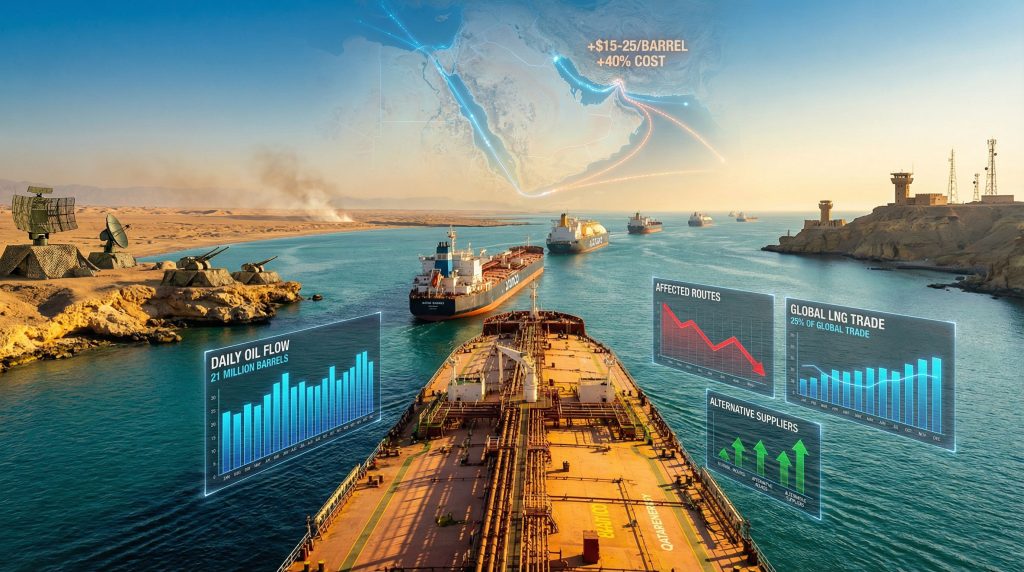
Current blockade conditions have suspended 21 million barrels per day of oil price movements transit, representing complete closure of this critical chokepoint. Recovery timelines project 6-8 weeks to restore normal operations once political agreements are reached, demonstrating both the immediate economic impact and the extended reconstruction challenges inherent in infrastructure-based conflict resolution.
LNG market disruptions compound the energy security challenges, with alternative routing creating cost premiums of 40% above normal transportation expenses. These elevated costs reflect not only extended voyage distances via the Cape of Good Hope route but also insurance market responses to geopolitical risk, with war risk premiums increasing 300-500% during active blockade conditions.
Moreover, maritime insurance markets price infrastructure conflict risk through sophisticated risk transfer mechanisms that create persistent cost elevation even after immediate threats subside. Lloyd's of London and international maritime insurers maintain elevated premiums for 12-18 months following conflict resolution, reflecting learned institutional memory about chokepoint vulnerability and precedent-setting concerns for future infrastructure-based conflicts.
How Does Strait of Hormuz Control Impact Global Supply Chain Economics?
Quantifying the 20% Global Energy Transit Bottleneck
The geographic characteristics of the Strait of Hormuz create unique economic vulnerability patterns that extend far beyond immediate energy price impacts. At its narrowest point of 21 nautical miles, this waterway represents an irreplaceable transit corridor for Gulf energy exports, with no practical alternatives for the majority of regional production capacity.
Strait of Hormuz Economic Impact Analysis
| Metric | Pre-Conflict | During Blockade | Projected Recovery |
|---|---|---|---|
| Daily Oil Transit | 21 million barrels | 0 barrels | 6-8 weeks to restore |
| LNG Shipments | 25% of global trade | Suspended | Alternative routes +40% cost |
| Insurance Premiums | Standard rates | +300-500% | 12-18 months normalisation |
| Alternative Route Costs | Baseline | +$15-25/barrel | Gradual reduction |
Alternative routing economics reveal the true cost structure of chokepoint dependency. Cape of Good Hope diversions add approximately 6,000+ additional nautical miles to standard voyages, requiring 2-3 weeks of additional sailing time and creating fuel consumption increases that compound the direct transportation cost premiums.
Additionally, Suez Canal toll structures add $300,000-600,000 per vessel transit, creating additional cost layers for already-stressed alternative routing options. These cumulative expenses demonstrate why infrastructure chokepoint control creates such powerful economic leverage, as alternatives prove both costly and capacity-constrained during extended closure periods.
Regional Economic Redistribution Effects
Energy supply disruptions create asymmetrical market impacts that benefit non-Gulf producers while creating supply security crises for import-dependent economies. US shale producers, Norwegian North Sea operators, and Brazilian pre-salt facilities experience windfall profits and expanded export opportunities during Gulf supply disruptions.
Asian economies face disproportionate impacts due to their structural dependence on Gulf energy imports. India, Japan, South Korea, and China must navigate price escalation and supply security risks while developing emergency procurement protocols that prioritise supply availability over cost optimisation.
Consequently, strategic petroleum reserve mobilisation becomes critical for import-dependent nations during extended supply disruptions. Coordinated release mechanisms demonstrate evolving international cooperation frameworks, though reserve capacity limitations create natural constraints on how long supply substitution can be maintained without permanent market adjustments.
What Are the Macroeconomic Implications of Extended Energy Disruption?
Inflation Transmission Mechanisms
Energy price volatility creates cascading effects throughout transportation, manufacturing, and consumer goods sectors that complicate central bank policy responses. The persistence of energy-driven inflation during supply disruptions conflicts with growth preservation objectives, creating complex monetary policy dilemmas for major economies.
Transportation cost increases transmit energy price shocks throughout global supply chains, affecting everything from agricultural products to manufactured goods. These second-order effects often persist longer than initial energy price spikes, creating sustained inflationary pressure that requires coordinated policy responses across multiple economic sectors.
Furthermore, central banks face unprecedented challenges when energy supply disruptions create inflation that cannot be addressed through traditional demand management tools. Supply-side price pressures require different policy frameworks than demand-driven inflation, necessitating coordination between monetary authorities and strategic reserve management agencies.
Strategic Reserve Utilisation Patterns
Government strategic reserve deployments reveal varying approaches to energy security management across different economies. Coordinated releases from strategic petroleum reserves demonstrate evolving international cooperation mechanisms during supply crises, though effectiveness depends on reserve capacity and consumption patterns.
Reserve depletion timelines become critical factors in determining policy sustainability during extended disruptions. Most strategic reserves are designed for 90-120 day emergency coverage, creating natural limits on how long supply substitution can bridge infrastructure disruptions without permanent market restructuring.
How Do Military Buildups Influence Energy Market Psychology?
Defence Spending Multiplier Effects
Military deployment escalation creates dual economic impacts through immediate defence contractor benefits and longer-term fiscal implications for sustained engagement. US naval operations in the Persian Gulf require specialised mine countermeasure vessels and extended patrol capabilities that drive defence spending increases across multiple budget categories.
Mine warfare capabilities represent particularly sophisticated naval technologies that require specialised equipment and training. Iranian Islamic Revolutionary Guard Corps mine deployment capabilities create credible blockade mechanisms that necessitate equally sophisticated countermeasures, driving defence innovation and procurement cycles.
In addition, defence contractor equity performance during infrastructure conflicts demonstrates market confidence in sustained military engagement requirements. Companies specialising in naval mine warfare, maritime patrol aircraft, and regional logistics support experience sustained demand increases that extend beyond immediate conflict timelines.
Market Risk Premium Calculations
Financial markets price not only current disruption impacts but also the precedent-setting nature of infrastructure-based economic warfare. This precedent concern creates persistent risk premiums that outlast immediate conflict resolution, fundamentally altering how markets assess geopolitical risk in energy infrastructure investments.
Infrastructure-based economic warfare creates precedent effects that fundamentally alter long-term risk assessment frameworks, establishing persistent market premiums that reflect institutional learning about chokepoint vulnerability and the effectiveness of non-kinetic economic pressure mechanisms.
Equity market volatility indices reflect both immediate conflict impacts and longer-term structural concerns about infrastructure vulnerability. Energy sector stocks experience particular volatility as markets reassess the sustainability of traditional supply chain assumptions and infrastructure dependency patterns.
What Economic Models Predict Post-Conflict Market Behaviour?
Recovery Timeline Scenarios
Three distinct economic recovery pathways emerge based on different negotiation outcome scenarios, each creating different long-term structural impacts on global energy markets and international trade relationships.
Rapid Resolution (2-4 weeks) scenarios assume quick political agreement and immediate infrastructure restoration. This pathway creates minimal long-term structural changes, with price normalisation and traditional supply chain restoration within standard market adjustment timeframes.
Extended Stalemate (3-6 months) scenarios drive permanent shifts toward alternative suppliers and routing mechanisms. Corporate supply chain managers implement diversification strategies that persist beyond conflict resolution, creating new trade relationships and shipping route dependencies that permanently alter market structure.
Escalation Scenario outcomes require fundamental restructuring of global energy trade patterns, accelerating transitions toward renewable energy infrastructure and geographically diversified supply chains that reduce chokepoint dependency over strategic timeframes.
Investment Flow Redirection Patterns
Prolonged energy supply uncertainty accelerates capital allocation toward renewable energy infrastructure, energy storage technologies, and supply chain diversification projects. These investment pattern shifts create structural market changes that persist regardless of immediate conflict resolution outcomes.
Energy storage and battery technology investments receive increased funding during infrastructure conflicts as corporations and governments seek to reduce supply chain vulnerability through technological solutions. These investment flows create innovation acceleration patterns that compound over time.
The next major ASX story will hit our subscribers first
How Are Regional Economies Adapting to Energy Supply Uncertainty?
Asian Market Diversification Strategies
Major Asian energy importers implement emergency procurement protocols that prioritise supply security over traditional cost optimisation frameworks. These adaptations create new trade relationships with non-traditional suppliers and establish alternative supply chain routes that influence long-term market structure.
Emergency procurement mechanisms often involve premium pricing arrangements and flexible contract terms that create new supplier relationship models. These arrangements frequently outlast immediate crisis periods as importers value supply security over marginal cost advantages.
Additionally, regional cooperation frameworks emerge as Asian economies coordinate strategic reserve sharing and alternative supply development. These cooperation mechanisms create new institutional relationships that influence long-term energy security planning and regional integration patterns.
European Energy Security Recalibration
European energy independence initiatives receive accelerated implementation during Middle Eastern supply disruptions. This acceleration represents fundamental shifts in transatlantic energy trade dynamics and European strategic autonomy objectives that extend beyond immediate crisis management.
Renewable energy investment timelines compress as European governments prioritise energy independence over traditional cost-benefit optimisation. These accelerated deployment patterns create new industrial capacity and technological innovation cycles that reshape European energy markets permanently.
What Financial Market Mechanisms Emerge During Energy Crises?
Commodity Market Volatility Management
New hedging instruments and risk management products develop to address prolonged energy supply uncertainty challenges. Financial innovation during crisis periods often creates permanent additions to risk management toolkits that influence how corporations approach energy price risk in long-term strategic planning.
Energy derivatives markets expand to accommodate new risk categories related to infrastructure vulnerability and supply chain disruption. These market innovations provide price discovery mechanisms for previously unhedged risks while creating new liquidity pools for energy market participants.
Currency Impact Patterns
Energy supply disruptions create divergent currency performance patterns between energy importers and exporters. Import-dependent currencies experience pressure while energy-exporting nations benefit from strengthened exchange rates, influencing international trade competitiveness and monetary policy coordination requirements.
Currency hedging mechanisms evolve to accommodate energy-related exchange rate volatility that extends beyond traditional economic fundamentals. These hedging innovations help corporations manage the intersection of energy price risk and currency exposure during infrastructure conflicts.
How Do Negotiation Failures Create Long-Term Economic Restructuring?
Supply Chain Resilience Investment
Corporate responses to energy supply uncertainty drive permanent changes in supply chain design, inventory management, and geographic diversification strategies. These adaptations create new economic efficiency patterns that outlast immediate crisis periods while establishing precedents for future risk management approaches.
Inventory management strategies shift toward higher safety stock levels and alternative supplier qualification during infrastructure conflicts. These operational changes create cost structure modifications that influence long-term competitiveness and profitability patterns across multiple industries.
Geopolitical Risk Premium Integration
Financial markets develop more sophisticated frameworks for pricing geopolitical risk in energy infrastructure investments. This analytical evolution influences capital allocation decisions across multiple sectors and geographic regions while establishing new standards for infrastructure vulnerability assessment.
Infrastructure investment decision frameworks incorporate chokepoint dependency analysis and alternative routing assessments that previously received limited consideration. These analytical improvements create new investment criteria that influence long-term capital allocation patterns and project evaluation methodologies.
What Broader Implications Emerge from Failed Peace Negotiations?
The breakdown of US Iran ceasefire talks has created ripple effects that extend far beyond the immediate regional context. According to recent diplomatic developments reported by Al Jazeera, the failure to reach a comprehensive peace agreement has intensified global market uncertainty and accelerated structural changes in international energy markets.
Furthermore, the US-China trade war effects compound the complexity of energy security challenges, particularly as Beijing navigates between maintaining Iranian energy relationships and preserving access to US financial systems. This triangular dynamic creates additional layers of economic complexity that influence regional supply chain decisions.
The persistent energy supply uncertainty has accelerated investment flows toward lithium industry innovations and critical minerals and energy security initiatives, as corporations and governments seek to reduce dependency on traditional hydrocarbon supply chains. These investment patterns represent fundamental shifts in energy transition timelines that outlast immediate geopolitical tensions.
Disclaimer: This analysis involves forecasts and speculation about geopolitical events and market behaviour. Economic projections and scenario analysis are subject to significant uncertainty and should not be considered as investment advice. Readers should conduct independent research and consult qualified professionals before making financial decisions based on geopolitical risk assessments.
The evolution of infrastructure-based conflict resolution creates new categories of international economic pressure that require updated analytical frameworks and policy responses. These developments influence not only immediate crisis management but also long-term strategic planning across energy security, financial risk management, and international trade relationship structures. However, the challenge of escalating US tariffs and inflation pressures further complicates the economic calculus for all parties involved in the negotiations, as detailed in comprehensive coverage by The Guardian.
Are You Looking to Capitalise on Energy Market Volatility?
While energy crises create market uncertainty, they also generate significant opportunities for investors who can identify the right mineral exploration companies early. Discovery Alert's proprietary Discovery IQ model delivers instant notifications on major ASX mineral discoveries, transforming complex geological data into actionable investment insights that could benefit from heightened commodity demand during supply chain disruptions. Start your 14-day free trial today to position yourself ahead of market-moving discoveries before they hit mainstream investor attention.