May 21, 2026
Complex macroeconomic cycles often hinge on unexpected diplomatic breakthroughs that reshape global commodity markets within hours rather than months. The intricate web connecting geopolitical negotiations to refined petroleum pricing demonstrates how fragile supply chains can experience rapid recalibration when critical transit chokepoints face potential reopening. The US and Iran ceasefire affects European oil product prices in ways that extend far beyond immediate market reactions, requiring examination of both immediate responses and underlying structural vulnerabilities that persist beyond temporary diplomatic solutions.
Analysing the Market Psychology Behind Energy Price Volatility
The temporary halt in US-Iran hostilities has triggered substantial recalibration across European refined product markets, with distinct patterns emerging that reflect deeper structural imbalances rather than simple supply-demand mechanics. This diplomatic window, announced on April 7, 2026, created immediate market adjustments that reveal the complex interplay between geopolitical risk premiums and fundamental commodity pricing mechanisms.
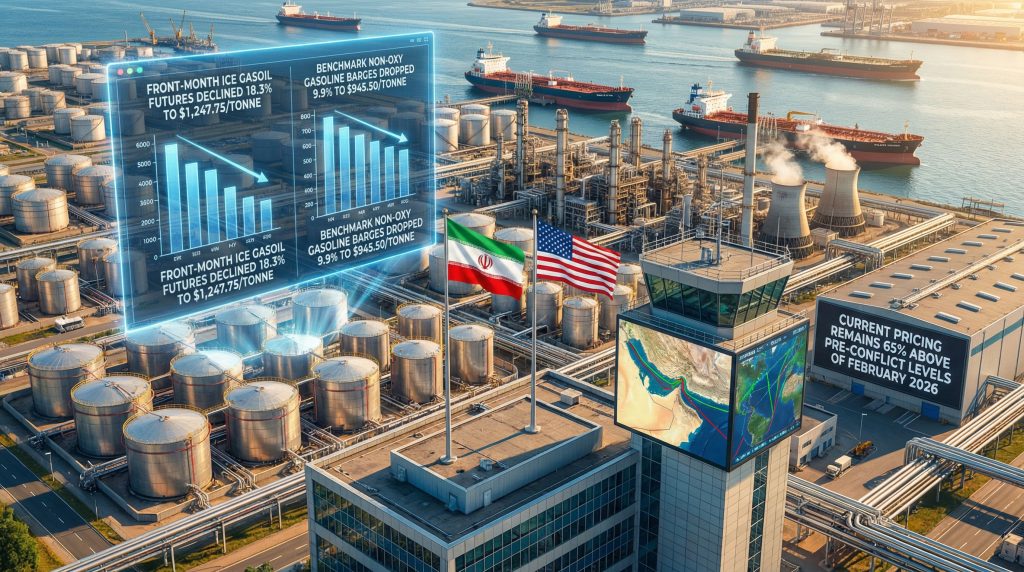
European refined product markets demonstrated asymmetric responses across different fuel categories following the ceasefire announcement. Middle distillates experienced the most dramatic corrections, with ICE gasoil futures declining 18.3% to $1,247.75 per tonne by 10:30 BST on April 8, while benchmark non-oxy gasoline barges dropped a more modest 9.9% to $945.50 per tonne. This differential reflects Europe's structural position as a net importer of diesel and jet fuel versus its role as a gasoline exporter.
Despite these declines, current pricing remains 65% above pre-conflict levels of $752.75 per tonne for gasoil and represents ongoing market stress. The persistence of elevated prices despite diplomatic progress indicates that traders are pricing in significant probability of renewed tensions and continued supply chain disruption. Furthermore, these oil price movements demonstrate how rapidly global energy markets can adjust to geopolitical developments.
Market Structure Analysis and Backwardation Patterns
The ceasefire announcement has had minimal impact on underlying market structure dynamics, with futures curves remaining in steep backwardation. ICE gasoil futures showed a front-month premium of $110.75 per tonne over second-month contracts, compared to just $9.75 per tonne in late February 2026. This represents a 1,036% increase in the backwardation premium, indicating persistent supply tightness expectations.
Key structural indicators:
• Front-month ICE gasoil premium: $110.75/t (vs $9.75/t pre-conflict)
• Eurobob gasoline May-June spread: $29.25/t premium
• East-West arbitrage: ICE gasoil trading at ~$150/t discount to Singapore
• Pre-conflict differential: $210/t discount (narrowed but still challenging)
These patterns suggest that despite diplomatic developments, market participants expect continued volatility and supply constraints. The persistence of backwardation indicates traders are willing to pay substantial premiums for immediate delivery versus future contracts. Additionally, effective market volatility hedging strategies become crucial during such uncertain periods.
When big ASX news breaks, our subscribers know first
Regional Import Dependencies and Supply Chain Reconfiguration
Europe's vulnerability to Middle Eastern supply disruptions varies significantly across product categories, creating differential impact patterns that explain asymmetric price responses. Analysis of import dependency reveals structural weaknesses that extend beyond temporary supply disruptions, particularly affecting energy export challenges globally.
European Refined Product Import Exposure Analysis:
| Product Category | Middle East Gulf Share | Strategic Vulnerability Level | Alternative Sources |
|---|---|---|---|
| Diesel | ~20% of total imports | Medium-High | US Gulf Coast, India |
| Jet Fuel | ~50% of total imports | High | Singapore, US |
| Gasoline | Net exporter position | Low | Domestic production |
The data reveals that jet fuel imports face the highest vulnerability, with approximately 50% of total EU, UK and Norwegian imports typically sourced from the Middle East Gulf region. This dependency explains why aviation fuel markets have experienced some of the most dramatic price adjustments during the conflict period.
Transit Recovery Challenges and Insurance Complications
Recovery of normal shipping patterns through the Strait of Hormuz faces significant operational hurdles beyond diplomatic agreements. According to Lloyd's List, shipping industry experts express cautious optimism while awaiting technical details from both the US and Iran regarding safe transit protocols.
Immediate transit challenges include:
• Unclear insurance coverage terms for Hormuz transits
• Limited vessel movements despite ceasefire (only Greek-owned NJ Earth and Liberia-flagged Daytona Beach reported)
• Security protocol establishment remains incomplete
• Disagreement on navigation terms between US and Iran
Maritime security firm Ambrey assessed that Iran maintains operational control over the strait despite US demands for unrestricted passage. The firm expects shipping risks to ease during the ceasefire but warns of continued realistic possibility of unauthorised transit risks and threats to Israel- and US-affiliated vessels.
Understanding East-West Arbitrage Dynamics
The conflict has fundamentally altered traditional arbitrage relationships between European and Asian markets, with implications extending beyond the immediate ceasefire period. European competitiveness for Middle Eastern volumes remains challenged despite price corrections following diplomatic progress. However, the broader context of US economy tariffs continues to influence global trade patterns.
Current arbitrage spreads indicate structural shifts in global fuel flows. The ICE gasoil versus Singapore gasoil spread narrowed to approximately $150 per tonne discount from around $210 per tonne, but Europe still struggles to compete effectively for available Middle Eastern volumes.
Alternative Supply Chain Development
European market participants have accelerated development of alternative sourcing arrangements during the conflict period. One European diesel trader indicated that the US remains a more likely source for European diesel imports, given that the spread between US Gulf Coast and northwest European diesel values remains much narrower than traditional Middle Eastern routes.
Supply chain diversification trends:
• Increased US Gulf Coast imports to Europe
• Enhanced utilisation of Indian refinery exports
• Development of Atlantic Basin supply relationships
• Reduced long-term dependence planning for Middle Eastern sources
These alternative arrangements may persist beyond the current diplomatic crisis, potentially representing permanent structural changes in global refined product trade flows. The situation mirrors broader discussions about OPEC production impact on global energy markets.
Price Transmission Mechanisms and Consumer Impact Assessment
The dramatic wholesale fuel cost adjustments are beginning to flow through to retail markets, with transportation sector implications and industrial energy input cost recalibration creating broader economic effects. Understanding these transmission mechanisms provides insight into potential inflationary pressures and policy response requirements.
Price transmission timeline analysis:
- Immediate impact (Day 1-3): Wholesale futures and spot markets adjust
- Short-term effects (Week 1-2): Retail fuel stations begin price adjustments
- Medium-term consequences (Month 1-3): Industrial cost structure modifications
- Long-term implications: Strategic sourcing and storage optimisation
The persistence of elevated pricing despite ceasefire developments suggests that full normalisation depends on sustained diplomatic progress and complete supply chain restoration. Current pricing remains substantially above February 2026 baselines, indicating market scepticism about conflict resolution durability.
Regional Policy Response Considerations
European governments face complex decisions regarding strategic petroleum reserve utilisation and potential market intervention mechanisms. The crisis has highlighted structural vulnerabilities in European energy import strategies, potentially accelerating policy discussions around renewable energy transition timelines and strategic storage capacity expansion.
Key policy considerations include:
• Strategic petroleum reserve deployment timing
• Regional refining capacity optimisation requirements
• Consumer protection mechanisms during price volatility periods
• Long-term energy security strategy reassessment
Technical Market Analysis and Trading Implications
The narrowing spread between bitumen and high-sulfur fuel oil to $17.25 per tonne exemplifies how refinery margin dynamics are adjusting to new supply realities. This compression suggests potential optimisation challenges for European refiners as they navigate volatile feedstock costs and product demand patterns.
Refinery margin dynamics analysis:
• Crack spreads adjusting to supply chain disruptions
• Product mix optimisation becoming more critical
• Inventory management strategies requiring reassessment
• Regional storage utilisation patterns shifting
Singapore-based refining activities provide additional insight into global market adjustments. At least two major Singapore refiners declared force majeure on bitumen exports due to feedstock supply disruptions, with Singapore bitumen prices surging 88% from pre-conflict levels to reach $700 per tonne fob on April 7.
Investment Strategy Implications During Uncertainty Periods
Market participants must balance short-term price relief against the possibility of renewed tensions and supply disruptions. The current environment requires sophisticated risk management approaches that account for multiple scenario outcomes and volatility persistence.
Strategic positioning considerations:
• Inventory optimisation balancing carrying costs against supply security
• Hedging strategy development for extended volatility periods
• Alternative supplier relationship development and maintenance
• Transportation and logistics flexibility enhancement
Monitoring Framework for Market Participants
Effective navigation of this uncertain period requires systematic monitoring of multiple indicators beyond simple price movements. Successful market participants are tracking vessel traffic data, insurance market conditions, diplomatic progress indicators, and alternative supply chain cost competitiveness.
Critical monitoring indicators include:
Vessel Traffic: AIS data through Hormuz showing actual recovery patterns rather than announced intentions
Insurance Markets: Coverage terms and premium adjustments for Middle Eastern transit routes
Diplomatic Developments: Progress indicators from Pakistan-mediated negotiations scheduled for later in the week
Alternative Supply Costs: Competitiveness analysis of US Gulf Coast and other non-Middle Eastern sources
The fragility of the current ceasefire became apparent within hours of its announcement, with Iran's state-owned refiner NIORDC reporting an attack on its 55,000 barrel per day Lavan Island refinery. Additionally, Kuwait intercepted 28 Iranian drones between 08:00-13:00 local time on April 8, some targeting vital oil installations and power stations in the south.
The next major ASX story will hit our subscribers first
Strategic Outlook and Risk Assessment Framework
The temporary nature of current diplomatic arrangements requires market participants to prepare for multiple scenarios while building resilient supply strategies. The two-week ceasefire timeline creates a compressed decision-making window for both diplomatic resolution and commercial planning. Moreover, understanding how the US and Iran ceasefire affects European oil product prices remains crucial for long-term strategic planning.
Scenario planning framework:
Optimistic scenario: Successful negotiations lead to permanent resolution and gradual supply chain normalisation over 2-3 months
Base case scenario: Extended periods of uncertainty with intermittent supply disruptions and elevated price volatility
Pessimistic scenario: Renewed hostilities after ceasefire expiration leading to further supply chain deterioration
Each scenario requires different strategic responses regarding inventory levels, supplier diversification, and risk management approaches. The persistence of steep backwardation in futures curves suggests markets are pricing higher probability for continued disruption scenarios. According to Reuters analysis, the market response reflects deep-seated concerns about regional stability.
Long-term strategic implications:
• Permanent shift toward Atlantic Basin supply relationships
• Enhanced strategic storage capacity requirements
• Accelerated renewable energy transition discussions
• Regional refining capacity optimisation programmes
Market participants should maintain flexible positioning while developing robust contingency plans for various diplomatic and supply chain outcomes. The current crisis demonstrates the continued vulnerability of global energy markets to geopolitical events and the importance of diversified supply strategies in managing commercial risk. The impact of the US and Iran ceasefire affects European oil product prices in ways that will likely reshape regional energy strategies for years to come.
Please note: This analysis is based on market conditions and diplomatic developments as of April 8, 2026, and involves speculative elements regarding future market developments. Readers should conduct independent analysis and consult with qualified advisors before making investment or commercial decisions. Energy markets remain highly volatile during geopolitical uncertainty periods, and past performance does not guarantee future results.
Ready to Capitalise on Global Commodity Market Disruptions?
Discovery Alert's proprietary Discovery IQ model delivers real-time alerts on significant ASX mineral discoveries, empowering subscribers to identify actionable opportunities whilst global markets experience unprecedented volatility. Begin your 14-day free trial at Discovery Alert and position yourself ahead of the market during these turbulent times.