August 6, 2026
Why the Strait of Hormuz sits at the centre of global oil risk
A single shipping lane can matter more to inflation, freight, and financial markets than many producing countries combined. That is why the US Iran conflict and Strait of Hormuz oil supply story remains one of the most closely watched energy risks in the world. When traders discuss geopolitical oil shock, they are often describing the danger that barrels cannot move freely through this narrow corridor.
Featured answer: Why the Strait of Hormuz matters to oil markets
The Strait of Hormuz is critical because a large share of internationally traded crude oil and refined products moves through it. Any military tension, transit restriction, or insurance disruption can affect oil prices, tanker availability, freight costs, and physical supply chains far beyond the Middle East.
According to the U.S. Energy Information Administration, the Strait of Hormuz has consistently ranked among the world’s most important oil transit chokepoints, with roughly one-fifth of global petroleum liquids consumption moving through the passage in recent years. Furthermore, its narrow geography magnifies risk because shipping lanes are limited and tanker rerouting options are poor.
Why this matters beyond a US-Iran dispute
The US Iran conflict and Strait of Hormuz oil supply issue is not merely a bilateral diplomatic problem. It is a macroeconomic transmission channel that can ripple across several layers of the global economy. In addition, it links directly to oil’s global economic role, because energy prices shape inflation, transport, manufacturing and trade.
- Inflation risk through higher crude, gasoline, diesel, and jet fuel prices
- Shipping disruption through longer delays, higher insurance premiums, and vessel access uncertainty
- Industrial spillovers through petrochemical feedstock costs and refinery margin shifts
- Monetary policy effects through rising inflation expectations and tougher central bank trade-offs
Even without a formal closure, friction can tighten effective supply. Delays, selective vessel restrictions, and trader caution can reduce available barrels in much the same way as an outright outage, at least for a period.
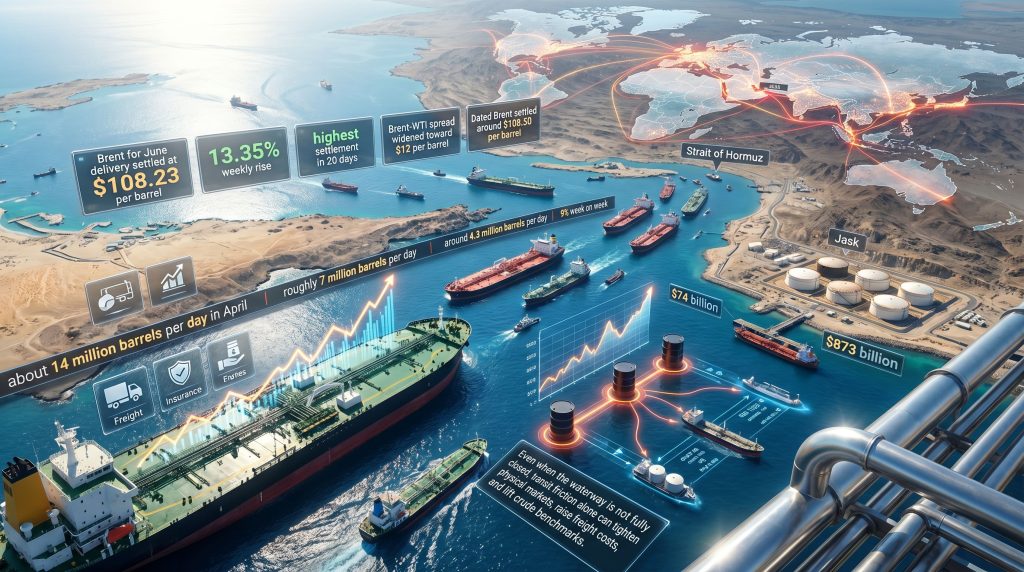
Even when the waterway remains technically open, transit friction alone can tighten physical markets, lift freight rates, and raise benchmark crude prices.
When big ASX news breaks, our subscribers know first
How conflict pressure moves from headlines to pump prices
Oil markets usually reprice risk before physical shortages fully appear. That is especially true when maritime chokepoints are involved. For instance, crude oil price trends often shift well before official supply data captures the full disruption.
The four-step transmission mechanism
A US-Iran standoff typically moves through the oil system in four stages:
- Military or diplomatic tension rises
- Shipping confidence weakens and cargo movement slows
- Inventories absorb the initial shock
- Prices rise enough to ration demand and restore balance
This sequence helps explain why market reactions can begin before production data shows a severe drop. Futures markets discount expected disruption, while refiners, shippers, and insurers begin adjusting behaviour immediately.
Why lost barrels matter before a formal closure
Research cited in late April 2026 estimated that global oil supply had fallen by about 14 million barrels per day during April. However, that figure did not translate one-for-one into consumption losses because the market used several buffers.
- Around 7 million barrels per day was offset by inventory drawdowns
- Roughly 4.3 million barrels per day was absorbed through demand destruction
- The remaining gap likely reflected rerouting inefficiency, storage limits and shut-ins
That distinction matters. Oil markets do not respond only to wellhead production. They also react to whether crude can be exported, stored, financed, shipped and insured.
Production loss versus export blockage
These terms are often blurred, but they are not the same:
| Market issue | What it means | Why it matters |
|---|---|---|
| Production loss | Oil is not being produced at the field | Hard supply reduction |
| Export blockage | Oil exists but cannot reach buyers | Immediate seaborne market stress |
| Storage saturation | Tanks fill up and force output cuts | Converts logistics problems into production loss |
| Voluntary shut-ins | Producers cut output proactively | Often tied to price or export uncertainty |
| Forced shut-ins | Output stops because barrels cannot move | Usually harder to reverse quickly |
Why uncertainty itself can be bullish for oil
Markets often stay firm even when diplomacy appears active. That is because uncertainty leaves a scar on trading behaviour.
- Shipowners may demand higher rates or avoid certain routes
- Insurers can reprice regional risk quickly
- Refiners may build precautionary inventories
- Traders demand wider risk premia for prompt cargoes
Even if negotiations improve, normalisation can lag. Commercial actors typically wait for repeated proof of safe passage rather than trusting a single political signal.
What current oil market numbers suggest about supply stress
Price action in late April 2026 pointed to tightening conditions rather than a clean resolution of risk. Consequently, the market looked more concerned about real barrels than about headlines alone.
Brent, Dated Brent, and the weekly surge
Market data cited for April 27 showed:
- Brent for June delivery at $108.23 per barrel
- A week-on-week rise of $12.75
- A 13.35% weekly gain
- The highest settlement in 20 days
That kind of move during diplomatic ambiguity often suggests concern about physical supply. In addition, oil geopolitics analysis helps explain why benchmark prices can surge before shortages become fully visible.
What the Brent-WTI spread is saying
The Brent-WTI spread widened towards $12 per barrel, another notable signal. Brent is the more internationally exposed seaborne benchmark, while WTI is more closely tied to inland North American crude dynamics.
A wider spread can suggest stronger stress in globally traded barrels than in domestic U.S. crude. In a Middle East transit crisis, that makes sense. Buyers dependent on imported seaborne oil are more directly exposed than refiners sourcing inland U.S. feedstock.
Could restricted Hormuz transit trigger a broader macro shock?
Yes, especially if inventories stop cushioning the market and higher prices begin to reduce demand more aggressively. As a result, the US Iran conflict and Strait of Hormuz oil supply threat can spread well beyond energy desks.
Inflation, freight, and fuel pass-through
A persistent disruption in the Strait of Hormuz oil transit system can spread quickly through the economy:
- Gasoline and diesel usually reflect crude moves with a lag
- Marine fuel costs rise as freight markets and bunker prices adjust
- Petrochemicals become more expensive because feedstocks track crude
- Airlines face higher jet fuel expenses
- Central banks must reassess inflation expectations
This is also why OPEC’s market influence matters in any prolonged disturbance, as spare capacity and signalling can shape how severe the shock becomes.
When inventories stop absorbing the shock
Inventories act as a temporary shock absorber, not a permanent solution. If stockpiles are tapped too heavily, the market can shift from manageable tightness to panic pricing. That tipping point is hard to identify in real time.
Demand destruction as the market’s harsh balancing tool
The estimated 4.3 million barrels per day decline in demand shows how the market rebalances when prices rise enough to force restraint.
- Soft adjustment through efficiency and slower discretionary driving
- Industrial slowdown as high energy input costs reduce activity
- Recessionary demand destruction if the shock spreads more broadly
Why sanctions, blockades, and storage constraints matter as much as naval risk
A chokepoint crisis is not only about ships under threat. It is also about whether cargoes can legally move, be financed, or find room in storage. Moreover, these pressures increase oil market disruption risks even when the shipping lane is not fully shut.
The overlooked bottleneck: storage saturation
One underappreciated issue is export terminal congestion. Market commentary indicated that storage at Jask, a major Iranian export terminal on the Gulf of Oman, had reached very high levels. According to reporting on Iran’s storage strain, this pressure can force producers to cut output if exports remain blocked.
When storage approaches capacity, a producer can no longer rely on waiting out short-term disruption. Logistics strain then turns into field-level production loss.
Why production shut-ins can outlast the crisis itself
Restarting supply is rarely instant. Delays often persist because of:
- field management constraints
- tanker scheduling backlogs
- buyer hesitation
- contract renegotiation
- insurance and freight repricing
In practical terms, calmer headlines do not mean full barrels return the same week.
What would signal de-escalation?
Markets tend to trust physical evidence before diplomatic language. Therefore, transit data, storage pressure and freight conditions usually matter more than political statements.
The first real confidence marker: freer vessel transit
A meaningful de-escalation would likely begin with more normal vessel access through the Strait. Partial selectivity is not the same as an open route. If some ships move while others face barriers, the market still prices residual risk.
Why back-channel diplomacy matters
Analysts have noted that indirect contacts and unofficial exchanges often shape oil pricing before formal agreements are signed. As outlined in a Congressional Research Service overview, sanctions, diplomacy and regional security frameworks can alter commercial expectations before any public breakthrough.
What durable de-escalation would probably require
A more convincing normalisation would likely involve simultaneous improvement in several areas:
- transit restrictions ease
- blockade pressure softens
- military signalling becomes less coercive
- sanctions enforcement intensity moderates
A ceasefire alone may not be enough if shippers and refiners still doubt the reliability of passage.
A ceasefire can calm headlines, but freight markets, insurers, and refiners usually need repeated evidence of safe passage before pricing in normal conditions.
The next major ASX story will hit our subscribers first
What businesses, policymakers, and investors should monitor next
For anyone tracking the US Iran conflict and Strait of Hormuz oil supply risk, the key is to watch several indicators together rather than in isolation.
For businesses exposed to fuel and freight
- review hedge ratios and procurement timing
- check freight contract flexibility
- reassess working inventory needs
- diversify suppliers where practical
- scenario-test budgets for $90 to $95 Brent and above
For policymakers and investors
- Brent and Dated Brent behaviour
- Brent-WTI spread movements
- tanker traffic through Hormuz
- storage congestion reports
- global inventory draw rates
- signs of deeper demand destruction
Weekly checklist
| Indicator | Why watch it |
|---|---|
| Brent and Dated Brent | Measures global and physical pricing stress |
| Brent-WTI spread | Captures seaborne versus inland divergence |
| Tanker movement through Hormuz | Direct evidence of transit conditions |
| Inventory data | Shows how long the market can absorb disruption |
| Sanctions or blockade updates | Alters commercial flow risk |
| Storage congestion | Signals possible forced shut-ins |
FAQ: US Iran conflict and Strait of Hormuz oil supply
How much of global oil supply is exposed to the Strait of Hormuz?
A large share of globally traded petroleum moves through the Strait, and official estimates have often placed it near one-fifth of world petroleum liquids consumption. However, readers should check the latest EIA or IEA updates for current figures.
Would oil prices surge if the Strait were only partially blocked?
Yes. Partial disruption can still lift prices materially because delays, insurance costs, selective vessel access and precautionary stockbuilding all tighten effective supply.
Can oil supply normalise quickly after a ceasefire?
Usually not fully. Logistics, storage imbalances, tanker allocation and buyer confidence often recover more slowly than headlines do.
Why does Brent usually react more than WTI in a Middle East crisis?
Brent is more exposed to globally traded seaborne crude flows. WTI is more connected to North American inland dynamics, so it often reacts less directly to Hormuz-specific shipping risk.
The most credible takeaway
The biggest threat is not necessarily a dramatic full closure. It is prolonged friction: constrained transit, storage saturation, inventory depletion and delayed normalisation. Oil markets react to confidence lost as much as barrels lost.
For readers following the US Iran conflict and Strait of Hormuz oil supply risk, the clearest lesson is to watch shipping access, inventories, benchmark spreads and diplomacy together. Looking at only one signal can miss how a manageable disruption becomes a macro shock.
Could the Next Market-Moving Discovery Arrive Without Warning?
For investors tracking how quickly commodity markets can shift, Discovery Alert provides real-time ASX mineral discovery alerts powered by its proprietary Discovery IQ model, helping identify actionable opportunities before the broader market reacts. To see how major discoveries have historically driven exceptional returns, explore Discovery Alert’s discoveries page and start a 14-day free trial today.