August 14, 2026
US-Iran conflict Strait of Hormuz closure scenarios represent one of the most significant potential disruptions to global energy security in the modern era. Understanding the strategic implications of this critical maritime chokepoint extends far beyond regional Middle Eastern politics, encompassing global economic stability, energy security frameworks, and international diplomatic relationships. The interconnected nature of global petroleum markets means that disruption in this narrow waterway could cascade through international supply chains and reshape economic patterns worldwide.
The complexity of potential conflict scenarios requires examining both immediate tactical considerations and broader strategic implications. When conventional military capabilities intersect with asymmetric warfare tactics, the resulting dynamics create vulnerabilities that extend throughout the global energy system.
Understanding the Strait of Hormuz Strategic Chokepoint
Geographic and Economic Significance of the World's Most Critical Oil Transit Route
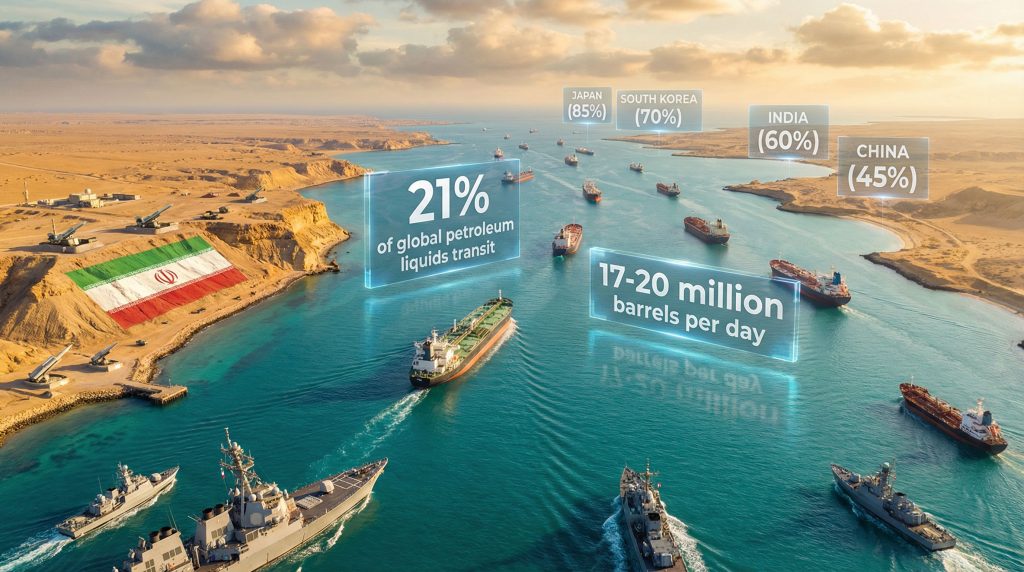
The Strait of Hormuz represents the most strategically significant energy transit point in the global economy, handling approximately 21.3 million barrels per day of crude oil and condensates in 2023. This narrow waterway, connecting the Persian Gulf to the Gulf of Oman and Arabian Sea, facilitates roughly 21% of global petroleum liquids trade and approximately 27% of all seaborne-traded oil.
The physical constraints of this passage create inherent vulnerabilities that amplify its strategic importance. With a minimum width of just 21 nautical miles, the strait funnels massive volumes of energy commodities through two-way shipping lanes that are each only 2 nautical miles wide, separated by a 2-nautical-mile buffer zone.
Furthermore, this geographic bottleneck accommodates approximately 30,000 transits annually, averaging 82 vessels per day through waters with depths of 40-50 meters in the primary channel. The concentration of traffic creates single points of failure that could simultaneously disrupt multiple energy commodity flows.
Beyond crude oil, the strait serves as a critical conduit for global liquefied natural gas markets. Approximately 99% of LNG exports from Qatar must transit through these waters, representing roughly one-third of all globally traded LNG. This concentration creates vulnerabilities that could simultaneously affect both oil and natural gas price trends to major consuming regions.
The International Energy Agency has consistently identified the Hormuz passage as the world's most critical oil chokepoint. Any prolonged disruption could create severe global energy supply shocks, particularly given the increasing importance of these waterways as global oil production and consumption patterns have shifted toward Asian markets.
Historical Precedents of Maritime Blockades in Energy Warfare
The 1980-1988 Tanker War during the Iran-Iraq conflict provides the most relevant historical precedent for understanding potential US-Iran conflict Strait of Hormuz closure scenarios. Over eight years of sporadic shipping attacks, approximately 540 merchant vessels were targeted using naval mines, anti-ship missiles, and speedboat attacks.
However, while oil prices experienced significant volatility during peak crisis periods, reaching over $40 per barrel in nominal terms, markets demonstrated adaptation capacity over extended periods. Critical lessons from this period include shipping industry adaptation through convoy systems, market resilience mechanisms, strategic reserve utilization, and alternative routing development.
The Suez Canal closure from 1967-1975 following the Six-Day War demonstrated how markets adapt to complete blockade scenarios over extended timeframes. During this 8-year closure, oil shipments were rerouted around the Cape of Good Hope, increasing shipping costs by approximately 15-20% but allowing markets to maintain functionality.
These precedents suggest that while initial disruption creates significant market volatility, sustained blockades typically trigger adaptation mechanisms that reduce long-term economic impact. Nevertheless, the modern global economy's increased energy intensity and reduced strategic reserve capacity may limit the effectiveness of these historical adaptation strategies, particularly given current oil price trade war effects.
Iran's Military Capabilities for Waterway Disruption
Iran's capability to disrupt Strait of Hormuz traffic combines conventional naval assets with asymmetric warfare systems specifically designed to exploit the waterway's geographic constraints. The Islamic Revolutionary Guard Corps Navy has developed doctrine emphasizing distributed, multi-vector attacks that leverage technological asymmetries.
Iran's anti-ship missile inventory includes multiple systems capable of covering the entire strait region. These include Noor missiles with operational ranges of 120-170 kilometers, Qader cruise missiles extending coverage up to 300 kilometers, and Khalij Fars variants providing 300-kilometer anti-ship capability through mobile platform deployment.
The submarine component includes approximately 14-16 submarines, consisting of 3 Russian-origin Kilo-class submarines and 11+ small coastal submarines. These platforms provide confirmed mine-laying capability alongside defensive torpedo systems, enabling covert deployment of naval mines across shipping channels.
Moreover, Iran maintains an estimated inventory of 5,000+ naval mines of various types, including moored contact mines, ground mines with acoustic activation, and remote-controlled variants. The combination of submarine and surface craft deployment capability allows for comprehensive minefield establishment across critical shipping areas.
When big ASX news breaks, our subscribers know first
How Would Iran Execute a Strait of Hormuz Closure Strategy?
Anti-Ship Missile Systems and Naval Mine Deployment Tactics
Iran's closure strategy would likely emphasize rapid, coordinated deployment across multiple vectors to maximize disruption while minimizing response time for opposing forces. Based on analysis of Iranian naval exercises conducted between 2011-2022, full mine deployment across the strait's width could potentially be completed within 4-7 days.
The tactical deployment sequence would likely prioritize initial mine placement in narrowest shipping channels using submarine stealth capabilities. Subsequently, anti-ship missile battery positioning at multiple coastal locations would occur within 24-48 hours, followed by fast attack craft deployment for ongoing harassment.
Mine deployment methodology would utilize Iran's diverse platform capabilities. Kilo-class submarines can carry 18 mines each, while midget submarines carry 4-6 mines, providing stealth deployment options. Surface craft deployment enables rapid, high-volume mine dispersal across broader areas.
In addition, the effectiveness of this approach depends on achieving sufficient mine density across shipping channels. Historical naval doctrine suggests 1-2 mines per square kilometer creates effective disruption for commercial traffic, while higher densities are required to impede military convoy operations.
Asymmetric Warfare Approaches Using Fast Attack Craft
Iran operates approximately 30+ fast attack craft, including Boghammars capable of speeds exceeding 45 knots and Ashm-class fast patrol boats. These platforms form the core of Iran's swarm attack doctrine, designed to overwhelm larger naval vessels through coordinated approaches.
Typical swarm tactics involve 5-15 vessels operating in coordination, armed with machine guns, rocket-propelled grenades, and small anti-ship missiles. The operational range of 50-100 kilometers from Iranian bases enables multiple simultaneous engagement zones across the strait.
Historical effectiveness data from the 1980s Tanker War indicates successful interdiction occurred in 25-30% of attack attempts, forced diversion in 50-60% of attempts, and failed attacks comprised 15-20% of attempts. However, the psychological impact often exceeds direct destructive capability.
Furthermore, the intensity and unpredictability of swarm attacks create significant disruption to commercial shipping schedules and insurance calculations, potentially deterring traffic even when actual damage rates remain limited.
Coordination with Regional Proxy Forces and Militia Networks
Iran's regional proxy network provides capabilities for expanding conflict beyond the immediate Strait of Hormuz theater. The Islamic Revolutionary Guard Corps Quds Force coordinates operations across multiple proxy relationships that could support broader disruption strategies.
Key proxy capabilities include the Houthi Movement in Yemen, with anti-ship missile and drone capabilities demonstrated in previous Red Sea operations. Their geographic positioning along Yemen's coast provides coverage of southern strait approaches through coordination mechanisms.
Iraqi Shi'a Militias comprise an estimated 20+ militia factions with varying degrees of Iranian coordination. Their operational focus on pressure against U.S. installations and Iraqi port infrastructure enables operations affecting regional energy infrastructure from primary bases in southern Iraq.
Lebanese Hezbollah possesses significant missile and drone capabilities for broader regional conflict escalation. While having limited direct operational role due to geographic distance, they provide potential for coordinated multi-front pressure campaigns.
What Are the Immediate Global Economic Consequences?
Oil Price Shock Scenarios and Market Volatility Projections
Complete closure of the Strait of Hormuz would immediately remove 17-20 million barrels per day from global markets, representing the largest supply disruption in modern energy history. Market analysis suggests initial price responses could drive Brent crude prices above $150-200 per barrel within the first week of sustained closure.
The psychological impact on markets often amplifies physical supply constraints. During the early stages of the Russia-Ukraine conflict, oil prices surged approximately 60% despite relatively limited immediate supply disruption, demonstrating how geopolitical risk premiums can exceed fundamental supply-demand imbalances, as evidenced in recent oil price rally analysis.
Key price shock mechanisms include immediate risk premium addition of $30-50 per barrel within 24-48 hours, physical supply constraint pricing adding $50-100 per barrel, and demand destruction feedback providing partial market stabilization through price-induced consumption reduction.
Consequently, historical analysis from previous oil shocks indicates that prices above $120 per barrel trigger significant demand destruction in transportation and industrial sectors, potentially reducing global oil consumption by 2-4 million barrels per day within 60-90 days.
Supply Chain Disruptions Beyond Energy Commodities
US-Iran conflict Strait of Hormuz closure extends beyond petroleum products to affect broader supply chain networks. Qatar's LNG exports, representing approximately one-third of global trade, would face complete disruption, creating natural gas shortages across Asian and European markets.
Secondary supply chain impacts include petrochemical feedstock shortages affecting plastics and pharmaceutical manufacturing, shipping route diversification costs adding 15-20% to transportation expenses, insurance market disruption through war risk premiums, and regional port capacity constraints.
The ripple effects cascade through industries dependent on petroleum-derived inputs. Chemical manufacturing, agricultural fertilizer production, and pharmaceutical synthesis all face potential input shortages that extend far beyond direct energy consumption impacts.
Regional Economic Impact on Gulf Cooperation Council States
Gulf Cooperation Council nations would experience immediate economic devastation from strait closure, despite their substantial oil reserves. The inability to export petroleum products would eliminate primary revenue sources for Saudi Arabia, Kuwait, and the United Arab Emirates within weeks.
Economic modeling suggests that complete export cessation would eliminate $2-3 billion daily in combined regional oil and gas revenues, trigger currency devaluation, create fiscal crisis conditions within 30-60 days, and force dramatic economic restructuring through emergency policies.
The interconnected nature of Gulf economies amplifies these impacts. UAE's role as a regional financial hub, Saudi Arabia's position as the largest regional economy, and Qatar's dominance in global LNG markets create systemic vulnerabilities throughout the Middle East economic system.
Which Countries Face the Greatest Strategic Vulnerabilities?
Asian Import Dependencies and Alternative Route Analysis
Asian economies demonstrate the most severe vulnerabilities to US-Iran conflict Strait of Hormuz closure due to their heavy reliance on Middle Eastern energy imports and limited alternative supply infrastructure. Japan's energy security presents perhaps the most critical risk profile, with approximately 85% of oil imports transiting through the strait.
South Korea faces similar challenges, with 70% of oil imports dependent on Hormuz transit and limited strategic reserve capacity relative to consumption needs. The country's advanced manufacturing economy and high energy intensity create multiplier effects where supply disruption translates directly into production constraints.
China's position reflects both vulnerability and relative resilience. While approximately 45% of oil imports transit the strait, China maintains substantial strategic petroleum reserves and growing pipeline capacity from Central Asia and Russia. However, the absolute volume means Hormuz closure would still create significant supply gaps.
India's 60% import dependency on Hormuz transit creates substantial vulnerability, though the country has developed some alternative pipeline infrastructure and maintains strategic relationships with non-Middle Eastern suppliers.
European Energy Security Implications
European vulnerability to Strait of Hormuz closure operates primarily through indirect mechanisms rather than direct import dependency. While Europe imports relatively limited quantities of Middle Eastern oil, LNG disruption from Qatar creates immediate natural gas supply constraints during winter seasons.
The economic impact manifests through LNG price escalation affecting industrial costs, refined product shortages as European refineries lose Middle Eastern crude inputs, chemical industry disruption through petrochemical feedstock limitations, and transportation fuel constraints.
Germany and the Netherlands face particular vulnerability due to their roles as regional energy distribution hubs and substantial chemical manufacturing sectors. The interconnected nature of European energy markets means disruption quickly propagates throughout the continental system.
Impact Assessment for Major Oil-Importing Economies
The United States presents a complex vulnerability profile reflecting both domestic production capacity and refinery infrastructure dependencies. While U.S. crude production has increased substantially since 2010, certain refinery configurations remain optimized for heavy crude imports from the Middle East.
U.S. vulnerability factors include refinery configuration constraints limiting crude substitution flexibility, gasoline price sensitivity affecting consumer spending, Strategic Petroleum Reserve capacity providing 30-60 day buffer capability, and domestic production surge capacity enabling medium-term supply replacement.
Brazil and Mexico represent emerging market vulnerabilities with limited strategic reserve capacity and growing import dependencies. Both countries rely heavily on refined product imports that could face severe disruption during strait closure scenarios.
How Long Could Iran Sustain a Maritime Blockade?
Military Sustainability Analysis and Resource Requirements
Iran's ability to sustain a maritime blockade depends critically on the balance between operational costs and strategic benefits. Military analysts estimate that maintaining comprehensive mine barriers and active patrol operations requires approximately 200-300 personnel in direct operational roles.
The asymmetric nature of Iran's strategy provides significant sustainability advantages. Mine warfare requires minimal ongoing resource commitment once deployment is complete, as mines remain effective for months without active maintenance. Fast attack craft operations consume more resources but can be scaled according to available capacity.
Key sustainability factors include mine replacement requirements at an estimated 10-15% monthly rate, fuel consumption for fast attack craft operations of approximately 50-100 tons daily, personnel rotation requiring 300-500 total personnel, and ammunition resupply through domestic production capabilities.
Iran's domestic defense manufacturing capability provides significant advantages for sustained operations. Indigenous production of naval mines, anti-ship missiles, and small craft ammunition reduces dependency on external supply chains that could face interdiction.
Economic Costs to Iran's Own Export Revenues
Strait closure creates immediate economic costs for Iran through elimination of its own oil export revenues, which typically represent 60-70% of government income and approximately 80% of foreign currency earnings. Complete export cessation would eliminate approximately $2-3 billion monthly in government revenues.
However, the economic calculation extends beyond immediate revenue loss. Oil price escalation during closure scenarios could potentially offset volume losses if Iran maintains limited export capability through alternative routes or achieves favorable post-conflict market positioning.
Economic sustainability analysis suggests government fiscal reserves provide capacity for 3-6 months of reduced revenue operations, currency devaluation acceleration of potentially 50-80% within 60-90 days, domestic economic disruption through fuel shortages, and strategic calculation trade-offs between costs and geopolitical benefits.
International Response Timeline and Escalation Scenarios
International military response capabilities determine the effective duration of any Iranian blockade strategy. Coalition mine-clearing operations typically require 2-4 weeks for basic shipping lane clearance, assuming limited ongoing resistance and specialized mine countermeasure vessels.
Escalation scenarios depend critically on the scope and intensity of international military response. Limited response scenarios involving only mine clearance operations could require 4-6 weeks for partial shipping restoration. Comprehensive response scenarios involving coordinated air and naval operations might achieve strait reopening within 2-4 weeks.
Extended conflict scenarios involving Iranian asymmetric response including proxy activation could require 2-6 months for conflict resolution, with substantial risk of broader Middle East regional war. The effectiveness depends on coalition coordination capabilities and willingness to commit substantial military resources.
What Military Options Exist for Reopening the Strait?
Naval Task Force Requirements and Coalition Building
Reopening the Strait of Hormuz following Iranian closure requires substantial multinational naval capabilities coordinated through complex command structures. Military planners estimate that effective mine clearance and shipping lane security demands approximately 40-60 specialized vessels.
Essential naval task force components include 15-20 mine countermeasure vessels for systematic clearing, 8-12 escort destroyers for defense, 20-30 fast attack craft for rapid response, 10-15 support ships for logistics, and 4-8 submarines for underwater reconnaissance.
Coalition building presents significant political and operational challenges. The United States maintains the largest mine countermeasure capability globally, but comprehensive operations require contributions from allied navies including the United Kingdom, France, and regional partners.
Historical precedent from the 1987-1988 Operation Earnest Will demonstrates both complexity and feasibility of coalition maritime security operations. That operation required 6 months of sustained naval presence with approximately 30 U.S. and allied vessels.
Mine Clearance Operations and Timeline Estimates
Mine warfare presents the most technically challenging aspect of strait reopening operations. Modern naval mines utilize sophisticated triggering mechanisms including acoustic, magnetic, and pressure sensors requiring specialized clearance equipment and procedures.
Mine clearance methodology involves sequential phases: reconnaissance and mapping requiring 3-7 days, systematic clearance taking 14-21 days, and verification requiring 7-14 days. The timeline assumes limited Iranian resistance and optimal equipment availability.
Technical factors affecting clearance efficiency include mine density, mine sophistication complicating neutralization procedures, environmental conditions affecting operational capability, and ongoing threat necessitating concurrent defensive operations.
Air Superiority Challenges in the Persian Gulf Theater
Establishing air superiority over the Strait of Hormuz region presents complex challenges due to Iran's integrated air defense systems and geographic constraints of the Persian Gulf theater. Iranian capabilities include Russian-origin S-300 systems and domestically produced variants.
Air superiority requirements include suppression of enemy air defenses, combat air patrol providing continuous coverage, electronic warfare disrupting Iranian systems, and intelligence surveillance providing real-time monitoring of Iranian military activity.
Coalition air assets would likely require 100-150 multirole fighters, 10-15 electronic warfare platforms, 20-30 tanker aircraft, and 15-25 reconnaissance platforms. The effectiveness depends on access to regional airbases and overflight permissions from Gulf Cooperation Council states.
The next major ASX story will hit our subscribers first
How Would Global Markets Adapt to Prolonged Closure?
Strategic Petroleum Reserve Deployment Strategies
Prolonged US-Iran conflict Strait of Hormuz closure would trigger coordinated strategic petroleum reserve releases from major consuming nations. The International Energy Agency maintains emergency response protocols requiring member countries to release reserves when supply disruptions exceed 2.5 million barrels per day for more than 30 days.
Global strategic reserve capacity totals approximately 1.5 billion barrels across major economies. The United States maintains 650 million barrels with release capacity of 4.4 million barrels per day, while China holds an estimated 200-300 million barrels, Japan maintains 160 million barrels, and the European Union holds 120 million barrels.
Reserve deployment strategy would follow a phased approach. Phase 1 would involve initial emergency releases targeting 2-3 million barrels per day to stabilize prices. Phase 2 would sustain releases at 4-6 million barrels per day while alternative sources develop. Phase 3 would reduce releases as alternative transportation routes become operational.
The effectiveness of reserve deployment depends on coordination mechanisms and market psychology, as evidenced by OPEC meeting insights regarding global supply management strategies.
Alternative Transportation Routes and Infrastructure Limitations
Prolonged strait closure would necessitate massive infrastructure adaptation as global energy markets seek alternative transportation pathways. The Cape of Good Hope route around Africa represents the primary alternative, adding approximately 3,000 nautical miles and 15-20 days to transit times.
Infrastructure constraints include Suez Canal capacity limitations with maximum daily transit of 100-120 vessels, Cape route shipping requiring additional 200-300 tanker vessels for equivalent capacity, and pipeline infrastructure acceleration through Central Asia.
The adaptation timeline depends on infrastructure flexibility and market incentives. Shipping companies could potentially increase effective capacity by 15-25% within 3-6 months through optimization, but complete supply chain adaptation requires 12-24 months for full implementation.
Long-term Energy Security Restructuring
Extended strait closure would trigger fundamental restructuring of global energy security policies, accelerating trends toward supply diversification and strategic autonomy. Major consuming nations would likely implement permanent policy changes to reduce vulnerability.
Key restructuring elements include strategic reserve expansion from 90-120 days to 180-240 days of import coverage, alternative energy infrastructure investment including accelerated renewable deployment, and supply chain diversification through long-term contracts with non-Middle Eastern suppliers.
The economic costs of such restructuring could exceed $500 billion globally over 5-10 years, but enhanced energy security benefits would likely justify these investments. The experience of European energy restructuring following Russian supply disruptions provides precedent for rapid policy adaptation, particularly given ongoing concerns about oil price stagnation factors.
What Are the Diplomatic Solutions and Negotiation Frameworks?
United Nations Maritime Law and International Arbitration
International legal frameworks provide multiple pathways for resolving Strait of Hormuz disputes through diplomatic rather than military means. The United Nations Convention on the Law of the Sea establishes clear principles regarding transit passage rights through international straits.
Key legal principles include transit passage rights for all vessels, non-suspendable transit obligations, peaceful resolution requirements, and International Court of Justice jurisdiction for maritime disputes. The International Tribunal for the Law of the Sea provides specialized jurisdiction offering arbitration mechanisms.
However, the effectiveness of these legal frameworks depends on willingness to accept international arbitration and comply with resulting decisions. Historical precedent from the 2016 Philippines vs. China arbitration demonstrates both potential and limitations of international maritime law.
Regional Mediation Through Gulf Cooperation Council
Gulf Cooperation Council states possess significant diplomatic leverage for mediating conflict scenarios due to their strategic positioning and economic relationships with all parties. The UAE, Qatar, and Oman maintain particularly active diplomatic channels with Iran while hosting substantial U.S. presence.
Regional mediation advantages include economic leverage through collective GCC economies representing major markets, cultural connections through shared Islamic heritage, and geographic positioning enabling rapid diplomatic engagement. Oman's historical role as mediator provides precedent for regional diplomatic intervention.
The effectiveness of GCC mediation depends on maintaining collective positions among member states and avoiding internal divisions. Historical tensions between Qatar and other GCC members illustrate challenges of achieving regional diplomatic unity during crisis scenarios.
Economic Sanctions vs. Military Intervention Trade-offs
The choice between economic sanctions and military intervention involves complex trade-offs affecting immediate tactical considerations and long-term strategic relationships. Economic sanctions offer advantages through reduced escalation risk and international legitimacy, while military intervention provides immediate problem resolution.
Economic sanctions advantages include lower escalation risk, international legitimacy, sustainable pressure affecting Iranian decision-making, and minimal military casualties. However, limitations include extended timelines, ongoing economic damage, uncertain effectiveness, and humanitarian concerns.
Military intervention advantages include immediate problem resolution, deterrent effects, allied burden sharing, and proven technical capability. Nevertheless, risks include escalation potential, casualty concerns, long-term occupation requirements, and regional destabilization possibilities.
The optimal approach likely combines elements of both strategies, beginning with diplomatic initiatives and economic pressure while maintaining military options for scenarios where other approaches prove insufficient. Recent analyses from the Wall Street Journal's coverage of Iran tensions and BBC reports on regional developments suggest that international coordination remains essential for effective crisis management.
In conclusion, US-Iran conflict Strait of Hormuz closure scenarios represent one of the most complex challenges facing global energy security in the modern era. The interconnected nature of economic, military, and diplomatic considerations requires comprehensive understanding of both immediate tactical responses and long-term strategic adaptations that could reshape international energy markets for decades to come.
Ready to Capitalise on Geopolitical Energy Market Volatility?
When global crises like Strait of Hormuz tensions create energy market disruptions, savvy investors position themselves ahead of the volatility through strategic resource investments. Discovery Alert's proprietary Discovery IQ model delivers real-time alerts on significant ASX mineral discoveries, providing actionable insights when geopolitical events drive commodity demand and create exceptional opportunities for informed investors.