June 19, 2026
The Inventory Reality That Oil Markets Are Ignoring
Every major supply disruption in modern history has eventually resolved itself through diplomacy, exhaustion, or economic necessity. The pattern repeats: prices spike, emergency reserves get drawn down, and when the geopolitical temperature falls, traders rush to reprice risk out of the market. What rarely gets priced in with equal speed is the structural damage left behind — the depleted buffers, the fractured trade routes, and the months-long gap between a ceasefire announcement and actual barrels flowing freely through contested waterways.
The current moment in global oil markets fits this template almost exactly. The U.S.-Iran deal oil prices relationship is more complex than the initial Brent selloff suggests, and understanding why requires moving past the headlines and into the mechanics of what the agreement actually commits each party to do.
When big ASX news breaks, our subscribers know first
What the 14-Point Memorandum of Understanding Actually Says
The framing matters enormously here. The agreement signed between the United States and Iran is a Memorandum of Understanding — a framework document designed to structure future negotiations rather than resolve the underlying conflict. This is not a technicality. It is the single most important variable for anyone attempting to model oil prices over the next 12 to 24 months.
Several provisions within the MoU carry significant ambiguity:
- The parties have committed to finalising a comprehensive agreement within a maximum 60-day window, which is itself extendable by mutual consent with no stated ceiling on how many extensions can be granted
- Iran's obligation regarding the Strait of Hormuz is framed around using best efforts to facilitate safe commercial passage, a formulation that creates no legally enforceable guarantee
- No verified technical commitments have been made regarding Iran's nuclear enrichment programme, which remains the core source of strategic tension between the two countries and between Iran and Western powers more broadly
- Sanctions relief on Iranian oil sales has been granted, but the pace and scope of implementation remains subject to U.S. domestic political dynamics that can shift rapidly
- The $300-billion reconstruction fund referenced in the agreement represents a significant economic concession but does not translate directly into near-term oil supply changes
"The MoU functions as a ceasefire architecture, not a geopolitical reset. Markets that priced it as the latter are now in the process of discovering the distinction."
When Brent crude dropped more than 5% in the immediate aftermath of the announcement, briefly trading around $82–83 per barrel, and WTI fell approximately 6% to touch the $80.75/barrel range, those moves reflected assumptions of near-simultaneous Hormuz normalisation and rapid Iranian supply re-entry into global markets. Both assumptions remain conditional on a successful final deal that has not yet been negotiated.
The Strait of Hormuz: What a Chokepoint Closure Actually Costs
To appreciate why the U.S.-Iran deal oil prices dynamic cannot simply resolve back to pre-conflict equilibrium, it helps to quantify what three months of supply disruption actually did to global inventory balances. Furthermore, understanding the scale of these draws is essential context for evaluating any bullish or bearish price thesis.
| Metric | Estimated Impact |
|---|---|
| Hormuz normal throughput | ~20% of global oil and LNG flows |
| Middle East shut-in production since conflict began | ~13 million bpd |
| Average pace of global inventory draws since February 28 | 3.8 million bpd |
| Crude-specific draw rate | 2.4 million bpd |
| Product-specific draw rate | 1.4 million bpd |
| OECD government inventories | Lowest level since December 1990 |
| U.S. Strategic Petroleum Reserve | Lowest level since 1983 |
These are not cyclical fluctuations. The U.S. SPR has been drawn down to a level not seen in more than four decades. OECD government stocks have reached lows not recorded since before the first Gulf War. China holds a notable exception, maintaining relatively elevated inventory positions compared to Western nations, but that divergence does not offset the structural deficit across the rest of the global system.
The pace of emergency stock releases accelerated sharply in the weeks preceding the ceasefire announcement, which means the buffer available to absorb any future disruption is now materially thinner than it was at the start of the conflict. This is the physical reality underneath the diplomatic optimism. These oil price movements driven by geopolitical tension have repeatedly demonstrated how quickly supply buffers can erode.
Testing the 2027 Oil Glut Thesis Against Real-World Constraints
The International Energy Agency's first forward assessment of 2027 market balances projects a striking structural surplus. Supply is forecast to reach approximately 110 million barrels per day, while demand is projected at around 105.3 million bpd, implying a theoretical overhang of roughly 4.7 million bpd. Supply growth of 8 million bpd is expected to dwarf demand growth of 2 million bpd.
| Variable | IEA Projection (2027) |
|---|---|
| Global demand | ~105.3 million bpd |
| Global supply | ~110 million bpd |
| Implied surplus | ~4.7 million bpd |
| Year-on-year demand growth | +2.0 million bpd |
| Year-on-year supply growth | +8.0 million bpd |
On the surface, these numbers appear to justify the bear case for oil prices. However, the projection rests on several assumptions that deserve scrutiny.
Scenario One: Inventory Rebuilding as a Structural Demand Sink
The most underappreciated dynamic in the current market is that a significant portion of returning Middle East supply will not hit spot markets at all. It will flow directly into strategic and commercial inventory replenishment programmes. Governments across Europe, Asia, and North America are actively reassessing their minimum strategic reserve thresholds following the supply shock of the past three months.
Countries that were already below comfortable inventory levels before the conflict began are now facing pressure to mandate higher reserve targets, creating durable incremental demand that does not show up in consumption forecasts. Consequently, the apparent surplus in IEA projections may be substantially absorbed before it ever exerts meaningful downward pressure on spot pricing.
Scenario Two: Production Restart Timelines Are Slower Than Assumed
The IEA's 8 million bpd supply growth projection is premised on a relatively smooth and rapid restart of shut-in production across the Middle East. Historical precedent from comparable disruptions — including the aftermath of the Gulf War and the Libyan civil conflict — consistently shows that actual restart timelines exceed initial estimates.
Infrastructure damage assessment, safety certification requirements, pipeline integrity testing, and logistical coordination all introduce delays measured in months rather than weeks. A 20–30% slippage in restart timelines would materially reduce the effective 2027 surplus.
Scenario Three: Demand Recovery Outpacing Consensus
Global oil demand contracted by 1.1 million bpd in 2026 as $100+ crude suppressed consumption across price-sensitive markets. Ole Hansen, Head of Commodity Strategy at Saxo Bank, has noted that demand growth forecasts for 2027 currently range from 1.73 million bpd according to OPEC to as high as 2.5 million bpd according to the U.S. Energy Information Administration.
The spread itself reflects broad consensus that current weakness represents deferred rather than permanently destroyed consumption. At sub-$80 oil, the demand destruction dynamics that characterised the high-price period begin reversing, potentially pushing 2027 consumption growth toward or above the upper end of that forecast range. These evolving crude oil price trends suggest that demand elasticity remains a powerful and underestimated variable.
Where Oil Prices Will Find Their New Floor
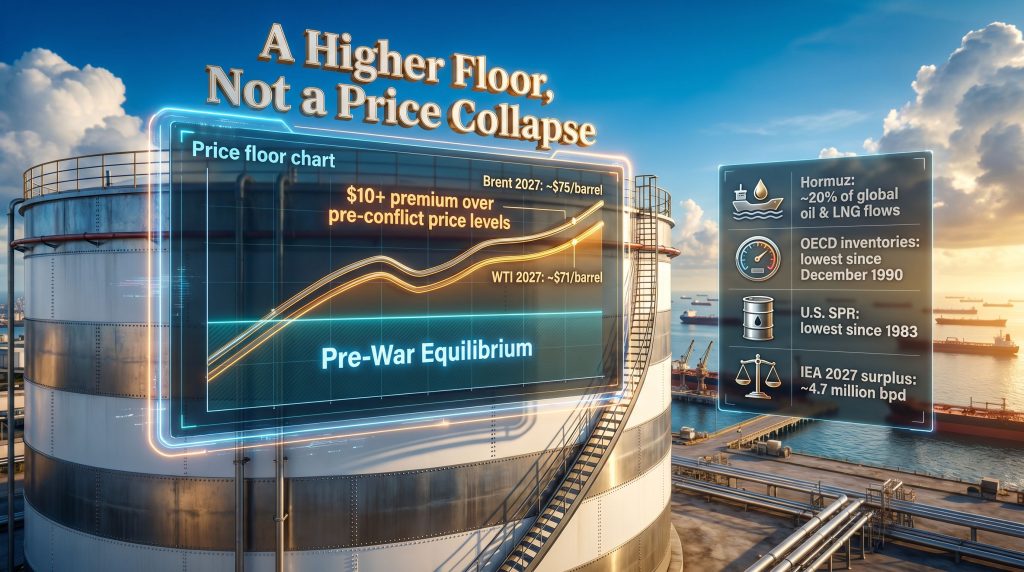
Futures markets are already answering this question with their own pricing signal. Brent crude for 2027 delivery is currently trading at approximately $75 per barrel, while the WTI 2027 curve sits near $71 per barrel. Both figures represent a $10+ premium over pre-conflict price levels, reflecting the market's embedded assessment that the structural environment has been durably altered.
| Price Level | Market Implication |
|---|---|
| Below $60–70/barrel | Pre-war equilibrium range; structurally unlikely given inventory deficits |
| $70–$75/barrel | Current WTI 2027 futures pricing; reflects inventory rebuild plus risk premium |
| $75–$80/barrel | Current Brent 2027 futures pricing; consensus analyst floor estimate |
| Above $80/barrel | Requires deal breakdown, renewed Hormuz closure, or fresh geopolitical escalation |
Hansen's analysis identifies four structural mechanisms that collectively support this elevated price floor:
- Inventory deficit overhang — Rebuilding global stocks from multi-decade lows requires sustained above-consumption supply absorption, limiting price downside for an extended period
- Strategic reserve reconstruction — Government-mandated reserve rebuilding creates durable incremental demand that operates independently of commercial consumption patterns
- Seasonal demand recovery — Lower prices historically stimulate consumption rebounds in price-sensitive emerging markets, with second-half 2026 and full-year 2027 demand both projected to recover from the 2026 contraction low
- Geopolitical risk premium persistence — The conditional nature of the Hormuz reopening, unresolved nuclear tensions, and the 60-day negotiation window all maintain a structural risk premium in forward pricing
The Unresolved Risks That Could Reprice Oil Overnight
Erik Meyersson, Chief Emerging Markets Strategist at SEB Bank, assessed that the MoU secures a ceasefire and provides Iran with meaningful economic relief, but it does not resolve the nuclear file in any technically meaningful sense, nor does it address the underlying sources of regional tension that drove the conflict in the first place.
The key risk vectors that remain active include:
- Nuclear programme ambiguity: No verified technical commitments on enrichment capabilities exist within the MoU framework
- 60-day negotiation failure risk: If comprehensive deal talks break down within the negotiation window, the rapid reinstatement of war-risk premiums could push Brent back above $100 per barrel within days
- Hormuz enforcement gap: The best efforts language creates genuine legal ambiguity around what happens if shipping incidents recur before a final agreement is reached
- Sanctions implementation uncertainty: The pace of actual sanctions waivers on Iranian oil sales depends on U.S. domestic political dynamics that remain volatile
Goldman Sachs has separately warned that Strait of Hormuz traffic patterns may never fully recover to pre-conflict norms, even under a successful final deal scenario. This is a structurally important observation that the futures curve is partially but not fully reflecting. In addition, OPEC's market influence over production policy during this period adds another layer of complexity to any price recovery thesis.
The next major ASX story will hit our subscribers first
Downstream and Adjacent Market Effects
The U.S.-Iran deal oil prices spillover extends well beyond crude benchmarks into interconnected commodity and freight markets.
Natural Gas and LNG
European gas prices fell 6% on the initial announcement, reflecting expectations of restored LNG transit through Hormuz. Qatar, whose LNG exports are heavily dependent on Hormuz passage, has been preparing rapid restart capabilities ahead of any formal reopening. Separately, more than 60 million barrels of oil equivalent in energy cargoes were reported ready to transit the strait following the ceasefire.
However, Australian LNG supply disruptions from unrelated industrial action have partially offset the relief, and the ECB has noted that the Iran peace framework will not erase Europe's structural energy price shock given the infrastructure and trade route adjustments already embedded in the continent's energy system.
Shipping and Freight Markets
The world's largest tanker operators have publicly cautioned against a rapid normalisation of Hormuz traffic, warning that sudden volume surges could create dangerous congestion and safety risks. High tanker rates have been disrupting Persian Gulf oil shipments to Asian buyers even ahead of a formal reopening, and falling Murban and Dubai crude benchmarks have opened new arbitrage windows for U.S. and European buyers seeking competitively priced Middle Eastern barrels. This broader oil market impact is being felt across freight, refining, and downstream product markets simultaneously.
U.S. Domestic Fuel Prices
The primary near-term domestic political benefit of the agreement for the Trump administration is the reversal of U.S. average gasoline prices above $4 per gallon, a threshold that had been breached during the conflict period and carries significant political sensitivity. This dynamic partly explains the administration's motivation for securing at least a framework agreement, even one that leaves major structural questions unresolved.
Key Indicators to Monitor During the 60-Day Window
For investors and energy market participants, the next two months represent a high-uncertainty environment with significant binary risk in either direction.
| Indicator | Significance |
|---|---|
| OECD inventory build rate | Measures pace of surplus absorption; slower builds support higher price floor |
| Hormuz vessel transit data | Real-time indicator of deal implementation progress |
| Iran crude export volumes | Tracks actual versus permitted sanctions relief execution |
| U.S. SPR refill announcements | Government-level demand signal for recovering supply |
| IEA monthly oil market report updates | Benchmark for 2027 supply-demand balance revisions |
| Brent/WTI 2027 futures curve | Contango depth signals market's surplus absorption expectations |
Furthermore, OPEC's market influence on production decisions during this window will be critical in determining whether the theoretical 2027 surplus materialises in practice or gets absorbed by coordinated output management.
Disclaimer: This article is for informational purposes only and does not constitute financial or investment advice. Oil price forecasts involve significant uncertainty and may differ materially from actual outcomes. Readers should conduct independent research before making any investment decisions.
A Recalibrated Market, Not a Broken One
The U.S.-Iran deal oil prices relationship has demonstrably shifted the probability distribution of oil market outcomes. It has reduced the near-term tail risk of a prolonged Hormuz closure and lowered the floor under near-term Brent pricing. What it has not done, however, is eliminate the structural supports that prevent a return to pre-conflict price levels.
The 2027 surplus projected by the IEA is real in a technical sense, but its market impact will be substantially cushioned by inventory rebuild demand, strategic reserve reconstitution requirements, slow production restart realities, and a demand recovery that multiple major forecasters expect to exceed the 2026 contraction. Futures markets are already pricing this outcome, with Brent and WTI 2027 curves sitting more than $10 above pre-war equilibrium levels.
The current price decline is best understood as a risk premium compression event triggered by reduced war probability. It is not a signal that the structural forces that elevated oil prices over the past several months have been resolved. The inventory hole is still there. The restart timelines are still uncertain. And the 60-day negotiation clock is still running.
Want to Stay Ahead of the Next Major Commodity Discovery Before the Market Moves?
While oil markets navigate the complex aftermath of the U.S.-Iran MoU and structural inventory deficits reshape commodity pricing dynamics, Discovery Alert's proprietary Discovery IQ model delivers real-time alerts on significant ASX mineral discoveries — instantly translating complex geological data into actionable investment opportunities for both short-term traders and long-term investors. Explore historic examples of exceptional discovery returns and begin your 14-day free trial today to position yourself ahead of the broader market.