May 25, 2026
The Geography of Global Energy Risk: Why a 33-Kilometre Passage Holds the World's Energy System Hostage
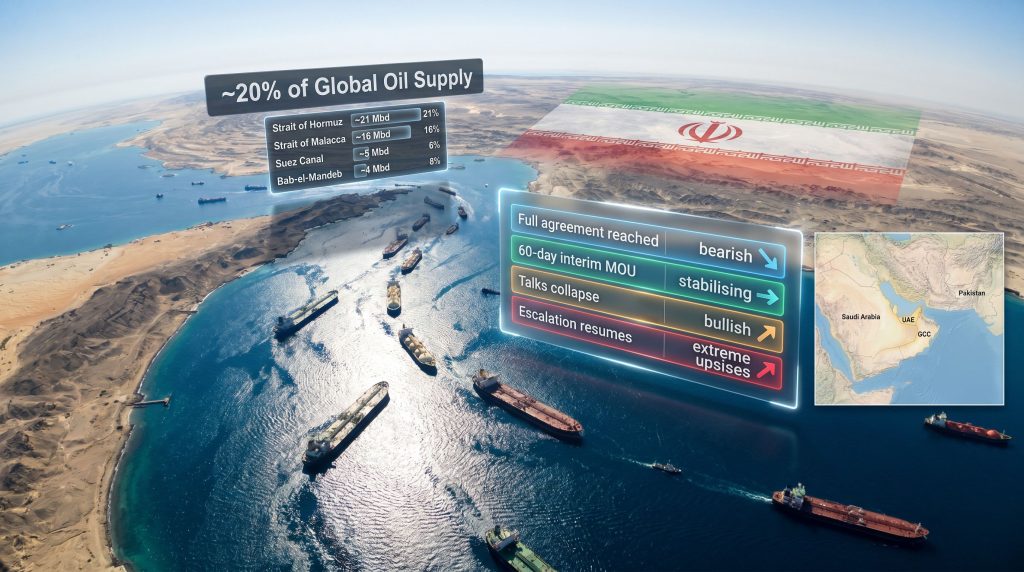
Imagine a single doorway through which roughly one-fifth of all globally traded oil and a significant portion of the world's liquefied natural gas must pass every day. That doorway is the Strait of Hormuz, a narrow waterway barely 33 kilometres across at its tightest navigable point, connecting the Persian Gulf to the Gulf of Oman. No other geographic feature on Earth concentrates so much economic and geopolitical risk into such a confined space — and the U.S. Iran Hormuz agreement now sits at the centre of that tension.
The strait's strategic weight is not simply a function of volume. It is a function of irreplaceability. While Saudi Arabia maintains its East-West crude pipeline, known as the Petroline or EAP system, with a theoretical capacity of around 5 million barrels per day, that figure falls well short of compensating for the approximately 20 million barrels per day that typically transit Hormuz.
The gap between what bypass infrastructure can carry and what the strait normally handles is itself one of the most under-appreciated vulnerabilities in global energy security planning.
A comparison of major maritime chokepoints illustrates just how exposed Hormuz is relative to other constrained passages:
| Chokepoint | Daily Oil Flow (approx.) | Alternative Route Available? | Diversion Cost Impact |
|---|---|---|---|
| Strait of Hormuz | ~20% of global supply | Partial (Saudi EAP pipeline) | Extreme |
| Strait of Malacca | ~15% of global supply | Yes (longer routes) | High |
| Suez Canal | ~10% of global supply | Yes (Cape of Good Hope) | Moderate–High |
| Bab-el-Mandeb | ~6% of global supply | Yes | Moderate |
Every other major chokepoint on this list has a meaningful rerouting alternative, even if that alternative is expensive. The Suez Canal can be bypassed via the Cape of Good Hope at considerable cost in time and fuel. The Strait of Malacca has competing routing options through the Lombok or Sunda Straits. Hormuz, however, has no equivalent escape valve at the volumes the global oil system currently requires.
That structural asymmetry is precisely why any diplomatic development tied to the U.S. Iran Hormuz agreement negotiations carries immediate and direct consequences for crude benchmarks, war-risk insurance premiums, and freight markets worldwide. Furthermore, the broader geopolitical risk landscape surrounding this corridor amplifies those consequences across commodity classes.
When Hormuz faces disruption, the cascade effect across energy markets moves with unusual speed. Brent crude benchmarks reprice within hours. War-risk insurance premiums on tankers operating in the Persian Gulf surge. Very Large Crude Carrier day rates tighten as operators reroute or stand vessels down pending clarity.
These are not theoretical risks. The conflict period running into 2026 demonstrated all three responses in real time, with oil price movements climbing sharply and tanker availability across the broader Gulf region contracting as a direct consequence of navigational uncertainty.
When big ASX news breaks, our subscribers know first
Understanding the Reported U.S. Iran Hormuz Agreement: MOU or Durable Treaty?
Defining the Framework: What Is Actually Being Negotiated?
The diplomatic architecture currently under discussion between Washington and Tehran is far more fragile than headlines might suggest. Analysts and officials familiar with the talks have consistently characterised the arrangement as a memorandum of understanding, or MOU, rather than a legally binding or Senate-ratified treaty. That distinction matters enormously for durability and enforceability.
According to reporting from CBS News and confirmed by multiple news sources, the draft framework reportedly includes:
- A 60-day ceasefire extension designed to create space for broader negotiation
- Conditional stabilisation and reopening of Hormuz shipping lanes during the negotiation window
- A limited resumption of Iranian crude oil export flows while talks continue
- Potential partial unfreezing of Iranian sovereign assets held in overseas accounts as part of a phased compliance structure
What triggered this negotiation window was not goodwill on either side but economic pressure. The sustained U.S. naval presence around the strait, operating as a de facto maritime blockade, created conditions that made the status quo costly for Iran. Meanwhile, elevated crude prices and constrained tanker availability generated their own pressures within global markets, creating incentives for both parties to at least explore a temporary arrangement.
Regional mediators, including Pakistan, played a facilitation role in keeping back-channel communication open when formal diplomatic contact remained limited.
The ceasefire that preceded the current talks has held in recent weeks, but analysts who study fragile negotiation environments are cautious. A ceasefire is not a settlement. It is an absence of active hostilities, and the conditions that produced the conflict remain largely unresolved beneath the surface of the current diplomatic pause.
The Core Sticking Points: Where U.S.-Iran Talks Risk Breaking Down
Nuclear Architecture: The Enrichment Impasse
The most structurally complex issue in the current negotiations involves Iran's nuclear infrastructure. U.S. officials have indicated that Iran has agreed in principle to dispose of its highly enriched uranium stockpile as part of a broader deal framework. That phrase, "in principle," carries significant diplomatic weight because it signals intent without constituting a commitment.
The gap between in-principle agreement and verified compliance is precisely where prior frameworks, most notably the 2015 Joint Comprehensive Plan of Action (JCPOA), encountered their most serious challenges.
Washington's position centres on verifiable denuclearisation, including restrictions on enrichment thresholds and ballistic missile capabilities. Tehran's counter-position preserves its right to civilian nuclear infrastructure, drawing a distinction between weapons development and peaceful nuclear energy.
Iranian President Masoud Pezeshkian has publicly stated that Iran is prepared to provide assurances to the international community that nuclear weapons are not its objective, while framing the country's broader posture around regional stability rather than bilateral concession to U.S. demands.
Republican lawmakers and national security voices within the United States have been vocal in their criticism of the reported framework, arguing it does not go far enough on either missile capability restrictions or enrichment thresholds. Israeli Prime Minister Benjamin Netanyahu has stated clearly that any final arrangement must comprehensively eliminate the threat of Iranian nuclear weapons, a condition that effectively raises the bar for what Washington can accept domestically.
The Economic Fault Lines: Asset Freezes and Sanctions Sequencing
Beneath the nuclear debate lies an equally contentious economic dispute. Iran's core demand is the release of frozen sovereign assets as a precondition for compliance with the agreement's terms. Washington's preference is to sequence sanctions relief after phased compliance verification, not as an upfront concession. These opposing positions reflect a fundamental asymmetry of trust that has defined U.S.-Iran negotiations for decades.
The sequencing problem is not merely procedural. It reflects each party's calculation of the other's reliability. Iran, having seen the JCPOA effectively dismantled after the U.S. withdrawal in 2018, has strong institutional incentives to demand front-loaded economic concessions before committing to verifiable compliance.
Washington, aware of that history, has equally strong domestic political incentives to demand compliance verification before releasing any economic relief. Consequently, this trust deficit remains one of the most stubborn obstacles in the current talks.
The Public Messaging Divergence
One of the more analytically interesting dimensions of the current negotiations is the gap between how each side is framing the talks publicly. U.S. President Donald Trump has described the bilateral relationship as moving toward being more professional and productive, while simultaneously maintaining the naval blockade and signalling that no agreement will be rushed.
Secretary of State Marco Rubio has offered cautiously optimistic signals, indicating the possibility of good news from negotiations without committing to a timeline.
Iranian state media, by contrast, has framed the strait as remaining under Iranian management and has not publicly confirmed several key provisions that U.S. negotiators have described. This public messaging divergence is not accidental. Both sides are using their domestic and international communications to shape leverage, reassure internal constituencies, and avoid the appearance of capitulation. It is, in itself, a negotiating tool.
How a U.S. Iran Hormuz Agreement Would Reshape Global Energy Markets
Crude Price Mechanics and Scenario Modelling
The energy market implications of the current negotiations span multiple commodity classes and market structures. The following scenario table captures the range of outcomes and their estimated market consequences:
| Scenario | Hormuz Status | Estimated Crude Price Impact | Tanker Market Response |
|---|---|---|---|
| Full agreement reached | Fully reopened | Bearish: significant downward pressure | Freight rates normalise |
| 60-day interim MOU | Partially reopened | Moderately bearish | Insurance premiums ease |
| Talks collapse | Remains disrupted | Strongly bullish | Rates spike further |
| Escalation resumes | Closed/contested | Extreme upside | Market seizes |
Even a credible interim agreement that falls short of a final deal can trigger meaningful repricing. War-risk insurance premiums are particularly sensitive to perceived probability shifts. When underwriters reassess the likelihood of safe transit, premium movements can be rapid and substantial, altering the economics of tanker operations across the entire Persian Gulf region before a single cargo has moved.
The Often-Overlooked LNG Dimension
Most market commentary focuses on crude oil when discussing Hormuz disruptions, but the LNG supply outlook is arguably less well understood and equally significant. Qatar, one of the world's largest LNG exporters, routes a substantial share of its output through or near the Hormuz passage to reach Asian buyers. Prolonged disruption to that corridor does not simply redirect cargoes — it compresses LNG shipping availability, inflates spot freight premiums, and creates secondary pricing dislocations across Asian import markets.
European LNG import economics are also affected, albeit less directly. If Persian Gulf supply remains constrained, competition for Atlantic Basin and U.S.-origin LNG cargoes intensifies, which tightens European supply margins and pressures utility procurement strategies at a time when European energy markets remain structurally sensitive to any tightening signal.
Iranian Oil Re-entry: Supply Overhang Risk
The potential return of Iranian barrels to global markets under a limited sanctions relief scenario introduces a structural complexity that OPEC+ has not yet had to openly address. Iran's oil production capacity, while degraded by years of sanctions, retains meaningful upside. Any arrangement that allows even partial resumption of Iranian exports outside the cartel's quota architecture creates a supply management headache for OPEC+ members who have already made production adjustments premised on Iranian barrels remaining largely sidelined.
The 2015 JCPOA oil market re-entry provides a useful but imperfect precedent. At that time, Iran returned roughly 500,000 to 1 million barrels per day to markets over a period of several months, contributing to a price environment that remained under sustained pressure through 2015 and 2016. The 2026 structural context differs in important ways: OPEC market influence mechanisms are more developed, but the cartel's internal tensions over quota compliance also run deeper.
Regional Geopolitics: Third-Party Mediators and the Israeli Veto Risk
Multilateral Facilitation and Gulf State Ambivalence
Pakistan's involvement in facilitating back-channel communication reflects a broader multilateral dimension to the talks that bilateral framing tends to obscure. Gulf Cooperation Council states occupy an uncomfortable position: they would benefit directly from Hormuz reopening through normalised shipping economics and reduced insurance costs, but they remain wary of any arrangement that strengthens Iranian regional influence or legitimises Tehran's strategic posture in the Gulf.
China and India, as the two largest consumers of Persian Gulf crude, maintain significant but largely quiet stakes in the outcome. Neither government has been a visible participant in the reported mediation architecture, but both would face meaningful import cost and supply security consequences under any scenario where Hormuz remains disrupted through 2026 and beyond. The global trade war impacts already weighing on both economies would only be compounded by prolonged energy market disruption.
The Israeli Veto Risk: Historical Precedent and Structural Limits
Netanyahu's stated red lines introduce a variable that U.S. negotiators cannot ignore. Israeli opposition to the 2015 JCPOA shaped the domestic U.S. ratification debate and ultimately contributed to the political conditions that enabled the 2018 withdrawal. The structural mechanism matters here: a presidential executive agreement can be concluded without Senate ratification, but that same structure makes it inherently reversible by a future administration.
A Senate-ratified treaty would be more durable but faces a far higher political threshold in the current U.S. domestic environment.
Assessing Deal Durability: A Four-Condition Framework
Analytical insight: Interim ceasefire extensions in high-stakes diplomatic negotiations frequently function as pressure-release valves rather than genuine pathways to durable settlement. The reported 60-day window would need to produce verifiable compliance architecture to transition from a fragile MOU into an enforceable framework.
Diplomatic history across comparable negotiation contexts suggests four conditions typically determine whether a fragile ceasefire evolves into something durable:
- Mutual economic incentive — both parties must face greater costs from continued disruption than from accepting compromise
- Verification mechanisms — third-party or multilateral inspection regimes that neither side can unilaterally override without consequence
- Domestic political insulation — leadership on both sides must be capable of defending concessions to hardline domestic constituencies
- Sequenced implementation — phased compliance tied to phased relief, reducing the front-loaded concession risk that undermined previous frameworks
The current negotiations satisfy the first condition reasonably well. Economic pressure on Iran from the effective maritime blockade is significant, and global energy market disruption creates political costs for Washington as well. However, the second, third, and fourth conditions remain largely unresolved, which is precisely why analysts are treating the reported progress cautiously.
Risk Factors That Could Collapse the Current Talks
Several specific scenarios could derail the framework before it solidifies:
- Hardliner resistance within Iran's Islamic Revolutionary Guard Corps, which operates with significant institutional autonomy from the civilian government and has its own strategic interests in maintaining pressure on Gulf shipping
- U.S. Congressional pushback from Republican members demanding stricter caps on both enrichment activities and ballistic missile development as a precondition for any sanctions relief
- A third-party incident, such as a tanker seizure, proxy attack, or navigational confrontation, that collapses the ceasefire atmosphere before the MOU is formalised
- The persistent credibility gap created by Iran's failure to publicly confirm key provisions that U.S. negotiators have described, which leaves the framework's actual terms ambiguous and disputed
The next major ASX story will hit our subscribers first
Frequently Asked Questions: U.S. Iran Hormuz Agreement
What is the reported U.S. Iran Hormuz agreement?
It is a draft interim framework, described by multiple reporting outlets as substantially negotiated but not yet finalised, that would extend the current ceasefire, stabilise Hormuz passage conditions, and establish a negotiating environment for broader nuclear and sanctions discussions. It is characterised as an MOU rather than a binding treaty.
Has the Strait of Hormuz been formally closed?
Shipping intelligence sources treated the strait as effectively disrupted during the conflict period, with Iran asserting tighter operational control over transits. A formal closure was not universally declared, but the practical effect on tanker routing, insurance, and freight economics was substantial. Fortune's analysis of the regional power balance offers further context on how this disruption reshaped the Persian Gulf's strategic dynamics.
What does each side want from the deal?
Iran is seeking release of frozen sovereign assets, international recognition of civilian nuclear rights, and sanctions relief, with the sequencing of those concessions being the primary dispute. The United States is seeking verifiable disposal of highly enriched uranium, restrictions on ballistic missile development, and a compliance-first structure before economic relief is extended.
How would a finalised deal affect oil prices?
A credible and verifiable agreement would exert downward pressure on crude benchmarks by restoring supply confidence and removing the war-risk premium currently embedded in prices. The magnitude of that correction would depend on whether Iranian exports resume, at what volume, and whether OPEC+ chooses to absorb or offset those additional barrels.
What are the consequences if talks collapse?
Renewed Hormuz disruption, further crude price escalation, tightening tanker availability, intensified LNG freight market stress, and the potential for a return to active hostilities in the region. Markets have already demonstrated their sensitivity to even signals of progress or regression in the talks.
A Narrow Window With Outsized Consequences
What to Watch as Indicators of Real Progress
The coming weeks represent a critically compressed window for both parties to either advance toward a structured compliance architecture or allow the current ceasefire equilibrium to degrade. Several observable indicators will signal whether genuine momentum is building or the framework is fragmenting:
- Iranian state media tone shifts: Any public acknowledgment by Tehran of specific provisions described by U.S. negotiators would represent a meaningful credibility signal and reduce the interpretive gap between both sides' public positions
- Tanker war-risk insurance premium movements: These function as a real-time market-implied probability gauge for Hormuz reopening, updating continuously as shipping underwriters reassess navigational risk
- U.S. Congressional posture: Whether Republican opposition to the reported framework coalesces into formal legislative obstruction will determine the domestic political viability of any executive-level agreement
- Third-party mediator signals: Statements from Pakistan or Gulf state facilitators indicating that back-channel progress is holding would carry diagnostic value that official government communications often obscure
The central analytical question surrounding the U.S. Iran Hormuz agreement is not whether economic incentives for a deal exist. For both parties, the costs of prolonged disruption are substantial and observable. The deeper question is whether the domestic political constraints on each side allow their respective leaderships to accept the compromises that a durable, verifiable framework requires. That question remains unresolved, and the 60-day window reportedly under discussion may be the clearest test of whether resolution is genuinely achievable in the near term.
This article is intended for informational purposes only and does not constitute investment advice or a recommendation to trade any financial instrument. Energy market forecasts and geopolitical scenario assessments involve inherent uncertainty and should not be relied upon as definitive predictions of future outcomes. Readers are encouraged to consult independent professional advice before making decisions based on geopolitical or commodity market developments.
Want to Capitalise on the Market Moves Triggered by Geopolitical Shocks Like the Hormuz Crisis?
Discovery Alert's proprietary Discovery IQ model delivers real-time alerts on significant ASX mineral discoveries, translating complex market signals into actionable opportunities the moment they emerge — start your 14-day free trial today and explore historic discoveries that have generated exceptional returns for investors who positioned themselves early.