August 23, 2026
The Hidden Architecture of a Crude Price Regime Shift
When geopolitical risk premiums are suddenly stripped from energy markets, the price movement itself is only the most visible layer of what is actually happening beneath the surface. The real story lies in the structural mechanics: which supply flows were artificially constrained, which demand signals were already deteriorating independently, and whether the apparent relief is durable or fragile. Mid-2026 presents exactly this kind of inflection moment for global oil markets, and understanding it requires moving past the diplomatic headlines to examine the conditional machinery underneath.
The US-Iran peace deal oil prices dynamic that emerged on June 16, 2026 is not simply a geopolitical de-escalation story. It is the convergence of a supply risk unwind, an independent demand deterioration, and a sequenced reopening process that contains multiple potential failure points. Each of those elements deserves careful examination on its own terms. For broader context on how we arrived here, the crude oil price trends leading into this period reveal much about the underlying structural pressures at play.
When big ASX news breaks, our subscribers know first
What the Strait of Hormuz Closure Actually Did to Global Energy Pricing
The Chokepoint Premium and Its Cost to Markets
The Strait of Hormuz carries approximately 20% of global seaborne oil trade, making it the single most consequential maritime chokepoint in the world energy system. When Iran closed the strait following the outbreak of conflict on February 28, 2026, crude markets did not simply react to a short-term disruption. They repriced for a sustained period of supply uncertainty, embedding a geopolitical risk premium into Brent and WTI that elevated both benchmarks well above levels justified by underlying demand fundamentals.
That premium served a specific market function: compensating traders, refiners, and importers for the probability-weighted cost of supply interruption across a forward horizon. Once a credible pathway to reopening the strait emerged, the unwinding of that premium was mechanical and largely inevitable. The question was never whether prices would fall, but by how much and over what timeline. The oil market trade war impact from earlier in the year had already begun to weaken the structural foundation underpinning prices before the conflict escalated.
China's Demand Signal Complicated the Picture Further
Layered on top of the supply disruption premium was an independent demand deterioration that markets had been absorbing simultaneously. China's crude imports collapsed by 29% in May 2026 to reach an eight-year low, a figure that points to structural softness in the world's largest crude importing economy rather than a temporary inventory adjustment.
Critical context: The confluence of a supply risk unwind and a genuine demand deterioration means the post-deal price floor is considerably more fragile than the headline percentage declines suggest. Markets pricing a swift recovery in crude toward pre-conflict levels are ignoring a demand-side headwind that exists entirely independently of the Hormuz situation.
Breaking Down the June 16 Memorandum: What Was and Was Not Agreed
An Interim Framework, Not a Binding Treaty
The agreement signed on June 16, 2026 is formally a preliminary memorandum of understanding. The distinction matters enormously for market pricing. No sanctions relief is activated, no frozen assets are released, and no Iranian oil export volumes return to market simply because a memorandum was signed. The formal treaty text is scheduled for signing in Geneva on June 19, 2026, following preparatory meetings in Doha.
Iranian media reports have described a deal framework that includes releasing $24 billion in frozen assets and a $300 billion reconstruction plan over a multi-year horizon. The US position makes clear that no financial flows are activated until Iran demonstrates verifiable adherence to the deal's terms. The reconstruction capital, if it materialises, could reshape Middle East infrastructure and energy sector investment significantly over the following decade, but that dimension belongs to a different investment horizon than near-term crude price dynamics.
The Reopening Sequence: Why Order Matters
The mechanism by which Gulf oil exports return to market is sequential and conditional, not simultaneous. Each stage depends on the successful completion of the previous one:
- A 60-day ceasefire extension from the April agreement provides the diplomatic foundation.
- The Strait of Hormuz reopens for mine clearance operations, enabling partial shipping resumption.
- The US naval blockade on Iranian ports is lifted in parallel with the Hormuz reopening schedule.
- Gulf oil export volumes begin recovering toward pre-war levels.
The critical market insight here is that mine clearance is not an instantaneous process. It requires specialised vessels, coordinated international oversight, and time. Any logistical bottleneck at this stage delays the entire sequence downstream, which is precisely why analysts at DBS Bank have flagged the risk of a price rebound within weeks if ports and shipping lanes do not reopen simultaneously. For a deeper look at how geopolitical events shape energy pricing, this oil and geopolitics analysis provides valuable structural context.
| Deal Component | Status as of June 16, 2026 | Oil Market Relevance |
|---|---|---|
| Ceasefire Extension | Active (60-day) | Removes near-term supply shock risk |
| Hormuz Reopening | Conditional on mine clearance | Partial shipping resumption underway |
| US Naval Blockade Removal | Tied to Hormuz schedule | Critical for export volume recovery |
| Formal Treaty Signing | Scheduled June 19, Geneva | Unlocks next phase of framework |
| Frozen Asset Release ($24B) | Pending compliance verification | Multi-year capital flow catalyst |
How Far Did Oil Prices Fall and What Are the Key Levels to Watch
The Price Movement in Precise Terms
The initial market reaction to the peace memorandum was sharp and immediate. According to Investopedia's market coverage, stock futures surged while oil prices fell decisively as traders unwound the geopolitical risk premium built up over months of conflict:
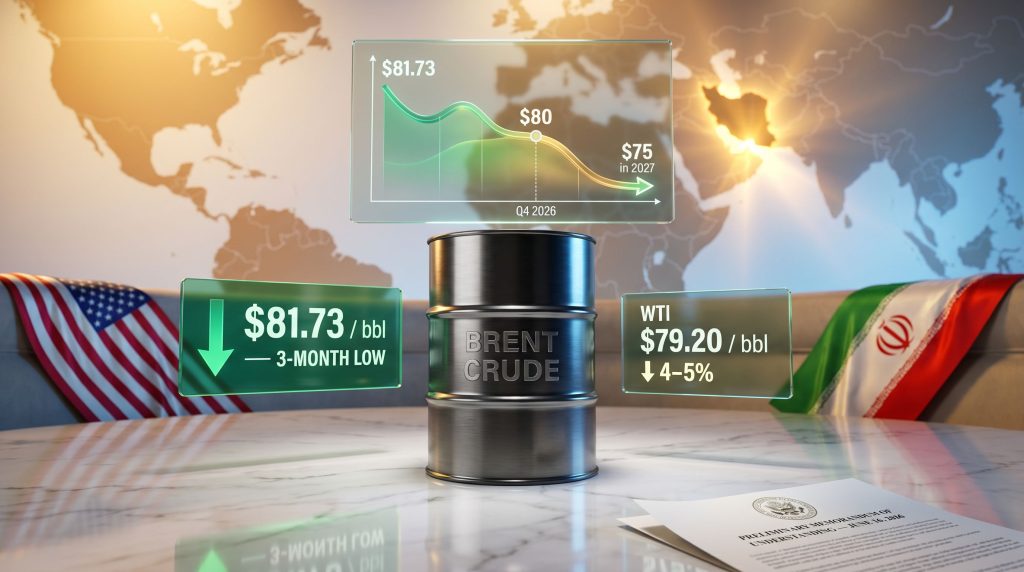
- WTI Crude dropped over 4% to 5%, settling near $79.20 per barrel, the lowest level since early March 2026.
- Brent Crude fell approximately 3.6% to 5%, settling between $81.73 and $84.21 per barrel, a three-month low.
- The US Dollar Index declined to a 10-day low of 99.76, reflecting the reduction in geopolitical safe-haven demand that had been supporting the greenback.
| Benchmark | Estimated Pre-Deal Level | Post-Deal Settlement | Approximate Decline | Context |
|---|---|---|---|---|
| Brent Crude | ~$85-$86/bbl | $81.73/bbl | ~1.7-5% | 3-month low |
| WTI Crude | ~$83-$84/bbl | $79.20/bbl | ~1.9-5% | 3-month low |
| US Dollar Index | ~100.5+ | 99.76 | ~0.7% | 10-day low |
What the Forecasting Community Is Signalling
Goldman Sachs has set a base case of Brent near $80 per barrel by Q4 2026, contingent on Gulf exports returning to pre-war volumes by the end of July. Under a sustained normalisation scenario, the bank projects a further decline toward $75 per barrel in 2027. The consumer-facing implication of that trajectory is meaningful: US retail gasoline prices could potentially fall below $3.75 per gallon before the July 4th holiday, compared to approximately $4.55 per gallon at recent highs.
Investor caution: Goldman Sachs' $80 Q4 2026 target assumes a smooth and timely reopening of Gulf export infrastructure. Any deviation from that timeline, whether logistical or geopolitical, invalidates the target and could see Brent rebound to pre-deal levels within weeks.
Three Scenarios Markets Are Now Pricing for Oil
Scenario 1: Smooth Reopening
Under this base case, mine clearance completes on schedule, the US naval blockade lifts in coordination with port reopening, and Gulf export volumes reach pre-war levels by the end of July. Brent tracks toward Goldman Sachs' $80 Q4 2026 target before declining further toward $75 in 2027. Inflation relief materialises across consumer energy costs, and central bank rate cut expectations solidify. Airlines, transport operators, and logistics companies benefit most directly from sustained lower fuel costs.
Scenario 2: Delayed Reopening
Logistical bottlenecks, mine clearance overruns, or port infrastructure damage prevent simultaneous reopening of shipping routes. Oil prices rebound within weeks, per analysis from DBS Bank. Under this scenario, Australian swaps market pricing implies a 30% probability of a 16-basis-point rate hike in August, which would apply significant additional pressure to already-strained housing and consumer discretionary sectors. Inflation relief is deferred by at least one quarter.
Scenario 3: Deal Breach via Geopolitical Re-escalation
Iranian Foreign Minister Abbas Araghchi has stated publicly that any Israeli military escalation in Lebanon, or continued Israeli presence on Lebanese territory, would constitute a breach of the interim deal. A breach scenario would restore the full supply risk premium to crude prices and reverse all post-deal price declines. Furthermore, it would effectively eliminate near-term rate cut expectations across major central banks. The safe-haven market dynamics that emerged during earlier phases of the conflict would almost certainly reassert themselves rapidly under such a scenario.
| Scenario | Trigger Condition | Brent Direction | Rate Cut Probability | AUD Outlook |
|---|---|---|---|---|
| Smooth Reopening | Exports resume by end of July | Toward $75-$80 | Increases | Modest support |
| Delayed Reopening | Logistical bottlenecks persist | Rebounds within weeks | Decreases | Neutral to negative |
| Deal Breach | Israeli escalation in Lebanon | Sharp reversal upward | Sharply decreases | Significant weakness |
Why Lower Oil Prices Do Not Immediately Cool Inflation
The Pipeline Transmission Problem
One of the most consistently misunderstood dynamics in energy economics is the lag between crude price movements and consumer-level inflation relief. Fuel cost reductions take weeks to months to flow through transport, logistics, food supply chains, and retail pricing. Oxford Economics Australia has noted that elevated energy, shipping, and agricultural costs are still transmitting into consumer prices even as crude benchmarks decline, meaning that markets which moved aggressively to price in rate cuts may be running ahead of what the underlying data will support.
The pipeline effect operates in both directions: crude price spikes are passed through to consumers relatively quickly, while crude price declines often stall at the refinery or distribution level, particularly when margins are being rebuilt after a period of compressed profitability. Consequently, the market volatility impacts seen earlier in the year continue to echo through supply chains even as the headline crude price narrative shifts.
Three Central Banks, Three Different Pressures
The monetary policy backdrop surrounding the US-Iran peace deal oil prices dynamic is unusually complex, with three major central banks pulling in partially different directions:
- Reserve Bank of Australia (RBA): Held its cash rate at 4.35% on June 16, 2026. Analysis from StoneX's Matt Simpson characterises the RBA's hawkish tone as a deliberate effort to preserve the cumulative impact of three prior rate hikes. With Australian Q1 GDP growth at a weak 0.3% and unemployment rising to a four-and-a-half-year high of 4.5%, the RBA faces a difficult balancing act between inflation persistence and growth fragility.
- Bank of Japan (BOJ): Raised rates to their highest level in 31 years via a 7-1 vote, maintaining a wide rate differential with the US. Analysis from Kieran Williams of Intouch Capital Markets highlights that this gap limits yen recovery potential and increases the probability of currency intervention. The yen was trading near 160.29 per dollar in the wake of the deal.
- US Federal Reserve: The oil price decline supports the disinflationary narrative, but rate cut timing remains strictly data-dependent. Gold market pricing implied a 57% probability of a rate hike still embedded in near-term expectations as of June 16, reflecting significant residual uncertainty about the inflation trajectory.
Three-year Australian bond yields rose 2 basis points to 4.457% in the aftermath of the memorandum signing, underscoring that rate expectations remain a primary market driver operating alongside oil price dynamics rather than simply following them.
The next major ASX story will hit our subscribers first
Sector Impacts: Who Benefits and Who Remains Exposed
Transport and Airlines: The Clearest Near-Term Winners
Airlines and transport operators are the most direct beneficiaries of a sustained crude price decline. Lower jet fuel costs expand operating margins immediately, and the sector responded with strong equity performance following the peace memorandum announcement. Logistics and shipping companies benefit from reduced diesel and bunker fuel costs, partially reversing the supply chain inflation that had compressed margins throughout the conflict period.
Australian Housing and Consumer Stocks: Structurally Vulnerable
Despite the oil price relief, rate-sensitive domestic sectors in Australia face a more complicated environment. The combination of weak GDP growth, rising unemployment, and an RBA unwilling to signal near-term easing creates a difficult backdrop for housing and consumer discretionary stocks regardless of the energy price trajectory. If the delayed reopening scenario materialises and oil prices rebound, these sectors face simultaneous pressure from inflation persistence and a deferred rate cut cycle.
Key Catalysts to Monitor Through June and July 2026
The following developments will determine which of the three scenarios above materialises. As Al Jazeera's economic reporting has highlighted, mixed signals from both sides continue to inject uncertainty into each of these critical checkpoints:
- June 19 Geneva signing: Formal treaty confirmation removes the deal-collapse tail risk and activates the next phase of the reopening framework.
- Hormuz mine clearance progress: The operational pace of shipping route restoration is the most critical near-term variable for Goldman Sachs' Q4 price target.
- Fed and Bank of England guidance: Whether policymakers signal that the oil price decline is sufficient to begin adjusting rate trajectories.
- BOJ Deputy Governor briefing: Shinichi Uchida's forthcoming commentary will clarify the pace of future Japanese rate increases, which carries significant implications for yen volatility and carry trade positioning.
- Israeli-Lebanon developments: The single most consequential geopolitical variable capable of reversing the entire market repricing in a matter of hours.
Bottom line for investors: The US-Iran peace deal oil prices relationship has created a genuine structural inflection point for inflation trajectories and rate expectations. However, the distance between a preliminary memorandum and durable supply normalisation is measured in conditional checkpoints, not calendar days. The spread between a smooth reopening and a delayed or breached deal could translate into $10-$15 per barrel on Brent and 50 or more basis points in rate expectation repricing across major developed market central banks. Positioning ahead of confirmed operational progress in the Hormuz reopening sequence carries substantially more risk than headline price movements currently reflect.
This article contains forward-looking analysis and scenario-based projections intended for informational purposes only. It does not constitute financial advice. All price targets and probability estimates referenced are drawn from third-party analysts and are subject to rapid change as conditions evolve. Past market behaviour during geopolitical de-escalation events does not guarantee equivalent outcomes in the current environment.
Want to Profit From the Next Major Mineral Discovery Before the Market Catches On?
While geopolitical shifts reshape energy markets, significant mineral discoveries on the ASX can generate equally dramatic price movements — and Discovery Alert's proprietary Discovery IQ model delivers real-time alerts the moment those discoveries are announced, turning complex data across 30-plus commodities into clear, actionable opportunities. Explore historic discovery returns on Discovery Alert's dedicated discoveries page and begin your 14-day free trial to position yourself ahead of the broader market.