August 2, 2026
Strategic Foundations of Current Diplomatic Tensions
Contemporary US Iran relations operate within a framework of competing strategic objectives that have evolved over multiple decades. The nuclear verification challenge represents just one dimension of a broader confrontation involving regional proxy conflicts, economic sanctions regimes, and technological competition. Furthermore, the interconnected nature of modern energy systems means that oil price trade impacts can trigger adjustments across continents.
Multi-track diplomatic channels currently operate through several mechanisms simultaneously. Pakistan, Oman, and Qatar have historically served as neutral facilitators, leveraging their relationships with both Washington and Tehran to maintain communication pathways even during periods of heightened tension. These intermediary roles become particularly crucial when direct bilateral channels face political constraints.
The economic leverage dynamics centre on approximately $6 billion in frozen Iranian assets held in international banking systems. This figure represents accumulated oil revenues that remained inaccessible due to comprehensive sanctions frameworks implemented since 2018. The release or continued restriction of these funds serves as a primary negotiation tool, creating immediate economic incentives for diplomatic engagement.
Nuclear enrichment capacity presents technical trade-offs that directly influence negotiation positions. Iran's current uranium stockpiles exceed Joint Comprehensive Plan of Action (JCPOA) limits by significant margins, with enrichment levels reaching 20% purity as of recent International Atomic Energy Agency reports. This technical capability creates time pressure for diplomatic resolution, as further enrichment advancement could fundamentally alter regional security calculations.
International oversight infrastructure requires substantial financial commitment and technical expertise. The IAEA's verification mechanisms historically employed real-time monitoring systems, including surveillance cameras at enrichment facilities and environmental sampling protocols. These systems cost approximately $50-100 million annually to maintain, representing a significant ongoing expense for sustainable compliance monitoring.
When big ASX news breaks, our subscribers know first
Economic Scenario Analysis and Market Implications
Breakthrough diplomatic agreement scenarios could trigger rapid energy market adjustments across multiple commodity sectors. Oil price volatility patterns historically demonstrate 15-25% corrections within 90 days following major geopolitical tension resolution. The Strait of Hormuz, which facilitates approximately 21% of global petroleum transit, could see traffic restoration to near-full capacity within months.
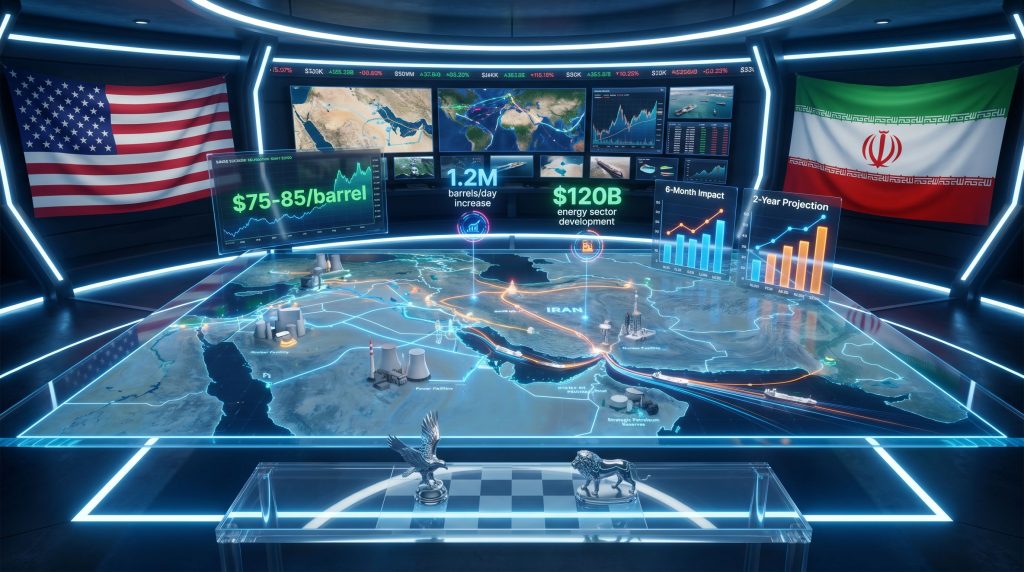
Iranian oil export potential represents a critical variable in global supply calculations. Pre-sanctions production capacity reached 2.5 million barrels per day, while current output remains constrained to 300,000-500,000 barrels daily due to international restrictions. Rapid export increase scenarios suggest potential addition of 1.2 million barrels per day within six months, contingent on infrastructure readiness and international compliance frameworks.
Regional investment flow projections indicate substantial capital deployment opportunities following sanctions relief. Energy sector development could attract $45-60 billion in infrastructure investment within the initial 18-month period, focusing primarily on upstream production enhancement and export facility modernisation. However, us tariffs and inflation concerns continue to influence global investment decisions.
| Economic Indicator | 6-Month Projection | 24-Month Outlook |
|---|---|---|
| Brent Crude Price Range | $75-85 per barrel | $70-80 stabilisation |
| Iranian Export Capacity | +1.2M bpd increase | +2.8M bpd potential |
| Strait Transit Volume | 95% capacity restoration | Full operational normalcy |
| Infrastructure Investment | $45B initial deployment | $120B cumulative development |
Prolonged stalemate scenarios create alternative economic pressures requiring adaptive responses. Alternative oil routing through Red Sea corridors incurs additional transportation costs of $3-5 per barrel, while insurance premiums for Middle Eastern shipping routes could increase 150-200% above baseline rates.
Strategic petroleum reserve utilisation becomes crucial during extended supply disruptions. The United States maintains approximately 700 million barrels in emergency stockpiles, sufficient for 30-40 days of import replacement at current consumption levels. Coordinated releases with International Energy Agency partners could extend this buffer to 60-90 days, providing diplomatic negotiation time.
LNG market reconfiguration affects global natural gas pricing structures beyond oil markets. European demand shifts toward US and Qatari suppliers could increase long-term contract prices by 20-30%, while spot market volatility may reach 40-50% above historical averages during transition periods. Additionally, tariffs impact markets across various sectors globally.
Military escalation pathways present the most severe economic disruption scenarios. Critical infrastructure targeting could affect regional power generation capacity for 6-12 months, while global commodity price shocks historically range from 50-100% increases during active conflict periods. Financial system vulnerabilities extend beyond energy markets to include semiconductor supply chains, agricultural exports, and shipping insurance availability.
Historical Precedents and Strategic Learning
The 1979-1981 hostage crisis provides instructive lessons for current diplomatic calculations. During this 444-day standoff, Iranian oil exports fell from 2.4 million barrels daily to near zero, demonstrating the economic costs of prolonged confrontation. Iran-United States relations have remained complex throughout subsequent decades. Algeria's successful mediation role offers a model for third-party diplomatic intervention, showing how neutral facilitators can create face-saving solutions for both parties.
Economic pressure effectiveness during the hostage crisis revealed limitations of sanctions-based coercion. Despite comprehensive international restrictions, fundamental policy positions remained unchanged until acceptable off-ramps emerged for both governments. This pattern suggests that economic leverage alone may not guarantee diplomatic breakthroughs without accompanying political incentives.
JCPOA implementation experience (2015-2018) demonstrates both opportunities and challenges in sanctions relief mechanisms. Following the agreement's effective date in January 2016, Iranian oil exports increased from 1.0 million barrels daily to 2.5 million barrels within six months, showing rapid production response capabilities.
Business confidence restoration proved more complex than technical production increases. Despite official sanctions relief, European companies required 18-24 months to fully re-engage with Iranian markets due to residual reputational risks and compliance uncertainties. Major transactions, including Airbus's $27 billion aircraft agreement and Total SA's South Pars energy investment, demonstrated gradual commercial normalisation patterns.
Verification mechanism effectiveness under the JCPOA employed sophisticated technical protocols. IAEA inspectors conducted 15 formal inspections during the first implementation year, utilising 24-day advance notice procedures for suspicious site access. Environmental sampling and isotopic analysis provided real-time compliance monitoring, though political sustainability ultimately determined agreement longevity.
Congressional oversight requirements create domestic political constraints on negotiation authority. The Corker-Cardin Act established 60-day congressional review periods for nuclear agreements, while treaty ratification requires two-thirds Senate approval. These procedural requirements significantly influence negotiation timelines and implementation strategies.
US withdrawal consequences (May 2018) illustrated rapid economic impact possibilities. Iranian oil exports collapsed from 2.5 million barrels daily to 100,000-300,000 barrels within 18 months, while European companies suspended operations despite continued JCPOA compliance by other signatories. This experience highlights the dominant influence of US financial system access on international business decisions.
Pressure Point Analysis and Strategic Vulnerabilities
US economic sensitivities centre on energy price impacts affecting domestic inflation calculations. Each $10 per barrel oil price increase correlates with approximately 0.3-0.5% inflation acceleration, creating electoral pressure during economic uncertainty periods. Current import dependence of 6-8 million barrels daily makes the US vulnerable to supply disruptions exceeding 2-3 million barrels globally.
Allied relationship management presents complex diplomatic challenges. European natural gas security depends on non-Russian supply sources totalling approximately 40% of consumption, requiring emergency LNG redirection during Middle Eastern disruptions. Maintaining sanctions coordination whilst addressing European energy needs creates ongoing policy tensions.
Military resource allocation faces competing global priorities across multiple theatres. Regional carrier group deployments and air asset positioning create credible deterrent capabilities but limit flexibility for simultaneous operations elsewhere. Defence budget constraints require strategic choices between regional presence and global readiness.
Iranian economic constraints demonstrate sanctions effectiveness whilst revealing adaptation strategies. GDP contraction reached 6.8% annually during comprehensive restrictions (2012-2015), while unemployment levels exceeded 12-13% in major urban areas. These economic pressures create domestic political stress but have not fundamentally altered nuclear policy positions.
Proxy network funding limitations affect regional influence capabilities. Iran's state budget historically allocated 5-10% to external operations through Islamic Revolutionary Guard Corps channels. Sanctions restrictions have reduced payment capabilities to Syrian allies and Hezbollah forces, limiting operational effectiveness but not eliminating regional activities.
Technological advancement barriers constrain nuclear development timelines. Semiconductor restrictions prevent acquisition of advanced manufacturing equipment, whilst centrifuge availability limits enrichment expansion. Iran's IR-1 and IR-2m centrifuges operate at 50-70% efficiency compared to Western equivalents, requiring larger installations for equivalent output.
Internal political dynamics create competing power centres affecting negotiation flexibility. The Supreme Leader, IRGC, and Parliament represent different institutional interests, with moderates seeking sanctions relief whilst hardliners fear economic dependence. These internal divisions can either facilitate compromise or prevent consistent policy implementation.
Regional Power Influence and Strategic Calculations
Saudi Arabia's market position provides significant leverage over global energy prices through OPEC+ coordination mechanisms. Controlling approximately 10% of global oil production and managing 40% of worldwide supply through cartel arrangements, Saudi decisions directly influence market stability during crisis periods. In this context, saudi exploration licenses continue to shape regional energy dynamics.
Vision 2030 economic diversification creates incentives for regional stability to attract international investment. The programme targets 50% non-oil revenue by 2030, requiring sustained foreign capital inflows and technological partnerships. Regional conflicts threaten these objectives by increasing risk premiums and deterring long-term commitments.
Yemen conflict resolution serves as a potential catalyst for broader regional de-escalation. Saudi-led coalition involvement since March 2015 has created humanitarian concerns whilst draining military resources. Proxy war termination could reduce Iranian-Saudi tensions and create diplomatic opportunities for broader agreement.
Israeli security doctrine implications centre on preemptive military options and intelligence sharing protocols. Advanced warning systems and defensive capabilities, including Iron Dome technology and regional missile defence networks, influence crisis escalation timelines. US-Israel coordination on Iranian nuclear monitoring provides real-time threat assessment capabilities.
Regional normalisation processes through the Abraham Accords create economic incentives for stability. Trade relationships between Israel and Arab states totalling $2.5 billion annually demonstrate commercial benefits of diplomatic cooperation. Expanding these frameworks requires continued US security guarantees and Iranian containment strategies.
China's economic interests complicate sanctions enforcement whilst providing alternative commercial relationships. Belt and Road Initiative projects in Iran total approximately $15-20 billion in committed infrastructure development, creating financial incentives for continued engagement despite US restrictions. Experts studying US-Iran relations note China's growing influence in this dynamic.
Technology transfer restrictions limit Chinese semiconductor and advanced manufacturing cooperation with Iran. However, alternative supply chains through third-party vendors and dual-use technology transfers continue despite official restrictions. Long-term energy import contracts provide Iran with guaranteed revenue sources independent of US financial systems.
Diplomatic mediation potential through the Shanghai Cooperation Organisation offers non-Western frameworks for conflict resolution. China's relationships with both Iran and regional energy consumers create opportunities for economic incentives supporting diplomatic breakthroughs. However, US-China strategic competition limits cooperation effectiveness on Middle Eastern issues.
Investment Implications Across Economic Sectors
Energy infrastructure development faces significant capital requirements and regulatory uncertainties. Pipeline capacity expansion through Central Asian and Caucasus routing alternatives requires $30-50 billion in construction investment over 5-7 year development timelines. These projects become economically viable only under sustained high oil price scenarios exceeding $80-90 per barrel.
Renewable energy acceleration receives increased investment attention during fossil fuel supply uncertainty. Regional solar and wind project financing could attract $25-40 billion in committed capital as governments seek energy security through diversification. Technology costs have declined 60-80% over the past decade, making renewable alternatives economically competitive in many applications.
Strategic storage facility construction becomes critical for supply security management. Emergency petroleum reserve expansion costs approximately $1-2 per barrel of storage capacity, whilst underground natural gas facilities require $5-10 per thousand cubic feet of capacity. Government subsidies and private investment partnerships could accelerate development timelines.
Defence and security market opportunities expand significantly during regional tension periods. Missile defence system procurement by Gulf states could reach $15-25 billion over the next five years, whilst cybersecurity infrastructure investments may total $5-10 billion annually across the region.
Maritime security services experience increased demand as shipping risks escalate. Insurance premium increases of 150-200% for Middle Eastern routes create market opportunities for private security firms and alternative routing services. Global shipping protection costs could increase $20-30 billion annually during prolonged instability.
Financial services adaptation requires substantial compliance infrastructure investment. Sanctions monitoring systems and regulatory reporting tools could represent $5-8 billion in global banking technology upgrades. Alternative payment mechanisms, including central bank digital currencies and blockchain-based settlement systems, receive accelerated development funding.
The next major ASX story will hit our subscribers first
What Role Do Technological Innovation and Diplomatic Integration Play?
Digital communication protocols enable secure diplomatic engagement even during political tensions. Encrypted messaging systems and verified identity frameworks allow continuous backchannel negotiations whilst maintaining public position flexibility. These technologies reduce miscommunication risks and enable rapid crisis de-escalation.
Real-time monitoring capabilities through satellite imagery and IoT sensor networks provide independent verification of agreement compliance. Commercial satellite systems offer sub-metre resolution imagery updated every 24-48 hours, whilst ground-based sensors can detect nuclear material transportation and facility modifications in real-time.
AI-powered analysis systems process multiple data streams to identify escalation patterns and predict policy responses. Machine learning algorithms analysing trade flows, military movements, and public statements can provide 72-96 hour advance warning of significant policy changes. These tools support diplomatic planning and crisis management effectiveness.
Blockchain verification frameworks create immutable records of agreement implementation and compliance milestones. Smart contracts could automate sanctions relief tied to verified compliance actions, reducing political discretion and increasing implementation predictability. These systems require international standards development and technology infrastructure investment.
Economic integration technologies facilitate gradual commercial relationship restoration. Central bank digital currencies enable controlled trade resumption whilst maintaining transaction monitoring capabilities. Supply chain transparency systems provide end-to-end tracking for sanctioned goods monitoring, reducing enforcement complexity.
Carbon credit mechanisms offer novel frameworks for environmental cooperation as diplomatic confidence-building measures. International carbon trading systems could create economic incentives for clean energy development whilst providing revenue sources independent of traditional commodity exports. These programmes require multilateral coordination and standardised measurement protocols.
How Might Long-term Strategic Architecture Evolve?
Regional security frameworks may evolve beyond current bilateral alliance structures toward multilateral cooperation mechanisms. Gulf Cooperation Council expansion and NATO partnership models could provide collective defence guarantees whilst reducing individual country military spending requirements. Moreover, global recession insights suggest that economic pressures may accelerate such regional cooperation.
Nuclear-weapon-free zone initiatives gain political momentum as regional states seek stability and economic development over military competition. Middle East denuclearisation proposals require comprehensive verification systems and security guarantees from major powers. Historical precedents from Latin America and Southeast Asia demonstrate implementation possibilities.
Maritime security cooperation through international naval coordination could normalise shipping operations in critical waterways. Cost-sharing arrangements for patrol operations and intelligence sharing could reduce individual country burdens whilst maintaining commercial navigation freedom. Private-public partnerships could supplement government capabilities.
Economic integration pathways toward competitive energy markets and transparent allocation systems require regulatory harmonisation and infrastructure development. Cross-border transportation and communication networks could total $100-150 billion in investment over 10-15 years, creating substantial employment and technology transfer opportunities.
Financial system integration through regional banking networks and investment funds could reduce dependence on US dollar-dominated systems. Alternative settlement mechanisms and trade finance structures could support commercial relationships independent of geopolitical tensions, though implementation requires substantial regulatory coordination.
The complexity of US Iran relations and their global energy market implications suggests that multiple scenario planning remains essential for stakeholders across government, business, and investment communities. Historical precedents indicate that diplomatic breakthroughs often emerge from unexpected opportunities, whilst economic pressures alone may not guarantee policy changes without political incentives for compromise.
This analysis is provided for educational purposes and should not be considered investment advice. Readers should consult qualified professionals before making financial decisions based on geopolitical assessments. Market projections involve substantial uncertainty and actual outcomes may differ significantly from scenario modelling.
Ready to Navigate the Next Geopolitical Market Opportunity?
Discovery Alert's proprietary Discovery IQ model delivers real-time alerts on significant ASX mineral discoveries, instantly empowering subscribers to identify actionable opportunities whilst global markets react to geopolitical developments. Understanding how major mineral discoveries can lead to substantial market returns is crucial during volatile periods—explore Discovery Alert's dedicated discoveries page showcasing historic examples of exceptional outcomes, then begin your 14-day free trial today to position yourself ahead of market shifts.