August 10, 2026
The Architecture of Global Energy Vulnerability: How a Single Waterway Holds the World Hostage
Every few decades, a single geographic bottleneck reminds the world just how fragile the scaffolding of global energy supply really is. The Panama Canal drought of 2023 briefly disrupted LNG shipments. The Suez Canal blockage of 2021 paralysed container trade for six days. But neither of those events came close to exposing the systemic fragility that the US Iran Strait of Hormuz crisis of 2026 has laid bare with brutal clarity.
This is not a conventional geopolitical standoff. It is a structural stress test of the global energy system, one that is simultaneously rewriting oil price forward curves, reorganising corporate supply chains, reshaping diplomatic alliances, and threatening to tip the world economy toward recession. Understanding it requires looking beyond the daily exchange of military claims and counter-claims, and examining the deeper mechanics of what happens when the world's single most consequential maritime chokepoint becomes a contested battleground.
When big ASX news breaks, our subscribers know first
Why the Strait of Hormuz Is Unlike Any Other Energy Chokepoint
The Strait of Hormuz is, in purely physical terms, a narrow passage stretching roughly 33 to 39 kilometres at its most navigable point between Iran's southern coastline and the Musandam Peninsula of Oman. What makes it categorically different from every other critical maritime route is the extraordinary concentration of global energy trade it handles with no viable alternative of comparable scale.
According to the U.S. Energy Information Administration, approximately 21 million barrels per day of crude oil and refined petroleum products transited Hormuz in 2023, representing roughly one-fifth of all globally traded oil. No other chokepoint comes close to combining that volume with such limited bypass optionality.
| Chokepoint | Daily Oil Flow (approx.) | Alternative Route Available | Closure Risk Level |
|---|---|---|---|
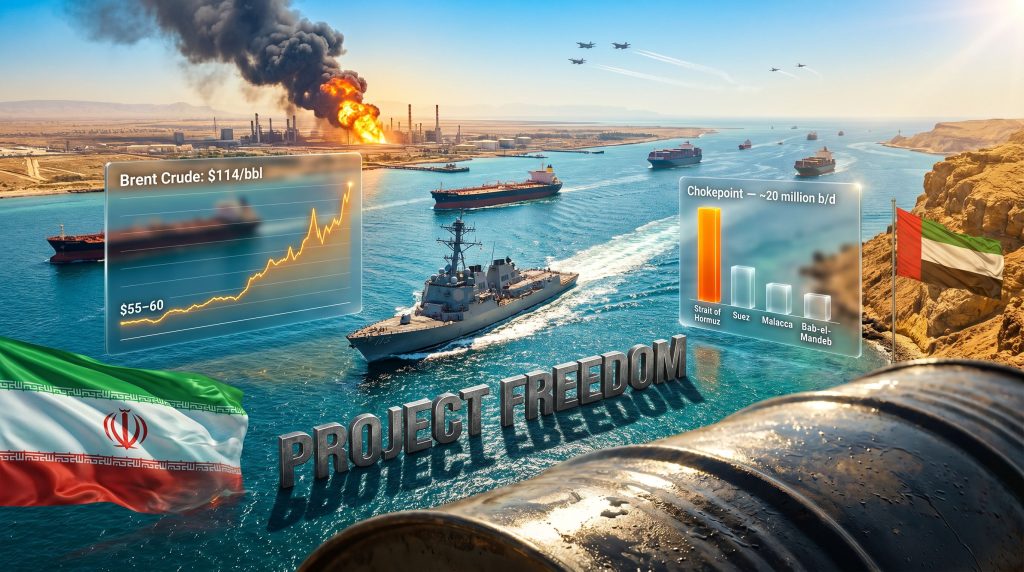
| Strait of Hormuz | ~20–21 million b/d | Extremely limited | Critical |
| Malacca Strait | ~16 million b/d | Lombok/Sunda Strait | Moderate |
| Suez Canal | ~9 million b/d | Cape of Good Hope | High |
| Bab-el-Mandeb | ~4–6 million b/d | Cape of Good Hope | Elevated |
Saudi Arabia's East-West Pipeline (Petroline) and the Abu Dhabi Crude Oil Pipeline do provide partial bypass capacity, but their combined throughput falls far short of what currently moves through the strait each day. In a genuine closure scenario, these alternatives function as pressure relief valves on an overloaded system, not as genuine substitutes.
What makes Hormuz particularly dangerous from a strategic asymmetry perspective is that Iran can impose enormous costs on global commerce without needing to win a conventional military confrontation. A sustained campaign of missile attacks, drone swarms, and small boat interdictions does not require Iran to defeat the U.S. Navy. It only requires making commercial operators unwilling to risk the transit without armed escort, which effectively transforms every shipment into a diplomatic and logistical negotiation. This pattern of geopolitical trade disruption is increasingly defining the modern energy security landscape.
From Ceasefire to Kinetic Confrontation: The 2026 Escalation Timeline
The US-Iran conflict that began in late February 2026 produced a fragile ceasefire around April 8, but that pause in full-scale hostilities has not translated into stable shipping conditions. U.S. officials have characterised more than 20 subsequent incidents as falling below the threshold required to formally restart the conflict, yet the tactical reality in the strait has remained anything but peaceful. For a broader overview of the events as they unfolded, Al Jazeera's coverage of the Hormuz attack claims provides essential background.
Operation Project Freedom: What It Is and What It Is Not
In response to the ongoing blockade conditions, the United States launched what it termed Project Freedom, a naval escort programme deploying destroyers including USS Truxtun and USS Mason, supported by Apache helicopter assets and fixed-wing aircraft, to shepherd commercial vessels through the strait. The operational logic is straightforward: demonstrate that transit remains possible under U.S. protection, thereby maintaining the fiction that commercial shipping lanes are open.
The United States has reported that nine commercial vessels successfully transited under escort during the programme's initial phase. Iran's Revolutionary Guard has publicly contested this, asserting that no unauthorised passage took place. Both narratives cannot simultaneously be accurate, and the credibility gap between them is not merely a propaganda contest.
The divergence between U.S. operational claims and Iranian counter-narratives directly determines whether global shipping operators will attempt independent transit, which in turn determines whether the escort programme functions as a genuine logistical solution or as a theatrical assertion of naval authority without practical commercial effect.
Pakistan has emerged as the primary diplomatic intermediary in ceasefire talks, but negotiations have stalled on what analysts describe as structurally incompatible positions. Iran has submitted a 14-point peace framework currently under review by the Trump administration, while experts at institutions including the Quincy Institute have assessed that the two sides remain separated by maximalist preconditions that prevent bridging even points of nominal agreement.
Quantifying the Supply Shock: What 11 Million Barrels Per Day Offline Actually Means
The most significant economic fact of the current US Iran Strait of Hormuz crisis is that approximately 11 million barrels per day of Middle Eastern production is currently offline, according to analysis published by Wood Mackenzie. This is not a demand-side disruption or a refinery outage. It is a transit blockage that has severed the connection between production and delivery at a scale that dwarfs any post-World War II energy disruption.
The paradox embedded in this crisis is that Gulf producers are simultaneously approaching storage capacity limits at the wellhead while downstream markets face acute physical shortages. Tanks are filling at the production end while refineries run short at the consumption end, because the pipeline between them has been severed.
Wood Mackenzie's assessment identifies Iraq as facing the most severe recovery constraints. Even after a hypothetical ceasefire, Iraq would require a minimum of nine months to return to pre-conflict production capacity, not because of infrastructure destruction alone, but due to fundamental reservoir engineering limitations. Extended periods of constrained or erratic production alter subsurface pressure dynamics in ways that cannot be rapidly reversed once production restarts. Kuwait and other Gulf producers face similar multi-month recovery horizons.
This creates a critical insight that oil markets appear to be pricing: a ceasefire announcement will not produce immediate supply relief. The wellhead inventories accumulated during the blockade would require two to three months to clear even under optimal post-conflict conditions, and reservoir recovery extends the supply normalisation timeline well into 2027 at the earliest.
Oil Price Trajectory: What the Forward Curve Is Telling Us
The immediate price response to the Iranian strikes on UAE port infrastructure sent Brent crude surging to $114 per barrel, according to reporting by OilPrice.com on May 5, 2026, before retreating to approximately $110 per barrel as ceasefire signals filtered through. However, the more revealing signal lies in the forward curve.
- December 2026 Brent contracts are trading at approximately $91 per barrel
- December 2026 WTI contracts are at approximately $85 per barrel
- Both benchmarks sit dramatically above the pre-crisis market consensus of $55 to $60 per barrel
This repricing reflects market conviction that even a successful diplomatic resolution will leave structural supply constraints in place for the remainder of 2026 and into 2027. Furthermore, forward curves do not lie about sentiment: when December contracts trade $35 per barrel above pre-crisis expectations, participants are pricing in persistent supply impairment, not a brief spike.
The economic threshold receiving significant attention from energy analysts is $125 per barrel, identified as the sustained price level at which global GDP growth begins to contract materially, based on historical relationships observed during the oil price shocks of 2008 and 2011. Iran has publicly warned that a prolonged conflict could drive prices toward $140 per barrel, a figure supported by the supply arithmetic if Hormuz transit remained fully constrained for an extended period. This figure should be treated as a scenario boundary rather than a forecast, as it assumes no meaningful alternative supply response. The recession risk in markets is consequently becoming a central concern for institutional investors and policymakers alike.
From Crude to Consumer: Downstream Price Transmission
The transmission of upstream supply shocks to retail fuel markets has been rapid and visible. California gasoline prices have exceeded $6 per gallon, a real-world consumer indicator of how quickly crude market disruptions penetrate the pump price. Indian Oil Corporation moved to raise LPG and jet fuel prices as the country's import-dependent energy sector absorbed the external shock.
TotalEnergies extended its retail fuel price cap in France, choosing to absorb supply-side volatility through corporate margins rather than pass the full impact to French consumers, a decision with significant fiscal implications that illustrates how governments and major operators are attempting to act as buffers against commodity inflation.
Iran Expands Its Area of Operations: The Fujairah Strikes and Their Strategic Significance
The most consequential tactical development beyond the strait itself has been Iran's decision to expand its targeting to UAE infrastructure. Missile and drone strikes on the Fujairah petroleum facility, a critical hub for oil storage and ship-to-ship fuel transfers supporting Gulf export logistics, represent a qualitative shift in the conflict's geographic scope. The tanker Barakah was also targeted in what OilPrice.com reported as part of a broader pattern of Iran expanding effective area of control toward Dubai shipping lanes.
Three Indian nationals were reported injured in a related vessel attack, a casualty detail that carries diplomatic weight exceeding its human cost. India has historically been among the largest buyers of Iranian crude and occupies a strategically ambiguous position in the conflict. New Delhi's condemnation of the Fujairah attack signals that Iranian targeting of third-party nationals is generating diplomatic friction with nations Iran cannot afford to alienate entirely.
If Iran succeeds in disabling Fujairah's storage and bunkering infrastructure on a sustained basis, the effective export capacity of the UAE could be compromised irrespective of whether the Hormuz strait itself remains physically open. This creates a second vector of supply disruption operating independently of the blockade.
The UAE formalised its departure from OAPEC on May 4, 2026, following its earlier withdrawal from both OPEC and OPEC+ effective May 1. While UAE officials characterised the OPEC exit as not directed against any particular party, the timing and context make clear that Abu Dhabi is repositioning itself strategically in response to the conflict. This development further undermines OPEC's market influence at a moment when cartel cohesion matters most.
Four Scenarios for Hormuz Resolution: A Forward Probability Matrix
Markets are not trading on a single outcome. They are pricing a probability-weighted distribution of scenarios, each with dramatically different oil price implications. The current structure of spot and forward prices suggests that participants assign the highest probability to a prolonged standoff rather than near-term resolution.
| Scenario | Trigger Conditions | Oil Price Outcome | Assessed Probability |
|---|---|---|---|
| Negotiated Corridor Agreement | Pakistan-mediated talks succeed; Iran accepts partial transit rights | Brent retreats to $75–85/bbl | Low-moderate near-term |
| Sustained Escort Operation | U.S. maintains Project Freedom; Iran limits attacks below escalation threshold | Brent holds $100–115/bbl with volatility | Most likely 30-day scenario |
| Full Escalation | Iranian strike causes confirmed U.S. military casualties; full strikes resume | Brent spikes $130–140/bbl; recession risk elevated | Tail risk, elevated |
| Unilateral Iranian Closure | Iran formally closes strait to all non-authorised traffic | Brent exceeds $140/bbl; strategic reserve releases triggered globally | Extreme tail risk |
Disclaimer: The scenario outcomes and probability assessments above are analytical frameworks drawn from market data and published expert analysis. They do not constitute investment advice and carry inherent uncertainty given the rapidly evolving geopolitical situation.
China's Dual-Track Energy Response
China's strategic positioning deserves particular analytical attention because it operates simultaneously on two distinct tracks. Beijing's Commerce Ministry formally instructed domestic companies to disregard U.S. sanctions targeting Iranian crude buyers, specifically protecting Hengli Petrochemical and four Shandong independent refiners, colloquially known in the industry as teapot refiners, from compliance obligations.
These smaller, independent refineries represent a structurally important node in China's Iranian crude import architecture and process volumes that state-owned majors avoid for sanctions-compliance reasons. In addition, this dynamic connects directly to the broader trade war oil markets tensions that have been reshaping energy trade flows throughout 2025 and into 2026.
Simultaneously, Chinese authorities eased rare earth export controls ahead of a scheduled Trump-Xi summit, approving the shipment of 60 tonnes of yttrium oxide to the United States, a volume reportedly 50% larger than the cumulative total of the previous 12 months. Yttrium oxide is a critical input for aerospace components and advanced semiconductor manufacturing. The timing strongly suggests that Beijing is managing energy security and critical minerals access as linked diplomatic levers rather than treating them as independent policy domains.
The next major ASX story will hit our subscribers first
How Global Energy Markets Are Adapting to the Supply Shock
Goldman Sachs has assessed that global oil inventories have fallen to an eight-year low, contextualising the severity of the current supply deficit and explaining why even the surge in Atlantic basin export volumes has failed to fully compensate for Middle Eastern losses.
The adaptive responses observable across global energy markets reveal how rapidly supply disruptions of this scale reorganise commercial behaviour:
- Japan's Taiyo Oil is set to receive a cargo of Russian crude from the Sakhalin-2 project, Japan's first such delivery since June 2025 and only the second since sanctions were introduced in late 2022, demonstrating how supply emergencies override geopolitical compliance preferences in import-dependent economies
- Venezuela's oil exports have reached a seven-year high as buyers scramble for non-Gulf barrels, with U.S. oil and gas firms also signing operational deals in Venezuela under the changed sanctions environment
- Iraq is offering significant price discounts on Hormuz-routed crude, a market signal that even producers within the conflict zone are willing to reduce per-barrel revenue to maintain volume throughput
- Pakistan has opened overland Iran transit corridors, providing a land-based routing alternative for regional buyers, though at capacities far below sea-based volumes
- Australia and Japan have deepened bilateral energy supply chain agreements, reflecting a structural long-term response to Middle Eastern supply vulnerability
Net crude supply loss stands at an estimated 9 million barrels per day despite the surge in Atlantic basin exports attempting to compensate, according to analysis from Vortex. The gap between what alternative sources can supply and what has been removed from the market remains enormous.
OPEC+ responded to the crisis by agreeing to a 188,000 b/d production increase for June 2026, led by Saudi Arabia and Russia among the core seven members. This figure is slightly below the 206,000 b/d hikes announced for April and May, partly reflecting the structural impact of the UAE's simultaneous departure from the cartel. The fundamental problem with OPEC+ output increases in this environment is that the bottleneck is transit infrastructure, not production capacity. Incremental barrels that cannot move through Hormuz add to wellhead inventories rather than reaching consuming markets.
The IEA proposed a longer-duration structural supply response: reducing global methane emissions from oil and gas operations could theoretically unlock 200 billion cubic metres per year of additional gas supply, equivalent to roughly double the volume disrupted by the Hormuz crisis. The IEA estimated the oil and gas sector produced 124 million tonnes of methane emissions in 2025, representing a theoretical supply volume that exists but is currently being destroyed rather than monetised. This proposal operates on a multi-year implementation horizon and does not address the immediate crisis.
Corporate Strategy Realignment: Big Energy Repositions Around Geopolitical Risk
The crisis is producing measurable strategic repositioning among major energy companies that extends well beyond routine portfolio management. Consequently, the geopolitical oil price drivers that analysts have been tracking for years are now manifesting in real capital allocation decisions across the sector.
Shell is reportedly evaluating a partial divestiture of East Mediterranean gas assets, with specific interest focused on the Aphrodite field offshore Cyprus, which holds an estimated 3.7 trillion cubic feet of gas reserves. Firm interest has been expressed by Arcius, the joint venture between BP and Abu Dhabi's XRG, adding complexity given BP's simultaneous portfolio review of its own UK North Sea assets. BP is reportedly considering divesting part or all of its North Sea operations, potentially generating up to $3 billion, as new CEO Meg O'Neill prioritises debt reduction over geographic diversification.
Chevron is redirecting crude produced from recently restarted Sable Offshore platforms in California to its 285,000 b/d El Segundo refinery, substituting local supply for disrupted Middle Eastern imports. Chevron's CEO Mike Wirth has publicly stated that physical crude shortages will begin manifesting first in Asia as strategic petroleum reserves are drawn down, before spreading sequentially to European markets. This geographic sequencing of supply stress provides a framework for anticipating where economic impacts will emerge most acutely.
Equinor committed $1.8 billion in new drilling contracts to sustain production output, a counter-cyclical investment signal suggesting that major operators with non-Gulf production capacity expect elevated prices to persist long enough to justify significant capital deployment. The BBC's reporting on the wider economic consequences of the conflict offers further context on how these corporate decisions are being interpreted globally.
Frequently Asked Questions: US-Iran Strait of Hormuz Crisis
What percentage of global oil passes through the Strait of Hormuz?
Approximately 20 to 21% of globally traded petroleum transited the Strait of Hormuz in 2023, according to the U.S. Energy Information Administration, representing roughly 21 million barrels per day. No other maritime chokepoint handles a comparable volume with such limited bypass alternatives.
Why can't oil exporters route around Hormuz?
Saudi Arabia's East-West Pipeline (Petroline) and the Abu Dhabi Crude Oil Pipeline offer partial rerouting capacity, but their combined throughput is far below the volumes currently moving through the strait. Unlike the Suez Canal, which can be bypassed via the Cape of Good Hope at significant but manageable cost, there is no practical full-scale alternative to Hormuz for most Gulf producers.
What is Project Freedom and is it working?
Project Freedom is a U.S. Navy escort programme deploying warships and air assets to shepherd commercial vessels through the strait. The U.S. reports nine vessels successfully transited during initial operations; Iran disputes this entirely. The programme's effectiveness depends on whether Iran escalates its interdiction tactics to the point that escort protection becomes operationally insufficient.
How long would Middle Eastern production take to recover after a ceasefire?
Recovery timelines vary by country. Wood Mackenzie's analysis indicates Iraq would require a minimum of nine months to return to pre-conflict capacity due to reservoir engineering constraints. Accumulated wellhead inventories across the region would require two to three months to clear even after a ceasefire, meaning supply relief would not be immediate upon conflict resolution.
Is the April 8 ceasefire still holding?
As of early May 2026, the ceasefire technically remains in effect, with U.S. officials characterising over 20 subsequent incidents as falling below the threshold for full conflict resumption. However, Iranian strikes on UAE infrastructure and continued naval clashes in the strait represent significant ongoing escalation risks.
The Three Variables That Will Determine the Outcome
Markets are pricing a prolonged disruption rather than a swift resolution. The structural repricing of 2026 and 2027 forward oil contracts reflects genuine supply-side impairment rather than purely speculative risk premium. Three variables will most directly determine whether the current situation stabilises or deteriorates further:
- Diplomatic progression: Whether Pakistan-mediated talks can bridge the gap between Iran's 14-point framework and U.S. negotiating positions before a military incident produces irreversible escalation
- Escort operation sustainability: Whether the United States can maintain Project Freedom operations against sustained Iranian interdiction without a politically defining casualty event that forces a binary choice between escalation and withdrawal
- Strategic reserve runway: How many months consuming nations can absorb the supply shock through reserve drawdowns before economic damage accumulates to a level that forces political resolution on unfavourable terms
Forward outlook: The structural repricing of late-2026 and 2027 Brent contracts well above pre-crisis consensus levels suggests that even optimistic ceasefire scenarios will leave energy markets operating at elevated prices for the remainder of the year. Full supply normalisation, accounting for reservoir recovery timelines and infrastructure restoration, appears unlikely before mid-2027 at the earliest. This analysis reflects publicly available market data as of early May 2026 and should not be construed as investment advice.
The US Iran Strait of Hormuz crisis is not a temporary spike in an otherwise stable energy market. It is a structural inflection point that is simultaneously testing the resilience of global supply chains, the credibility of military deterrence, the cohesion of producer cartels, and the limits of diplomatic patience. The combination of a dual blockade, active naval engagement, and expanding third-party infrastructure targeting distinguishes this episode from every previous Hormuz tension event in the post-Cold War era, and the forward curve is reflecting precisely that distinction.
Want to Capitalise on the Market Volatility Reshaping Global Energy?
Discovery Alert's proprietary Discovery IQ model delivers real-time alerts on significant ASX mineral discoveries, instantly identifying actionable opportunities as geopolitical shocks ripple through commodity markets — explore Discovery Alert's discoveries page to see how historic finds have generated substantial returns, and begin a 14-day free trial to position yourself ahead of the next major market move.