July 17, 2026
The Strait of Hormuz and the Logic of Escalation: Understanding the US-Iran Military Campaign
Every significant armed confrontation in the modern Middle East eventually circles back to one unavoidable geographic reality: whoever controls the Strait of Hormuz holds leverage over a substantial portion of the world's energy supply. This is not a new observation, but the events of mid-July 2026 have transformed that abstract strategic principle into a live, daily crisis with direct consequences for global markets, Gulf state security, and diplomatic stability across multiple continents.
The US strikes Iran for sixth straight night headline that emerged on July 17, 2026, reflects something deeper than a nightly military update. It signals a conflict that has shifted decisively from an initial air campaign into a sustained infrastructure-targeting operation, one calibrated to impose economic and logistical pressure on Tehran rather than simply degrade its military hardware.
When big ASX news breaks, our subscribers know first
Six Consecutive Nights: The Operational Logic Behind the Campaign
When the United States and Israel jointly initiated military operations against Iran on February 28, 2026, Tehran responded by effectively sealing the Strait of Hormuz to international shipping. That single action reframed the entire conflict. What began as a conventional air campaign targeting military assets evolved, by mid-July, into a contest over who could sustain more economic and physical pain.
The sixth consecutive night of US airstrikes, conducted from 18:00 GMT on July 16 through to dawn on July 17, 2026, marked a notable shift in target selection. US Central Command confirmed that dozens of targets were engaged across multiple locations, with an increasing emphasis on infrastructure rather than purely military hardware.
Confirmed strike locations during the sixth night included:
- Qeshm Island, a strategically positioned island at the mouth of the Strait of Hormuz
- Bandar Abbas, Iran's primary commercial port and naval hub on the strait
- Chabahar, Iran's deep-water port on the Gulf of Oman
- Iranshahr, an inland city in Sistan-Baluchestan province
- Bandar-e Khamir, a coastal city in Hormozgan province directly adjacent to the strait
- Areas in the vicinity of Bushehr, home to Iran's nuclear power facility
Iranian state media reported at least seven fatalities from the overnight strikes, concentrated in Hormozgan province. Across all strikes since the campaign began, Iranian officials have cited more than 35 killed and upward of 300 wounded.
What the Target List Reveals About US Strategy
The categories of targets engaged over six nights of operations tell a coherent story about Washington's operational objectives:
| Target Category | Strategic Rationale |
|---|---|
| Air defense systems | Reduce Iran's capacity to intercept subsequent strike packages |
| Coastal surveillance assets | Degrade maritime monitoring near the Strait of Hormuz |
| Missile and drone storage sites | Limit Iran's retaliatory strike capacity against US assets |
| Logistics and supply infrastructure | Disrupt operational sustainment across Iranian military branches |
| Maritime capabilities | Protect commercial shipping lanes from Iranian interdiction |
| Bridges in Hormozgan province | Apply economic pressure to compel easing of strait restrictions |
The inclusion of bridges in Hormozgan province is particularly significant. These are not military installations. Targeting civilian and economic infrastructure represents a deliberate escalation in the coercive pressure campaign, one that President Trump had telegraphed publicly in preceding days before it materialised.
Why the Strait of Hormuz Is the Central Variable in This Conflict
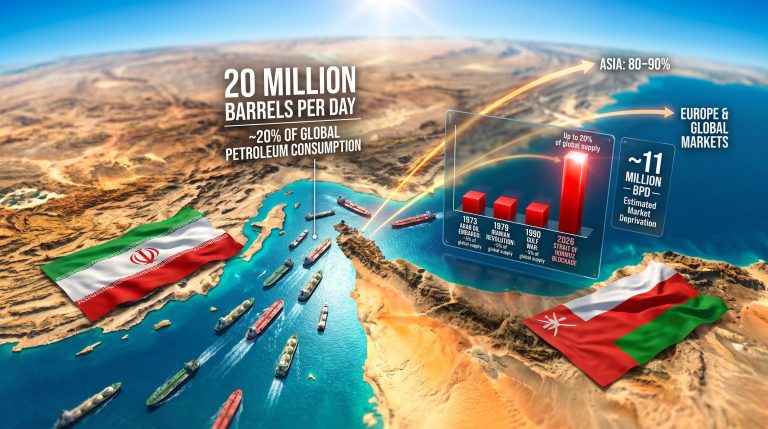
To understand why both sides are prepared to absorb significant military and economic costs, it is necessary to grasp the Strait of Hormuz's structural role in global energy markets. During peacetime, approximately one-fifth of all oil and natural gas traded globally transited this narrow waterway. There is no realistic short-term substitute for this volume, a reality that has driven sharp movements in crude oil price trends since hostilities intensified.
Pipeline alternatives exist and have absorbed some diverted cargo, but the aggregate capacity of these routes is structurally insufficient to compensate for the scale of maritime throughput that the strait provides. The arithmetic simply does not work in the short term.
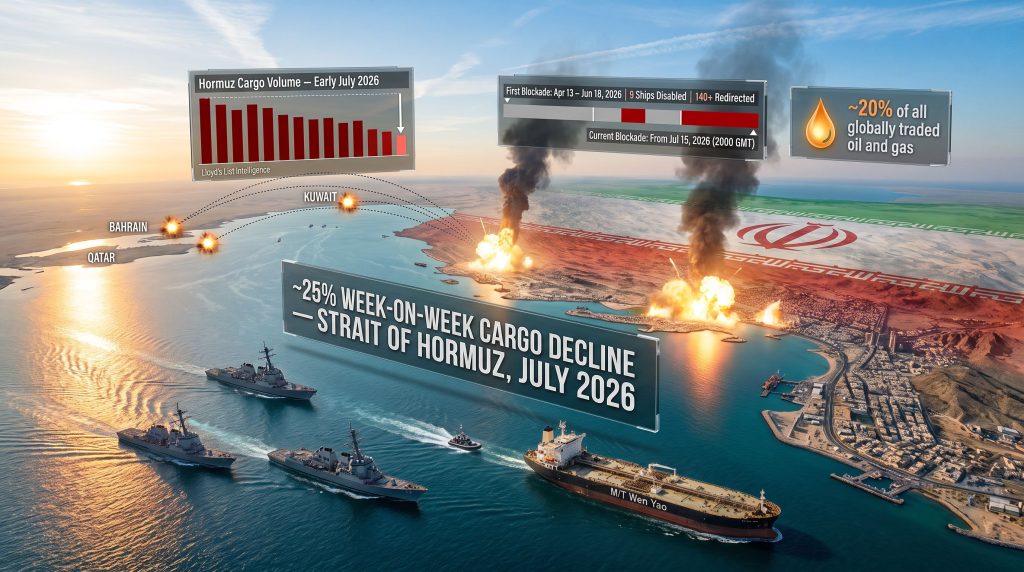
According to maritime data from Lloyd's List Intelligence, week-on-week cargo shipments through the strait had already fallen by approximately 25% in early July 2026, before the latest surge in hostilities. That figure almost certainly deteriorated further as the sixth night of strikes concluded and Iranian retaliation against Gulf states intensified.
What Are Shippers Doing to Cope?
The behavioural response from the shipping industry is revealing. Lloyd's List Intelligence reported that a growing number of oil shippers are transiting the strait with their Automatic Identification System (AIS) transponders disabled to avoid detection. AIS transponders are the maritime equivalent of a flight transponder: their deactivation creates significant blind spots in maritime safety monitoring and raises serious concerns about collision risk, insurance liability, and cargo tracking integrity.
The AIS transponder issue is not merely a commercial inconvenience. In a congested waterway under active military tension, vessels operating without location broadcasting represent a genuine navigational hazard. The cumulative risk profile for insurers, port operators, and naval commanders is rising with each passing day.
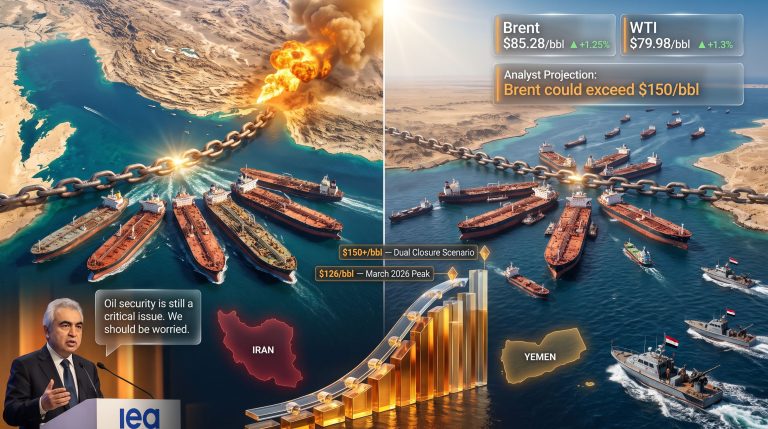
Furthermore, the IEA chief has stated publicly that global energy security faces serious risk if the strait does not reopen within weeks, a timeline that was already under pressure before the sixth night of strikes added further uncertainty.
Iranian Retaliation: Gulf States Come Under Direct Fire
The conflict's geographic scope expanded materially on the night of July 16–17, 2026. Iran did not limit its response to US forces operating in the region. Instead, it directed missile and drone strikes against three US-allied Gulf states: Bahrain, Kuwait, and Qatar. Al Jazeera's live coverage confirmed sirens sounding across Bahrain and Kuwait as the strikes unfolded.
Qatar's Interior Ministry confirmed that a child was injured by debris from interception operations, as air defense systems engaged the incoming Iranian missile barrage. Residents across Qatar reported hearing explosions overhead, a visceral reminder that this conflict has moved beyond military-on-military engagement into territory that directly affects civilian populations in neighbouring states.
The retaliation strikes against Bahrain and Kuwait were framed by Iranian military spokespeople as a direct consequence of US bridge strikes inside Iran. Col. Ebrahim Zolfaghari, spokesperson for the Iranian military's Khatam Al-Anbiya Central Headquarters, issued a warning that Iran retained the capacity to launch widespread attacks on all infrastructure across the region if the US proceeded with strikes against Iranian power plants.
Iran's declared position on the Strait of Hormuz carries the weight of an existential red line in Tehran's strategic calculus. Iranian officials have stated explicitly that no foreign power will be permitted to interfere in the strait under any circumstances, framing this not as a tactical military position but as a matter of sovereign inviolability.
The Bab El-Mandeb Dimension: A Dual Chokepoint Scenario
Perhaps the most consequential piece of strategic intelligence to emerge in recent days involves Iran's reported communications with Houthi forces in Yemen. Reporting indicates that Tehran has instructed Houthi-aligned forces to prepare to close the Bab El-Mandeb strait if US forces strike Iranian power grid infrastructure.
This matters enormously for global energy security. The Bab El-Mandeb is the southern gateway between the Red Sea and the Gulf of Aden, connecting European and Asian markets to Gulf energy exports via an alternative routing through the Suez Canal. A simultaneous closure of both the Strait of Hormuz and the Bab El-Mandeb would represent an unprecedented dual chokepoint scenario, one that energy security analysts are assessing as a tail-risk event with systemic implications for oil supply chains globally.
No historical precedent exists for the simultaneous closure of both major energy shipping chokepoints connecting the Gulf to global markets. The strategic and economic modelling for such a scenario remains immature, precisely because it was previously considered implausible. That assumption is now being revisited.
The Naval Blockade: Mechanics and Current Status
Running parallel to the airstrike campaign is the US naval blockade on Iranian crude oil exports, reimposed at 20:00 GMT on July 15, 2026 after a period of suspension. The blockade's first cycle ran from April 13 to June 18, 2026, during which nine vessels were disabled and more than 140 were redirected, according to US Central Command.
The current cycle moved quickly. US Marines boarded the M/T Wen Yao in the Gulf of Oman on July 16 to enforce blockade compliance. Separately, a US aircraft fired on and disabled an unladen oil tanker that attempted to breach the blockade. Three additional commercial vessels were redirected in the opening days of the renewed enforcement regime.
| Blockade Phase | Period | Key Enforcement Actions |
|---|---|---|
| First Cycle | April 13 to June 18, 2026 | 9 ships disabled; 140+ vessels redirected |
| Ceasefire Window | June 18 to approximately July 15, 2026 | Blockade suspended; diplomatic talks active |
| Current Cycle | From July 15, 2026 (20:00 GMT) | M/T Wen Yao boarded; 1 tanker disabled; 3 vessels redirected |
The ceasefire that created the June 18 window has now fully collapsed. Qatar and Pakistan served as the principal mediating parties, but negotiations broke down specifically over the unresolved question of Iranian sovereignty over the Strait of Hormuz, a dispute that sits at the heart of the entire conflict and resists straightforward diplomatic resolution.
Regional Power Dynamics: The Paradox of Qatar's Position
Qatar occupies an almost paradoxical position in this conflict. The country has served as a key diplomatic intermediary, hosting talks and maintaining communication channels between the warring parties. Simultaneously, it is now a direct target of Iranian missile strikes, having been hit in retaliation for US military operations inside Iran.
This dual role creates a structural contradiction. Qatar's value as a mediator depends on its perceived neutrality and relationships with all parties. Being subjected to Iranian missile attacks complicates that neutrality significantly and may ultimately constrain Qatar's ability to serve as a credible bridge between Washington and Tehran.
The broader Gulf dynamic is equally complex. US allies in Bahrain, Kuwait, and Qatar are absorbing Iranian fire while remaining dependent on US security guarantees for their protection. This creates political pressure on Washington from multiple directions simultaneously: allies demanding protection on one side, and the costs of sustained military escalation on the other.
However, China's stake in this outcome is also worth noting. The People's Republic of China is among the largest importers of Gulf crude oil, and a prolonged closure of the Strait of Hormuz would impose significant economic costs on Beijing's energy supply chains. This creates a structural incentive for Chinese diplomatic engagement, though the form and timing of any such intervention remain uncertain.
The next major ASX story will hit our subscribers first
The White House's Public Posture and the Coercion Framework
US Central Command has consistently framed the six nights of strikes as a coercive pressure campaign designed to degrade Iran's capacity to threaten commercial shipping and enforce the naval blockade, rather than as a territorial conquest operation. This framing matters for understanding the conflict's potential off-ramps.
Despite the intensity of military operations, the White House has maintained publicly that diplomatic channels remain open. Administration officials have indicated that Iranian counterparts have signalled continued interest in reaching an agreement with Washington, even as strikes continue on both sides.
President Trump stated in a primetime national address that the US was "winning in Iran" and that "the results of the military campaign would become visible in the near term." White House Press Secretary Karoline Leavitt confirmed that Iran would face "consequences for acts of terrorism affecting strait navigation."
This public posture, combining military escalation with stated diplomatic openness, reflects a classic coercive bargaining framework: increase the cost of non-compliance while keeping a negotiated exit pathway visible. The US strikes Iran for sixth straight night, and yet diplomatic back-channels reportedly remain active. Whether that framework produces results before the economic and humanitarian costs of a prolonged strait closure become unmanageable remains the defining question of this conflict.
The broader economic picture is further complicated by geopolitical trade tensions that were already straining global supply chains before the Iran conflict escalated. Furthermore, the global trade disruption stemming from earlier tariff disputes has left many economies with limited buffers to absorb a sustained energy supply shock of this magnitude.
Consequently, WTI and Brent futures have reflected the mounting anxiety in energy markets, with volatility spiking sharply during each successive night of strikes. In addition, eroding trust in the US dollar as a stable reserve currency has added a further layer of financial uncertainty to an already volatile geopolitical environment.
Key Data Summary: US-Iran Conflict Escalation (July 2026)
| Metric | Data Point |
|---|---|
| Consecutive nights of US strikes | 6 (as of July 17, 2026) |
| Total Iranian casualties reported | 35+ killed, 300+ wounded |
| Strait cargo volume decline (early July 2026) | Approximately 25% week-on-week |
| Ships disabled in first blockade cycle | 9 vessels |
| Vessels redirected in first blockade cycle | 140+ |
| Peacetime global energy share via Hormuz | Approximately 20% of all traded oil and gas |
| Sixth night strike commencement | 18:00 GMT, July 16, 2026 |
| Confirmed sixth night strike locations | Qeshm Island, Bandar Abbas, Chabahar, Iranshahr, Bandar-e Khamir, near Bushehr |
Frequently Asked Questions
When did the US-Iran war begin?
Military operations were jointly initiated by the United States and Israel on February 28, 2026. Iran responded by effectively closing the Strait of Hormuz to international shipping, triggering the energy market disruption that has defined the conflict's economic dimension.
What happened on the sixth night of US strikes?
US forces conducted strikes across multiple locations in southern and eastern Iran between the evening of July 16 and dawn on July 17, 2026. Targets included bridges in Hormozgan province, coastal surveillance assets, and military infrastructure across several provinces. Reuters reporting confirmed that Iran simultaneously targeted bases in Kuwait and Jordan in response.
Which countries has Iran attacked in retaliation?
Iran has launched missile and drone strikes against Bahrain, Kuwait, and Qatar in direct retaliation for US military operations inside Iran. Qatar's Interior Ministry confirmed civilian injury from debris during the July 16–17 exchange.
Is the Strait of Hormuz currently open?
The strait remains severely disrupted. Cargo volumes dropped by approximately 25% week-on-week in early July 2026, before the latest escalation intensified the situation further. Many vessels are either avoiding the route entirely or transiting with AIS transponders disabled.
Is there an active ceasefire?
No. The interim ceasefire brokered in June 2026 has collapsed. Mediation efforts by Qatar and Pakistan have stalled over the unresolved question of Iranian control over the Strait of Hormuz.
What is the significance of the Bab El-Mandeb threat?
Reports indicate Iran has communicated to Houthi-aligned forces in Yemen to prepare to close the Bab El-Mandeb strait if US forces strike Iranian power grid infrastructure. A simultaneous closure of both the Hormuz and Bab El-Mandeb straits would represent an unprecedented disruption to global energy shipping with no adequate short-term alternative routing available. This is precisely why the US strikes Iran for sixth straight night while keeping diplomatic channels nominally open — the stakes of full escalation are simply too high for either side to ignore.
This article is based on reporting current as of July 17, 2026. The situation remains fluid and developments may have changed since publication. Readers seeking ongoing coverage of the US-Iran conflict and its regional implications can access further reporting via Arab News at arabnews.com.
Want to Track the Commodity Market Impact of the US-Iran Conflict in Real Time?
As energy supply chains face unprecedented disruption from simultaneous chokepoint threats, Discovery Alert's proprietary Discovery IQ model instantly identifies significant ASX mineral discoveries — including those in energy commodities — delivering real-time alerts that turn market volatility into actionable opportunity. Explore how historic discoveries have generated substantial returns and begin your 14-day free trial today to position yourself ahead of the market.