August 8, 2026
Global energy markets operate within a complex web of supply, demand, and geopolitical uncertainty that creates measurable risk premiums across commodity pricing structures. These premiums represent how financial markets translate political tensions into immediate economic costs, affecting everything from consumer fuel expenses to national energy security planning. When examining US-Iran tensions impact on oil prices in 2026, the relationship between Middle Eastern political developments and oil pricing demonstrates how international relations directly impact global economic stability.
Energy market participants employ sophisticated risk assessment models that incorporate probability-weighted scenarios of supply disruption, creating pricing mechanisms that reflect both current fundamentals and potential geopolitical outcomes. Professional traders and institutional investors continuously evaluate political developments through the lens of supply chain vulnerability, transforming diplomatic announcements into quantifiable market positions within hours of political events.
Economic Mechanisms Behind Supply Concentration Vulnerabilities
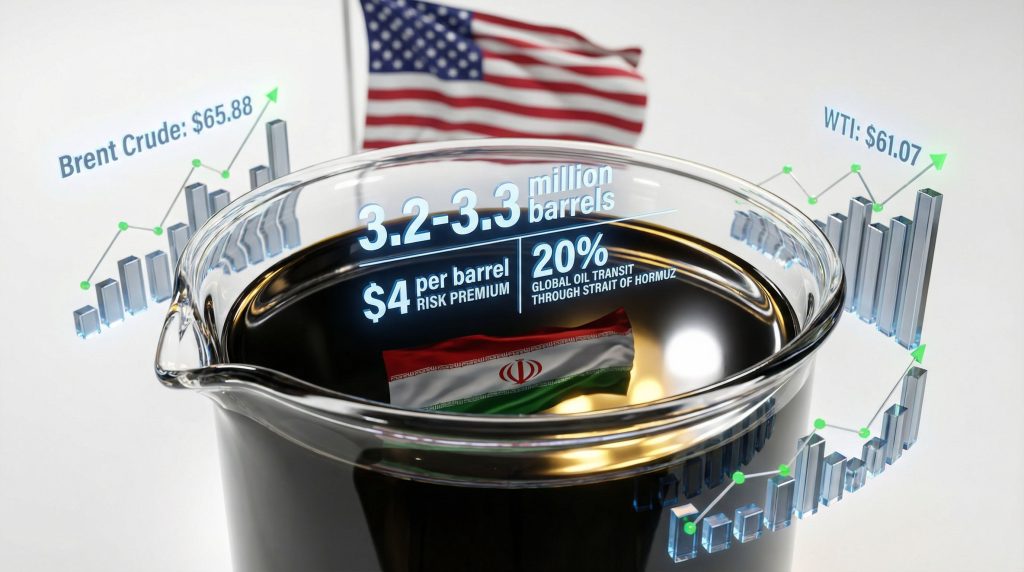
Iran's position as a significant OPEC producer creates structural market vulnerabilities that extend far beyond its individual production capacity. With daily output capabilities reaching approximately 3.2-3.3 million barrels per day, Iran represents roughly 3.2% of global crude oil production, positioning it among the world's top ten producers. This concentration level creates disproportionate market sensitivity because alternative suppliers cannot immediately replace such volumes during disruption scenarios.
The mathematics of supply chain elasticity reveal why concentrated production from politically sensitive regions generates amplified price responses. Unlike distributed production systems where individual supplier losses can be absorbed through spare capacity adjustments, the sudden removal of a major producer creates inelastic short-term supply conditions. Historical precedents demonstrate this dynamic: during Libya's 2011 production losses of 1.6 million barrels per day (approximately 1.7% of global supply), Brent crude prices experienced significant spikes despite the smaller production base compared to Iran's current capacity.
Furthermore, market participants recognise that Iran's production infrastructure represents not just current output but also strategic reserve capacity that could be activated during global supply stress periods. This dual vulnerability creates compound risk scenarios where geopolitical tensions simultaneously threaten existing production whilst removing potential emergency supply options from global markets. Additionally, OPEC meeting insights reveal how production coordination decisions amplify these concentration vulnerabilities.
When big ASX news breaks, our subscribers know first
Financial Market Psychology and Risk Incorporation Mechanisms
Professional energy traders employ sophisticated risk premium calculations that translate geopolitical uncertainty into measurable price components. These calculations follow probability-weighted outcome models where current market prices reflect the mathematical sum of various scenario probabilities multiplied by their respective price impacts. When political tensions escalate, traders immediately adjust these probability assessments, creating rapid price movements that precede any actual supply disruptions.
Recent market data from January 2026 demonstrates this psychological pricing mechanism in action. Following political announcements on January 23, 2026, Brent crude futures responded with immediate gains exceeding 2.9%, whilst WTI crude moved proportionally higher. These price movements occurred without any physical supply disruption, illustrating how market psychology incorporates worst-case scenarios into current pricing structures. Consequently, the oil price rally demonstrates similar psychological mechanisms at work.
The sustained nature of these gains through subsequent trading sessions reveals another psychological component: once risk premiums are incorporated into pricing, they tend to persist until clear resolution signals emerge. Market analysis from January 26, 2026, showed continued gains of 0.18% for Brent crude and 0.23% for WTI crude, maintaining weekly performance gains of 2.7% despite concurrent positive supply developments from Kazakhstan pipeline operations returning to full capacity.
How Does Market Sentiment Affect Oil Pricing?
Market sentiment operates through sentiment-driven price discovery mechanisms that translate geopolitical uncertainty into immediate financial positions. Professional traders utilise algorithmic trading systems that incorporate news sentiment analysis alongside traditional supply-demand fundamentals, creating pricing structures that respond to political developments within minutes of announcement.
Strategic Waterway Dependencies and Transit Vulnerabilities
The Strait of Hormuz represents one of the world's most critical energy chokepoints, handling approximately 20% of global oil transit volumes. This geographic concentration creates systematic vulnerability that financial markets continuously price through risk premiums whenever political tensions affect the Persian Gulf region. The narrow waterway's strategic importance extends beyond simple transit statistics to encompass global energy security architecture.
Military positioning announcements create immediate market recognition of chokepoint vulnerability. The deployment of U.S. military assets, including aircraft carrier strike groups announced in January 2026, triggered measurable market responses as traders interpreted these movements as escalation indicators. Professional market participants understand that military presence near critical transit routes translates into tangible supply disruption possibilities, regardless of actual conflict probability.
Alternative routing options for Middle Eastern oil exports involve significantly higher costs and extended timelines, making Strait of Hormuz disruptions economically consequential even with backup transportation methods available. Pipeline alternatives through the United Arab Emirates and Saudi Arabia to Red Sea ports provide some redundancy, but lack sufficient capacity to replace full Strait of Hormuz throughput during extended closure scenarios.
Weather-Related Supply Pressures and Market Amplification Effects
Concurrent weather disruptions compound geopolitical supply concerns through layering effects that professional traders interpret as multiplicative rather than additive price pressures. Recent winter storm impacts across the United States demonstrate this amplification dynamic, with production losses reaching approximately 250,000 barrels per day across the Bakken region, Oklahoma, and parts of Texas during late January 2026.
These weather-related disruptions, whilst typically temporary, create immediate supply tightness that magnifies market sensitivity to geopolitical developments. When domestic production constraints coincide with international political tensions, energy markets experience heightened volatility as traders price multiple concurrent supply risks into forward contracts and options positions. Moreover, declining US drilling activity compounds these supply pressures.
Key Production Impact Data:
- Bakken Region: Cold weather impacts on well operations and gathering system functionality
- Oklahoma: Natural gas production constraints reducing associated crude oil output
- Texas: Refinery operations complications affecting crude oil processing capacity
- Recovery Timeline: Typical weather disruption recovery ranges from 2-7 days for full production restoration
The timing coincidence of U.S. winter production losses with Middle Eastern tensions created compound supply pressure scenarios that professional market participants interpreted as particularly significant. JPMorgan analysts documented these concurrent pressures in formal research communications, noting the combination of domestic weather impacts with international geopolitical uncertainty as driving sustained price momentum.
Infrastructure Maintenance Timing and Supply Chain Coordination
Pipeline maintenance schedules can create additional supply constraints that amplify geopolitical price pressures when timing coincides with political tensions. Kazakhstan's Caspian Pipeline Consortium operations exemplified this dynamic during January 2026, with maintenance activities temporarily reducing global supply availability precisely during heightened US-Iran diplomatic tensions.
The return of Kazakhstan's pipeline to full capacity on January 26, 2026, provided some supply relief that might typically have produced downward price pressure. However, sustained geopolitical concerns prevented significant price corrections, demonstrating how political risk premiums can override positive supply developments when uncertainty remains unresolved.
This infrastructure timing dynamic reveals how global energy markets operate as integrated systems where individual supply components interact with geopolitical risk assessment in complex ways. Professional traders monitor multiple supply variables simultaneously, creating pricing models that account for both physical supply mathematics and political probability assessments. In addition, trade war oil moves demonstrate similar supply chain vulnerability patterns.
Military Asset Deployment Signals and Market Interpretation
Military deployment announcements function as interpretable escalation signals that professional energy traders translate into portfolio positioning adjustments within hours of political communications. The announcement of U.S. military aircraft carrier strike groups heading toward the Middle East in January 2026 created immediate market responses that demonstrate this signal transmission mechanism.
Escalation Signal Timeline Analysis:
- January 23, 2026: Political announcement of military deployment → Brent crude +2.9% immediate response
- January 24, 2026: International diplomatic responses → Price momentum maintenance
- January 26, 2026: Ongoing military positioning → Sustained gains despite positive Kazakhstan pipeline news
This sequential market response pattern reveals how professional traders interpret military announcements as probability adjustments for potential conflict scenarios. Rather than waiting for actual military engagement, energy markets immediately incorporate increased confrontation possibilities into pricing structures through options market positioning and futures contract adjustments.
Furthermore, market analysts note that presidential declarations of military armadas reignite supply disruption fears, adding measurable risk premiums to crude prices whilst supporting broader risk aversion flows across financial markets. This professional assessment confirms that political rhetoric translates directly into quantifiable market positioning within institutional investment strategies.
What Role Do Military Deployments Play in Oil Pricing?
Military deployments serve as escalation indicators that professional traders interpret through probability-weighted risk models. These deployments signal increased likelihood of supply disruption scenarios, prompting immediate portfolio adjustments that translate geopolitical uncertainty into measurable price premiums across energy commodity markets.
The next major ASX story will hit our subscribers first
Historical Price Recovery Patterns and Cycle Analysis
Previous US-Iran tension episodes provide analytical frameworks for understanding typical market recovery cycles and duration patterns. Historical analysis reveals that initial price spikes following political escalations typically maintain elevated levels for 2-4 weeks before beginning gradual normalisation processes, assuming no actual supply disruptions materialise during the tension period.
The 2020 Soleimani assassination period demonstrated similar market dynamics, with immediate price spikes followed by sustained elevated pricing for approximately three weeks before markets began discounting the probability of extended conflict. These historical patterns provide institutional investors with benchmark expectations for current tension cycle duration and magnitude.
Professional energy market participants employ these historical precedents in their risk management strategies, often maintaining elevated energy security positions for 4-6 week periods following major political escalations. This institutional behaviour contributes to price persistence effects that extend geopolitical premiums beyond the immediate news cycle duration. Consequently, understanding US-Iran tensions impact on oil prices requires analysing these cyclical patterns alongside current market fundamentals.
Economic Transmission Mechanisms and Inflation Impacts
Oil price increases driven by geopolitical tensions create inflationary transmission effects that ripple through global economic systems in measurable ways. Central banking institutions monitor these developments closely as energy price volatility affects monetary policy calculations and economic growth forecasting models used for institutional planning purposes.
A sustained disruption in Iranian oil exports could fundamentally alter global economic projections, potentially shifting oil markets from expected oversupply conditions to significant deficit scenarios. Economic modelling suggests such disruptions could elevate Brent crude pricing to approximately $91 per barrel by Q4 2026 under full export halt conditions, representing substantial departures from baseline economic assumptions.
These transmission mechanisms extend beyond immediate fuel costs to affect transportation, manufacturing, and consumer goods pricing across international markets. Professional economic analysts incorporate these multiplier effects into investment strategies and corporate planning processes, recognising that geopolitical oil premiums create cascading economic impacts across multiple sectors. However, OPEC tariff effects demonstrate how policy coordination can moderate these transmission mechanisms.
How Do Oil Price Spikes Affect Global Inflation?
Oil price increases transmit through economic systems via transportation costs, manufacturing inputs, and consumer energy expenses. Central banks monitor these transmission effects as energy price volatility affects monetary policy decisions and inflation targeting strategies across developed and emerging market economies.
Investment Strategy Adaptations During Tension Periods
Institutional investors employ specific portfolio hedging approaches during geopolitical uncertainty periods, often increasing energy sector exposure whilst simultaneously hedging against potential price volatility through derivatives market positioning. These professional strategies reflect sophisticated risk management approaches that balance opportunity recognition with downside protection.
Common Institutional Strategies Include:
- Energy equity overweighting: Increasing positions in energy company securities during tension periods
- Futures market hedging: Using options and futures contracts to manage price volatility exposure
- Strategic reserve coordination: Monitoring government strategic petroleum reserve release possibilities
- Alternative energy acceleration: Evaluating renewable energy investment opportunities during geopolitical price spikes
Government strategic petroleum reserves become economically valuable during tension periods, with release decisions affecting both domestic energy costs and international market stability calculations. Professional investors monitor these policy tools as potential market intervention mechanisms that could moderate geopolitical price premiums under specific economic conditions.
Regional Market Response Variations and Geographic Dependencies
Asian energy markets demonstrate particular sensitivity to Middle Eastern tensions due to supply chain dependencies and geographic proximity to potential conflict zones. China's position as a major Iranian oil customer creates specific economic vulnerabilities during sanction periods, forcing supply chain adjustments that affect regional pricing dynamics and trade relationship calculations.
European markets face distinct challenges during Middle Eastern tensions, balancing energy security concerns with diplomatic objectives whilst managing price volatility impacts on industrial competitiveness. These regional variations create arbitrage opportunities for professional traders whilst highlighting the uneven global distribution of geopolitical energy risk.
Professional market participants monitor these regional disparities as trading opportunities whilst recognising that geographic dependencies create systematic vulnerabilities that affect long-term investment strategy planning across international portfolio management. Moreover, understanding US-Iran tensions impact on oil prices requires recognising these regional dependency patterns and their economic implications.
Long-Term Structural Market Evolution
Sustained geopolitical oil price premiums often accelerate investment flows toward alternative energy sources, creating structural changes in global energy markets that persist beyond original political tension periods. These acceleration effects represent unintended consequences of political instability that reshape energy economics over multi-year investment cycles.
Energy transition acceleration during geopolitical uncertainty periods demonstrates how political tensions can catalyse technological adoption and investment reallocation toward renewable energy infrastructure. Professional investors monitor these transition dynamics as potential investment themes that benefit from sustained political uncertainty in traditional energy supply regions.
The current US-Iran tensions impact on oil prices illustrates persistent interconnections between Middle Eastern politics and global economic stability, highlighting continued strategic importance of diplomatic solutions in maintaining energy market equilibrium. Understanding these transmission mechanisms enables better risk assessment and strategic planning for both institutional investors and policy makers navigating increasingly complex international energy landscapes.
Disclaimer: This analysis is for informational purposes only and should not be considered investment advice. Commodity markets involve significant risk and volatility. Geopolitical predictions and economic forecasts are subject to substantial uncertainty and may not materialise as projected.
Ready to Capitalise on Energy Market Volatility?
Discovery Alert's proprietary Discovery IQ model delivers real-time notifications on significant ASX mineral discoveries, instantly empowering subscribers to identify actionable opportunities ahead of the broader market. Begin your 30-day free trial today and understand why major mineral discoveries can generate substantial returns by positioning yourself ahead of market volatility.