
August 25, 2026
U.S.-Iran Tensions Shape Oil Market Dynamics
Global energy markets operate within complex frameworks where multiple scenarios unfold simultaneously, creating intricate risk assessment environments that extend far beyond traditional supply-demand mechanics. Modern oil pricing reflects traders' sophisticated attempts to evaluate numerous potential outcomes concurrently, particularly when U.S.-Iran tensions and oil prices intersect with fundamental market dynamics.
The contemporary oil market demonstrates how strategic uncertainty creates premium pricing structures that often disconnect from immediate physical fundamentals. This disconnect becomes most pronounced during periods when abundant current supply exists alongside potential future disruption risks, creating what market participants term "risk paradox pricing."
When big ASX news breaks, our subscribers know first
Critical Infrastructure Vulnerabilities in Global Energy Transit
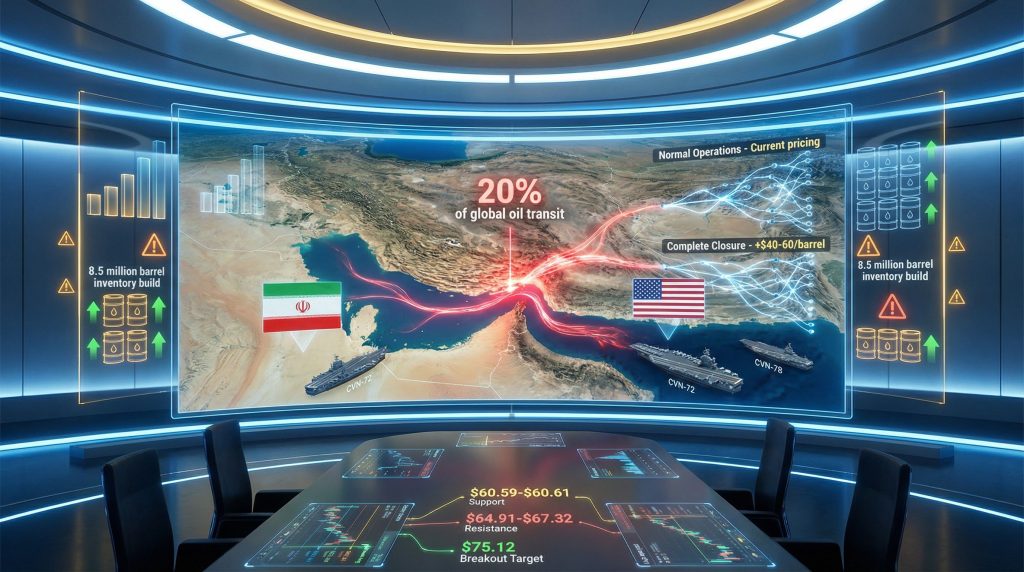
The Strait of Hormuz represents the world's most strategically vulnerable energy transit chokepoint, handling approximately 20 million barrels of oil daily. This narrow waterway creates binary risk scenarios where normal operations maintain baseline pricing, while any disruption triggers immediate supply shortage concerns with limited alternative routing options.
Geographic constraints within this critical passage mean military actions could immediately affect global supply chains, unlike other geopolitical risks that typically develop gradually. The waterway's strategic importance stems from its role as the primary export route for Persian Gulf oil producers, making it irreplaceable in short-term scenarios.
Supply Disruption Impact Analysis
| Disruption Level | Daily Impact | Estimated Price Response | Recovery Timeline |
|---|---|---|---|
| Partial Restrictions | 5-10 million bpd | +$15-25/barrel | 2-4 weeks |
| Significant Blockage | 15-18 million bpd | +$30-45/barrel | 1-3 months |
| Complete Closure | 20 million bpd | +$40-60/barrel | 3-6 months |
Alternative routing through pipelines and other waterways could offset only 30-40% of Strait capacity within the first month of any closure. This highlights the strategic vulnerability that maintains elevated risk premiums even during periods of global oversupply.
Inventory Abundance Creating Market Contradictions
Recent U.S. crude inventory expansions demonstrate the complex interaction between physical oversupply and geopolitical risk assessment. When inventories exceed expectations by significant margins, fundamental analysis suggests price declines should follow. However, geopolitical risk premiums often override these basic supply-demand calculations.
The strategic paradox emerges when abundant current supply coexists with potential future disruption scenarios. Traders must price both the immediate oversupply reality and the possibility that current abundance becomes irrelevant during supply disruptions. In fact, understanding the oil price stagnation factors helps explain why traditional indicators sometimes fail to predict market movements.
Market Psychology in Risk Premium Calculation
Competing Market Narratives:
• Physical oversupply indicating price decline pressure
• Geopolitical uncertainty supporting premium pricing
• Economic demand concerns weighing on long-term outlook
• Supply security fears maintaining price floors
This creates volatile price oscillations as traders shift focus between competing narratives, often resulting in sharp intraday movements when new information tips the balance toward either fundamental or geopolitical factors.
Strategic Military Positioning and Market Implications
Naval deployment strategies in the Persian Gulf region create multiple potential pathways for market development, each carrying distinct pricing implications. Aircraft carrier positioning represents escalation signalling rather than immediate action preparation, generating various strategic scenarios.
Deterrence Framework: Military presence prevents aggressive actions while gradually reducing risk premiums as tensions stabilise through demonstrated strength without engagement.
Escalation Dynamics: Military buildup increases confrontation probability, maintaining elevated risk pricing until diplomatic resolution or military conclusion. Furthermore, analysts tracking US Iran conflict concerns suggest that market volatility could intensify as diplomatic efforts remain uncertain.
Negotiation Leverage: Naval positioning strengthens diplomatic bargaining power while providing contingency options, creating uncertainty about ultimate resolution pathways.
Regional Exposure Assessment
| Geographic Region | Strait Dependency | Alternative Options | Strategic Vulnerability |
|---|---|---|---|
| Asia-Pacific | 40% direct exposure | Limited short-term | Highest risk impact |
| European Union | 15% direct exposure | North Sea alternatives | Moderate flexibility |
| North America | 5% direct exposure | Domestic production | Minimal direct impact |
| Middle East Producers | 85% export route | Pipeline alternatives | Extreme dependency |
Economic Fundamentals Versus Security Concerns
International energy demand projections increasingly incorporate multiple variables beyond traditional economic growth metrics. Reduced demand growth forecasts reflect economic slowdown concerns in key consuming regions alongside accelerating transitions toward alternative energy sources.
Structural Demand Shifts:
- Electric vehicle adoption accelerating in major markets
- Industrial efficiency improvements reducing consumption per unit of output
- Renewable energy expansion displacing petroleum in power generation
- Geopolitical diversification driving investment in domestic alternatives
These fundamental shifts create long-term bearish pressure on oil demand while short-term supply security concerns maintain risk premiums. Consequently, this results in complex pricing dynamics that traditional models struggle to capture accurately. Additionally, the trade war oil market impact demonstrates how broader economic tensions compound these challenges.
How Do OPEC Decisions Influence Current Market Dynamics?
OPEC production strategies add another layer of complexity to current market conditions. The organisation's response to geopolitical tensions often determines whether risk premiums translate into sustained price increases or temporary volatility spikes.
Recent developments suggest that OPEC production impact remains significant in shaping market expectations. The cartel's ability to adjust output provides some buffer against supply disruptions, yet members' own geopolitical considerations sometimes conflict with pure market optimisation.
Production Response Scenarios
Immediate Compensation: OPEC could increase production by 1-2 million barrels daily within 30-60 days to offset disruptions, potentially limiting price spikes to $15-20 above baseline levels.
Delayed Response: Political considerations might delay production increases for 90-120 days, allowing prices to spike $25-35 above baseline before gradual normalisation begins.
Limited Capacity: Existing spare capacity constraints could prevent full compensation, maintaining elevated prices until alternative supplies develop over 6-12 months.
The next major ASX story will hit our subscribers first
Diplomatic Resolution Pathways and Price Discovery
Indirect negotiation frameworks through intermediary nations create multiple potential resolution scenarios, each carrying different market implications. Current diplomatic efforts establish various possible outcomes ranging from comprehensive agreements to partial arrangements or complete breakdown.
Successful Comprehensive Agreement: Complete risk premium removal could decrease prices $10-15/barrel as geopolitical concerns fade and Iranian supply returns gradually.
Partial Sanctions Modification: Gradual supply increases of 1-2 million barrels daily over 12-18 months would create bearish pressure while maintaining some risk premiums.
Diplomatic Stalemate: Continued uncertainty maintains current risk assessment levels with periodic volatility spikes during negotiation developments.
Complete Breakdown: Military action considerations could spike prices $20-40/barrel depending on escalation severity and duration. Moreover, industry experts monitoring oil price rally trends emphasise that any significant escalation could push Brent crude beyond $75 per barrel.
Technical Trading Integration with Geopolitical Events
Current price action reveals critical technical levels that amplify geopolitical developments when breached. These technical boundaries often determine whether geopolitical events create minor price adjustments or significant trend changes.
Key Technical Zones:
- Primary support: $60.59-$60.61 (50% retracement and 52-week moving average convergence)
- Resistance cluster: $64.91-$67.32 (main range retracement zone)
- Breakout target: $75.12 (major long-term resistance)
Geopolitical events gain significantly greater market impact when they push prices beyond these established technical boundaries. This creates momentum-driven moves that amplify initial reactions through algorithmic and technical trading systems.
Long-Term Strategic Energy Infrastructure Transformation
Sustained geopolitical tensions accelerate fundamental shifts in global energy infrastructure investment and strategic planning. Beyond immediate price impacts, persistent uncertainty drives capital allocation toward supply chain diversification and security enhancement.
Infrastructure Development Priorities:
- Non-Middle Eastern production capacity expansion
- Strategic petroleum reserve enhancement programmes
- Alternative transportation route development
- Pipeline infrastructure bypassing vulnerable chokepoints
However, understanding broader economic implications remains crucial, as US economy & tariffs insights reveal how fiscal policies interact with energy security concerns.
Investment Flow Redirection Analysis
Persistent geopolitical risks systematically redirect capital flows across the energy sector:
• North American Unconventional Development: Enhanced investment in shale oil and gas projects providing supply security
• Renewable Energy Acceleration: Geopolitical instability drives energy independence through domestic renewable capacity
• Energy Storage Technology: Advanced battery and hydrogen storage systems reducing dependence on volatile supply chains
• Critical Minerals Security: Diversification of rare earth and lithium supply chains essential for energy transition
What Scenarios Should Traders Consider?
Market participants require sophisticated scenario analysis given high uncertainty and multiple potential resolution pathways. Traditional single-outcome forecasting proves inadequate when geopolitical and economic variables create numerous possible futures.
Probability-Weighted Scenarios (Next 6-12 Months)
Diplomatic Normalisation (40% probability): Gradual tension reduction stabilises prices in $55-65/barrel range as risk premiums fade and Iranian supply returns incrementally.
Prolonged Standoff (35% probability): Elevated uncertainty maintains $65-75/barrel trading range with periodic volatility spikes during negotiation developments or military posturing changes.
Limited Military Engagement (20% probability): Brief price surge to $80-90/barrel during acute crisis phase, followed by normalisation as conflict scope remains contained.
Major Regional Conflict (5% probability): Prices potentially exceed $100/barrel during extended crisis period with supply disruptions and broader Middle Eastern instability.
Market Psychology and Trading Behaviour Analysis
Current market conditions reveal sophisticated trader psychology where participants simultaneously evaluate multiple competing narratives. Professional traders increasingly employ scenario-based hedging rather than directional bets, reflecting uncertainty about dominant factors.
Behavioural Trading Patterns:
- Increased options activity reflecting volatility expectations
- Shorter-duration contract preferences reducing long-term exposure
- Greater emphasis on technical levels during geopolitical uncertainty
- Enhanced correlation with broader geopolitical risk assets
This behavioural shift creates different price dynamics compared to traditional supply-demand driven markets. Consequently, there's increased sensitivity to headline news and diplomatic developments. The comprehensive oil price rally analysis demonstrates how various factors combine to influence trading decisions.
Strategic Implications for Energy Security Planning
Current tensions illuminate fundamental vulnerabilities in global energy architecture that extend beyond immediate pricing concerns. Strategic planners increasingly recognise that energy security requires diversification across supply sources, transportation routes, and fuel types.
Critical Security Considerations:
- Single-point-of-failure vulnerabilities in transportation infrastructure
- Geopolitical concentration risk in key producing regions
- Alternative fuel development as security rather than environmental priority
- Strategic reserve adequacy during extended disruption scenarios
These considerations drive policy development across consuming nations, creating long-term structural changes in energy markets that persist beyond immediate geopolitical resolution.
Frequently Asked Questions: Understanding Complex Oil Market Dynamics
Why Do Abundant Inventories Fail to Reduce Prices During Tensions?
Geopolitical risk premiums reflect potential future supply disruptions rather than current availability. Traders recognise that abundant present inventories become irrelevant if major supply routes face disruption, requiring premium pricing for scenarios where current abundance disappears rapidly.
How Rapidly Could Alternative Sources Offset Major Disruptions?
Strategic petroleum reserves provide 2-3 months of buffer capacity, while increased production from alternative sources requires 6-12 months for meaningful impact. U.S. shale production offers the fastest response capability, potentially adding 1-2 million barrels daily within 6-9 months under emergency conditions.
What Determines Risk Premium Magnitude During Crises?
Risk premium calculations incorporate disruption probability, potential duration, available alternatives, and strategic reserve adequacy. Higher probability scenarios with limited alternatives and inadequate reserves generate larger premiums, while multiple backup options reduce premium requirements.
How Do Technical Levels Interact with Geopolitical News?
Geopolitical developments gain amplified market impact when they drive prices beyond established technical boundaries. Breaking key support or resistance levels triggers algorithmic and momentum trading that magnifies initial geopolitical reactions, creating larger price movements than fundamental analysis alone would suggest.
This strategic analysis demonstrates how U.S.-Iran tensions and oil prices create multilayered impacts requiring sophisticated scenario planning and risk assessment frameworks. Market participants must navigate competing narratives while preparing for multiple potential outcomes in an increasingly complex geopolitical environment. Furthermore, understanding these dynamics becomes essential as U.S.-Iran tensions and oil prices continue shaping global energy markets through interconnected political, economic, and strategic considerations.
Looking to Capitalise on Energy Market Volatility?
Discovery Alert's proprietary Discovery IQ model delivers real-time alerts on significant ASX mineral discoveries, including energy and critical minerals companies positioned to benefit from shifting geopolitical dynamics. While oil markets navigate complex U.S.-Iran tensions, Australian exploration companies continue uncovering valuable resources that could reshape supply chains—begin your 14-day free trial today to stay ahead of these actionable opportunities.