July 19, 2026
Oil price volatility extends far beyond simple supply and demand mechanics, forming a complex web of interconnected factors that ripple through global financial markets and economic systems. Understanding these dynamics becomes particularly crucial when examining how US-Iran tensions and oil prices interact, creating measurable market impacts across energy commodities that influence international trade patterns.
The energy sector operates within a framework where political developments can instantly reshape pricing structures, creating cascading effects that influence everything from transportation costs to manufacturing expenses worldwide. Furthermore, this interconnected nature means that regional conflicts often evolve into global economic phenomena, affecting countries and industries far removed from the initial source of tension.
The Architecture of Energy Market Risk Assessment
Modern commodity markets have developed sophisticated mechanisms for pricing uncertainty, particularly when geopolitical events threaten established supply chains. These pricing models incorporate multiple layers of risk evaluation, including transportation route security, production capacity threats, and broader regional stability concerns.
Current market positioning reveals Brent crude trading at $70.23 per barrel and WTI crude at $65.11 per barrel as of February 19, 2026, with both benchmarks experiencing recent volatility following a 4% surge on February 18. These price movements reflect traders' ongoing assessment of escalating diplomatic tensions and their potential impact on energy flows, particularly concerning how US oil production decline affects global supply dynamics.
The concept of geopolitical risk premiums operates through three distinct channels that collectively influence market pricing:
- Supply disruption expectations create immediate price adjustments based on potential capacity losses
- Transportation route vulnerability adds premium costs reflecting chokepoint disruption risks
- Demand destruction fears incorporate anticipated economic slowdown effects from higher energy costs
Market analysts currently assign varying probabilities to different escalation scenarios, with full-scale armed conflict considered unlikely while limited military action scenarios receive higher probability weightings. This assessment framework directly influences options market volatility and futures pricing structures across energy commodities.
When big ASX news breaks, our subscribers know first
Strategic Chokepoints and Global Energy Flows
The global energy system depends heavily on specific maritime passages that serve as critical bottlenecks for petroleum product transportation. Among these, certain waterways hold disproportionate importance due to their geographic positioning and the volume of energy commodities that transit through them daily.
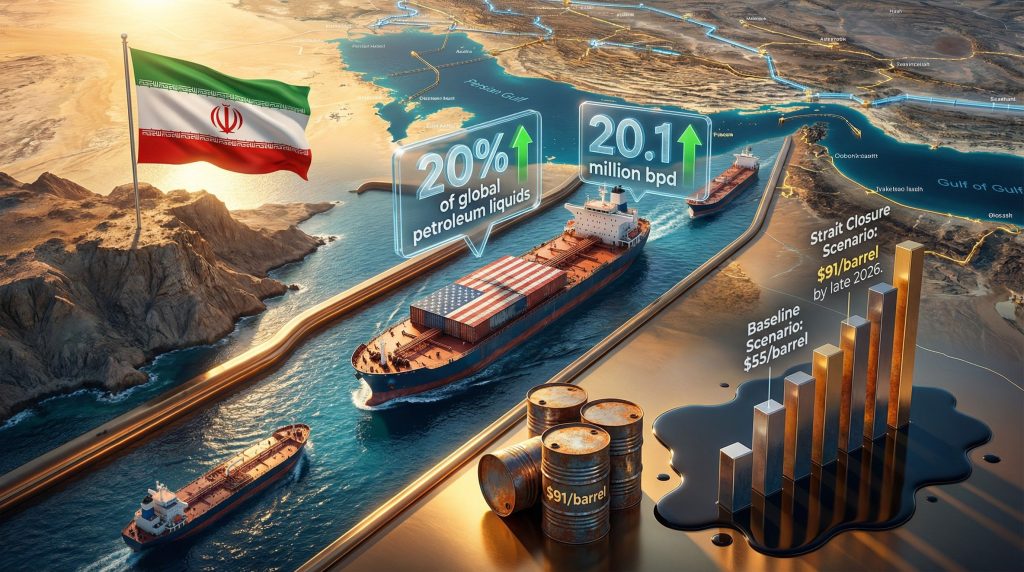
The most strategically significant of these passages facilitates approximately 20% of global petroleum liquids, handling complex flows that include crude oil, refined products, and liquefied natural gas shipments. Consequently, this concentration creates systemic vulnerability within the global energy supply chain.
Daily Transit Volumes Through Critical Energy Chokepoints
| Product Type | Daily Volume | Global Market Share |
|---|---|---|
| Crude Oil | 15.2 million bpd | 18% of global crude |
| Total Petroleum Liquids | 20.1 million bpd | 20% of global supply |
| LNG Shipments | 3.2 bcf/day | 22% of global LNG trade |
The geographic constraints of this waterway create unique vulnerabilities that distinguish it from other international trade routes. At its narrowest point, the passage measures approximately 21 miles wide, with commercial shipping lanes restricted to 2-mile wide corridors in each direction. This physical limitation means that any disruption would immediately impact global energy availability.
Historical precedent demonstrates the feasibility of supply chain disruptions in this region. During the 1987-1988 period, attacks on petroleum shipping created significant market volatility and forced international intervention to maintain commercial navigation. These events established important reference points for understanding how geopolitical tensions translate into actual supply constraints.
However, the absence of viable alternative routes for petroleum products amplifies the strategic importance of this chokepoint. Unlike other major shipping lanes that offer potential workarounds, energy commodities from key producing regions have no practical alternatives for reaching global markets, creating an irreplaceable component in international energy security planning.
Sanctions Architecture and Export Constraint Mechanisms
Economic restrictions targeting major oil-producing nations operate through increasingly sophisticated mechanisms designed to limit export capacity without directly disrupting global production facilities. These multilayered approaches create artificial supply constraints that influence international energy pricing, with Trump tariff implications adding additional complexity to trade relationships.
Recent data indicates Iranian crude export volumes declined to approximately 1.39 million barrels per day in January 2026, representing a 26% year-over-year decrease from previous export levels. This reduction reflects the cumulative impact of various restriction mechanisms rather than production capacity limitations.
The enforcement framework operates through several interconnected pressure points:
- Primary Sanctions impose direct restrictions on Iranian oil exports
- Secondary Sanctions create penalties for entities facilitating Iranian trade
- Tariff Mechanisms establish trade barriers affecting commercial partners
- Financial Isolation accelerates capital flight as export revenues decline
Shadow fleet operations have emerged as a primary method for circumventing these restrictions, utilizing aging and unregistered vessels with unclear ownership structures. Current assessments suggest 86% of vessels transporting Iranian crude face various forms of sanctions, while Chinese port discharges fell from 1.4 million bpd to 1.13 million bpd, indicating reduced purchasing despite no formal Chinese government compliance requirements.
The effectiveness of these measures appears in accumulated offshore storage, with over 170 million barrels of unsold crude reportedly stored on tankers. This storage accumulation represents a significant portion of global floating storage capacity and creates additional market dynamics as stored volumes potentially return to markets under different geopolitical conditions.
Revenue impacts from these constraints show substantial effects on exporting nation finances. Oil export earnings reportedly dropped to $20 billion during an eight-month fiscal period, representing significant pressure on government budgets and economic planning capabilities.
Military Escalation Scenarios and Price Impact Modeling
Financial markets utilise sophisticated modelling frameworks to assess potential outcomes from various levels of military confrontation, with each scenario carrying distinct implications for global energy pricing and supply chain stability. These assessments incorporate historical precedent, current military positioning, and economic transmission mechanisms that shape US-Iran tensions and oil prices relationships.
Scenario-Based Price Impact Analysis
| Escalation Level | Brent Price Target | Duration Estimate | Probability Assessment |
|---|---|---|---|
| Diplomatic Breakdown | $5-8 premium | 2-4 weeks | Moderate (40%) |
| Limited Military Action | $12-18 premium | 4-8 weeks | Lower (25%) |
| Supply Route Disruption | $25-35 premium | 8-16 weeks | Low (10%) |
| Regional Conflict Expansion | $40-60 premium | 12+ weeks | Very Low (5%) |
Current expert analysis suggests that political leadership considerations may constrain military action scope. Market participants note that concerns about oil price increases could influence decision-making regarding the extent of any potential military response, with preferences for limited duration actions if military options are pursued. This dynamic interacts with broader Trump tariffs and OPEC policy considerations affecting global trade flows.
Economic transmission mechanisms for oil price shocks operate through multiple channels that amplify initial supply disruptions. Short-term price elasticity of oil demand typically ranges between -0.1 to -0.3, meaning relatively small supply reductions can produce disproportionate price movements. A 5% supply reduction historically generates 15-30% price increases during compressed timeframes.
Historical comparison points provide context for current market assessments. The 2019 attacks on Saudi Arabia's Abqaiq processing facility removed approximately 5.7 million barrels per day from production, causing Brent crude to spike from $63 to $71 per barrel in a single trading session. Full production restoration required approximately five weeks, with market normalisation occurring within 4-6 weeks as spare capacity deployment offset the disruption.
The 1973 Arab oil embargo offers additional reference for understanding longer-term supply shock impacts. OPEC production reductions of approximately 5 million barrels per day during that period contributed to crude prices increasing from roughly $3 to $12 per barrel over several months, demonstrating how sustained supply constraints create more dramatic and persistent price effects.
OPEC+ Response Capabilities and Strategic Reserve Systems
Global energy security depends significantly on the coordinated response capabilities of major oil-producing nations and strategic petroleum reserve systems maintained by consuming countries. These mechanisms provide crucial buffers during supply disruptions but operate within specific capacity constraints that limit their effectiveness during major crises, particularly when considering OPEC production impact on global markets.
Current spare production capacity among key producers offers some cushion against supply shocks. Saudi Arabia maintains an estimated 2-3 million barrels per day of additional production capability, while the UAE can expand output by approximately 1 million barrels per day. However, the speed at which this capacity can be deployed varies significantly based on the type of disruption and market conditions.
Strategic petroleum reserves represent another critical component of emergency response systems. Major Strategic Reserve Capacities:
- US Strategic Petroleum Reserve: 638 million barrel capacity available for emergency releases
- IEA Coordinated Response: International Energy Agency members hold 1.5 billion barrels in strategic stocks
- Combined Buffer Capacity: Theoretical ability to offset major supply disruptions for extended periods
The effectiveness of these response mechanisms depends heavily on the nature and duration of supply disruptions. Short-term disruptions affecting 2-3 million barrels per day can typically be managed through spare capacity deployment and limited strategic reserve releases. However, disruptions affecting 15-20 million barrels per day would exceed the immediate response capabilities of existing systems.
Coordination challenges also affect response effectiveness. While the IEA framework provides mechanisms for coordinated releases, political considerations and national energy security priorities can complicate rapid deployment during crisis situations. Historical precedent shows that coordinated responses typically require several weeks to fully implement, creating temporary supply gaps during initial disruption periods.
Moreover, Saudi Arabia exploration activities continue expanding production potential, though these developments require longer timeframes to influence immediate supply scenarios.
Financial Market Mechanisms and Options Pricing
Energy commodity futures markets incorporate geopolitical uncertainty through complex pricing structures that reflect both immediate supply concerns and longer-term stability expectations. These mechanisms operate through derivatives markets, options volatility patterns, and risk premium calculations that translate political developments into quantifiable market impacts.
Current market positioning suggests traders are pricing moderate escalation probability while remaining vulnerable to rapid repricing during crisis developments. Implied volatility in oil futures options typically expands 15-25% during periods of heightened geopolitical uncertainty, creating additional costs for hedging activities across energy-intensive industries.
Risk Premium Components in Current Pricing:
"Markets currently price approximately $5-10 per barrel in geopolitical risk premium based on existing tension levels" – Baseline Assessment
"Each increase in diplomatic tension typically adds $2-4 per barrel in additional premium pricing" – Escalation Sensitivity
"Actual supply disruptions create 3-5x amplification of risk premium components" – Supply Shock Multiplier
The mathematical framework for pricing geopolitical risk operates through several interconnected variables including supply elasticity coefficients, historical volatility patterns, and correlation analysis between political events and price movements. These calculations form the foundation for options pricing models used by energy trading firms and financial institutions.
Precautionary demand represents another significant factor in crisis pricing. During periods of elevated geopolitical risk, strategic purchasing increases as market participants hedge against future supply shortages. This additional demand layer can add 10-15% to baseline consumption during peak uncertainty periods, creating feedback loops that amplify initial price movements.
The next major ASX story will hit our subscribers first
Macroeconomic Transmission and Inflation Dynamics
Oil price volatility stemming from geopolitical tensions creates extensive ripple effects throughout global economic systems, influencing monetary policy decisions, inflation trajectories, and growth patterns across major economies. Understanding these transmission mechanisms helps explain why regional conflicts often evolve into worldwide economic phenomena.
Central bank responses to energy price shocks follow established patterns based on the persistence and magnitude of price increases. Temporary spikes lasting 4-8 weeks typically receive minimal monetary policy response, while sustained increases over 12+ weeks often prompt interest rate adjustments to prevent broader inflationary pressures.
Primary Economic Transmission Channels:
- Inflation Pressure: Higher energy costs feed directly into consumer price indices through transportation and heating expenses
- Monetary Policy Response: Central banks may adjust interest rate policies to prevent inflation expectations from becoming entrenched
- Currency Fluctuations: Oil-importing nations face balance of payments pressures that weaken exchange rates
- Growth Impact: Energy-intensive industries experience margin compression affecting employment and investment decisions
Historical analysis shows that $10 per barrel sustained oil price increases typically translate to 0.2-0.4 percentage point increases in core inflation rates across developed economies. This relationship varies based on energy intensity, economic structure, and existing inflation levels within individual countries.
Energy-importing developing economies face disproportionate impacts from oil price volatility. Countries with high energy import ratios (exceeding 80% of consumption) experience more severe balance of payments pressures and currency depreciation during sustained price increases. These effects often persist longer than in developed economies due to limited strategic reserve capabilities and reduced fiscal flexibility for subsidy programs.
Consumer spending patterns also shift significantly during energy price shock periods. Historical data indicates that sustained $15+ per barrel price increases typically reduce discretionary consumer spending by 2-3% as household budgets adjust to higher transportation and utility costs.
Investment Strategy Implications and Portfolio Positioning
US-Iran tensions and oil prices create specific opportunities and risks for different categories of investors, requiring careful analysis of exposure levels, hedging requirements, and sector rotation strategies. Understanding these dynamics enables more effective portfolio positioning during periods of elevated geopolitical uncertainty.
Energy sector equity performance during geopolitical crises follows predictable patterns based on price duration and company operational characteristics. Upstream producers typically outperform during initial price spikes, while integrated energy companies provide more stable returns during extended uncertainty periods.
Sector-Specific Investment Considerations:
- Upstream Oil & Gas Companies: Direct beneficiaries of higher crude prices, with operating leverage amplifying price increases into earnings growth
- Pipeline and Infrastructure: Benefit from increased transportation demand and higher utilisation rates
- Energy Service Companies: Experience mixed impacts based on short-term project delays versus longer-term development acceleration
- Renewable Energy: May receive increased investment interest as energy security concerns promote diversification
Defensive positioning strategies during geopolitical oil price volatility focus on sectors with predictable demand patterns and limited energy cost exposure. Utilities with stable regulatory frameworks, consumer staples companies, and healthcare providers typically maintain more consistent performance during energy price shock periods.
Currency hedging becomes particularly important for international investors during oil price volatility periods. Energy-importing currencies often depreciate against the US dollar during sustained price increases, creating additional return variability for unhedged international equity positions.
Commodity exposure methods for individual investors include direct futures contracts, energy sector ETFs, and inflation-protected securities that adjust for energy price changes. Each approach carries distinct risk profiles and requires different levels of market expertise for effective implementation.
What Are the Key Risk Management Strategies?
Professional investors typically employ multiple risk management approaches during periods of elevated US-Iran tensions and oil prices volatility:
- Dynamic hedging through options strategies that adjust based on volatility levels
- Sector rotation away from energy-intensive industries during sustained high price periods
- Geographic diversification to reduce exposure to regions most affected by supply disruptions
- Inflation-linked instruments that provide protection against broad-based price increases
Regional Economic Vulnerabilities and Adaptation Mechanisms
Different regions exhibit varying degrees of sensitivity to oil price volatility based on their energy import dependency, economic structure, and available policy response mechanisms. These variations create distinct patterns of economic impact that persist beyond initial price shock periods.
Energy Import Dependency Analysis:
- Asia-Pacific Region: Countries like Japan and South Korea face significant vulnerability due to 85%+ energy import ratios
- European Union: Diverse energy profiles create varying national impacts, with Eastern European nations typically more vulnerable
- North America: Domestic production capabilities provide some insulation, though regional variation exists
- Sub-Saharan Africa: Limited fiscal capacity for subsidies amplifies consumer-level impacts
Government response mechanisms vary significantly based on fiscal capacity and existing energy subsidy frameworks. Countries with established fuel subsidy programmes face difficult choices between maintaining consumer protection and preserving fiscal stability during extended high price periods.
Adaptation strategies employed by energy-importing nations include strategic reserve building, supply source diversification, and accelerated renewable energy deployment. However, these adaptations require multi-year implementation periods and substantial capital investment, limiting their effectiveness during immediate crisis periods.
Industrial sector impacts concentrate in energy-intensive manufacturing including aluminium, steel, and chemical production. These industries often experience margin compression during sustained high oil price periods, potentially leading to production curtailment and employment adjustments in affected regions.
Transportation sector adaptation occurs through multiple mechanisms including route optimisation, fuel efficiency improvements, and modal shifts toward less energy-intensive options. These adaptations typically emerge gradually during extended high price periods rather than immediate crisis response.
Long-Term Energy Security Planning and Infrastructure Development
The recurring nature of geopolitical oil price volatility has prompted significant changes in energy infrastructure planning and security frameworks across both producing and consuming nations. These developments reflect recognition that short-term crisis management must be complemented by longer-term structural adaptations.
Strategic infrastructure investments focus on reducing chokepoint vulnerabilities through alternative transportation routes, expanded pipeline networks, and increased strategic storage capacity. However, these projects require multi-year development timelines and substantial capital commitments that limit their immediate crisis response effectiveness.
Technological developments in energy production, storage, and distribution create new options for managing supply security risks. Enhanced oil recovery techniques, improved strategic reserve systems, and advanced demand management technologies provide additional flexibility during disruption periods.
International cooperation mechanisms continue evolving through expanded sharing agreements, coordinated response protocols, and joint strategic planning initiatives. The effectiveness of these frameworks depends heavily on political alignment between participating nations during actual crisis periods.
"Energy security planning increasingly focuses on system resilience rather than absolute supply security, recognising that complete disruption prevention may be neither feasible nor cost-effective" – Industry Perspective
Private sector adaptation includes expanded hedging activities, supply chain diversification, and operational flexibility improvements. Energy-intensive industries particularly focus on fuel switching capabilities and efficiency improvements that reduce exposure to price volatility.
Market structure evolution reflects these security considerations through expanded derivatives markets, improved price discovery mechanisms, and enhanced information sharing systems that enable more effective crisis response coordination.
Understanding these long-term adaptation processes provides crucial context for evaluating the persistent effects of geopolitical tensions on energy markets, extending well beyond immediate price impacts to influence fundamental market structure and participant behaviour patterns. For instance, ongoing assessments of oil market developments continue highlighting the complex relationships between political risk and commodity pricing.
Furthermore, comprehensive analysis of current market conditions reveals how quickly sentiment can shift based on diplomatic developments, underscoring the importance of maintaining flexible response capabilities across both public and private sector planning frameworks.
Disclaimer: This analysis is for educational purposes only and should not be considered as investment advice. Oil price forecasting involves significant uncertainty, and actual outcomes may differ substantially from scenario projections presented. Readers should consult with qualified financial professionals before making investment decisions based on geopolitical risk assessments.
Ready to Profit from the Next Energy Market Surge?
Discovery Alert's proprietary Discovery IQ model delivers instant notifications on significant ASX mineral discoveries, transforming complex market data into actionable trading opportunities that help investors capitalise on energy and commodity price volatility before broader markets react. With oil price tensions creating ripple effects across all commodities, explore how historic mineral discoveries generate substantial returns and begin your 14-day free trial today to secure your market-leading advantage.