August 26, 2026
Strategic energy security concerns have reached a critical inflection point as global oil markets navigate an increasingly complex web of geopolitical uncertainties. The intersection of military posturing, diplomatic negotiations, and energy infrastructure vulnerabilities creates a volatile environment where traditional supply-and-demand fundamentals take a backseat to risk premium calculations. Understanding how these dynamics unfold requires analyzing multiple layers of market psychology, technical constraints, and strategic positioning that extend far beyond headline-grabbing military threats, particularly as U.S.-Iran tensions oil price rise scenarios continue to evolve.
Iran's Strategic Position Drives Global Energy Market Volatility
Iran's Critical Role in Global Energy Infrastructure
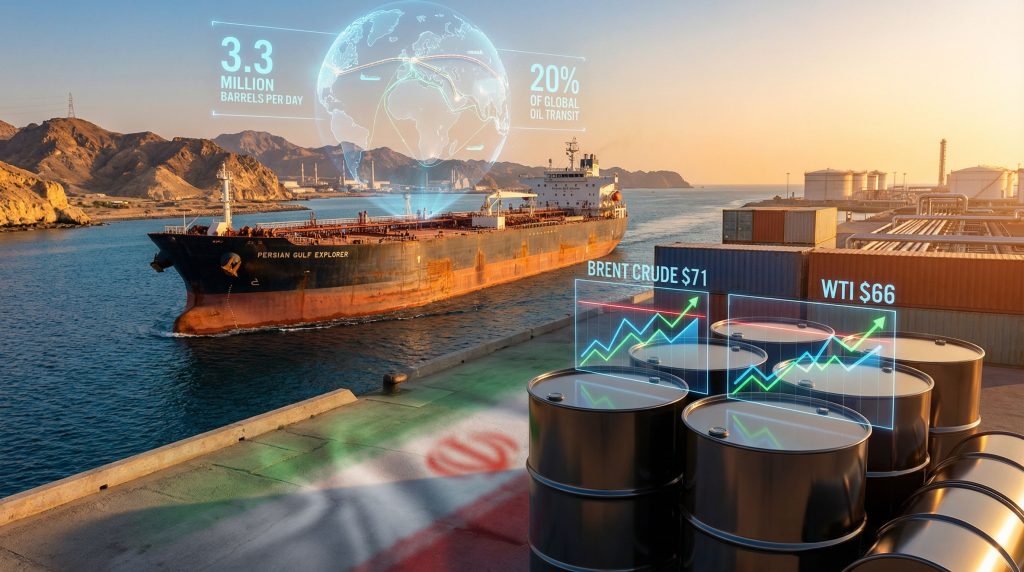
Iran's position in global oil markets extends beyond its 3.3 million barrels per day production capacity to encompass broader strategic control over critical energy infrastructure. The country's geological advantages include massive proven reserves exceeding 150 billion barrels, positioning it among the world's top four reserve holders. However, decades of international sanctions have constrained Iran's ability to modernize extraction technologies, leaving significant untapped potential in mature fields where enhanced recovery techniques could boost output by an additional 1-2 million barrels per day.
The Strait of Hormuz represents perhaps the most significant energy chokepoint globally, with approximately 21-23 million barrels per day transiting through its narrow 33-nautical-mile passage during peak periods. This represents roughly 20-21% of globally traded crude oil according to International Energy Agency data. The strait's vulnerability stems not only from its geography but from Iran's strategic positioning along its northern shore, providing the country with theoretical capability to disrupt maritime traffic through mine deployment, missile systems, or naval harassment tactics.
Historical precedent demonstrates how Iranian actions can rapidly transform global energy pricing. During the 1987-1988 Tanker War phase of the Iran-Iraq conflict, over 430 merchant vessels were attacked, creating insurance premium spikes ranging from 1-5% of cargo value. More recently, the 2019 attacks on two tankers in the Gulf of Oman, attributed to Iranian forces, temporarily spiked Brent crude prices by 4-6% within hours of the incidents, illustrating the market's sensitivity to perceived Iranian threats.
Geopolitical Risk Premium Mechanisms in Energy Markets
Energy markets incorporate geopolitical uncertainty through sophisticated risk premium calculations that reflect both probability assessments and potential magnitude of disruption. Current analysis suggests that $3-4 per barrel risk premium specifically related to U.S.-Iran tensions has been embedded in oil prices since late 2025. This premium represents trader consensus regarding probability-weighted costs of supply disruption, incorporating factors including escalation likelihood, potential response scenarios, and expected duration of any conflict.
Options market positioning provides quantitative insight into trader sentiment and risk assessment. Recent data indicates that bullish call options have traded at premiums relative to bearish puts for the longest stretch in approximately 14 months, with bullish option additions growing at the fastest pace in at least six years. This positioning suggests that sophisticated investors are willing to pay significant premiums to protect against upside price movement, indicating genuine concern about supply disruption scenarios rather than speculative positioning.
The psychological component of geopolitical risk premiums often amplifies physical market concerns. Academic research demonstrates that price responses correlate more strongly with perceived threat credibility than with actual military capabilities. When political leaders make explicit military threats while concurrent Iranian warnings about strait operations create dual escalation signals, markets experience what economists term ambiguity premium – additional price pressure arising from uncertainty about whether threats represent genuine escalation or negotiating posture.
When big ASX news breaks, our subscribers know first
Military Escalation Pathways and Energy Infrastructure Vulnerabilities
Naval Deployment Impact on Critical Shipping Corridors
Military escalations translate into energy market disruptions through multiple interconnected pathways, beginning with immediate impacts on shipping route security and insurance costs. The Strait of Hormuz operates under strict International Maritime Organization protocols, with two separate traffic lanes occupying only 6-8 nautical miles of navigable channel despite the strait's 21-nautical-mile width at its narrowest point. This constraint means that any disruption reducing capacity to 50% would eliminate 10-12 million barrels per day from global markets, equivalent to roughly 10-12% of global daily oil demand.
Insurance premium escalation follows predictable patterns during military tensions. Standard war risk premiums for Strait of Hormuz transit typically range from 0.1-0.2% of cargo value during normal periods but can spike to 2.5-3.5% during severe escalation phases. These premium increases translate to approximately $0.50-$3.00 per barrel in additional transportation costs depending on vessel size and cargo origin. During the January 2020 escalation following military strikes in Iraq, insurance premiums temporarily reached 3-4% of cargo value for high-risk transits.
Alternative routing capacity remains severely constrained, creating strategic vulnerabilities that amplify geopolitical risk premiums. Furthermore, the primary alternative route through the Suez Canal can accommodate approximately 3-4 million barrels per day for oil shipments while adding 8-12 days to transit time and $1.50-$3.00 per barrel in additional costs. Combined pipeline alternatives through Turkey and Saudi Arabia carry approximately 2-2.5 million barrels per day capacity, proving inadequate for full substitution during a complete strait closure scenario.
Regional Supply Chain Ripple Effects
Military escalations create cascading effects across regional energy supply chains that extend far beyond direct production disruptions. European refineries rely on Middle Eastern crude for approximately 40-45% of inputs, while Japanese and South Korean refineries derive 50-60% of crude inputs from Middle Eastern sources. When strait disruptions force substitution with alternative crude grades, refineries face configuration challenges requiring 5-15 days to adjust processing parameters, during which operating margins deteriorate significantly.
Strategic Petroleum Reserve deployment provides limited near-term supply buffer during escalation scenarios. The International Energy Agency maintains coordinated SPR procedures established through the 1974 International Energy Program, with coordinated releases typically occurring in 30-day deployment windows releasing approximately 60 million barrels. However, historical SPR deployments following Hurricane Katrina in 2005 and the Libyan civil war in 2011 reveal that releases often occur after market prices have already peaked, limiting effectiveness in preventing price spikes.
OPEC+ coordination mechanisms face significant challenges during simultaneous geopolitical crises. Saudi Arabia maintains documented spare production capacity of approximately 3-3.5 million barrels per day, while the United Arab Emirates maintains approximately 1.5-2.0 million barrels per day spare capacity. Combined, Gulf Cooperation Council countries can mobilize approximately 5-6 million barrels per day of additional production, though ramping to full capacity typically requires 3-7 days and cannot fully offset scenarios combining Iranian production loss with shipping disruptions.
Current Tension Dynamics and Market Price Drivers
Options Market Psychology and Positioning Analysis
Current U.S.-Iran tensions oil price rise scenarios are driving sophisticated institutional positioning that reflects genuine supply disruption concerns rather than speculative momentum. Options market skew – the relative pricing difference between calls and puts – serves as a market-based sentiment gauge more reliable than survey data because it reflects actual capital allocation decisions by sophisticated investors. The recent shift toward bullish positioning represents the most sustained directional bias in 14 months, indicating persistent rather than ephemeral concern about escalation scenarios.
The velocity of bullish option additions provides insight into market conviction regarding upside price movement. Institutional traders have added bullish positions at the fastest pace in at least six years, suggesting that risk managers across energy-dependent industries are implementing hedging strategies based on quantitative assessments of escalation probability. This positioning differs qualitatively from speculative bubbles, where retail participation typically dominates options flow and positioning lacks fundamental risk management rationale.
Professional oil traders distinguish between event-driven volatility and structural supply tightness when calibrating risk premiums. Current positioning reflects assessment that U.S.-Iran tensions represent structural rather than transient risk factors, given the intersection of nuclear program concerns, regional proxy conflicts, and domestic political pressures in both countries. This assessment supports sustained rather than temporary risk premium embedding in oil prices.
Technical Price Breakthrough Analysis
Brent crude's breach of the $71 resistance level represents a significant technical development that validates escalation concerns through market-based price discovery. This resistance level had contained multiple rally attempts since August 2025, making the breakthrough particularly significant for algorithmic trading systems and momentum-based strategies. The accompanying surge in trading volume during the breakthrough suggests genuine institutional conviction rather than thin-market technical manipulation.
West Texas Intermediate's concurrent movement above the $66 threshold confirms that price appreciation reflects broad-based supply security concerns rather than regional-specific factors. The WTI-Brent spread behavior during the escalation provides additional insight: when spreads widen beyond $5, markets typically signal concerns about supply route disruptions affecting Brent-linked crudes disproportionately. Current spread dynamics suggest that markets are pricing in Middle Eastern supply risks rather than North American production issues.
Volume analysis supports price momentum sustainability across multiple timeframes. Intraday volume patterns during the initial rally showed consistent institutional accumulation rather than speculative day-trading activity. This pattern typically indicates that price movements reflect fundamental reassessment of supply security rather than temporary risk-on/risk-off sentiment shifts that characterize speculative episodes.
Strategic Escalation Scenarios and Price Impact Modeling
Limited Military Action Consequences
Targeted military strikes on Iranian nuclear facilities would likely generate $5-15 per barrel price premiums depending on scope and Iranian response patterns. Historical precedent from Israeli strikes on Iraqi nuclear facilities in 1981 and Syrian facilities in 2007 suggests that markets initially price in maximum retaliation scenarios before gradually moderating as actual response becomes clear. However, Iranian capabilities for asymmetric response have expanded significantly since these historical precedents.
The duration of price premiums under contained conflict scenarios typically follows predictable patterns over 1-3 months. Initial spike phases last 48-72 hours as markets incorporate maximum disruption scenarios. Secondary adjustment phases over 1-2 weeks reflect reassessment as actual military capabilities and response patterns become evident. Final normalization phases over 4-12 weeks depend heavily on whether conflicts remain contained or expand to involve regional proxies or allies.
Regional proxy response probability remains the critical variable determining price premium sustainability. Iranian relationships with Houthi forces in Yemen, Hezbollah in Lebanon, and Shia militia groups in Iraq provide multiple avenues for indirect retaliation that could sustain energy market uncertainty even after direct military actions conclude. Markets have demonstrated particular sensitivity to threats against Saudi Arabian energy infrastructure, given the country's role as swing producer and holder of the world's largest spare capacity reserves.
Strait of Hormuz Closure Impact Assessment
Complete Strait of Hormuz closure represents a maximum disruption scenario that could generate $20-30 per barrel price spikes based on the elimination of 21-23 million barrels per day from global transit routes. This scenario assumes Iranian deployment of mine barriers, anti-ship missile systems, and naval harassment tactics that effectively close the waterway to commercial shipping. However, complete closure scenarios face significant practical limitations due to Iranian dependence on the strait for its own energy exports and food imports.
Partial disruption effects provide more realistic modeling scenarios, where Iranian actions reduce strait capacity by 30-50% rather than complete closure. Such scenarios could sustain $8-15 per barrel premiums over 3-6 months while alternative supply routes ramp capacity and diplomatic solutions develop. Partial disruptions prove more sustainable from Iranian strategic perspectives because they maximize pressure on global markets while avoiding complete economic isolation.
Timeline for alternative supply route activation represents a critical constraint limiting market response flexibility. Suez Canal capacity expansion requires 2-4 weeks to implement emergency protocols increasing daily throughput. Pipeline network activation through Turkey and Saudi Arabia requires 1-2 weeks for capacity reallocation. Combined alternative routes can accommodate approximately 5-7 million barrels per day during emergency operations, leaving substantial supply gaps during major strait disruptions.
Diplomatic Resolution Pathways and Price Normalisation
Price normalisation following tension de-escalation typically occurs rapidly but rarely returns to pre-crisis levels immediately. Historical analysis of previous U.S.-Iran escalation cycles suggests that 20-40% of geopolitical risk premiums remain embedded in prices for 3-6 months following diplomatic breakthrough announcements. This persistence reflects market learning about escalation potential and structural vulnerabilities revealed during crisis periods.
Turkey's mediation role provides one of the most viable diplomatic pathways for tension reduction, given Ankara's relationships with both Washington and Tehran. Turkish officials have historically facilitated nuclear program discussions and economic cooperation agreements that temporarily reduced U.S.-Iran tensions. However, Turkey's own regional strategic priorities and relationships with European allies create constraints on its effectiveness as a neutral mediator.
Market correction velocity after false alarm scenarios depends heavily on whether escalation cycles damage fundamental supply infrastructure or represent purely political theatre. When military positioning and threatening rhetoric occur without actual infrastructure damage or production disruptions, markets typically correct 60-80% of price premiums within 2-4 weeks. However, any actual damage to production facilities, shipping infrastructure, or regional producer capabilities creates lasting supply security concerns that sustain elevated price floors.
Regional Market Exposure and Vulnerability Assessment
Geographic Supply Chain Dependencies
European energy security faces particularly acute vulnerability to Middle Eastern supply disruptions due to infrastructure constraints and limited alternative sourcing capacity. European refineries optimised for Middle Eastern crude grades cannot rapidly substitute with alternative feedstocks without significant operational adjustments requiring 1-3 weeks for full implementation. Germany and Italy show especially high dependency ratios, with 45-55% of crude inputs sourced from Middle Eastern producers.
Asian markets demonstrate the highest absolute exposure to Strait of Hormuz disruptions, with Japan, South Korea, and China collectively importing approximately 12-15 million barrels per day through the waterway. However, Asian countries have invested more heavily in strategic petroleum reserves and alternative supply relationships, providing greater buffer capacity during disruption scenarios. Japan maintains approximately 150-200 days of crude oil reserves, compared to 90-120 days typical in European markets.
North American shale production response capacity provides the most significant global buffer against Middle Eastern supply disruptions, though activation timeline remains constrained. For instance, us drilling decline trends have shown that U.S. shale producers require 4-6 months to bring new production online once drilling campaigns commence, creating temporal gaps during acute crisis periods. However, existing drilled but uncompleted wells provide 1-2 million barrels per day of potential rapid response capacity that could activate within 6-12 weeks.
Sector-Specific Impact Analysis
Transportation industry cost absorption capabilities vary dramatically across subsectors and geographic regions. Commercial aviation faces immediate margin pressure from fuel cost increases, with $10 per barrel oil price increases typically translating to 2-4% increases in operating costs for major carriers. However, airlines maintain sophisticated fuel hedging programs that can provide 3-6 months of price protection during sudden escalation scenarios.
Chemical and petrochemical industries demonstrate highest sensitivity to sustained oil price increases due to feedstock dependency and limited substitution capacity. Naphtha-dependent ethylene producers face particularly acute margin compression, with $1 per barrel crude oil increases typically translating to $15-25 per ton feedstock cost increases. European chemical producers show greater vulnerability than North American counterparts due to higher Middle Eastern crude dependency ratios.
Power generation fuel switching economics create demand destruction mechanisms that moderate extreme price spikes over 3-6 month periods. Natural gas-fired power plants can typically substitute for oil-fired generation when crude prices exceed $75-85 per barrel, depending on regional gas prices. However, fuel switching capacity remains limited in many developing markets where oil-fired generation represents critical base load capacity.
Historical Pattern Analysis and Precedent Assessment
Comparative Crisis Timeline Analysis
The 2019 Saudi Aramco attack provides the most relevant recent precedent for understanding market response to Middle Eastern infrastructure disruption. Drone and cruise missile attacks eliminated approximately 5.7 million barrels per day of production capacity, causing Brent crude prices to spike 19.5% from approximately $60 to $71.95 per barrel on September 16, 2019. However, this spike proved temporary, with prices normalising to approximately $63 per barrel within two weeks as Saudi Arabia deployed replacement capacity and confirmed rapid repair timelines.
The 1980s Tanker War period demonstrates how sustained military tensions can create persistent rather than temporary energy market premiums. During the most severe phases from 1987-1988, crude oil prices sustained $5-12 per barrel premiums for over 18 months as insurance costs, shipping delays, and supply uncertainty created structural market tightness. Unlike acute crisis scenarios, sustained low-level conflict created adaptation mechanisms that embedded permanent risk premiums into global pricing.
Gulf War precedents from 1990-1991 illustrate how actual supply disruption differs dramatically from threatened disruption in terms of market response. Iraqi invasion of Kuwait eliminated approximately 4.5 million barrels per day of combined production, causing oil prices to spike from $17 to $42 per barrel within weeks. However, coordinated Strategic Petroleum Reserve releases and Saudi production increases moderated prices to $25-30 per barrel range within 4-6 months, demonstrating effectiveness of coordinated policy response during actual rather than threatened disruptions.
Market Efficiency in Geopolitical Event Pricing
Oil futures markets demonstrate remarkable efficiency in incorporating geopolitical information, typically achieving price discovery within 15-30 minutes of major political or military announcements. However, this efficiency applies primarily to initial event assessment rather than duration and magnitude predictions, where markets show consistent overreaction tendencies during initial phases followed by gradual normalisation as actual consequences become clear.
Correlation between threat credibility and price response shows strong statistical relationships across historical episodes. Markets respond most strongly to scenarios combining explicit political rhetoric with visible military positioning, as demonstrated during current U.S.-Iran tensions oil price rise situations. Pure rhetorical escalation without military movement typically generates $1-3 per barrel price responses, while combined political and military signals can generate $3-8 per barrel responses depending on perceived escalation probability.
Overreaction patterns during geopolitical crises follow predictable cycles, with initial price spikes typically exceeding fundamental supply disruption by 20-40% during first 48-72 hours, followed by gradual correction phases over 2-4 weeks as actual supply impacts become quantifiable. This pattern reflects the asymmetric risk assessment inherent in energy markets, where supply disruption costs exceed supply abundance benefits from market participant perspectives.
The next major ASX story will hit our subscribers first
Investment Strategy Considerations During Tension Scenarios
Energy Sector Positioning Approaches
Upstream producer equity positions benefit most directly from sustained higher oil prices, though investor positioning must account for operational exposure to Middle Eastern assets and transportation route dependencies. Integrated oil companies with downstream refining operations face more complex risk profiles, as refining margins can compress during crude price spikes if product demand destruction occurs faster than input cost pass-through to consumers.
Alternative energy sector acceleration under high oil price environments creates secondary investment opportunities that markets often undervalue during acute geopolitical crisis periods. Historical analysis demonstrates that sustained oil prices above $75-85 per barrel for 6+ months typically accelerate renewable energy adoption timelines by 12-24 months and increase clean energy investment by 15-25%. However, these effects manifest over 2-5 year timeframes rather than immediate crisis periods.
Energy infrastructure investments, particularly pipeline and LNG terminal projects, demonstrate enhanced economic returns under sustained geopolitical uncertainty. Alternative routing capacity becomes strategically valuable during crisis periods, with infrastructure assets showing 10-20% premium valuations when geopolitical tensions highlight existing chokepoint vulnerabilities. However, infrastructure investment benefits require 3-7 years development timelines that limit immediate crisis period relevance.
Portfolio Risk Management and Hedging Mechanisms
Oil futures and options positioning strategies must balance directional exposure with volatility management across multiple time horizons. Professional energy traders typically implement butterfly spread strategies during geopolitical uncertainty periods, capturing premium from elevated volatility while limiting maximum downside exposure. These strategies prove most effective when implemented before rather than during acute crisis periods.
Energy Exchange-Traded Fund exposure considerations require careful analysis of underlying asset composition and geographic exposure patterns. Funds with heavy Middle Eastern producer weighting can experience amplified volatility during regional tensions, while funds focused on North American producers may provide more stable exposure to energy price appreciation without direct geopolitical risk amplification.
Currency hedge requirements for oil-importing economies become particularly critical during geopolitical crisis periods, as energy price spikes often coincide with broader emerging market currency pressure. Furthermore, us economy tariff effects can compound these challenges, as countries with significant oil import dependency should maintain currency hedging capacity equivalent to 3-6 months of import requirements during elevated tension periods to avoid compounding energy cost increases with currency devaluation effects.
Long-Term Energy Security Infrastructure Implications
Strategic Reserve Policy Evolution
National stockpile adequacy evaluations face fundamental reassessment as geopolitical tensions highlight infrastructure vulnerabilities and supply chain fragilities. Current International Energy Agency guidelines recommend 90-day import equivalent reserves, but extended Middle Eastern crisis scenarios could require 120-180 day capacity for adequate security buffer. However, strategic reserve expansion requires significant government investment and long-term storage capacity development.
International Energy Agency coordinated release protocols established through the 1974 International Energy Program require modernisation to address contemporary geopolitical challenges and market dynamics. Current protocols assume brief disruption scenarios lasting 30-90 days, but sustained tensions between major powers could require 6-12 month coordinated release programs exceeding existing reserve capacity and coordination mechanisms.
Private sector inventory management adaptations increasingly emphasise supply chain diversification and alternative sourcing relationships that reduce dependency on single geographic regions or transportation routes. Corporate energy procurement strategies now incorporate 15-25% premium costs for supply diversification that provides insurance against geopolitical disruption scenarios, representing fundamental shift from lowest-cost procurement models toward risk-adjusted total cost optimisation.
Energy Infrastructure Development Priorities
Pipeline diversification project acceleration demonstrates how geopolitical tensions drive long-term infrastructure investment decisions with strategic rather than purely economic rationales. Projects like the Trans-Caspian Pipeline and East African crude export systems receive renewed investment support during Middle Eastern tension periods, despite requiring 5-10 year development timelines and uncertain economic returns under normal market conditions.
LNG terminal expansion priorities reflect shifting global energy security paradigms that emphasise fuel diversification alongside supply source diversification. European LNG import capacity expansion accelerated following Middle Eastern tensions, with 12-15 new terminals planned across the continent specifically to reduce Middle Eastern crude dependency. However, LNG infrastructure development requires 3-5 years for completion and faces significant capital intensity constraints.
Renewable energy transition timeline modifications represent perhaps the most significant long-term consequence of sustained geopolitical energy tensions. Historical analysis indicates that oil price volatility periods lasting 12+ months accelerate renewable adoption by 20-30% and increase clean energy investment by 25-40%. Additionally, oil price trade movements demonstrate how sustained tensions could accelerate global energy transition timelines by 2-4 years compared to scenarios assuming stable Middle Eastern energy supplies.
| Scenario | Probability | Price Impact | Duration | Key Triggers |
|---|---|---|---|---|
| Diplomatic Resolution | 40% | -$2 to -$5 | 2-4 weeks | Turkey mediation success, negotiated agreements |
| Limited Military Action | 35% | +$5 to +$15 | 1-3 months | Targeted nuclear facility strikes, contained response |
| Strait Closure (Partial) | 20% | +$15 to +$30 | 3-6 months | Iranian retaliation measures, shipping disruption |
| Full Regional Conflict | 5% | +$30 to +$50 | 6+ months | Multi-country involvement, infrastructure damage |
Key Market Indicators to Monitor:
- Brent-WTI spread widening beyond $5 signals supply route concerns and potential shipping bottlenecks
- Options skew favouring calls indicates sustained bullish sentiment and institutional risk management activity
- Tanker insurance rates provide early warning signals of shipping disruption probability and severity
- Regional producer spare capacity utilisation rates demonstrate supply response capability and constraints
- Strategic petroleum reserve draw rates indicate government assessment of crisis duration and severity
Navigating Oil Price Volatility in Geopolitical Uncertainty
Strategic Framework for Market Participants
Risk management priorities during extended geopolitical tensions require fundamental reassessment of traditional volatility management approaches and time horizon considerations. Energy-dependent industries must balance immediate cost management with longer-term supply security, often accepting higher near-term costs to secure alternative supplier relationships and geographic diversification. This strategic shift represents evolution from optimisation-focused procurement toward resilience-focused supply chain management.
Timing considerations for energy sector exposure adjustments depend heavily on investment horizon and risk tolerance parameters. Short-term traders can capitalise on volatility through options strategies and futures positioning, whilst examining oil price rally analysis to understand market dynamics, while long-term investors benefit from sustained higher energy prices through upstream producer equity exposure. However, optimal positioning requires continuous assessment of escalation versus de-escalation signals and corresponding adjustment of exposure levels.
Monitoring frameworks for escalation versus de-escalation signals should incorporate both quantitative market indicators and qualitative political analysis. Markets provide real-time assessment through options positioning, futures curve shape, and cross-asset correlation patterns, whilst considering oil price crash insights and their implications. Political developments require assessment of diplomatic initiatives, military positioning changes, and domestic political pressures in key countries. Effective risk management requires synthesis of both analytical frameworks rather than reliance on single information sources.
The intersection of U.S.-Iran tensions oil price rise dynamics with global oil markets illustrates how geopolitical risks increasingly dominate traditional supply-demand fundamentals in energy pricing. As these tensions continue evolving, market participants must prepare for sustained volatility periods where risk premiums become embedded structural features rather than temporary price distortions. Success in this environment requires sophisticated risk management, diversified exposure strategies, and continuous monitoring of both market signals and geopolitical developments that could trigger significant escalation or de-escalation scenarios.
Investors and market participants tracking these developments should closely monitor Wall Street Journal's coverage of geopolitical tensions and consider insights from MarketWatch's analysis of oil price surges, as these provide real-time market perspectives on evolving U.S.-Iran tensions oil price rise scenarios and their broader implications for global energy security.
Disclaimer: This analysis is based on publicly available information and market data as of January 2026. Geopolitical situations remain highly fluid and unpredictable. Oil price forecasts and scenario analysis represent probabilistic assessments rather than definitive predictions. Investors should conduct their own due diligence and consider multiple scenarios when making investment decisions related to energy markets and geopolitical risks.
Searching for Oil Discovery Opportunities?
Discovery Alert's proprietary Discovery IQ model delivers instant alerts on significant oil and energy-related ASX discoveries, turning complex market volatility into actionable investment insights. With geopolitical tensions driving unprecedented oil price movements, positioning yourself ahead of major mineral and energy discoveries becomes crucial for capitalising on market opportunities before they become mainstream knowledge. Begin your 14-day free trial today to access real-time discovery alerts and understand how historic mineral finds have generated substantial returns during volatile energy markets.