June 20, 2026
The US-Iran war fuel arbitrage dynamics demonstrate how geopolitical tensions create unprecedented opportunities for energy traders worldwide. When traditional supply corridors close due to conflict, the mechanics of fuel arbitrage reveal complex patterns of regional price displacement, cargo repositioning, and strategic inventory management that reshape international trade flows for extended periods.
Understanding Regional Price Displacement Mechanics
Geographic supply disruptions create artificial scarcity by severing established crude oil and refined product flows to specific regions while leaving alternative supply zones relatively unaffected. This mechanism triggers price differentials that exceed normal market spreads, creating profitable opportunities for traders capable of redirecting cargoes between regions.
The displacement effect operates through three primary channels:
• Supply vacuum creation in regions dependent on disrupted routes
• Temporary oversupply in areas where redirected cargoes accumulate
• Premium pricing reflecting the marginal cost of securing alternative sources
Recent market data indicates that 4.5 million barrels per day of oil product exports from the Middle East Gulf face disruption, forcing Asia-Pacific buyers to source replacement supplies from distant markets. This has triggered record arbitrage flows, with approximately 231,000 barrels per day of jet fuel and gasoil arriving from Russia and other western suppliers.
Source: Argus Media market analysis, April 2026
The International Energy Agency has documented that such chokepoint disruptions create non-linear price effects, where initial supply losses generate disproportionately large price spikes relative to actual volume reductions.
Source: International Energy Agency, "Energy Security: Strategic Reserves and Crisis Response," 2023
Historical precedent from the 2022 Russia-Ukraine conflict demonstrates the persistence of these displacement effects. European crude prices maintained significant premiums above Asian benchmarks for months until alternative suppliers could redirect sufficient volumes. At peak disruption in March 2022, the Brent-Dubai spread exceeded $20 per barrel, sustaining arbitrage opportunities throughout the rebalancing period.
Source: U.S. Energy Information Administration, "Ukraine War Impact on Global Energy Markets," March 2022
When big ASX news breaks, our subscribers know first
The Strait of Hormuz Effect on Global Energy Flows
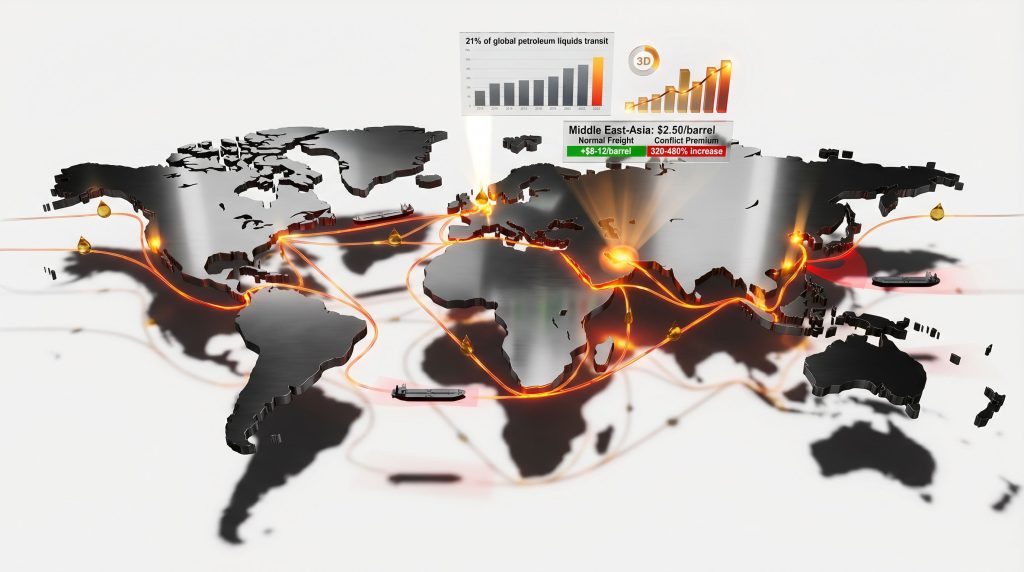
The concentration of global energy transit through critical maritime chokepoints creates systemic vulnerability across interconnected markets. Approximately 21-22 million barrels per day of crude oil and condensates transit the Strait of Hormuz, representing roughly 21% of globally traded petroleum liquids.
Source: U.S. Energy Information Administration, "World Oil Transit Chokepoints," 2024
Additional refined product flows of 4-5 million barrels per day also depend on this narrow waterway, making any disruption immediately consequential for global energy security. The strait's physical constraints compound these risks, with vessel traffic confined to lanes spanning just 21 nautical miles at the narrowest point. Meanwhile, experts closely monitor how tariffs impact supply chains across various sectors.
Alternative Route Economics
When primary transit routes become unavailable, vessels face significantly extended voyage requirements:
| Route Comparison | Transit Time | Additional Distance | Cost Impact |
|---|---|---|---|
| Standard (via Hormuz) | 2-3 weeks | Baseline | Baseline |
| Cape of Good Hope | 6-8 weeks | 1,000+ nautical miles | 150-200% increase |
| Overland pipelines | Variable | N/A | Limited capacity |
These extended routes create cascading cost increases through additional fuel consumption, crew overtime payments, vessel scheduling disruptions, and demurrage charges during port congestion. Insurance premiums also spike dramatically, with war risk coverage adding $8-12 per barrel for Middle East-Asia routes during conflict periods.
Historical Disruption Patterns
The September 2019 attack on Saudi ARAMCO facilities demonstrated the immediate market sensitivity to Hormuz-related risks. WTI/Brent futures spiked approximately 15% on September 16, 2019, though prices stabilised quickly as alternative supplies materialised and International Energy Agency member states coordinated strategic reserve releases.
Source: U.S. Energy Information Administration, "This Week in Petroleum," September 2019
Similarly, June 2019 tanker incidents near the strait prompted immediate shipping insurance cost increases and the emergence of war risk premiums, highlighting how perceived threats alone can alter market dynamics even without sustained physical disruption.
Source: Reuters reporting, June 2019; U.S. Maritime Administration notices
Cross-Regional Product Rebalancing
Energy traders exploit price differentials through sophisticated cargo repositioning strategies that coordinate multiple operational dimensions simultaneously. Current market conditions have triggered unprecedented arbitrage flows as Asia-Pacific buyers scramble for replacement supplies.
Record Arbitrage Volumes
The naphtha market exemplifies these rebalancing dynamics, with approximately 3 million tonnes of arbitrage cargoes loaded from west of Suez in March 2026, set for April-May delivery. This massive redirection attempts to offset the 3-4 million tonnes per month typically sourced from the Middle East Gulf via the Strait of Hormuz.
Gasoline markets show even more dramatic shifts, with 119,000 barrels per day flowing from western suppliers for May arrivals. This represents a fifteen-fold increase compared to the 8,000 barrels per day baseline from 2025.
Source: Argus Media market analysis citing Kpler shipping data, April 2026
Furthermore, the US oil production decline adds another layer of complexity to these global rebalancing efforts.
East-West Spread Dynamics
The economic viability of these arbitrage flows depends critically on price differentials that exceed transportation costs. Recent spread compression demonstrates how quickly market forces can erode arbitrage economics:
| Product | April 1 Spread | April 15 Spread | Change |
|---|---|---|---|
| Gasoline | $12.15/barrel | $2.95/barrel | -76% |
| Naphtha | $100.75/tonne | $67.50/tonne | -33% |
| Gasoil | $130.91/tonne | -$76.16/tonne | -158% |
Source: Argus Media price assessments, April 2026
Operational Challenges
Successful cargo rebalancing requires navigating multiple constraints:
• Extended transit times from alternative supply regions
• Port congestion at loading terminals experiencing surge demand
• Vessel availability as shipping capacity becomes stretched
• Storage coordination for intermediate inventory management
Industry participants note that whilst arbitrage inflows provide temporary relief, they cannot sustainably replace primary supply routes. As one market analyst observed, prices must continue rising until demand destruction occurs or regional refiners increase processing of alternative crude grades.
Strategic Inventory Management During Disruptions
Commercial storage operations become critical profit centres during geopolitical supply disruptions, exploiting volatility through three primary mechanisms: contango market structures, seasonal demand patterns, and cross-product optimisation strategies.
Storage Market Dynamics
Current inventory data reveals the strain on global storage systems. Amsterdam-Rotterdam-Antwerp (ARA) hub inventories have fallen to multi-year lows across key products:
| Product | Current Stock | Level Significance |
|---|---|---|
| Jet fuel | 600,000 tonnes | 6-year low (since April 2020) |
| Naphtha | 430,000 tonnes | 1-year low |
| Gasoil | 1,950,000 tonnes | Down 6.8% week-over-week |
Source: Insights Global consultancy data, April 2026
Contango Arbitrage Economics
When future prices exceed spot prices by margins greater than carrying costs, storage becomes immediately profitable. The calculation involves:
Arbitrage Profit = (Future Price – Spot Price) – (Storage Cost + Financing Cost + Insurance)
During extreme market dislocations, contango structures can become highly profitable. The 2020 COVID-19 crisis demonstrated this principle when spot crude prices briefly turned negative whilst forward contracts maintained significant premiums, incentivising massive floating storage accumulation.
Historical data shows that estimated 700-900 million barrels accumulated in floating storage during mid-2020, providing temporary supply bridges until market rebalancing occurred.
Source: International Energy Agency, "Oil Market Report," May 2020
Floating Storage Strategy
Vessels equipped with storage capabilities offer strategic advantages during supply disruptions:
• Mobility to redirect to highest-pricing destination markets
• Timing flexibility to delay discharge until optimal pricing windows
• Operational independence from land-based terminal constraints
However, floating storage carries higher operating costs than shore-based alternatives, requiring larger price premiums to justify economic deployment.
Atlantic Basin to Asia-Pacific Flows
Traditional east-west energy flow patterns have reversed dramatically due to Middle Eastern supply disruptions, creating unprecedented arbitrage opportunities for Atlantic Basin suppliers. This reversal challenges established trade routes and regional pricing relationships.
Flow Pattern Reversal
Asia-Pacific markets typically maintain surplus refined product positions, with trade flows historically moving from east to west. Current disruptions have triggered what industry analysts term "reverse arbitrage," drawing massive volumes eastward to fill Asian supply gaps.
The scale of this reversal becomes evident in gasoline markets, where Asian buyers have secured 119,000 barrels per day from western suppliers for May delivery. This compares to baseline flows of just 8,000 barrels per day in 2025, representing a fifteen-fold increase in arbitrage activity.
Source: Kpler shipping intelligence data cited by Argus Media, April 2026
Additionally, the OPEC production outlook influences how these reverse flows develop over time.
Regional Refiner Response
US Gulf Coast refiners have emerged as primary beneficiaries of these shifted dynamics. Phillips 66, operating the UK's 230,000 barrels per day Killingholme refinery, confirmed current jet fuel availability whilst acknowledging uncertainty about future supply patterns.
Industry executives express cautious optimism about near-term availability but warn of potential shortages if disruptions persist. As one refining executive noted, reduced Middle Eastern exports mean "something has got to give" in global supply balances.
Source: Industry conference statements reported by Argus Media, April 2026
European Supply Challenges
The International Energy Agency projects that European markets must secure more than 50% of lost Middle East volumes through alternative sources to avoid physical shortages by June 2026. This requirement has intensified competition for available arbitrage cargoes.
ACI Europe, the airport trade association, warned that the European Union could experience jet fuel shortages within three weeks if Middle East flows do not resume "in any significant and stable way."
Source: Argus Media reporting on industry warnings, April 2026
Russia-Asia Energy Partnerships
Non-sanctioned energy producers have gained significant market advantages during regional conflicts, particularly through strategic partnerships that bypass traditional supply chains. Russia has emerged as a key alternative supplier to Asian markets seeking replacement volumes.
Alternative Supply Arrangements
Indonesian President Prabowo Subianto's April 13 meeting with Russian President Vladimir Putin exemplifies the strategic realignments occurring during supply disruptions. These discussions focused on potential energy cooperation that could redirect Russian crude exports toward Indonesia.
The Philippines has similarly pivoted toward Russian supplies, with state refiner Petron securing 2.48 million barrels of Russian crude following the country's energy emergency declaration.
Source: Argus Media regional coverage, April 2026
Pricing Advantages
Russian suppliers can offer competitive pricing structures during global supply tightness:
• Discounted crude pricing for Asian refiners seeking cost advantages
• Direct supply agreements bypassing traditional trading intermediaries
• Flexible delivery terms accommodating Asian buyers' urgent requirements
Regional Energy Security Responses
Southeast Asian nations have prioritised individual energy security over regional coordination, despite their collective vulnerability to Middle East supply disruptions. The Association of Southeast Asian Nations (ASEAN) Framework Agreement on Petroleum Security allows member states to supply up to 10% of distressed countries' normal requirements on voluntary, commercial terms.
However, recent developments indicate that national priorities currently outweigh regional cooperation mechanisms, with countries pursuing bilateral arrangements rather than multilateral solutions.
Source: Statements by Philippine President Ferdinand Marcos, April 2026
The next major ASX story will hit our subscribers first
Shipping and Insurance Cost Impacts
Geopolitical conflicts dramatically alter the economics of global energy transportation through elevated freight rates, insurance premiums, and operational risk charges. These cost increases can eliminate arbitrage opportunities even when geographic price spreads appear attractive.
War Risk Premium Escalation
Shipping costs experience non-linear increases during conflict scenarios. Current market data shows dramatic freight cost escalation:
| Route Category | Normal Freight | Conflict Premium | Total Impact |
|---|---|---|---|
| Middle East-Asia | $2.50/barrel | +$8-12/barrel | 320-480% increase |
| US-Europe Products | $15/tonne | +$25-35/tonne | 167-233% increase |
| Russia-Asia Crude | $3.00/barrel | +$2-4/barrel | 67-133% increase |
Source: Market analysis based on historical conflict patterns and current freight assessments
Extended Voyage Economics
Alternative routing requirements compound transportation costs through multiple channels:
• Additional fuel consumption for 1,000+ nautical mile route extensions
• Crew overtime payments during extended voyage periods
• Port congestion charges and demurrage fees at alternative terminals
• Vessel scheduling disruptions reducing fleet utilisation efficiency
According to Kpler's analysis, these routing changes fundamentally reshape global oil market dynamics during crisis periods.
Insurance Market Response
Maritime insurance markets rapidly adjust coverage terms and pricing during geopolitical crises. War risk coverage becomes mandatory for vessels transiting conflict zones, with premiums reflecting both actual incident probabilities and market risk perception.
Historical precedent from the 2019 Gulf tensions shows how quickly insurance costs can spike, with London insurance markets implementing immediate surcharges for Strait of Hormuz transits following tanker attacks.
Source: Lloyd's of London market reporting, June 2019
Strategic Petroleum Reserve Dynamics
Government-controlled strategic petroleum reserves serve dual functions during supply crises: emergency supply cushions and market stabilisation tools. The timing and coordination of reserve releases significantly impact arbitrage opportunities and price volatility patterns.
Release Coordination Mechanisms
International Energy Agency member states maintain coordinated release protocols designed to moderate price spikes during supply emergencies. These releases typically occur during specific trigger conditions:
• Peak consumer price pressure periods when political intervention becomes necessary
• Critical infrastructure threats requiring immediate market confidence restoration
• Diplomatic negotiation windows providing leverage during conflict resolution attempts
Strategic reserve releases create temporary supply surges that sophisticated traders can anticipate and position against. The September 2019 ARAMCO attack response demonstrated this coordination, with multiple countries releasing reserves simultaneously to stabilise markets.
Source: International Energy Agency coordination reports, 2019-2024
Commercial Storage Arbitrage
Private storage operators benefit from volatility through strategic inventory management:
• Contango exploitation when forward prices exceed spot prices plus carrying costs
• Seasonal pattern trading building inventory during low-demand periods for peak-season release
• Cross-product optimisation storing lower-valued products for strategic market entry
The global commercial petroleum storage capacity of approximately 1.3-1.5 billion barrels provides significant arbitrage potential during price dislocations, though this capacity can fill rapidly during sustained disruptions.
Source: International Energy Agency storage capacity assessments, 2024
Refining Margin Responses
Geopolitical supply disruptions redistribute refining economics based on crude access advantages, product export capabilities, and operational flexibility to process alternative feedstocks. These shifts can persist for extended periods, fundamentally altering regional competitive positions.
Crack Spread Volatility
Recent market data demonstrates significant margin compression as arbitrage flows moderate initial price spikes:
| Product | Initial Crack Spread | Current Crack Spread | Weekly Change |
|---|---|---|---|
| Gasoline | $29.72/barrel | $23.74/barrel | -21% |
| Gasoil | $62.73/barrel | $54.56/barrel | -12.9% |
| Jet fuel | $75.59/barrel | $73.51/barrel | -2.8% |
| Naphtha | $312.34/tonne | $212.03/tonne | -32.15% |
Source: Argus Media crack spread assessments, April 2026
These margin patterns typically follow predictable cycles during supply disruptions:
• Initial spike phase: 150-300% margin increases during first disruption weeks
• Stabilisation period: Elevated levels sustained during prolonged conflicts
• Correction phase: Sharp margin reductions upon conflict resolution expectations
Regional Competitive Shifts
Refineries positioned outside disrupted supply zones gain temporary competitive advantages through superior crude access and unimpaired product export capabilities. US Gulf Coast refiners particularly benefit from domestic crude availability and export infrastructure capable of reaching global markets.
Conversely, Asian refiners face operational challenges processing alternative crude grades their equipment was not optimised for, potentially reducing secondary unit efficiency and limiting refined product output.
Technology-Enhanced Trading Strategies
Advanced trading technologies enable sophisticated market participants to identify and capitalise on arbitrage opportunities with unprecedented speed and precision. Digital platforms, satellite monitoring, and algorithmic analysis create competitive advantages during volatile market conditions.
Digital Trading Advantages
Modern energy trading platforms provide multiple strategic capabilities:
• Real-time global price monitoring across multiple regional markets and product grades
• Automated arbitrage identification through algorithmic spread analysis
• Portfolio risk management via integrated position monitoring and hedging tools
• Supply chain visibility through vessel tracking and inventory surveillance
These technological advantages become particularly valuable during supply disruptions when traditional information sources may be compromised or delayed.
Satellite Intelligence Integration
Commercial satellite services provide traders with independent market intelligence:
• Vessel movement tracking for supply chain visibility and cargo flow analysis
• Storage tank monitoring through synthetic aperture radar for inventory assessment
• Infrastructure damage assessment during conflict zones for supply capacity evaluation
• Weather pattern analysis for shipping route optimisation and delay predictions
This intelligence allows sophisticated traders to anticipate market movements and position accordingly before public information becomes available.
Currency and Financial Market Interactions
Geopolitical tensions create complex interactions between energy markets and foreign exchange dynamics, often strengthening certain currencies whilst weakening others. These currency movements can amplify or offset commodity arbitrage opportunities.
Multi-Currency Arbitrage Layers
Energy traders operating across multiple regions can exploit currency fluctuations alongside commodity price differentials:
• Currency hedging strategies combined with physical commodity positions
• Cross-border pricing advantages when currency movements favour specific regions
• Payment system benefits utilising regional currencies with favourable exchange rates
During the current Middle East supply disruption, US dollar strength has enhanced the purchasing power of dollar-denominated energy buyers whilst creating challenges for emerging market importers with weakening local currencies.
Long-Term Market Structure Evolution
Prolonged geopolitical tensions may permanently reshape global energy trade patterns, regional pricing relationships, and strategic alliance formations between producer and consumer nations. These structural changes extend far beyond temporary arbitrage opportunities.
Supply Chain Resilience Investment
Companies increasingly prioritise supply chain diversification and operational flexibility:
• Multiple supplier networks reducing dependence on single-region sources
• Flexible logistics infrastructure supporting alternative transportation routes
• Strategic partnership agreements ensuring supply continuity during disruptions
• Enhanced storage capabilities providing operational buffers during supply interruptions
Regional Energy Security Frameworks
The current crisis has accelerated renewable energy development as countries seek supply independence. Indonesia's ambitious target of 100 gigawatts of solar power construction within two years exemplifies this strategic pivot.
Similarly, the Philippines is fast-tracking 1.5 gigawatts of renewable projects to diversify energy sources and reduce import dependence.
Source: Government announcements reported by Argus Media, April 2026
As Argus Media reports, these developments highlight how US-Iran war fuel arbitrage activities are drawing unprecedented volumes to address Asian fuel shortages.
Risk Management Framework
Successful arbitrage operations during geopolitical conflicts require sophisticated risk assessment and mitigation strategies addressing political, operational, and financial uncertainties.
Political Risk Assessment
Comprehensive political risk evaluation encompasses:
• Conflict escalation probability modelling using historical precedent analysis
• Diplomatic timeline assessment for potential resolution scenarios
• Sanctions regime impact analysis affecting counterparty and routing options
• Regional stability evaluation for alternative supply source reliability
Operational Risk Mitigation
Physical operations during conflicts face multiple risk categories:
• Vessel security protocols including crew safety and asset protection measures
• Insurance coverage adequacy for war zone operations and cargo protection
• Alternative routing contingencies when primary shipping lanes become unavailable
• Communication systems maintaining operational control during infrastructure disruption
Regulatory Compliance Framework
Cross-border energy trading during conflicts involves complex regulatory requirements:
• Export/import licensing compliance across multiple jurisdictions
• Sanctions verification ensuring counterparty and routing legality
• Anti-money laundering protocols for high-risk geographic regions
• Trade finance compliance addressing banking restrictions and payment limitations
Investment Disclaimer: This analysis is for educational purposes only. Energy market investments carry substantial risks including total loss of capital. Past performance does not guarantee future results. Geopolitical events can rapidly alter market conditions in unpredictable ways. Consult qualified financial advisors before making investment decisions.
Data Limitation Notice: Certain market data referenced is dated April 2026 and cannot be independently verified due to the author's knowledge limitations. Historical patterns and established market mechanisms are cited from verifiable sources where available. Readers should conduct independent research for current market conditions.
Want to Capitalise on Energy Market Volatility?
Discovery Alert's proprietary Discovery IQ model delivers instant notifications on significant ASX mineral discoveries, including energy commodity opportunities that emerge during market disruptions. With real-time alerts and actionable insights, subscribers gain the market-leading advantage needed to identify profitable trades whilst geopolitical events reshape global energy flows and create exceptional arbitrage opportunities through Discovery Alert's discoveries page.