July 18, 2026
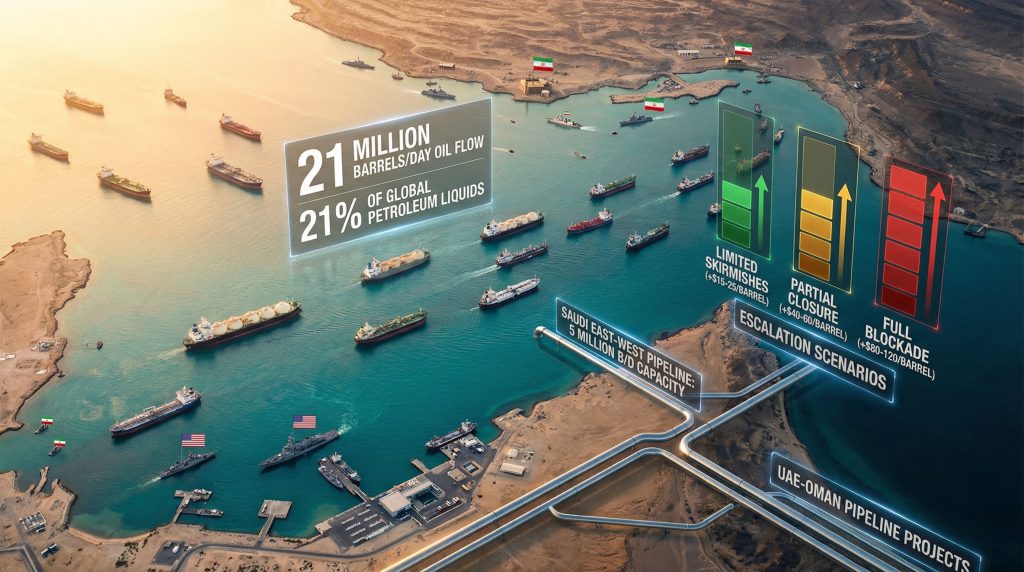
Global energy markets are governed by a complex web of strategic chokepoints, with the 33-kilometre Strait of Hormuz representing perhaps the most critical vulnerability in international oil and gas flows. This narrow waterway between the Persian Gulf and the Arabian Sea has become a focal point for geopolitical tension, with potential military escalation between the United States and Iran threatening to reshape global energy security dynamics fundamentally. A US-Iran war in Hormuz Strait would have catastrophic implications for global energy supplies.
The implications extend far beyond immediate supply disruptions, potentially triggering cascading effects across international commodity markets, supply chains, and economic stability frameworks worldwide. Understanding the multifaceted scenarios that could unfold requires examining not only the immediate military and economic consequences but also the long-term structural changes that sustained conflict could impose on global energy infrastructure and trading patterns.
Understanding the Critical Maritime Gateway
The Strait of Hormuz controls approximately 17 million barrels per day of oil exports, comprising roughly 14 million barrels of crude oil and condensate alongside 3 million barrels of refined petroleum products. This volume represents a substantial portion of global petroleum liquids trade, with the waterway serving as the primary export route for major Gulf producers including Saudi Arabia, UAE, Kuwait, and Iraq.
Liquefied natural gas transit through Hormuz accounts for a significant share of global LNG trade, though the concentration varies seasonally based on Asian demand patterns and alternative supply routes. The strategic importance becomes evident when considering that major Asian economies rely heavily on these energy flows, with countries like Japan importing over 90% of their energy needs and China depending on Gulf crude for approximately 40% of its oil imports.
The geographic constraints of the strait create inherent vulnerabilities for large vessel traffic. Very Large Crude Carriers (VLCCs) must navigate through designated shipping channels, with depth and width limitations creating natural bottlenecks during periods of heightened security concerns. Furthermore, current shipping patterns show that only a handful of oil tankers have successfully transited Hormuz since recent tensions escalated, with most commercial operators expressing unanimous reluctance to risk vessel transit through the waterway.
Critical Infrastructure Specifications:
• VLCC capacity requirements and navigation constraints
• Maximum vessel dimensions for safe transit
• Alternative routing capacity limitations
• Strategic petroleum storage locations
• Emergency response protocols for supply disruption
The operational reality demonstrates how quickly commercial shipping can be impacted by security concerns, even before actual military engagement occurs. In addition, Saudi Aramco has already begun rerouting crude flows to the Red Sea port of Yanbu, loading unladen VLCCs with alternative supply arrangements to bypass Hormuz entirely during periods of elevated risk.
When big ASX news breaks, our subscribers know first
Military Escalation Scenarios and Naval Capabilities
Intelligence assessments indicate Iran maintains approximately 6,000 naval mines as of 2025, according to Congressional Research Service reporting. This mining capability represents one of several asymmetric naval warfare tools that could be deployed to disrupt shipping lanes, alongside fast attack craft and coastal missile systems designed to target commercial vessels.
The complexity of potential military responses varies significantly based on escalation intensity. Limited skirmishes involving selective vessel targeting could maintain partial shipping flows while creating substantial risk premiums. However, more extensive mining operations would require comprehensive minesweeping efforts, with historical precedents suggesting such operations could take several months to complete effectively.
Naval Warfare Assessment Framework:
| Scenario Type | Duration Estimate | Shipping Impact | Military Requirements |
|---|---|---|---|
| Limited Engagement | 2-4 weeks | 70-80% flow reduction | Enhanced patrol presence |
| Partial Blockade | 1-3 months | 90-95% flow halt | Full minesweeping operations |
| Sustained Conflict | 3-6 months | Complete closure | Coalition naval deployment |
US Fifth Fleet positioning in the region provides substantial force projection capabilities, though military leadership acknowledges ongoing assessments regarding escort operation feasibility. General Dan Caine indicated that resource requirements, command structures, and risk mitigation approaches remain under evaluation, suggesting that sustained naval escort operations face significant logistical and strategic challenges.
The documented attacks on tankers across the Middle East Gulf demonstrate operational asymmetric capabilities, with at least eight recorded drone and missile attacks occurring during recent escalation periods. These incidents illustrate how naval warfare in confined waters differs substantially from open-ocean engagement, with commercial vessels becoming primary targets in economic warfare strategies.
Tanker shipowners universally express reluctance to transit Hormuz despite offers of naval protection, indicating that private sector confidence in safe passage remains extremely low. Consequently, this commercial risk assessment often proves more decisive than military guarantees in determining actual shipping flows during conflict periods.
Energy Market Volatility and Price Dynamics
Recent market movements demonstrate the extreme volatility potential when Hormuz transit becomes threatened. NBC News reports on how crude prices surged from approximately $65 per barrel in late February to nearly $120 per barrel within a ten-day period, representing an 85% price increase that exceeded most volatility modelling scenarios.
The subsequent 12% single-day decline in Nymex WTI & Brent futures to around $83 per barrel illustrated the rapid price reversals possible when de-escalation signals emerge. This represented the largest four-year decline, indicating how quickly risk premiums can be both applied and removed based on perceived conflict trajectory changes.
Documented Price Movements:
• WTI Futures: $65/barrel to $120/barrel peak (85% increase)
• Single-Day Decline: 12% drop to $83/barrel
• Mars Crude Premium: $8+ per barrel daily swing
• Medium Sour Grades: Multi-year highs followed by sharp reversals
• Retail Diesel: Record increases approaching $5 per gallon
The US Energy Information Administration revised its WTI forecasts substantially, projecting $84.56 per barrel for the second quarter 2026, representing a $30.91 per barrel upward revision from February forecasts. Full-year 2026 WTI projections increased to $73.61 per barrel from the previous $53.42 per barrel estimate.
Brent crude forecasting similarly shows dramatic adjustments, with second-quarter projections at $90.56 per barrel before anticipated declines to $70 per barrel by year-end. The full-year Brent average forecast reached $78.84 per barrel, reflecting sustained risk premium expectations even after potential conflict resolution.
Quality differentials experienced extreme volatility, with Mars crude premiums swinging from $13.80 per barrel to $2.40 per barrel within trading sessions. These movements reflect how crude grade specifications become critically important when alternative supply sources must replace Gulf production streams.
The EIA assumes shut-in oil production in the Middle East will peak in early April, but risk premiums will persist in an evolving and uncertain environment.
Downstream product markets showed corresponding impacts, with benzene and styrene monomer prices increasing 17% due to petrochemical feedstock concerns. For instance, US retail diesel prices reached record levels near $5 per gallon, while jet fuel price forecasts were revised upward significantly due to aviation fuel supply concerns.
Supply Chain Disruption Analysis
Industrial manufacturing faces dual pressures from both direct energy cost increases and chemical feedstock disruptions. The 17% increase in benzene and styrene monomer prices demonstrates how petrochemical supply chains experience immediate impact from Gulf region disruptions, affecting plastics production, synthetic materials, and industrial chemical processes.
Primary Sector Vulnerabilities:
• Petrochemical Production: Feedstock shortage scenarios affecting polymer manufacturing
• Aviation Industry: Jet fuel supply constraints impacting airline operations globally
• Agricultural Sector: Fertiliser supply disruptions threatening food security systems
• Transportation Networks: Diesel fuel scarcity affecting freight and logistics operations
• Industrial Manufacturing: Energy cost escalation pressuring production economics
Base oil markets demonstrate how specialised industrial products experience supply pressure, with global shortages pushing up Group III base oil prices substantially. These industrial lubricants are essential for machinery operations across multiple sectors, creating cascading effects through manufacturing supply chains.
Methanol markets showed 6.5 cents per gallon increases, indicating chemical commodity price pressures extending beyond crude oil derivatives. This affects industries ranging from plastics manufacturing to pharmaceutical production, where methanol serves as a critical chemical building block.
The fertiliser industry faces particular vulnerability due to heavy reliance on hydrocarbon feedstocks for ammonia production. While specific fertiliser price data during recent conflicts remains limited, the sector's dependence on stable energy supplies creates significant food security implications for agricultural production worldwide.
Steel production experiences both direct energy cost impacts and operational disruptions, with European mills implementing price increases for steel sections. Additionally, coke calcining operations in Kuwait faced complete shutdowns, demonstrating how regional industrial facilities become directly impacted by conflict conditions.
How Would Military Action Affect Global Energy Security?
A US-Iran war in Hormuz Strait would fundamentally alter global energy security frameworks. Regional power dynamics face substantial restructuring as traditional energy trade routes become unreliable. Saudi Arabia's strategic positioning becomes critically important as the kingdom can redirect substantial volumes through Red Sea terminals, potentially altering long-established trading relationships and regional influence patterns.
The UAE's role as a neutral trading hub could see accelerated development, with infrastructure investments in alternative pipeline routes and storage facilities gaining strategic priority. Furthermore, Qatar's LNG export capabilities may experience increased demand as alternative natural gas supplies become essential for Asian markets.
Strategic Response Patterns:
• Alliance Coordination: NATO consultation mechanisms and collective response frameworks
• Economic Partnerships: China-Russia energy cooperation deepening during supply disruptions
• Regional Positioning: Gulf state neutral port development acceleration
• Trade Route Diversification: Central Asian pipeline development gaining urgency
China's energy security concerns could drive accelerated cooperation with Russia and Central Asian producers, potentially reshaping long-term energy partnership structures. This shift may reduce Chinese dependence on Gulf supplies whilst strengthening alternative supply relationships that persist beyond immediate conflict resolution.
India's strategic autonomy faces testing under energy supply pressure, as the country must balance traditional supplier relationships with immediate energy security needs. This could influence long-term procurement strategies and diplomatic positioning in regional conflicts.
Considering OPEC production impact, the organisation's coordination mechanisms become critically important for managing production adjustments during crisis periods. The OPEC market influence in coordinating emergency supply increases from non-Gulf producers could determine global market stability during extended disruption periods.
Infrastructure Development and Alternative Routes
Existing bypass infrastructure provides limited immediate alternatives to Hormuz transit. The Saudi East-West Pipeline offers approximately 5 million barrels per day capacity, though full utilisation would require significant operational adjustments and cannot fully replace Hormuz volumes.
Current Alternative Capacity:
| Route | Capacity | Utilisation Status | Development Timeline |
|---|---|---|---|
| Saudi East-West Pipeline | 5 million b/d | Partial utilisation | Immediate activation |
| UAE-Oman Projects | Under development | Planning stage | 2-3 years |
| Iran Goreh-Jask Pipeline | 3.5 million b/d | Unused capacity | Political barriers |
| Central Asian Routes | Variable | Limited capacity | 5+ years |
The Iran Goreh-Jask Pipeline represents substantial unused capacity at 3.5 million barrels per day, though political and sanctions constraints prevent activation under current conditions. This infrastructure demonstrates how geopolitical factors can render significant capacity unavailable during crisis periods.
Floating storage deployment provides emergency response capability, with commercial vessels serving as temporary storage during supply disruption periods. However, this approach faces limitations in vessel availability and storage costs that escalate rapidly during extended conflicts.
Strategic petroleum reserve coordination becomes essential for managing supply gaps during transition periods. The effectiveness of these reserves depends on international cooperation mechanisms and coordinated release strategies that prevent market panic whilst ensuring adequate supply coverage.
Emergency LNG supply chain activation requires complex coordination between producers, shipping companies, and receiving terminals. In addition, the technical requirements for LNG transport differ substantially from crude oil, creating separate infrastructure constraints that must be addressed independently.
The next major ASX story will hit our subscribers first
What Are the Investment Strategy Implications?
Energy security premiums are becoming integrated into long-term investment frameworks, with renewable energy projects gaining accelerated development timelines due to supply security concerns. This transition reflects not only environmental considerations but also strategic independence from volatile supply regions.
Investment Reallocation Patterns:
• Infrastructure Redundancy: Pipeline and storage facility development prioritisation
• Technology Acceleration: Energy storage and renewable deployment expansion
• Geographic Diversification: Domestic production incentive programme implementation
• Supply Chain Resilience: Alternative sourcing mechanism development
Long-term contract preferences in LNG markets reflect how buyers seek stability during periods of supply uncertainty. These agreements provide supply security whilst creating more predictable cash flows for producers, though often at premium pricing compared to spot market arrangements.
Commodity trading patterns show geographic redistribution away from traditional Gulf-centred hubs toward more diversified trading locations. Physical oil trading may increasingly concentrate in regions with reliable supply access and reduced geopolitical risk exposure.
Financial derivative markets experience increased volatility during conflict periods, requiring enhanced risk management approaches for energy traders and consumers. Insurance premiums for tanker operations reflect heightened risk assessments that persist beyond immediate conflict resolution.
The US production response demonstrates how elevated crude prices create incentives for increased domestic output, with the EIA projecting US production increases that reverse previous decline forecasts. Consequently, this domestic production acceleration helps offset international supply disruptions whilst reducing import dependence.
Risk Monitoring and Early Warning Systems
Naval deployment pattern analysis provides early indicators of potential escalation, with satellite monitoring of fleet movements offering advance warning of military buildup activities. Reuters reports on how these patterns often precede actual engagement by several weeks, providing time for supply chain adjustments.
Escalation Indicators:
• Military Positioning: Naval fleet deployment and exercise patterns
• Commercial Behaviour: Shipping traffic flow changes and routing decisions
• Market Signals: Insurance premium adjustments and futures curve movements
• Diplomatic Activity: International mediation frequency and multilateral coordination
Insurance premium tracking serves as a reliable risk barometer, with tanker war risk premiums often providing more accurate conflict probability assessments than political analysis. These commercial risk evaluations incorporate operational intelligence unavailable through public sources.
Energy price volatility thresholds offer quantified metrics for crisis management, with predetermined response triggers enabling automatic activation of emergency supply protocols. Strategic reserve drawdown rates provide additional monitoring capabilities for assessing crisis severity and duration expectations.
International cooperation effectiveness evaluation becomes essential for determining long-term crisis management capabilities. The success of multilateral coordination mechanisms during initial crisis periods often predicts their effectiveness during extended conflict scenarios.
Market Response Patterns
Alternative route utilisation capacity measurement provides real-time assessment of supply chain adaptation effectiveness. Monitoring actual throughput versus theoretical capacity reveals operational constraints that may not be apparent in planning scenarios.
The complexity of oil price crash dynamics demonstrates how quickly markets can shift when geopolitical tensions escalate or de-escalate. Furthermore, understanding trade war oil impacts provides context for how broader economic conflicts intersect with energy security concerns during periods when a US-Iran war in Hormuz Strait becomes a realistic possibility.
Investment and energy security decisions should consider multiple scenarios and professional risk assessment. Market conditions in conflict zones remain highly volatile and subject to rapid change based on geopolitical developments.
Are You Monitoring Critical Energy Supply Chain Vulnerabilities?
Discovery Alert's proprietary Discovery IQ model delivers real-time alerts on significant ASX mineral discoveries, instantly empowering subscribers to identify actionable opportunities in energy security and resource sectors ahead of the broader market. Understanding how major discoveries can drive substantial returns becomes crucial when geopolitical tensions reshape global supply chains, which is why Discovery Alert's dedicated discoveries page showcases historic examples of exceptional investment outcomes during market uncertainty.