June 17, 2026
The US-Israel military strikes on Iran have created significant financial market volatility, demonstrating how geopolitical conflicts reshape global investment landscapes. Understanding these dynamics becomes crucial as gold prices record highs whilst traditional risk assets face pressure from escalating tensions.
What Are the Economic Implications of Escalating Middle East Military Tensions?
The economic ramifications of military escalation extend far beyond immediate regional boundaries, creating ripple effects through interconnected global systems. Energy markets, safe-haven assets, and currency relationships undergo rapid repricing as investors reassess risk-return profiles across asset classes.
Oil Market Volatility and Energy Security Concerns
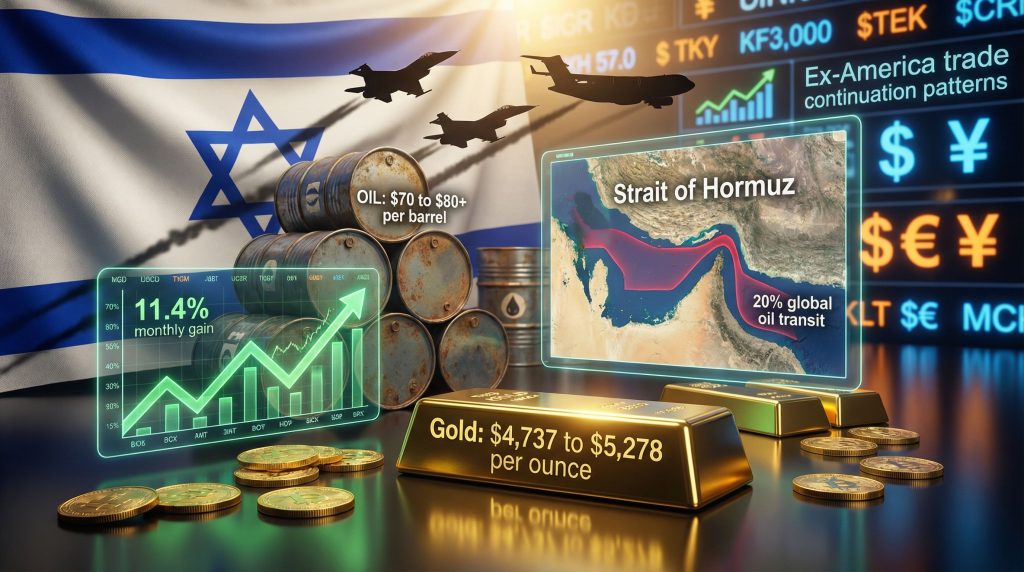
Energy market disruption represents the most immediate transmission mechanism through which Middle Eastern conflicts impact global economic conditions. The Strait of Hormuz serves as a critical chokepoint for global energy security, with approximately 20% of global oil transit flowing through this narrow waterway. During the February 2026 escalation, Brent crude prices surged from $70 to over $80 per barrel within days, representing a 14% price shock that rippled through global supply chains.
Furthermore, the oil price rally impact on global markets demonstrates how energy volatility creates multiple downstream effects:
• Transportation cost increases affecting goods distribution globally
• Manufacturing input cost pressures reducing profit margins
• Consumer price inflation through energy pass-through mechanisms
• Central bank policy complications balancing growth versus inflation concerns
The speed of energy market repricing during crisis periods reflects the concentrated nature of global oil infrastructure. Alternative routing through the Suez Canal or overland pipelines involves significantly longer transit times and higher logistics costs, creating supply elasticity constraints that amplify price volatility during disruption scenarios.
Safe-Haven Asset Migration Patterns
Crisis periods trigger systematic asset reallocation toward instruments perceived as store-of-value alternatives. Gold experienced remarkable performance during February 2026, advancing from approximately $4,737 to $5,278 per ounce, representing an 11.4% monthly gain. This performance extended gold's exceptional run, with the precious metal gaining more than 70% over the preceding 12 months.
Safe-haven migration patterns during the US-Israel military strikes on Iran demonstrated several key characteristics:
| Asset Class | Performance Pattern | Duration Risk |
|---|---|---|
| Gold | Strong appreciation (+11.4% monthly) | Low correlation to interest rates |
| Government Bonds | Yield compression in developed markets | Duration sensitivity varies by maturity |
| US Dollar | Counterintuitive weakness | Complex safe-haven dynamics |
| Cryptocurrencies | Mixed correlation patterns | High volatility during traditional rallies |
The USD weakness during the crisis period created additional complexity, as traditional safe-haven currency dynamics conflicted with domestic policy uncertainties. This divergence provided currency translation benefits for internationally diversified investors holding non-US assets, amplifying returns through foreign exchange appreciation.
When big ASX news breaks, our subscribers know first
How Do Military Conflicts Reshape Global Investment Flows?
Military conflicts catalyse structural shifts in capital allocation patterns, accelerating trends that might otherwise develop gradually over extended periods. However, these shifts reflect both defensive positioning and opportunistic capital deployment toward sectors positioned to benefit from increased defence spending and infrastructure investment.
Defence Sector Investment Opportunities
European rearmament spending has begun translating into measurable corporate earnings growth, with defence contractors experiencing unprecedented order flow acceleration. Rolls-Royce delivered a 40% year-on-year earnings increase during the February 2026 reporting period, exemplifying how geopolitical tensions convert into tangible profit expansion for aerospace and defence companies.
In addition, defence sector investment themes encompass multiple sub-categories:
- Aerospace Engines: Military aircraft propulsion systems seeing accelerated procurement
- Electronics and Avionics: Advanced guidance and communication systems demand
- Shipbuilding and Marine Systems: Naval capacity expansion requirements
- Cybersecurity and Intelligence: Digital defence infrastructure investment
- Dual-Use Technologies: Commercial applications with military relevance
The defence sector's structural profitability improvement reflects reduced customer price sensitivity during geopolitical urgency periods. Military procurement decisions prioritise capability delivery over cost optimisation, creating pricing power dynamics absent from typical commercial markets.
Regional Market Divergence Analysis
The "Ex-America" trade continuation represents one of the most significant structural market themes emerging from recent geopolitical developments. According to BBC's analysis of global market reactions, global equities outside the US posted solid advances despite uncertainty, while the S&P 500 declined 0.8% during February 2026. This divergence reflects fundamental valuation differentials and fiscal policy trajectories.
European equity outperformance stems from multiple convergent factors:
• Fiscal stimulus programmes in defence and infrastructure showing corporate earnings impact
• Valuation discounts relative to US counterparts creating value opportunities
• Currency translation benefits from USD weakness amplifying returns
• Defensive characteristics of dividend-paying large-cap stocks attracting institutional capital
The FTSE 100's resilience, maintaining near-record levels after breaking 10,000 for the first time in January 2026, demonstrates how defensive equity characteristics provide portfolio stability during volatile periods. Large-cap dividend-yielding stocks offer income cushion while maintaining international revenue exposure that benefits from currency diversification.
What Role Do Central Bank Policies Play During Geopolitical Crises?
Central bank decision-making during geopolitical crises involves complex balancing acts between financial stability, inflation control, and economic growth support. Consequently, the Federal Reserve's policy impact during such periods creates currency volatility and affects cross-border capital flows significantly.
Interest Rate Policy Recalibration
The Bank of England's February 5, 2026 decision highlighted central bank policy uncertainty during crisis periods. The 5-4 vote split to maintain rates at 3.75% proved more dovish than the 7-2 split most economists had forecast, with four members favouring immediate 25 basis point cuts. This close voting pattern signals significant internal disagreement about appropriate policy responses to geopolitical developments.
Market expectations for BoE rate cuts currently price one to two quarter-point reductions in 2026, potentially bringing base rates to the 3.25% – 3.5% range by year-end. The April meeting represents the most probable timing for the next reduction, contingent on inflation trajectory maintenance and geopolitical stability.
European Central Bank positioning involves different considerations, holding the deposit rate at 2.0% during February meetings. However, renewed energy price pressures from the Iran conflict complicate inflation projections across the eurozone, potentially constraining further monetary easing despite economic growth concerns.
Inflation Trajectory Modifications
UK inflation showed meaningful deceleration, with CPI dropping from 3.4% in December 2025 to 3.0% in January 2026. The Bank of England now projects inflation returning to the 2% target by June 2026, representing a significantly earlier timeline than the previous Q2 2027 forecast.
Energy price volatility creates asymmetric inflation risks:
Upside Risks: Prolonged energy price elevation feeding through to core goods and services inflation, potentially derailing central bank disinflationary progress.
Downside Risks: Demand destruction from energy price shocks reducing broad-based inflationary pressures beyond energy components.
The transmission mechanism timing varies significantly across economies. UK inflation sensitivity to energy prices occurs more rapidly due to energy market liberalisation, while eurozone transmission involves longer lags through regulated utility pricing structures.
How Do Trade Policy Disruptions Amplify Geopolitical Tensions?
Trade policy uncertainty compounds geopolitical instability by creating additional vectors for economic conflict and supply chain disruption. For instance, the tariffs impact on investments demonstrates how domestic legal decisions influence international economic relationships.
Supreme Court Trade Authority Limitations
The February 20 Supreme Court ruling striking down International Emergency Economic Powers Act tariff authority created immediate policy uncertainty. The 6-3 decision eliminated broad tariff powers, prompting President Trump's swift response with a 10% global tariff under Section 122 of the Trade Act of 1974, effective from February 24.
This legal and policy sequence illustrates several critical dynamics:
• Executive power limitations in trade policy implementation during crisis periods
• Alternative legal authorities available for trade restriction implementation
• Rapid policy response capabilities when primary authorities face judicial challenges
• International relationship complications from unpredictable trade policy shifts
For UK and European businesses, these developments represent partial easing compared to peak tariff regimes, though uncertainty remains elevated regarding future escalation possibilities, particularly if geopolitical tensions continue expanding.
Economic Sanctions Framework Evolution
Financial system isolation mechanisms have evolved significantly beyond traditional trade restrictions. Modern sanctions frameworks target:
- SWIFT payment system access restricting international financial transactions
- Central bank reserves limiting sovereign monetary policy effectiveness
- Commodity export channels disrupting revenue sources for target nations
- Technology transfer restrictions affecting military and civilian capabilities
Alternative payment systems development accelerates during sanctions periods, with affected nations investing in SWIFT alternatives and bilateral currency arrangements. These developments potentially fragment global financial architecture over extended periods.
What Are the Portfolio Management Implications of Regional Conflicts?
Portfolio construction during geopolitical uncertainty requires balancing defensive positioning with opportunistic exposure to sectors benefiting from crisis-related spending increases. February 2026 demonstrated the value of genuine diversification across asset classes, geographic regions, and currency exposures.
Diversification Strategy Optimisation
Multi-asset portfolio performance during February 2026 highlighted diversification benefits that extend beyond simple correlation reduction. While US equities declined 0.8%, portfolios with meaningful exposure to global equities and gold captured strong returns through multiple complementary mechanisms:
• Geographic diversification reducing single-country policy risk exposure
• Currency diversification providing translation gains during USD weakness
• Asset class diversification balancing growth assets with safe-haven alternatives
• Sector diversification capturing defence spending themes while limiting concentration risk
Professional portfolio management approaches demonstrated particular value during this period. Smart Portfolio strategies with automatic rebalancing maintained target allocations while capturing momentum from outperforming asset classes, demonstrating systematic approach advantages over discretionary portfolio management during volatile periods.
Sector Rotation Dynamics
Value outperformed growth within US markets, consistent with historical patterns during geopolitical stress periods. Value stocks typically demonstrate superior crisis performance due to:
• Shorter earnings duration reducing terminal value sensitivity
• Higher current dividend yields providing income stability
• Lower valuation multiples offering downside protection
• Cyclical exposure benefiting from defence and infrastructure spending
Momentum strategies rebounded across most regions following initial crisis-driven reversals, suggesting that trend-following approaches maintain effectiveness once markets establish new directional biases during extended uncertainty periods.
How Do Geopolitical Events Impact Long-Term Investment Themes?
Geopolitical crises often accelerate structural investment themes that were developing gradually, creating both risks and opportunities for long-term investors. Energy transition, infrastructure investment, and supply chain resilience emerge as dominant themes requiring capital allocation adjustments.
Energy Transition Acceleration Factors
Energy independence strategic priorities gain urgency during supply disruption periods, potentially accelerating renewable energy investment and critical minerals strategy development. Governments facing energy security threats typically increase support for domestic energy production capabilities, including both traditional and renewable sources.
Critical mineral supply chain security becomes particularly relevant as electric vehicle adoption and renewable energy infrastructure require lithium, cobalt, rare earth elements, and other materials with concentrated geographic production patterns. Supply diversification efforts require substantial capital investment and extended development timelines.
Infrastructure Investment Priorities
Defence infrastructure spending increases encompass multiple categories beyond traditional military procurement:
| Infrastructure Category | Investment Drivers | Timeline |
|---|---|---|
| Transportation Networks | Supply chain resilience requirements | 5-10 years |
| Communication Systems | Cybersecurity and intelligence capabilities | 3-5 years |
| Energy Infrastructure | Independence and redundancy priorities | 10-20 years |
| Manufacturing Capacity | Strategic industry onshoring | 5-15 years |
These infrastructure investment requirements create long-term secular themes for equity investors, particularly in construction, engineering, technology, and materials sectors positioned to benefit from increased government and corporate capital spending.
The next major ASX story will hit our subscribers first
What Are the Systemic Risk Implications for Global Markets?
Systemic risk assessment during geopolitical crises requires understanding potential cascading effects through interconnected financial systems. Banking sector exposures, insurance industry claims, and credit market liquidity represent key monitoring priorities for financial stability authorities.
Financial System Stability Measures
Banking sector exposure assessment involves multiple risk vectors during geopolitical escalation:
• Geographic lending exposure to affected regions creating potential credit losses
• Energy sector financing vulnerable to commodity price volatility
• Foreign exchange exposure through international operations and funding
• Counterparty risk from financial institution interconnectedness
Credit market liquidity typically deteriorates during crisis periods as risk appetite declines and bid-ask spreads widen across fixed-income markets. Corporate bond markets experience particular stress when underlying business fundamentals face uncertainty from supply chain disruption or demand destruction.
Economic Growth Trajectory Adjustments
Consumer confidence deterioration creates feedback loops affecting economic growth through reduced spending, delayed major purchases, and increased savings rates. Business investment postponement amplifies these effects as capital formation declines during uncertainty periods.
International trade volume contractions occur through multiple channels:
- Direct disruption of shipping routes through conflict zones
- Insurance cost increases for cargo and vessels travelling through affected regions
- Supply chain diversification reducing efficiency in favour of resilience
- Inventory building by businesses seeking buffer stock against disruption
These adjustments typically persist beyond immediate crisis resolution periods, creating lasting effects on global trade patterns and economic growth trajectories.
How Should Investors Position for Extended Geopolitical Uncertainty?
Extended geopolitical uncertainty periods require portfolio positioning strategies that balance defensive characteristics with opportunities emerging from crisis-related spending and market dislocations. Risk management frameworks must incorporate both traditional correlation breakdowns and unique crisis-specific factors.
Risk Management Framework Enhancement
Volatility hedging strategies become particularly valuable during geopolitical uncertainty, though implementation complexity increases as traditional correlation relationships deteriorate. Correlation breakdown preparation requires scenario analysis incorporating multiple simultaneous stress factors rather than single-variable stress testing.
Liquidity preservation priorities extend beyond cash holdings to include:
• High-quality government bond exposure providing liquidity and capital preservation
• Money market fund diversification across multiple currency denominations
• Credit facility maintenance ensuring financing availability during market stress
• Portfolio rebalancing capacity maintaining dry powder for opportunistic deployment
Stress testing scenarios should incorporate compound events rather than single-factor shocks, recognising that geopolitical crises often coincide with other market disruptions creating non-linear risk profiles.
Opportunity Identification Methodologies
Dislocation-driven value creation emerges as high-quality assets experience temporary price depression due to forced selling or generalised risk aversion. Systematic approaches to opportunity identification include:
• Valuation screening for fundamentally sound companies trading at historical discounts
• Sector rotation timing capturing performance leadership shifts during crisis evolution
• Geographic allocation adjustment toward regions offering superior risk-adjusted returns
• Currency positioning exploiting exchange rate dislocations and central bank policy divergence
Technology innovation acceleration often occurs during crisis periods as governments and corporations invest in capabilities addressing newly identified vulnerabilities. Artificial intelligence, cybersecurity, autonomous systems, and advanced materials represent areas receiving accelerated development funding during security-focused periods.
What Does the Future Hold for Regional Stability?
The ongoing conflict developments suggest that the US-Israel military strikes on Iran represent a broader shift in Middle Eastern geopolitical dynamics. These changes will likely persist beyond immediate resolution, creating lasting implications for global investment strategies.
Regional stability assessment requires monitoring multiple interconnected factors that extend beyond military actions to include economic sanctions effectiveness, alliance relationship evolution, and energy infrastructure resilience.
The February 2026 experience with the US-Israel military strikes on Iran demonstrates how geopolitical events create both immediate market disruption and lasting structural changes affecting long-term investment landscapes. Successful navigation requires combining defensive positioning with opportunistic capital deployment, maintaining portfolio flexibility while preserving downside protection capabilities.
This analysis is for informational purposes only and should not be considered investment advice. Past performance does not guarantee future results. Geopolitical events involve significant uncertainties and outcomes may differ materially from current expectations. Investors should conduct thorough due diligence and consider their individual risk tolerance before making investment decisions.
Looking to Navigate Geopolitical Investment Opportunities?
Discovery Alert's proprietary Discovery IQ model delivers real-time alerts on significant ASX mineral discoveries, helping investors identify actionable opportunities that often emerge during market volatility and geopolitical uncertainty. With critical minerals becoming increasingly important for energy transition and supply chain security, explore Discovery Alert's discoveries page to understand how historic mineral discoveries have generated substantial returns, and begin your 14-day free trial today to position yourself ahead of the market.