July 21, 2026
Energy market volatility has reached unprecedented levels as global supply chains face disruption from geopolitical tensions across multiple regions. The intersection of strategic resource control, transportation bottlenecks, and financial market psychology creates cascading effects that extend far beyond crude oil pricing. Understanding these transmission mechanisms becomes critical for investors, policymakers, and businesses navigating an increasingly complex energy landscape. The US-Israel war with Iran impact on oil prices has become a defining factor in global market dynamics.
Strategic Chokepoints and Global Energy Architecture
Maritime transportation routes serve as the backbone of global energy distribution, with certain passages carrying outsized importance for worldwide economic stability. The concentration of oil transit through narrow waterways creates inherent vulnerabilities that amplify during periods of regional conflict.
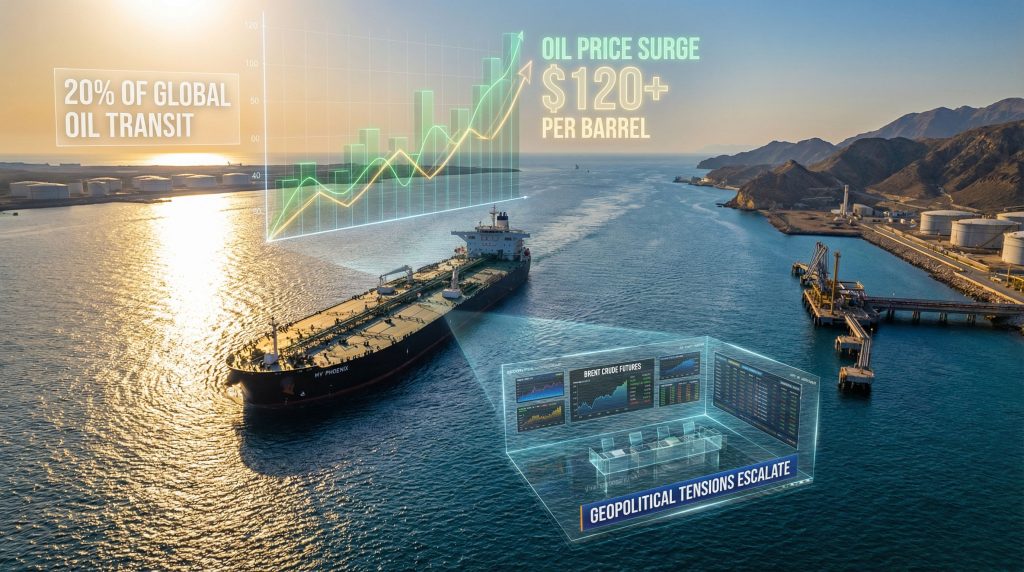
Recent market events demonstrate this vulnerability in stark terms. WTI crude prices surged from approximately $65 per barrel in late February 2026 to nearly $120 per barrel by March 9, representing an 85% increase within roughly two weeks. This dramatic price movement occurred as comprehensive oil price rally analysis revealed the complex factors driving these extraordinary fluctuations.
The Strait of Hormuz exemplifies strategic chokepoint economics, where geography creates leverage disproportionate to territorial size. Industry analysts note that approximately one-fifth of global oil transit depends on this narrow passage, making it a critical pressure point during regional conflicts. Furthermore, the US oil production decline compounds these supply concerns as domestic output faces its own structural challenges.
Insurance Markets and Risk Premium Calculations
The maritime insurance sector provides early signals of geopolitical risk escalation through premium adjustments. Tanker operators speaking at a New York shipping forum unanimously agreed they would not operate vessels through the Strait of Hormuz under current security conditions, indicating complete market rejection of transit risk.
This unanimous industry position demonstrates how risk assessment transcends government assurances or diplomatic statements. When commercial operators withdraw from routes, physical supply constraints become inevitable regardless of theoretical production capacity. Moreover, the geopolitical tensions drive oil price surge as markets struggle to price unprecedented risk scenarios.
Alternative routing options carry significant cost implications. Vessels redirected around the Cape of Good Hope face extended transit times and higher fuel consumption, effectively reducing global shipping capacity and increasing delivered crude costs even for non-Middle Eastern supplies.
Historical Precedent Analysis
Comparing current events to previous oil market disruptions reveals distinct patterns in price response and recovery timelines. The 1973 Arab oil embargo demonstrated how coordinated supply restrictions could quadruple oil prices within months, while the 1991 Gulf War showed how swift military resolution could limit sustained price impacts.
The following table illustrates major oil supply disruptions and their market impacts:
| Event | Year | Peak Price Increase | Duration | Recovery Timeline |
|---|---|---|---|---|
| Arab Oil Embargo | 1973 | 300%+ | 6 months | 2 years |
| Iranian Revolution | 1979 | 150% | 12 months | 18 months |
| Gulf War | 1991 | 100% | 3 months | 6 months |
| Iraq War | 2003 | 75% | 2 months | 8 months |
| US-Iran Conflict | 2026 | 85% | Ongoing | TBD |
Current risk premium manifestation differs from historical patterns due to market structure evolution and strategic reserve capabilities. The EIA's March 2026 analysis assumes Middle East production shutdowns will peak in early April, with persistent risk premiums continuing due to the "evolving and uncertain" geopolitical environment.
When big ASX news breaks, our subscribers know first
Economic Transmission Pathways of Oil Price Volatility
Energy price shocks propagate through economic systems via multiple channels, creating complex feedback loops between commodity markets, consumer behaviour, and monetary policy. The speed and magnitude of these transmissions depend on economic structure, energy intensity, and policy response mechanisms. Consequently, detailed oil price movements analysis has become essential for understanding these interconnected effects.
The EIA's latest Short-Term Energy Outlook reveals how quickly forecasting models adjust to geopolitical reality. WTI price predictions for Q2 2026 jumped to $84.56 per barrel, representing a $30.91 per barrel upward revision from February forecasts. This dramatic adjustment reflects both immediate supply concerns and persistent uncertainty premiums.
Brent crude forecasts show similar volatility, with Q2 2026 averaging $90.56 per barrel before declining to $70 per barrel by year-end. The projected $78.84 per barrel full-year 2026 average represents a $20.19 per barrel increase from previous estimates.
Supply and Demand Rebalancing Dynamics
Counterintuitively, the EIA increased both US and global petroleum demand forecasts despite higher price projections. This suggests relatively inelastic demand even at elevated price levels, challenging traditional economic assumptions about price-quantity relationships.
2026 Demand Revisions:
- US petroleum consumption: 20.6 million barrels per day (+10,000 b/d revision)
- Global petroleum demand: 105.17 million barrels per day (+380,000 b/d revision)
2027 Demand Projections:
- US consumption: 20.73 million barrels per day (+70,000 b/d revision)
- Global demand: 106.61 million barrels per day (+540,000 b/d revision)
This demand resilience indicates either modelling assumptions about economic growth continuation or delayed price elasticity effects. The persistence of consumption growth despite price increases suggests structural energy requirements override short-term price sensitivity. However, the tariffs impact markets analysis shows additional complexity in these demand patterns.
Production Response Mechanisms
Higher crude prices incentivise domestic production increases, particularly in the United States where shale operations can respond relatively quickly to price signals. The EIA revised US production outlooks upward significantly:
- 2026 US production: 13.61 million b/d (+100,000 b/d revision)
- 2027 US production: 13.83 million b/d (+510,000 b/d revision)
Global production adjustments show more complex patterns, with 2026 output revised downward by 810,000 barrels per day to 107.04 million barrels per day due to Middle East disruptions. However, 2027 global production received an 860,000 barrel per day upward revision to 109.61 million barrels per day, with US increases accounting for over half this gain.
Inventory Dynamics and Market Tightness
Strategic inventory management becomes critical during supply disruptions. The EIA significantly reduced inventory build expectations, projecting 1.9 million barrels per day accumulation in 2026, down from 3.1 million barrels per day in previous forecasts.
This 1.2 million barrel per day reduction in surplus accumulation represents a 39% decrease in available inventory building capacity. Such tight market conditions leave minimal buffer for additional supply disruptions and increase volatility during demand fluctuations.
Strategic Reserve Management and Crisis Response
Strategic Petroleum Reserves function as economic stabilisation tools during supply disruptions, yet their effectiveness depends on coordination timing, release volumes, and market psychology. The mere discussion of reserve utilisation can influence prices independent of actual deployment.
Political dynamics surrounding SPR releases reveal competing priorities between energy security and fiscal considerations. Democrats urged President Trump to release SPR crude while G7 nations confirmed no emergency oil supply release as of March 10, 2026. This policy divergence creates uncertainty about coordinated international response mechanisms. Meanwhile, the broader energy transition challenges add complexity to long-term policy planning.
Military Security Considerations
Naval escort capabilities represent another dimension of strategic response to supply route threats. General Dan Caine, US Joint Chiefs of Staff Chairman, indicated the military was "only starting to assess the feasibility" of providing naval escorts through the Strait of Hormuz.
The assessment process involves multiple variables:
- Resource requirements for sustained operations
- Command and control structures
- Risk mitigation strategies
- Timeline for implementation
Market psychology demonstrates extreme sensitivity to security announcements. A deleted social media post by Energy Secretary Chris Wright claiming the US Navy had escorted a tanker through Hormuz caused WTI futures to plummet approximately 14% within hours, from roughly $94 per barrel to $81 per barrel.
This price movement illustrates how quickly markets respond to perceived security improvements, even when information later proves premature or inaccurate. The correction following post deletion emphasised the importance of verified communication channels during crisis periods.
Infrastructure Vulnerability Assessment
Regional refinery capacity demonstrates particular vulnerability during conflicts. Saudi Arabia's Ras Tanura refinery, representing approximately 16% of the kingdom's 3.4 million barrel per day refining capacity, suffered Iranian drone strikes on March 2 and March 4, 2026.
Despite official statements describing "limited damage" and claims that "supply of products to markets was unaffected," the 550,000 barrel per day facility remained offline for over a week. Aramco CEO Amin Nasser confirmed restart procedures were underway but provided no specific timeline for full operational resumption.
Such targeted attacks on processing infrastructure create supply chain bottlenecks beyond crude production losses. Refined product shortages can develop even when crude oil remains available, creating regional price dislocations and distribution challenges. The war drives oil prices above $100 as infrastructure vulnerabilities become increasingly apparent.
Investment Flow Restructuring During Energy Crises
Energy conflicts fundamentally reshape capital allocation patterns as investors reassess risk-return profiles across sectors and geographies. Traditional portfolio diversification strategies may prove inadequate during periods when energy supply security dominates market psychology. The US-Israel war with Iran impact on oil prices has forced institutional investors to reconsider their exposure to energy-intensive sectors.
The shipping industry provides clear evidence of capital flight from high-risk operations. Tanker owners' unanimous rejection of Hormuz transit creates immediate capacity constraints while forcing insurance companies to reprice maritime risk premiums. This reallocation affects freight costs globally, not merely in conflict zones.
Market Structure Evolution
Commodity futures positioning becomes increasingly important during supply disruptions as financial markets attempt to price uncertain scenarios. The rapid price movements between $120 per barrel and $81 per barrel within days demonstrate how quickly speculative positions can amplify or dampen physical market signals.
Energy sector equity valuations face competing pressures during conflicts. Higher commodity prices improve upstream profitability while increasing operational risks in unstable regions. Downstream operations may benefit from inventory gains while facing margin compression from elevated input costs.
Companies with geographically diversified operations typically outperform those concentrated in conflict zones, leading to portfolio rebalancing toward perceived safer jurisdictions. This trend accelerates energy infrastructure development in stable regions while constraining investment in higher-risk areas.
Long-term Strategic Implications
Extended conflicts accelerate energy transition investments as governments and corporations seek supply security through diversification. Renewable energy projects gain strategic value beyond environmental considerations when viewed as import substitution mechanisms.
Nuclear power programmes receive renewed attention during oil crises as baseload electricity generation reduces dependence on volatile fossil fuel markets. Strategic infrastructure projects including LNG terminals, pipeline networks, and storage facilities attract accelerated funding despite higher construction costs.
Government Policy Tools and Market Intervention
Coordinated international responses to oil market disruptions require complex diplomatic and economic mechanisms. The effectiveness of such interventions depends on timing, scale, and sustained commitment from multiple stakeholders with varying national interests.
The divergence between Democratic Party calls for SPR releases and G7 reluctance to authorise emergency supply releases illustrates how domestic political pressures can conflict with international coordination efforts. Such policy fragmentation may reduce intervention effectiveness while creating additional market uncertainty.
Central Bank Response Considerations
Monetary policy faces difficult trade-offs when energy-driven inflation threatens economic stability. Central banks must balance inflation control against growth preservation, particularly when supply shocks originate from geopolitical rather than demand factors.
Interest rate responses to commodity price increases can amplify economic disruption if timed inappropriately. Premature tightening may worsen supply-side inflation through reduced investment in energy production capacity, while delayed responses may allow inflation expectations to become entrenched.
Currency market impacts vary significantly between energy importers and exporters. Oil-importing nations face current account pressures and currency depreciation during price spikes, while energy exporters may experience currency appreciation that offsets some domestic inflationary pressures.
Emergency Economic Measures
Energy-intensive industries require targeted support mechanisms during sustained high-price periods. Manufacturing sectors may need temporary subsidies or tax relief to maintain competitiveness, while transportation industries face immediate margin compression requiring policy intervention.
Strategic stockpiling beyond petroleum reserves becomes important for maintaining industrial continuity. Chemical feedstocks, fertiliser inputs, and other energy-derived products may require emergency reserves to prevent cascading supply chain failures.
Extended Conflict Scenario Analysis
Prolonged energy conflicts create cumulative economic impacts that exceed initial price shock effects. The longer disruptions persist, the more structural adjustments become necessary across multiple economic sectors and geopolitical relationships. The US-Israel war with Iran impact on oil prices demonstrates how quickly regional conflicts can reshape global economic calculations.
Saudi Aramco officials have indicated that extended Strait of Hormuz closures would be "catastrophic" for global energy markets, suggesting industry recognition that current price levels may represent only initial adjustment phases. Such statements imply potential for significantly higher prices if conflicts extend beyond current projections.
Alternative Supply Development
Extended disruptions accelerate alternative supply route development and production capacity in non-conflict regions. However, such infrastructure requires years for completion, creating potential gaps between disruption onset and replacement capacity availability.
US shale production demonstrates relatively rapid response capabilities, with 2027 output projections increasing by 510,000 barrels per day above previous forecasts. This responsiveness provides some buffer against sustained Middle East supply losses, though full replacement would require multiple years of sustained investment.
International cooperation on alternative supply routes becomes critical for maintaining global energy security. Pipeline projects, LNG infrastructure, and strategic partnerships gain urgency during extended conflicts, reshaping long-term energy geopolitics.
Economic Adaptation Mechanisms
Businesses and consumers develop adaptation strategies during prolonged high energy costs, potentially reducing demand elasticity over extended periods. Industrial processes may shift toward less energy-intensive technologies, while transportation patterns could favour efficiency improvements.
Such structural adaptations create permanent demand reduction that persists even after supply disruptions resolve. This adjustment process helps explain why post-conflict price normalisation often occurs gradually rather than immediately upon supply restoration.
Regional economic specialisation may accelerate as high energy costs favour production in lower-cost locations. Manufacturing migration toward regions with cheaper energy supplies could reshape global trade patterns beyond immediate conflict resolution.
The next major ASX story will hit our subscribers first
Risk Management and Uncertainty Analysis
Energy market forecasting during active conflicts requires sophisticated scenario modelling that accounts for multiple uncertain variables. Traditional price prediction models may prove inadequate when geopolitical factors dominate fundamental supply-demand calculations.
Monte Carlo simulation approaches become valuable for commodity market analysis under high uncertainty conditions. Such methods can incorporate multiple possible conflict outcomes, policy responses, and economic feedback effects that deterministic models cannot capture effectively.
Leading indicators for conflict progression include diplomatic progress monitoring, military escalation signals, and market sentiment tracking through futures positioning. However, these indicators may provide limited predictive value during rapidly evolving situations where information asymmetries are significant.
Business Continuity Planning
Energy-dependent businesses require sophisticated contingency planning that addresses both price volatility and supply availability risks. Single-sourcing strategies become particularly vulnerable during regional conflicts, necessitating diversified supplier relationships despite higher costs.
Financial hedging strategies must account for extreme price movements that exceed normal volatility parameters. Traditional derivatives may prove insufficient during crisis periods, requiring more complex risk management tools and higher capital reserves.
Supply chain resilience depends on multiple backup options and flexible logistics capabilities. Companies with greater operational flexibility typically outperform those with fixed supply arrangements during extended disruptions.
Building Resilient Energy Economic Frameworks
Long-term energy security requires fundamental reconsideration of economic models that prioritise efficiency over resilience. The US-Israel war with Iran impact on oil prices demonstrates how quickly globalised supply chains can face severe disruption from regional conflicts.
Strategic reserve optimisation involves balancing storage costs against supply security benefits. Current events suggest that reserve capacities may need expansion beyond historical levels to address increasingly complex geopolitical risks.
International cooperation frameworks require strengthening to enable rapid coordinated responses to future supply disruptions. The current divergence in G7 policy responses indicates gaps in crisis management protocols that could amplify market volatility.
Energy diversification imperatives extend beyond individual company or country strategies to encompass global economic architecture. Sustainable energy systems must incorporate geopolitical risk considerations alongside environmental and cost factors.
Market stabilisation mechanisms need updating to address modern conflict scenarios where targeted infrastructure attacks can create disproportionate supply chain impacts. Traditional economic tools may prove insufficient for contemporary hybrid warfare approaches.
Investment and energy market analysis involves significant risks and uncertainties. Historical performance does not guarantee future results, and geopolitical developments can create rapid market changes. Readers should conduct independent research and consider professional advice before making investment decisions. This analysis is for educational purposes and does not constitute financial advice.
Looking to Capitalise on Energy Market Volatility?
Discovery Alert's proprietary Discovery IQ model delivers real-time alerts on significant ASX mineral discoveries, empowering subscribers to identify actionable investment opportunities whilst energy markets remain volatile and resource companies adjust to changing global dynamics. Begin your 14-day free trial today and gain access to historic discovery returns that demonstrate why major mineral discoveries can generate substantial portfolio advantages during uncertain market conditions.