June 30, 2026
The global energy landscape operates within an intricate web of geopolitical dependencies, where regional conflicts can cascade across continents through supply chain disruptions. Asian economies, representing the world's largest energy consumption hub, face mounting pressure as traditional supply routes from the Middle East encounter unprecedented volatility. The US-Israeli war on Iran and Asian energy security has become a critical consideration, as energy security planners across the region are implementing defensive strategies that reveal both the depth of current vulnerabilities and the sophistication of modern crisis response mechanisms.
How Middle East Conflicts Reshape Global Energy Architecture
The Persian Gulf region's role as the world's primary energy export hub creates systemic vulnerabilities that extend far beyond regional borders. Approximately 21 million barrels per day of crude oil and condensates transit through the Strait of Hormuz, representing roughly 21% of global petroleum trade flows. This geographic concentration transforms a narrow waterway into one of the world's most critical economic chokepoints.
The Strait of Hormuz Chokepoint Analysis
The strategic significance of this 33-mile-wide passage cannot be overstated. International shipping lanes operate through carefully managed 2-mile corridors in each direction, governed by traffic separation schemes established by the International Maritime Organization. Approximately 750-800 million barrels of oil remain in transit globally at any given time, creating a massive floating inventory vulnerable to supply chain disruption.
Historical precedents demonstrate the immediate impact of regional instability. During the 1980-1988 Iran-Iraq War, temporary supply disruptions sent shockwaves through global markets. Furthermore, analysts note that global energy markets remain acutely sensitive to Middle Eastern developments, particularly when military actions threaten critical infrastructure. More recently, the 2019 attacks on Saudi oil infrastructure at Abqaiq and Khurais facilities resulted in the temporary loss of approximately 5.7 million barrels per day of production capacity, illustrating how quickly regional incidents can affect global supply balances.
Asian Energy Import Dependency Matrix
Asian economies have structured their energy infrastructure around Middle Eastern supply chains, creating deep dependencies that cannot be quickly restructured. Japan imports approximately 88-92% of its crude oil requirements, with the Middle East representing roughly 75% of total imports. South Korea maintains similar exposure levels, importing 96% of its crude oil needs, with Middle Eastern sources accounting for three-quarters of this volume.
China's position as the world's second-largest oil consumer, processing approximately 14-15 million barrels per day, amplifies regional vulnerability. Middle Eastern crude represents 48-52% of Chinese imports, varying by quarter based on market conditions and diplomatic relationships. This concentration creates what energy analysts describe as single-source exposure, where geopolitical disruption in one region cascades across multiple importing nations.
Consequently, tracking oil price movements has become essential for understanding how regional conflicts impact Asian markets. The interconnected nature of global energy trade means that developments in the Middle East directly influence pricing structures across the Pacific region.
Critical Infrastructure Vulnerability Assessment
Asian refinery infrastructure compounds these dependencies through technical specifications. Refineries across China, Japan, and South Korea are optimized for Middle Eastern crude oil characteristics, including specific API gravity and sulfur content parameters. Switching to alternative crude sources requires technical recalibration of refining processes, potentially causing 3-7% capacity reduction during transition periods alongside increased operational costs and catalyst consumption.
Alternative routing options through the Suez Canal and Bab el-Mandeb strait provide limited backup capacity during crisis periods. These chokepoints face their own vulnerability profiles and capacity constraints, limiting their effectiveness as comprehensive alternative pathways for Asian energy imports.
When big ASX news breaks, our subscribers know first
What Makes Asian Economies Vulnerable to Energy Supply Disruptions?
Energy security vulnerability varies significantly across Asian markets, creating a complex risk matrix that influences both regional and individual country responses to supply chain threats. Understanding these differentials provides insight into why certain economies implement more aggressive defensive measures than others.
Import Dependency Ratios Across Major Asian Markets
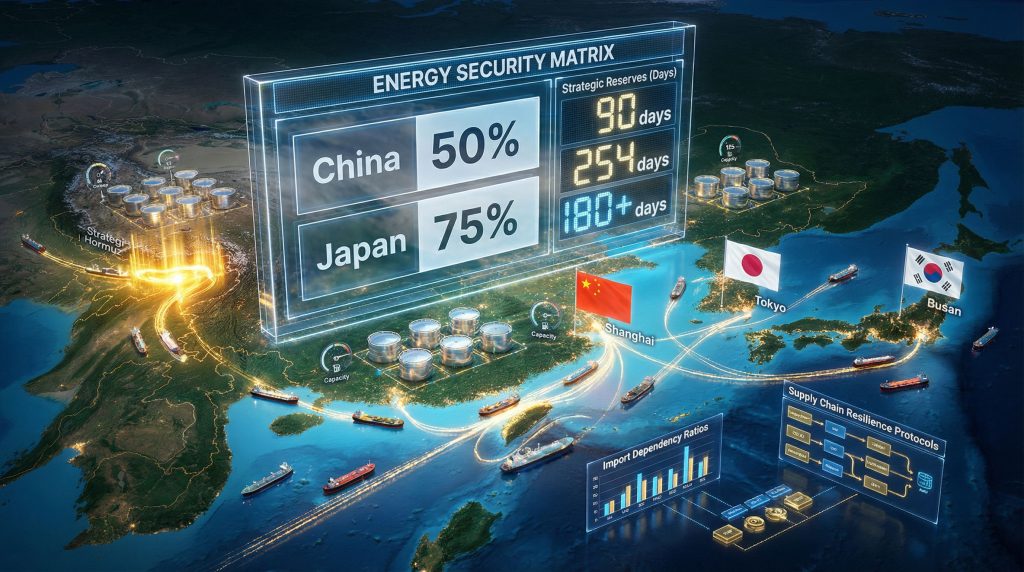
| Economy | Middle East Oil Dependency | Strategic Reserves (Days) | Primary Vulnerability |
|---|---|---|---|
| China | 50% | 90 days | Strait of Hormuz closure |
| Japan | 75% | 254 days | LNG supply disruption |
| South Korea | 75% | 180+ days | Refined product shortages |
| Southeast Asia | 60% | <30 days | Price volatility |
This dependency matrix reveals fundamental structural differences in vulnerability profiles. ASEAN nations collectively maintain minimal strategic petroleum reserves, with most countries holding less than 30 days of import coverage. This creates acute exposure to price volatility and short-term supply disruptions that larger economies with substantial reserves can weather more effectively.
However, Asia's most vulnerable position to Middle Eastern energy bottlenecks has prompted urgent discussions about supply chain resilience.
Strategic Reserve Capacity Analysis by Country
Japan's 254-day import coverage represents the region's most comprehensive strategic buffer, equivalent to approximately 100-110 million barrels in coastal storage facilities. This capacity was developed following earlier energy crises and has been tested through actual deployment during the 1991 Gulf War and 2011 Fukushima disaster response.
South Korea maintains 180+ days of coverage through a distributed model combining government-controlled reserves with mandated industry stockpiles. This approach reduces single-point infrastructure risk by requiring refiners and chemical producers to maintain operational inventory reserves as part of national energy security architecture.
China's strategic position remains partially opaque, with official capacity disclosed at approximately 270 million barrels in acknowledged facilities. However, Reuters analysts estimate total stockpiles at roughly 900 million barrels when including both official and commercial reserves, providing approximately 75-90 days of import coverage.
LNG vs Crude Oil Exposure Differentials
Liquefied natural gas markets present different vulnerability characteristics compared to crude oil supply chains. Global LNG liquefaction capacity reaches approximately 440 million tonnes per annum, but only 40-45% provides flexible spot market availability. Lead times for shipping LNG from production facilities to Asian markets require 3-6 weeks minimum, limiting rapid substitution capabilities during acute shortages.
LNG infrastructure requires specialised receiving terminals and regasification equipment, creating additional bottlenecks that cannot be quickly bypassed through alternative suppliers. This technical constraint means that while LNG provides diversification from some traditional crude oil sources, it cannot serve as a comprehensive substitute during comprehensive Middle Eastern supply disruptions.
Strategic Reserve Systems: Asia's Energy Security Buffer
Strategic petroleum reserves represent the primary defensive mechanism Asian economies employ against supply chain disruptions. These systems have evolved significantly over the past two decades, incorporating lessons from multiple energy crises and reflecting different national philosophies toward energy security management.
China's Undisclosed Stockpile Strategy
Chinese energy planners implement a strategic philosophy emphasising undisclosed accumulation timing to avoid market impact from public announcements. This approach allows opportunistic purchasing during price troughs while integrating reserves into both energy security and macroeconomic stabilisation objectives.
During the 2016-2018 period when crude oil prices remained depressed, China significantly accelerated reserve accumulation. Official reports indicated purchases at price points between $35-50 per barrel, contrasting favourably with 2022 prices exceeding $90 per barrel. This strategy aligned economic stimulus objectives with energy security buffer development.
Chinese strategic reserve construction began in the late 1990s with major expansions occurring between 2003-2013, creating a distributed storage network that reduces single-point vulnerabilities while maintaining operational flexibility for crisis response.
Japan's Post-Fukushima Reserve Philosophy
Following the 2011 Fukushima nuclear disaster, Japanese energy security planning underwent fundamental transformation. Pre-2011 nuclear energy provided approximately 30% of electricity generation, but this contribution declined sharply as reactors underwent safety reviews. Strategic reserves became integral to compensating for reduced nuclear capacity and increased reliance on fossil fuel imports.
Japan's reserve system employs both underground salt cavern storage and above-ground coastal tank farms. Underground facilities provide naturally impermeable geological formations with minimal evaporation and temperature-stable conditions, while coastal facilities enable rapid maritime loading and unloading for emergency deployment.
The operational readiness of Japan's reserve infrastructure was demonstrated during the March 2011 earthquake and tsunami response. Japan coordinated with the International Energy Agency on releasing approximately 2.5 million barrels over the initial 30-day period, supporting fuel distribution to affected regions while stabilising domestic prices.
South Korea's Industrial Contingency Planning
South Korea's distributed reserve model integrates approximately 60% government-controlled strategic reserves with 40% mandated industry minimum stockpiles. This structure requires refiners and chemical producers to maintain operational inventory reserves as part of their business operations, creating redundancy that reduces infrastructure risk.
The Korean approach emphasises supply diversification alongside reserve accumulation, recognising that stockpiles alone cannot address prolonged supply chain disruptions. Strategic reserves provide crisis response capability while diplomatic and commercial relationships with multiple suppliers offer longer-term resilience.
ASEAN Collective Energy Security Framework
Southeast Asian economies face the greatest collective vulnerability due to limited strategic reserve capacity and high dependency on Middle Eastern imports. Most ASEAN nations maintain less than 30 days of strategic petroleum reserves, creating acute exposure to both price volatility and supply disruptions.
Regional cooperation mechanisms are developing to address these vulnerabilities through shared infrastructure and coordinated crisis response protocols. However, implementation remains limited compared to the comprehensive reserve systems maintained by northeast Asian economies.
How Are Asian Governments Responding to Supply Chain Threats?
Recent geopolitical tensions have activated defensive mechanisms across Asian energy markets, revealing both the sophistication of crisis response systems and the underlying anxieties about supply chain resilience. Government actions during periods of elevated risk provide insight into policy priorities and operational capabilities.
Price Control Mechanisms and Market Interventions
China has announced its sharpest rise in retail petrol and diesel prices since 2022, while simultaneously ordering state-owned oil majors to secure stable supplies of refined products and comply with official price controls. This dual approach attempts to balance market signals with social stability concerns, reflecting the complex relationship between energy costs and broader economic management.
The price adjustment mechanism demonstrates China's willingness to allow cost pass-through to consumers while maintaining strategic oversight of supply chain security. State-owned enterprises receive explicit instructions to prioritise supply stability over short-term profit optimisation, illustrating how energy security considerations override pure market mechanisms during crisis periods.
Emergency Release Protocols for Strategic Reserves
Japan instructed national storage sites to prepare for possible strategic reserve releases, activating protocols developed through previous crisis experiences. The preparation phase enables rapid deployment if circumstances require actual reserve utilisation, while maintaining flexibility to avoid unnecessary market intervention if tensions subside.
This preparation phase reflects lessons learned from the 1991 Gulf War and 2011 Fukushima responses, where coordination between government decision-making and operational readiness proved crucial for effective crisis management. Most Asian strategic petroleum reserve systems can sustain release rates of 100,000-500,000 barrels per day for 30-90 day periods before requiring replenishment logistics.
Diplomatic Hedging Strategies with Multiple Suppliers
Asian governments are simultaneously pursuing diplomatic engagement with alternative suppliers to reduce structural dependence on Middle Eastern sources. These efforts include expanded relationships with producers in West Africa, the Americas, and Central Asia, though technical and logistical constraints limit the speed of supply chain diversification.
Furthermore, monitoring OPEC production impact decisions becomes crucial for understanding how production adjustments affect Asian import costs.
Energy security planners across Asia are implementing supply chain resilience protocols that prioritise reserve releases, price stabilisation, and alternative sourcing arrangements to maintain economic stability during geopolitical crises.
Which Asian Markets Face the Greatest Energy Security Risks?
Risk assessment across Asian energy markets reveals significant variation in vulnerability profiles, reflecting differences in strategic reserves, supply diversification, and economic resilience mechanisms. Understanding these differentials helps explain varying policy responses and investment priorities across the region.
High-Risk Economies with Limited Reserve Capacity
ASEAN economies collectively represent the highest-risk category due to minimal strategic petroleum reserves and limited crisis response infrastructure. Countries maintaining fewer than 30 days of import coverage face immediate vulnerability to supply disruptions, with limited buffering capacity to weather extended crisis periods.
These economies also tend to have less sophisticated refinery infrastructure, reducing their ability to process alternative crude types during supply chain disruptions. Price volatility exposure becomes particularly acute as these markets lack the fiscal resources to implement comprehensive price stabilisation mechanisms employed by larger economies.
Medium-Risk Markets with Diversified Supply Chains
China occupies a medium-risk position despite its massive consumption volume due to substantial strategic reserves and supply chain diversification efforts. The estimated 900 million barrel stockpile provides meaningful crisis response capability, while diplomatic relationships with multiple suppliers offer alternatives to Middle Eastern sources.
However, China's sheer consumption scale means that even partial supply disruptions create significant economic impact. The recent announcement of sharp price increases demonstrates how global supply chain tensions immediately translate into domestic economic pressure, despite strategic buffer capacity.
In addition, concerns about a potential US oil production decline could further complicate China's supply diversification strategies.
Lower-Risk Economies with Strategic Advantages
Japan's 254-day strategic reserve capacity provides the region's most comprehensive buffer against supply disruptions. Combined with sophisticated crisis response protocols tested through multiple deployments, Japan maintains operational readiness that reduces both economic and social vulnerabilities during energy supply crises.
South Korea's 180+ day capacity and distributed reserve model similarly provide meaningful protection, though geographic proximity to regional tensions creates additional geopolitical risk factors that strategic reserves alone cannot completely mitigate.
Long-Term Energy Diversification Strategies Across Asia
Energy security concerns are accelerating long-term diversification strategies across Asian economies, reflecting recognition that strategic reserves provide crisis response capability but cannot address fundamental supply chain vulnerabilities without structural transformation.
Renewable Energy Acceleration Programs
Asian governments are accelerating renewable energy deployment as both climate policy and energy security strategy. Solar and wind capacity expansion reduces structural dependence on imported fossil fuels while providing price stability through domestically controlled generation sources.
China leads global renewable energy installation with massive solar and wind capacity additions, though the intermittency characteristics of these sources require continued fossil fuel backup capacity for grid stability. Japan and South Korea are similarly expanding renewable deployment while maintaining strategic petroleum reserves for transitional energy security.
Alternative Supplier Relationship Development
Diplomatic and commercial engagement with non-Middle Eastern suppliers represents a parallel diversification strategy. African producers, American shale oil, and Central Asian sources provide alternative supply options, though logistical constraints and quality specifications limit rapid substitution capabilities.
These relationships require long-term development through infrastructure investment, diplomatic engagement, and commercial agreements that cannot be rapidly activated during acute crisis periods. Strategic reserves provide immediate crisis response while alternative supplier relationships offer longer-term structural resilience.
For instance, developments in Saudi exploration licenses could influence global supply dynamics and provide opportunities for Asian buyers to secure additional supplier relationships.
Regional Energy Grid Integration Projects
Regional electricity grid integration projects across Northeast Asia and ASEAN aim to create shared resilience through diversified generation sources and mutual support capabilities. These infrastructure investments require substantial capital and regulatory coordination but provide structural alternatives to individual country energy security strategies.
Grid integration enables renewable energy sharing across national boundaries while providing backup capacity during domestic supply disruptions. However, these projects remain in early development phases compared to established strategic reserve systems.
Nuclear Power Revival Considerations
Several Asian economies are reconsidering nuclear power expansion as energy security strategy, despite ongoing safety and waste management concerns. Nuclear generation provides baseload capacity independent of imported fuel sources, though uranium supply chains create different dependency relationships.
Japan's nuclear restart process reflects this strategic reconsideration, balancing safety requirements with energy security objectives. South Korea and other Asian economies face similar policy debates about nuclear power's role in comprehensive energy security architecture.
The next major ASX story will hit our subscribers first
Economic Spillover Effects: Inflation and Growth Implications
Energy price volatility creates cascading economic effects across Asian economies, influencing inflation expectations, industrial production costs, and currency stability. Understanding these transmission mechanisms helps explain why energy security receives such high policy priority despite substantial strategic reserve investments.
Stagflation Risk Assessment for Asian Economies
The combination of energy price increases with existing economic challenges creates stagflation risks that policymakers actively seek to avoid. Energy costs represent significant input costs for industrial production while directly affecting consumer price indices through transportation and heating expenses.
Asian economies experiencing deflationary pressures face particular complications when energy price increases create conflicting policy requirements. Central banks must balance inflation control with growth support objectives, complicating monetary policy responses during energy crisis periods.
Consumer Price Impact Analysis
Historical analysis reveals that energy price transmission to consumer prices varies significantly across Asian markets based on subsidy structures, price control mechanisms, and consumption patterns. Urban economies with high transportation fuel consumption experience more immediate price transmission compared to rural areas with different energy consumption profiles.
The 2022 energy crisis demonstrated these transmission mechanisms across Asian markets. Japanese electricity costs increased approximately 30-40% year-on-year, while South Korean industrial users experienced energy surcharge increases of 15-25%. Chinese electricity demand management protocols were activated in multiple provinces to manage cost pressures.
Industrial Production Disruption Scenarios
Energy-intensive industries face the most immediate impact from supply chain disruptions and price volatility. Chemical production, steel manufacturing, and aluminium smelting operations require stable energy inputs for operational continuity, with limited ability to rapidly adjust production processes to alternative energy sources.
These industrial vulnerabilities create employment and economic growth implications that extend beyond direct energy costs. Supply chain disruptions in energy-intensive sectors cascade through manufacturing networks, affecting export competitiveness and employment levels across multiple industries.
Meanwhile, Australia faces its own energy export challenges that could affect regional supply dynamics.
Currency Stability Under Energy Price Pressure
Energy import costs affect current account balances and currency stability across Asian economies. Higher energy prices increase import costs while potentially reducing export competitiveness through higher production costs, creating dual pressure on currency values.
Countries with substantial foreign exchange reserves can weather short-term currency pressure more effectively, while economies with limited reserves face more immediate adjustment requirements. Strategic petroleum reserves provide some buffer against these currency pressures by reducing immediate import requirements during crisis periods.
Regional Cooperation Mechanisms for Energy Crisis Management
Energy security challenges have stimulated regional cooperation mechanisms designed to provide collective resilience against supply chain disruptions. These frameworks range from formal agreements to informal coordination protocols that activate during crisis periods.
ASEAN Energy Security Framework
The Association of Southeast Asian Nations has developed regional energy security protocols aimed at coordinating crisis response across member economies. These mechanisms include information sharing, coordinated strategic reserve releases, and mutual support arrangements during supply emergencies.
However, implementation remains limited by the substantial variation in individual country reserve capacity and crisis response infrastructure. Most ASEAN economies lack the strategic reserves necessary for meaningful mutual support during extended supply disruptions.
Northeast Asian Energy Partnership Protocols
Japan, South Korea, and China maintain informal coordination mechanisms for energy crisis management despite broader geopolitical tensions. These arrangements recognise shared vulnerability to Middle Eastern supply disruptions while enabling technical cooperation on crisis response strategies.
The International Energy Agency framework provides formal coordination mechanisms for reserve releases and crisis response among member countries. Japan and South Korea participate actively in these protocols, while China maintains observer status with more limited formal participation.
China-Japan-South Korea Trilateral Coordination
Despite periodic diplomatic tensions, the three largest Northeast Asian economies maintain technical cooperation on energy security issues. Shared vulnerability to supply chain disruptions creates common interests that transcend broader geopolitical disagreements.
This cooperation includes information sharing on strategic reserve management, coordinated responses to supply disruptions, and technical exchanges on crisis response infrastructure. However, formal agreements remain limited compared to the substantial individual country investments in strategic reserves.
Emergency Sharing Agreements and Protocols
Regional emergency sharing agreements enable coordinated responses to acute supply disruptions while avoiding duplicative market interventions that could create additional volatility. These protocols require careful calibration to ensure that collective actions enhance rather than undermine individual country energy security.
The effectiveness of these mechanisms depends heavily on the crisis response infrastructure and strategic reserves maintained by individual participating countries. Regional cooperation provides coordination benefits but cannot substitute for adequate national preparedness.
Investment Implications for Asian Energy Infrastructure
Energy security priorities are driving substantial infrastructure investments across Asian economies, creating opportunities in strategic storage, alternative energy development, and supply chain resilience technologies. Understanding these investment trends provides insight into long-term regional energy architecture evolution.
Strategic Reserve Expansion Requirements
Asian economies with limited strategic reserve capacity represent priority investment opportunities for storage infrastructure development. Underground cavern storage, coastal tank farms, and specialised handling facilities require substantial capital investment but provide critical national security infrastructure.
These investments typically involve government funding or strategic partnerships with private energy companies, creating opportunities for engineering firms specialising in petroleum storage infrastructure. Salt cavern storage technology and rock cavern engineering represent particular areas of technical expertise demand.
Alternative Energy Source Development Priorities
Renewable energy infrastructure expansion receives priority investment support as both climate policy and energy security strategy. Solar panel manufacturing, wind turbine installation, and grid integration technologies benefit from policy support driven by energy security objectives.
Nuclear power infrastructure similarly receives consideration as energy security investment, though regulatory approval processes and public acceptance remain significant implementation challenges. Uranium supply chain development represents a parallel investment opportunity with different risk characteristics.
Supply Chain Resilience Investment Needs
Refinery infrastructure modifications to process alternative crude oil sources require substantial technical investment. Asian refineries optimised for Middle Eastern crude specifications need equipment upgrades to efficiently process West African, American, or Central Asian crude alternatives.
Transportation infrastructure including pipeline networks, port facilities, and tanker fleet capacity represents additional investment requirements for supply chain diversification. These investments typically require long development timelines but provide strategic value during crisis periods.
Regional Energy Hub Development Opportunities
Strategic locations for energy storage and distribution hubs provide investment opportunities that serve multiple national energy security objectives. Singapore's energy trading hub model demonstrates how strategic positioning can create commercial value while supporting regional energy security.
LNG regasification terminals and specialised petroleum product storage facilities require substantial capital investment but provide critical infrastructure for supply chain flexibility during disruption periods.
Future-Proofing Asian Energy Security Architecture
Long-term energy security planning requires integration of technological innovation, geopolitical risk assessment, and climate transition objectives. Asian economies are developing comprehensive frameworks that address multiple challenges simultaneously while maintaining operational flexibility.
Technology Solutions for Supply Chain Monitoring
Advanced monitoring systems provide real-time visibility into global energy supply chains, enabling earlier crisis response and more sophisticated risk management. Satellite tracking of tanker movements, automated inventory management, and predictive analytics enhance situational awareness for energy security planners.
Artificial intelligence applications in supply chain optimisation can identify alternative routing options and supplier substitution possibilities during disruption periods. These technologies enhance the effectiveness of strategic reserves by optimising deployment timing and coordination mechanisms.
Predictive Analytics for Crisis Response
Machine learning applications in geopolitical risk assessment and energy market analysis provide improved early warning capabilities for supply chain disruptions. These systems analyse multiple data streams including political developments, economic indicators, and infrastructure status to generate crisis probability assessments.
Predictive capabilities enable proactive reserve management and supplier diversification strategies rather than purely reactive crisis response. This approach optimises strategic reserve utilisation while reducing economic disruption during supply chain stress periods.
Multi-Source Portfolio Optimisation Strategies
Portfolio theory applications to energy supply chain management enable optimisation across multiple risk factors including price volatility, supply reliability, and geopolitical stability. These mathematical approaches support strategic decision-making about supplier relationships and reserve management strategies.
Dynamic hedging strategies using financial instruments alongside physical reserves provide additional tools for managing energy security risks. These approaches require sophisticated analytical capabilities but offer enhanced crisis response flexibility.
Climate Transition Compatibility Assessment
Energy security infrastructure investments must align with long-term climate transition objectives to avoid stranded asset risks. Strategic petroleum reserves provide crisis response capability while renewable energy expansion addresses structural supply chain vulnerabilities.
This dual approach requires careful coordination between short-term energy security requirements and long-term decarbonisation objectives. Investment decisions must consider both immediate crisis response needs and compatibility with future low-carbon energy systems.
The evolution of Asian energy security architecture reflects both immediate crisis response requirements and long-term structural transformation objectives. Strategic reserves provide essential crisis response capability while alternative energy development addresses fundamental supply chain vulnerabilities. Understanding these multi-layered approaches provides insight into regional preparedness for future energy security challenges.
Regional cooperation mechanisms enhance individual country capabilities while technological innovation improves crisis response effectiveness. Investment opportunities span traditional infrastructure, alternative energy sources, and advanced monitoring systems that collectively strengthen energy security resilience across Asian economies. The US-Israeli war on Iran and Asian energy security considerations continue to shape policy responses and infrastructure development priorities throughout the region.
Could Rising Energy Costs Create New Investment Opportunities?
The complex energy security challenges facing Asian markets highlight the critical importance of staying informed about resource sector developments and their market implications. Discovery Alert's proprietary Discovery IQ model delivers real-time alerts on significant ASX mineral discoveries, instantly empowering subscribers to identify actionable opportunities ahead of the broader market as global energy dynamics reshape investment landscapes. Begin your 14-day free trial today and secure your market-leading advantage whilst energy security concerns drive increased focus on resource exploration and development.