June 5, 2026
Maritime shipping regulations intersect with global energy security in complex ways that extend far beyond simple transportation economics. The intricate web of cabotage laws, strategic commodity flows, and geopolitical risk management creates a regulatory framework where temporary policy adjustments can reshape entire supply chains. Understanding these dynamics requires examining how domestic shipping protections balance national security imperatives against market efficiency pressures, particularly when energy infrastructure faces coordinated attacks across critical chokepoints. The recent us jones act waiver and px trade flows represents a pivotal case study in how regulatory flexibility responds to supply chain disruptions.
Understanding Maritime Cabotage Laws and Their Economic Impact
The foundation of American domestic shipping policy rests on century-old legislation that fundamentally shapes how energy commodities move between US ports. The regulatory architecture established in 1920 created a comprehensive framework requiring vessels engaged in domestic trade to meet four distinct compliance criteria, fundamentally altering the competitive landscape for maritime transportation.
The Foundation of US Domestic Shipping Regulations
The Merchant Marine Act of 1920, commonly known as the Jones Act, established mandatory domestic shipping requirements that remain largely unchanged after more than a century of operation. The legislation requires vessels to be US-built, US-flagged, US-owned (minimum 75% ownership), and US-crewed (minimum 75% of crew) to engage in waterborne commerce between American ports.
This regulatory structure applies comprehensively to merchandise, military supplies, coal, petroleum products, and agricultural commodities moving between points within the United States. The policy reflects mercantilist economic principles that prioritised maintaining a viable domestic maritime industry capable of supporting national defence requirements during both peacetime operations and crisis periods.
The US-built designation requires construction at American shipyards, creating an absolute barrier for foreign-built vessels regardless of other compliance factors. This construction requirement, administered through the US Coast Guard and Maritime Administration documentation process, creates significant capacity constraints within the domestic fleet.
Cost Structure Analysis of Domestic vs. International Shipping
The Jones Act compliance requirements generate substantial premium pricing mechanisms that distinguish domestic maritime transportation from international alternatives. As of 2024, the US domestic maritime fleet consisted of approximately 80-90 Jones Act-compliant tankers, creating significant capacity constraints that directly contribute to elevated transportation costs.
| Fleet Category | Vessel Count | Primary Constraint | Cost Impact |
|---|---|---|---|
| Compliant Tankers | 80-90 units | Limited construction capacity | Premium pricing |
| Alternative Modes | Pipeline/rail/truck | Modal capacity limits | Variable competition |
| International Fleet | Restricted access | Regulatory prohibition | Cost differential |
These capacity limitations force shippers to evaluate modal competition from rail, pipeline, and trucking alternatives, though each mode presents distinct operational constraints and cost structures. The concentration of regulatory compliance requirements in a relatively small fleet creates pricing dynamics that can shift dramatically during supply chain disruptions.
Furthermore, international cabotage frameworks typically maintain some form of domestic preference, but the American combination of construction requirements plus operational restrictions represents uniquely comprehensive scope compared to European equivalent policies. This regulatory intensity reflects historical concerns about merchant marine viability that have evolved into modern national security infrastructure maintenance arguments.
When big ASX news breaks, our subscribers know first
What Triggered the 60-Day Regulatory Suspension?
The temporary suspension of Jones Act requirements emerged from a cascading series of geopolitical events that fundamentally disrupted global energy infrastructure and transportation networks. The regulatory response reflects emergency authority mechanisms designed to address supply chain vulnerabilities when traditional maritime routes face significant operational constraints. These events highlight how us tariffs and inflation concerns intersect with maritime security challenges.
Geopolitical Supply Chain Disruptions
The conflict beginning February 28, 2026, created immediate restrictions on vessel movement through the Strait of Hormuz, a critical chokepoint through which approximately 20-25% of globally-traded oil passes under normal operating conditions. The strategic importance of this shipping lane means that any operational disruption creates immediate ripple effects across international commodity markets.
Regional energy infrastructure faced coordinated attacks that damaged multiple facilities across the Middle East Gulf region:
- Kuwait's Mina al-Ahmadi refinery (346,000 b/d capacity): Direct strike caused small fire
- Kuwait's Mina Abdullah refinery (454,000 b/d capacity): Unit damage with fire reported
- Saudi Arabia's Samref refinery at Yanbu (400,000 b/d capacity): Drone strike impact
- Qatar's Ras Laffan complex: Extensive damage to Pearl GTL facility and multiple LNG facilities
These infrastructure attacks drove Brent crude prices up 8% on March 19, 2026, pushing front-month Brent trading above $100/barrel for four consecutive days, marking the first such occurrence since mid-2022. The concentration of major refining and processing capacity in the Middle East Gulf region creates cascading supply chain effects when regional conflicts impact port operations or vessel routing through critical straits. Such disruptions demonstrate the potential for an oil price rally under tariffs scenarios.
Emergency Authority and Precedent Analysis
Presidential authority for emergency waivers operates under statutory provisions within the Jones Act that allow temporary suspension of cabotage requirements during national emergencies. The 60-day authorisation specifically permits foreign-flagged vessels to transport domestic energy commodities between US ports for the limited duration specified, representing a significant but temporary regulatory adjustment.
Historical waiver patterns during natural disasters provide precedent for emergency regulatory flexibility, though the current situation differs substantially from hurricane-related disruptions. Previous waivers typically addressed specific regional infrastructure damage rather than global supply chain constraints affecting strategic commodity flows.
The legal framework distinguishes between emergency authority under existing Jones Act language versus standalone administrative action authority, creating specific duration and scope parameters for temporary regulatory suspension. Additionally, according to Reuters, market participants noted that supplies had tightened for several products as vessel movement through critical chokepoints deteriorated, creating acute supply pressure independent of actual inventory depletion.
Which Petrochemical Products Benefit Most from Shipping Deregulation?
The temporary regulatory suspension creates differentiated impacts across petrochemical product categories, with certain commodities positioned to benefit significantly from eliminated transportation cost premiums while others remain largely unaffected due to existing infrastructure relationships.
Paraxylene (PX) Trade Flow Restructuring
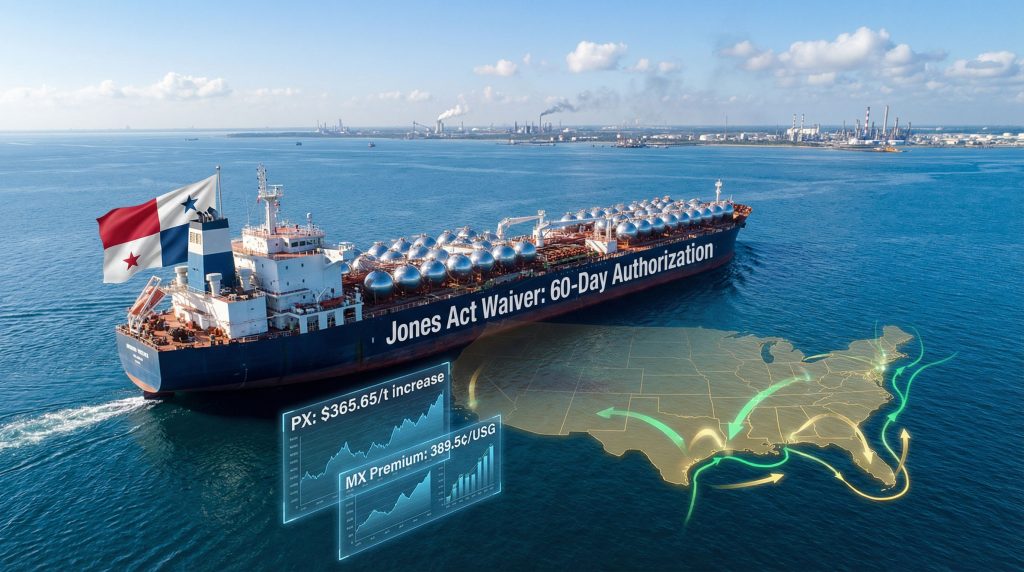
Paraxylene markets represent the most significant opportunity for trade pattern restructuring under the temporary waiver. US Atlantic Coast consumers traditionally depend on imports because domestic US Gulf Coast production has been typically consumed within that region, making inter-coastal shipping an untapped arbitrage opportunity. This represents a key component of how us jones act waiver and px trade flows interact in practice.
Saudi Arabia accounted for over 50% of US paraxylene imports as of March 2026, following supply chain reshuffling caused by tariff implementations in 2025. Additional historical import sources included South Korea, Brunei, Netherlands, Taiwan, and India, creating a diverse but import-dependent supply structure for Atlantic coast consumers.
PX pricing dynamics reflect the supply chain disruption impact:
- Price increase since conflict onset: $365.65/t
- Assessment price on March 13, 2026: $1,438.73/t
- Potential volume shift: 20-30% from Saudi imports to USGC production
The eliminated Jones Act transportation costs combined with elevated pricing create viable arbitrage between Gulf and Atlantic markets that previously remained economically unviable. Market sources indicate that higher prices and temporary removal of transportation cost premiums could prompt greater USGC PX production to ship to the Atlantic coast.
Energy Product Categories Under Waiver Coverage
The regulatory suspension applies comprehensively to crude oil and refined petroleum products, natural gas and natural gas liquids, coal and fertiliser commodities based on emergency energy security rationale. This broad scope reflects the strategic importance of maintaining flexible supply chains during infrastructure disruption periods.
Mixed xylene (MX) premium evolution demonstrates commodity-specific price dynamics:
- USGC 5211-grade MX rise: 102¢/USG
- Price level through March 18, 2026: 389.5¢/USG
- Impact on trade flows: Cost-dependent adoption patterns
However, certain products remain largely unaffected by the waiver due to existing infrastructure relationships. Benzene and styrene shipments face minimal impact because many consumers maintain integration with refineries, pipelines, or receive volumes from inland barges, creating structural differences between independent blenders and vertically integrated refiners.
How Do Regional Price Differentials Drive Trade Pattern Changes?
The elimination of Jones Act transportation premiums creates immediate arbitrage opportunities between US Gulf Coast production centres and Atlantic Coast consumption markets, fundamentally altering the economic calculus for domestic energy commodity flows. These changes reflect broader tariffs' market impact considerations.
Gulf Coast to Atlantic Coast Arbitrage Opportunities
Traditional trade patterns reflected transportation cost barriers that made domestic inter-coastal shipping economically unviable compared to international imports. The temporary regulatory suspension removes these cost premiums, creating new competitive dynamics between domestic production and established import relationships.
Transportation cost elimination benefits extend beyond simple freight savings to encompass broader supply chain restructuring opportunities. The higher prices and temporary removal of costs associated with Jones Act compliance enable USGC producers to compete directly with international suppliers for Atlantic coast market share.
The regulatory suspension creates a temporary competitive advantage that challenges traditional import-dependent supply chains, particularly affecting commodities where transportation costs represent significant portions of delivered pricing.
Competitive Positioning Against International Suppliers
Saudi Arabia's dominant market share faces vulnerability to displacement by USGC suppliers during the 60-day waiver period. This shift reflects not only eliminated transportation costs but also reduced geopolitical risk exposure through domestic supply chain reliance.
Blending stock preferences add complexity to competitive positioning analysis. US blenders historically prefer alkylate from Europe over reformate or aromatic blendstocks, with alkylate imports exempt from tariff policy due to energy sector classification. This preference pattern may limit the extent of trade flow restructuring in certain product categories.
Consequently, the waiver creates opportunities for USGC toluene and mixed xylene shipments to Atlantic coast destinations for gasoline blending applications, though market adoption depends on relative pricing advantages and existing contractual relationships with European suppliers.
What Are the Operational Constraints and Market Realities?
Despite the regulatory flexibility provided by the waiver, significant operational limitations constrain the extent of immediate trade flow restructuring, reflecting infrastructure capacity restrictions and existing commercial relationships.
Fleet Capacity and Infrastructure Limitations
Available foreign-flagged vessel inventory suitable for US domestic trade represents a critical constraint on waiver utilisation. The vessels must be positioned appropriately, possess suitable cargo handling capabilities, and maintain scheduling flexibility to capitalise on temporary arbitrage opportunities.
Port handling capabilities for increased domestic flows face capacity limitations at both loading and discharge facilities. Gulf Coast export infrastructure designed primarily for international trade may require operational adjustments to accommodate increased domestic shipments, while Atlantic coast facilities must manage receiving additional volumes alongside continued import operations.
Scheduling and logistics coordination challenges compound these infrastructure constraints, as market participants must rapidly reconfigure supply chains designed around established trade patterns. The 60-day duration creates urgency for implementation while limiting long-term investment justification.
Industry Stakeholder Response Patterns
Refinery-integrated consumer behaviour differs substantially from independent market participant responses. Integrated operations with existing pipeline connections or barge transportation face limited incentives to restructure supply chains for temporary regulatory changes, creating heterogeneous market responses across consumer categories.
Independent blender decision-making criteria focus primarily on delivered cost advantages, though contractual obligations and relationship maintenance considerations may limit immediate supply source switching. Long-term contract renegotiation implications create additional complexity as parties evaluate whether temporary regulatory changes justify permanent commercial adjustments.
Moreover, market sources noted that traditional import relationships, particularly for alkylate blending stocks, may prove resistant to change despite temporary cost advantages from domestic alternatives.
How Does This Compare to Historical Waiver Precedents?
Previous emergency waivers provide context for understanding both the scope and limitations of the current regulatory suspension, though fundamental differences in triggering circumstances create distinct market impact profiles. These precedents also inform analysis of trade war and oil prices relationships.
Hurricane and Emergency Response Comparisons
Historical hurricane-related waivers typically addressed specific regional infrastructure damage, such as refinery outages or port closures, rather than global supply chain constraints affecting strategic commodity flows. These precedents involved clearly defined geographic impact areas and restoration timelines tied to infrastructure reconstruction efforts.
Duration and scope comparisons reveal that the current 60-day authorisation represents standard emergency response timeframes, though the underlying circumstances differ significantly from weather-related disruptions. Previous waivers focused on maintaining existing supply chains during infrastructure repair periods rather than creating new trade flow opportunities.
Recovery timelines to normal regulatory compliance historically depended on infrastructure restoration completion rather than geopolitical conflict resolution, creating different uncertainty profiles for market planning purposes. The current situation involves ongoing conflict dynamics rather than finite reconstruction projects.
Economic Impact Assessment Methodologies
Consumer price relief quantification presents significant analytical challenges due to the complex interaction between eliminated transportation costs, alternative supply source pricing, and ongoing commodity price volatility from the underlying supply disruption. Traditional economic impact measures may inadequately capture the full scope of temporary regulatory flexibility benefits.
Regional supply security enhancement metrics extend beyond immediate cost savings to encompass strategic supply chain diversification and reduced geopolitical risk exposure through domestic sourcing expansion. These benefits prove difficult to quantify but represent substantial value during extended conflict periods.
In addition, employment and revenue implications for the domestic maritime sector create countervailing considerations, as increased foreign vessel utilisation may reduce opportunities for Jones Act-compliant fleet operations during the waiver period.
The next major ASX story will hit our subscribers first
What Are the Broader Policy Implications?
The temporary regulatory suspension raises fundamental questions about the balance between maritime industry protection and energy supply chain flexibility, creating potential momentum for longer-term policy evolution.
Maritime Industry Opposition Arguments
National security considerations in shipping dependence represent core arguments for maintaining Jones Act requirements, emphasising the importance of domestic maritime capability for defence logistics and crisis response. Industry advocates argue that temporary cost savings must be evaluated against long-term strategic capacity maintenance requirements.
Domestic employment protection rationale encompasses both direct maritime jobs and supporting infrastructure industries, including shipbuilding, maintenance, and logistics services. The economic multiplier effects of domestic maritime operations extend beyond vessel operations to encompass broader industrial base considerations.
Tax revenue impacts from reduced domestic vessel utilisation create fiscal implications at federal and state levels, though these must be balanced against broader economic benefits from reduced transportation costs during supply chain disruptions.
Energy Security vs. Economic Efficiency Trade-offs
Supply chain resilience enhancement strategies involve complex trade-offs between cost optimisation and risk management across different threat scenarios. The current situation demonstrates how geopolitical conflicts can rapidly shift the economic calculus for domestic versus international supply chain dependence. These challenges mirror broader energy transition challenges facing nations worldwide.
Cost-benefit analysis of regulatory flexibility must account for dynamic risk environments where traditional economic relationships may become temporarily inverted during crisis periods. International competitiveness considerations extend beyond immediate transportation costs to encompass broader industrial competitiveness factors.
Furthermore, the regulatory framework's ability to provide crisis response flexibility while maintaining normal-period industry protection represents a critical policy balance that may require structural adjustments based on evolving threat environments. According to Politico, such regulatory adaptations reflect broader strategic planning requirements.
Future Regulatory Evolution and Market Adaptation
The temporary waiver experience provides valuable data for evaluating potential permanent regulatory modifications and understanding market adaptation capabilities under different policy frameworks.
Post-Waiver Market Structure Predictions
Permanent trade flow alterations likelihood depends significantly on the duration and intensity of the underlying supply chain disruption, as well as the degree of infrastructure investment that occurs during the waiver period. Market participants may develop new commercial relationships that persist beyond the regulatory suspension timeframe.
Investment decision impacts for domestic shipping capacity create complex incentive structures, as reduced utilisation during waiver periods must be balanced against long-term fleet maintenance requirements. The experience may influence future emergency response planning and fleet sizing strategies.
Regulatory reform momentum assessment suggests that demonstrated market adaptability during crisis periods may strengthen arguments for increased policy flexibility, though maritime industry opposition will likely intensify if temporary measures appear to threaten permanent market share.
Strategic Planning Considerations for Market Participants
Hedging strategies for transportation cost volatility become increasingly important as regulatory framework flexibility introduces new sources of cost uncertainty alongside traditional market price risks. Companies must develop capabilities to rapidly adjust supply chain configurations based on regulatory environment changes.
Supply chain diversification imperatives extend beyond simple cost optimisation to encompass regulatory risk management, requiring development of capabilities to operate effectively under multiple policy scenarios. Long-term contracting structure adaptations may need to incorporate regulatory change provisions and alternative performance mechanisms.
The experience demonstrates the value of maintaining flexible operational capabilities that can capitalise on temporary regulatory adjustments while preserving existing commercial relationships for post-waiver periods.
Balancing National Interests with Market Efficiency
The intersection of maritime regulation and energy security creates complex policy challenges that require balancing multiple national interests across different time horizons and threat scenarios.
Key Takeaways for Industry Stakeholders
Short-term arbitrage opportunities in petrochemical flows demonstrate the immediate market impact of regulatory flexibility, particularly for products like paraxylene where transportation costs represent significant competitive factors. The us jones act waiver and px trade flows creates temporary competitive advantages that may reshape PX trade flows beyond the 60-day duration.
Medium-term supply chain reconfiguration potential depends on infrastructure investment decisions and commercial relationship development during the waiver period. Market participants must evaluate whether temporary regulatory changes justify permanent operational adjustments or represent purely opportunistic arbitrage situations.
Long-term regulatory framework evolution signals suggest increasing recognition of the need for crisis response flexibility within existing maritime protection policies, though the specific mechanisms for achieving this balance remain subject to ongoing policy development.
Monitoring Metrics for Ongoing Assessment
Price differential tracking across regions provides critical data for evaluating waiver effectiveness and understanding market response patterns. Key metrics include USGC-to-USAC transportation cost savings, import displacement rates, and consumer price impact measurements.
Volume flow measurement methodologies must account for the complex interaction between temporary regulatory changes and underlying supply disruption effects. Distinguishing waiver-specific impacts from broader market dynamics requires sophisticated analytical approaches.
Policy effectiveness evaluation criteria should encompass both immediate economic benefits and longer-term strategic implications for domestic maritime capacity, energy supply chain resilience, and crisis response capabilities. The current experience provides valuable data for future emergency response planning and regulatory framework optimisation.
Disclaimer: This analysis involves forecasts and speculation about regulatory impacts and market dynamics that may not materialise as predicted. Market conditions, geopolitical developments, and policy decisions can significantly alter the outcomes discussed. Readers should conduct independent analysis before making commercial or investment decisions based on this content.
Ready to Position Yourself Ahead of the Next Major Market Movement?
Maritime shipping disruptions and regulatory changes create complex ripple effects across commodity markets, often generating unexpected opportunities for savvy investors. Discovery Alert's proprietary Discovery IQ model delivers real-time alerts on significant ASX mineral discoveries, helping subscribers identify actionable opportunities that emerge from evolving market conditions before the broader market catches up. Begin your 14-day free trial today to secure your market-leading advantage in an increasingly volatile global landscape.