
August 25, 2026
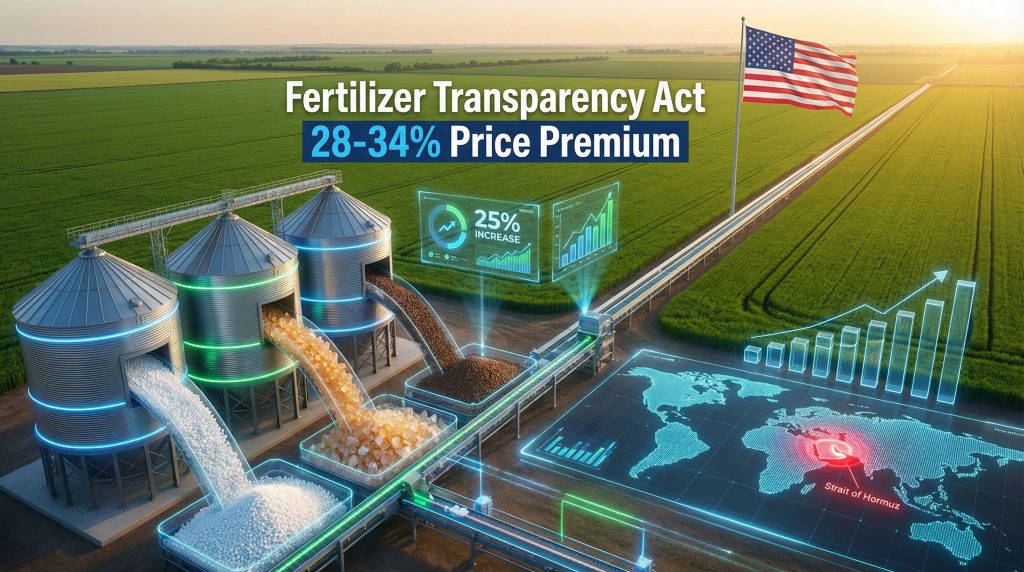
The current geopolitical crisis has exposed critical vulnerabilities in America's agricultural supply chain, with US lawmakers seek to lower war-driven fertilizer costs becoming a central policy priority as commodity input prices surge to unprecedented levels. Representative Angie Craig's bipartisan coalition of 18 Congressional members has directly petitioned Agriculture Secretary Brooke Rollins for emergency intervention measures, highlighting systemic weaknesses that threaten domestic food security and farm-level profitability.
Strategic Dependencies Expose Agricultural Input Vulnerabilities
The closure of the Strait of Hormuz since February 28, 2026, has transformed theoretical supply chain risks into immediate agricultural crises, with urea output reductions exceeding 1.5 million metric tonnes in March 2026 alone. This disruption affects approximately two-thirds of U.S. urea imports, which traditionally flow through this critical maritime corridor from Middle Eastern producers.
Furthermore, the tariff impact on markets demonstrates how trade policies compound supply chain vulnerabilities. The geographic concentration of fertilizer production creates single points of failure that amplify regional conflicts into global agricultural disruptions.
Key Supply Chain Metrics:
• Production facility shutdowns: Multiple facilities forced offline due to direct attacks or storage capacity constraints
• Transportation delays: Earliest vessel arrivals to New Orleans pushed to late May or early June 2026
• Infrastructure damage: Requires months of repair work before full operational capacity restoration
• Global impact scope: Middle East accounts for 50% of global seaborne sulfur movements
Natural gas, the primary feedstock for nitrogen fertilizer production, faces similar bottlenecks through the same maritime routes, compounding supply chain vulnerabilities across multiple agricultural input categories.
Maritime Chokepoint Economics Drive Policy Intervention
Freight cost escalation demonstrates how transportation infrastructure becomes a multiplier of commodity price shocks. Shipping rates increased 118% from $16-18 per tonne to $36-38 per tonne for 40,000-45,000 tonne shipments to India's east coast between February 26 and March 26, 2026.
These increases reflect not only distance and congestion factors but elevated insurance premiums that create dual-cost pressures on agricultural inputs. The Strait of Hormuz serves as the primary passage for nitrogen products essential for crop protein development.
Moreover, oil price movements during conflict periods create additional cost pressures through elevated energy expenses. Alternative shipping routes through the Cape of Good Hope add approximately 3,500 nautical miles to delivery timelines.
Insurance underwriters have imposed risk premiums that effectively price out smaller independent importers, concentrating market power among vertically integrated agricultural input suppliers.
When big ASX news breaks, our subscribers know first
Congressional Response Mechanisms Reveal Market Intelligence Gaps
Representative Angie Craig's bipartisan coalition identified critical information asymmetries between fertilizer manufacturers and agricultural producers that amplify price volatility during supply disruptions. Current voluntary annual surveys provide insufficient real-time data for crisis response planning.
However, the broader implications of US-China trade war impacts on agricultural markets suggest that current fertilizer challenges exist within a complex web of international trade tensions. US lawmakers seek to lower war-driven fertilizer costs by addressing fundamental transparency gaps.
Legislative Framework Analysis:
| Policy Tool | Current Status | Proposed Enhancement |
|---|---|---|
| Price Transparency | Annual voluntary surveys | Weekly mandatory reporting requirements |
| Import Duties | 28-34% premium on Morocco/Russia phosphate | Suspension or elimination authority |
| Export Controls | No fertilizer retention mechanism | Emergency export ban capability |
| Production Incentives | Limited domestic capacity support | Expanded grant/loan programs for manufacturers |
The Congressional letter specifically highlighted pre-existing financial pressures from previous trade policies, positioning current supply disruptions as compounding factors rather than isolated events.
Market Intelligence Infrastructure Limitations
Agriculture Secretary Brooke Rollins' assessment that 80% of domestic farmers had pre-purchased fertilizer for spring 2026 applications contrasts sharply with market participant reports. Industry sources indicate phosphate usage down 30-40% and potash demand reduced 5-10% due to affordability constraints.
This disconnect between government analysis and real-time market conditions reveals gaps in agricultural market intelligence systems. Weekly price reporting requirements could provide policymakers with enhanced visibility into manufacturer inventory levels and production capacity utilisation.
Furthermore, US tariffs and industries demonstrate how trade policy coordination challenges extend across multiple sectors. The information asymmetry creates policy implementation challenges where government assessments diverge from producer experiences.
Price Volatility Amplification Through Input Cost Compression
Agricultural producers face asymmetric economic pressure when input cost increases coincide with commodity price weakness. The current scenario combines elevated fertilizer prices with what Congressional members describe as a "low commodity price environment".
Additionally, commodity market volatility creates compounding challenges for farm-level financial planning. Component-Specific Price Impacts include urea experiencing 25% price increases and phosphate facing sharp elevation in compound fertilizer production costs.
The German chemical manufacturer LANXESS implemented immediate 40% price increases for sulfur-based products, citing geopolitical tensions, elevated logistics costs, and higher energy prices. These increases affect ultra-pure sulfuric acid and other inorganic acids supplied to semiconductor and agrochemical applications.
Farm-Level Economic Stress Mechanisms
Fertilizer buyers report that despite pre-purchased inventory, actual application rates are declining as farmers adjust to price pressures. The 30-40% reduction in phosphate usage and 5-10% decrease in potash demand indicate higher-cost inventory may be held rather than utilised.
This behaviour pattern reveals several critical market dynamics including inventory hoarding, application rate optimisation, and crop mix adjustments. The cumulative effect creates potential yield reductions that could persist beyond immediate supply chain recovery.
According to recent agricultural policy analysis, bipartisan legislation aims to address these systemic challenges through enhanced market transparency and strategic intervention capabilities.
Trade Policy Intervention Tools and Market Access Dynamics
Existing countervailing duties imposed on Morocco and Russia since 2021 create 28-34% price premiums on phosphate imports. Industry participants specifically advocated for duty elimination rather than temporary suspension, indicating expectations of sustained supply constraints.
Policy Intervention Hierarchy:
- Export retention mechanisms: Potential fertilizer export bans to preserve domestic supply
- Duty suspension authority: Temporary relief from import tariffs during crisis periods
- Emergency procurement powers: Federal intervention for strategic inventory building
- Market monitoring enhancement: Real-time price intelligence for intervention triggers
The Department of Commerce maintains authority over trade remedy adjustments, but Congressional pressure suggests legislative interest in expediting administrative processes during agricultural emergencies. US lawmakers seek to lower war-driven fertilizer costs through coordinated policy responses.
Strategic Reserve Development and Storage Infrastructure
Australia's formation of a Fertilizer Supply Working Group combining government agencies with industry representatives provides a model for coordinated crisis response. The group's mandate includes securing alternative supply sources and monitoring market conditions.
Australian Policy Response Framework:
• Strategic reserve powers: Authority to stockpile essential agricultural inputs
• Import financing support: Government underwriting for elevated-risk cargoes
• Industry coordination: Formal collaboration between producers and farm organisations
• Alternative sourcing: Active identification of non-Middle Eastern suppliers
The Australian approach includes legislative amendments allowing Export Finance Australia to provide insurance and guarantees for critical import security. This framework could inform U.S. policy development for agricultural input strategic reserves.
Innovation Pathways for Agricultural Input Independence
Domestic production capacity expansion represents a long-term solution to import dependency vulnerabilities. Congressional proposals focus on grant and loan programmes for small and mid-sized fertilizer manufacturers, aiming to reduce geographic concentration risks.
Technology Development Priorities:
• Biological nitrogen fixation: Reducing synthetic fertilizer requirements through soil biology enhancement
• Precision agriculture applications: Optimising fertilizer placement to minimise total input requirements
• Sustainable production methods: Developing renewable energy-based fertilizer manufacturing
• Alternative nutrient sources: Commercialising organic and recycled fertilizer options
Investment frameworks for agricultural input diversification require coordination between research institutions, private manufacturers, and federal agencies. Public-private partnership models could accelerate innovation adoption whilst maintaining competitive market dynamics.
Regional Production Distribution Strategy
Geographic diversification of fertilizer manufacturing reduces single-point-of-failure risks whilst supporting regional agricultural economies. Small and mid-sized production facilities distributed across agricultural regions could provide supply chain resilience.
Regional Capacity Development Framework:
- Strategic facility placement: Locations optimised for agricultural demand patterns
- Raw material access: Proximity to natural gas pipelines and mineral resources
- Transportation infrastructure: Integration with existing agricultural distribution networks
- Emergency coordination: Rapid capacity scaling during supply chain disruptions
Storage infrastructure development enables seasonal inventory management that smooths demand fluctuations. Regional distribution networks could support both domestic production and strategic import diversification.
Market Monitoring Systems for Crisis Prevention
Enhanced price intelligence through weekly manufacturer reporting could transform agricultural input market transparency. Real-time data collection would enable proactive intervention rather than reactive crisis management, supporting the goal where US lawmakers seek to lower war-driven fertilizer costs.
Monitoring System Components:
• Production capacity utilisation: Real-time facility operation status
• Inventory level tracking: Regional storage and distribution capacity
• Price transmission analysis: Wholesale to retail markup patterns
• Import flow monitoring: Country-of-origin diversification metrics
Competitive dynamics under enhanced information disclosure could reduce price manipulation opportunities whilst maintaining commercial confidentiality requirements. Market participants benefit from improved demand forecasting, whilst policymakers gain visibility into emerging supply constraints.
How Can Predictive Analytics Improve Agricultural Security?
Geopolitical risk assessment integration with agricultural policy planning could provide advance warning of potential supply disruptions. Cross-sector coordination mechanisms enable rapid response when transportation, production, or political factors threaten fertilizer availability.
Early warning indicators might include regional conflict escalation in fertilizer-producing areas, natural gas price volatility affecting production economics, and currency fluctuations impacting import costs. This analytical framework supports strategic decision-making for inventory management and emergency policy activation.
According to industry analysis from Reuters, corn planting is expected to decline whilst soybean acreage increases as farmers adapt to elevated input costs, demonstrating the real-world impact of these supply chain disruptions.
The next major ASX story will hit our subscribers first
Long-Term Agricultural Security Policy Framework
The current fertilizer supply crisis establishes precedents for federal intervention in agricultural input markets, expanding regulatory authority for crisis prevention and market stabilisation. This represents significant evolution in agricultural policy from reactive support to proactive market oversight.
Policy Evolution Indicators:
• Market intervention capability: Federal authority to influence fertilizer pricing and availability
• Strategic stockpile management: National reserves for agricultural input security
• International trade coordination: Diplomatic engagement for supply chain reliability
• Domestic production incentives: Long-term investment in manufacturing capacity
These developments suggest agricultural input security will be treated as a national security asset, similar to strategic petroleum reserves or critical mineral stockpiles. The integration of agricultural policy with broader economic security frameworks reflects growing recognition of food system vulnerabilities.
What Does Enhanced Global Market Position Mean for Farmers?
Enhanced domestic production capacity combined with strategic import diversification could strengthen U.S. negotiating positions in international agricultural trade. Reduced dependency on geopolitically volatile regions provides policy flexibility during crisis periods.
The Congressional response to current supply disruptions may establish institutional frameworks for ongoing agricultural input security management. This evolution reflects broader trends toward economic security integration across commodity markets and industrial supply chains.
Consequently, the initiatives where US lawmakers seek to lower war-driven fertilizer costs represent more than temporary crisis management—they signal fundamental shifts in how America approaches agricultural input security and food system resilience.
Disclaimer: This analysis is based on market information available as of March 2026 and includes forward-looking statements that involve risks and uncertainties. Fertilizer market conditions, geopolitical developments, and policy responses may change rapidly. Investors and agricultural producers should conduct independent research and consult qualified professionals before making financial decisions based on this information.
Looking to Position Yourself Ahead of Agricultural Market Shifts?
Discovery Alert's proprietary Discovery IQ model delivers real-time alerts on significant ASX mineral discoveries, including critical fertiliser and agricultural input commodities that drive global supply chains. With geopolitical tensions reshaping commodity markets, subscribers gain actionable insights into mining discoveries that could benefit from agricultural sector disruptions, positioning themselves ahead of broader market recognition during these volatile periods.