August 14, 2026
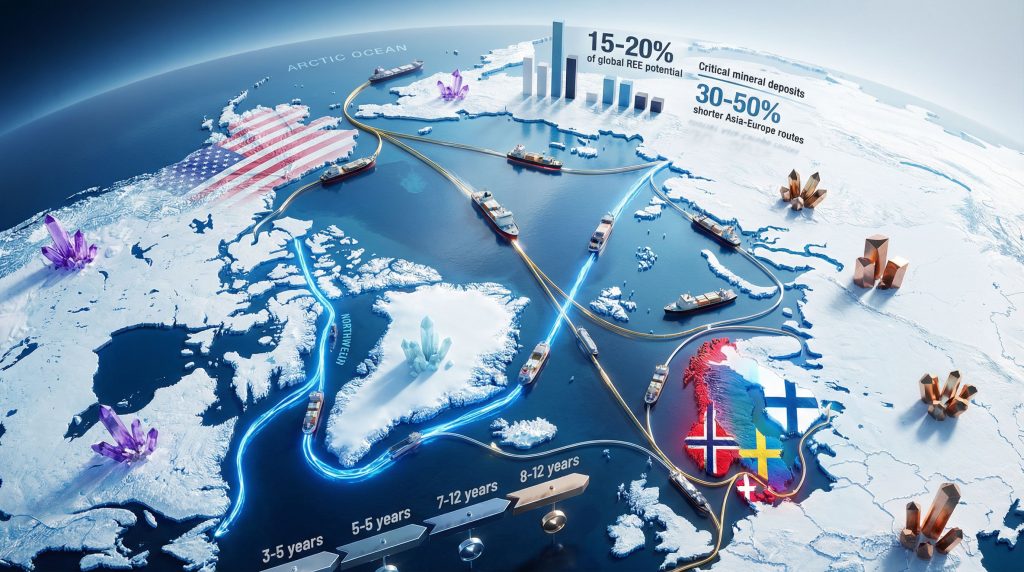
The Arctic represents a convergence of three transformative forces reshaping global supply chain architecture: climate-driven infrastructure opportunities, geopolitical competition over critical resources, and technological advances enabling previously impossible commercial operations. For strategic planners evaluating long-term supply chain resilience, understanding how these dynamics create new pathways for diversification becomes essential. Rather than viewing Arctic development as a distant possibility, current market conditions suggest that U.S. leverage in Arctic supply chain diversification may represent one of the few viable routes to meaningfully reduce dependency on concentrated supplier networks, particularly in critical minerals and rare earth elements.
The strategic implications extend beyond simple resource extraction. Arctic supply chain development operates at the intersection of alliance frameworks, infrastructure investment cycles, and regulatory environments that could either accelerate or constrain diversification efforts. Recent enforcement actions in maritime trade, combined with evolving Nordic partnerships and Greenland's critical minerals potential, create a framework where traditional leverage mechanisms may determine whether Arctic routes become genuine alternatives to existing supply chains or remain marginalised by regulatory uncertainty and capital constraints.
Strategic Foundations of Arctic Supply Chain Influence
The architecture of U.S. leverage in Arctic supply chain diversification rests on three interconnected pillars that differentiate American capabilities from other global powers. These foundations create potential leverage points that, when properly coordinated, could reshape critical mineral flows over the next decade.
Alaskan Resource Base and Processing Potential
Alaska's critical mineral endowment represents a largely untapped strategic asset. The state holds approximately 3.2 million metric tons of rare earth element resources, primarily concentrated in the Bokan Mountain deposit, which contains significant heavy rare earth elements including dysprosium and terbium. This resource base becomes strategically relevant when considering that the United States currently produces zero refined rare earth elements domestically, creating complete import dependency for processing operations.
The scale of Alaska's potential becomes clearer when compared to existing production. MP Materials' Mountain Pass facility in California, representing the only U.S. rare earth mining operation, produces approximately 15% of global rare earth oxide output as of 2024. Scaling similar operations across Alaska's identified deposits could fundamentally alter global supply dynamics, though this requires addressing the 8-12 year development timelines typical for Arctic mineral projects.
Processing infrastructure development faces particular challenges in Arctic environments. Rare earth processing facilities require $500 million to $1.5 billion in capital investment for commercial-scale operations, with Arctic infrastructure costs typically running 2-4 times higher than comparable temperate-zone projects due to extreme conditions, remote locations, and seasonal construction windows.
Nordic Alliance Architecture and Processing Integration
Nordic partnerships amplify U.S. strategic leverage through established industrial capabilities and aligned regulatory frameworks. Norway's developing rare earth processing capabilities at the Fen Complex target production by 2026-2027, while Sweden's discovery of over 1 million tonnes of rare earth oxides in the Kiruna area represents Europe's largest known deposit, announced in January 2023.
The strategic value of Nordic integration extends beyond resource endowments to encompass specialised capabilities:
- Finnish icebreaker construction expertise: Finnish shipyards delivered 50% of the world's icebreaking vessels between 2015-2023
- Norwegian offshore technology: Deep-sea mining and Arctic engineering capabilities developed through petroleum sector experience
- Swedish mining infrastructure: Established large-scale operations producing 90,000 tonnes of iron ore daily from LKAB facilities
- Danish-Greenland relationships: Access to Greenland's estimated 11 million tonnes of rare earth oxides at the Kvanefjeld deposit
The U.S.-Norway Memorandum of Understanding on Critical Minerals, signed in June 2023, establishes frameworks for joint exploration, processing technology sharing, and investment screening. Norway's sovereign wealth fund, holding $1.6 trillion in assets as of Q3 2024, represents substantial potential investment capacity for critical minerals infrastructure development.
Infrastructure Control and Maritime Gateway Development
Arctic infrastructure control creates leverage through logistics chokepoints and operational standards. However, current U.S. capabilities face significant constraints. The U.S. Coast Guard operates only two operational polar icebreakers compared to Russia's fleet of over 40 icebreakers, including nuclear-powered vessels, creating a substantial capability gap for year-round Arctic operations.
Furthermore, port infrastructure development presents both opportunities and challenges. The Port of Nome serves as Alaska's primary Arctic port but has a maximum draft of 6.5 metres and operates seasonally from June to October, limiting commercial shipping capacity. This contrasts with Russia's operation of 10 deep-water Arctic ports with year-round capabilities, including Murmansk handling over 60 million tonnes annually.
The U.S. Coast Guard's Polar Security Cutter programme aims to address icebreaker deficits, with the first new heavy polar icebreaker expected by 2029 and a second vessel by 2031. Total programme costs reach $2.95 billion for the first vessel, with subsequent vessels projected at $2.1 billion each, indicating the substantial investment required to establish Arctic operational parity.
When big ASX news breaks, our subscribers know first
Economic Geography of Arctic Commercial Navigation
Arctic shipping routes fundamentally alter global logistics calculations through distance reductions and transit time savings that create new competitive advantages for supply chain managers. These geographic realities become increasingly relevant as climate change extends navigation windows and reduces traditional barriers to Arctic commerce.
Transit Time Advantages and Cost Implications
The Northern Sea Route between Shanghai and Rotterdam spans approximately 7,900 nautical miles compared to 12,400 nautical miles via the Suez Canal, representing a 36% distance reduction. This geographic advantage translates to average transit times of 20-25 days versus 30-35 days via the Suez Canal during ice-free periods from July through October.
Fuel savings on Northern Sea Route passages reach 20-30% compared to Suez Canal routes due to shorter distances, creating substantial cost advantages for freight operators. However, these savings must be weighed against additional costs including specialised ice-class vessel construction costs that exceed standard vessels by 15-25%, and Arctic insurance premiums that can exceed standard rates by 50-100%.
Inventory cost reductions represent an often-overlooked advantage of Arctic routing. Reduced transit times of 7-15 days enable manufacturers to carry lower inventory levels, reducing working capital requirements and improving cash flow dynamics. For high-value commodities like rare earth elements or processed critical minerals, these inventory savings can offset higher Arctic shipping premiums.
Climate-Driven Infrastructure Development
Arctic navigation windows continue expanding due to climate change impacts. Arctic sea ice extent in September 2023 measured 4.37 million square kilometres, significantly below the 1981-2010 average of 6.4 million square kilometres, indicating extended navigation possibilities. The ice-free navigation season in the Northern Sea Route has extended from approximately 90 days in 2010 to 120-150 days in 2023.
This expanded access creates infrastructure development opportunities but requires specialised capabilities. The International Maritime Organisation's Polar Code, adopted in 2017, mandates specific construction standards for polar water operations, categorised from PC1 (year-round Arctic operations) to PC7 (summer/autumn operation in thin first-year ice).
Communications infrastructure remains a constraining factor. Arctic regions currently operate with approximately 10-15% satellite coverage compared to temperate zones, with latency issues affecting real-time logistics coordination. SpaceX's Starlink constellation has expanded coverage to Arctic regions above 60°N latitude as of 2023, though reliability decreases above 75°N, limiting commercial applications in the highest latitudes.
Comparative Infrastructure Investment Analysis
| Infrastructure Type | U.S. Current Capacity | Russian Capacity | Investment Gap |
|---|---|---|---|
| Polar Icebreakers | 2 operational vessels | 40+ vessels (4 nuclear) | $15-20 billion |
| Deep-water Arctic Ports | 1 seasonal (Nome) | 10 year-round facilities | $8-12 billion |
| Arctic Communication Networks | Limited coverage | Established infrastructure | $3-5 billion |
| Search and Rescue Capability | Seasonal coverage | Year-round operations | $2-3 billion |
Nordic Integration and Strategic Alliance Building
The expansion of U.S. leverage in Arctic supply chain diversification through Nordic partnerships represents a force-multiplier approach that leverages existing capabilities rather than building entirely new infrastructure. This integration strategy addresses capability gaps while distributing investment costs across alliance frameworks, creating opportunities for a significant pivot in critical minerals strategies.
Bilateral Partnership Frameworks and Technology Transfer
The U.S.-Norway critical minerals framework establishes precedents for deeper industrial integration. Beyond the June 2023 memorandum, practical cooperation includes joint research and development in sustainable extraction techniques, shared environmental monitoring systems, and coordinated investment screening to prevent technology transfer to strategic competitors.
Finland's specialised Arctic engineering capabilities deserve particular attention. The country operates the Pyhäsalmi mine, Europe's deepest metal mine at 1,430 metres depth, demonstrating advanced underground mining capabilities directly relevant to Arctic conditions. Finnish industrial electricity prices averaging €60-80 per MWh in 2023 provide competitive advantages for energy-intensive processing operations compared to many other developed economies.
Swedish mining infrastructure offers immediate scaling potential. LKAB's operations produce approximately 90,000 tonnes of iron ore per day from Kiruna and Malmberget mines, demonstrating established large-scale extraction and logistics capabilities. The company's January 2023 announcement of over 1 million tonnes of rare earth oxides in the Kiruna area positions Sweden as a potential major supplier outside Chinese control.
NATO Defence Industrial Base Coordination
NATO's Defence Production Action Plan, announced at the July 2023 Vilnius Summit, emphasises supply chain resilience for critical materials as a collective security issue. This framework extends beyond traditional defence procurement to encompass dual-use minerals and processing capabilities essential for both military applications and civilian technology manufacturing.
Coordinated production capabilities strengthen collective security through redundant supply sources and shared technical standards. Nordic countries contribute specialised capabilities that complement U.S. resource endowments:
- Norwegian offshore expertise: Technology transfer from petroleum sector to deep-sea mining applications
- Finnish shipbuilding capacity: Icebreaker construction and Arctic vessel design capabilities
- Swedish metallurgical knowledge: Advanced processing techniques for complex ore bodies
- Danish Arctic access: Greenland relationship management and environmental compliance frameworks
Investment coordination reduces individual country risk exposure while accelerating development timelines. Norway's sovereign wealth fund represents significant potential capital deployment for critical minerals infrastructure, while Finnish pension funds and Swedish industrial conglomerates provide additional financing sources for large-scale projects.
Greenland Strategic Positioning and Resource Access
Greenland's resource endowment and geographic position create unique strategic opportunities within the Nordic partnership framework. The territory contains multiple world-class deposits including the Kvanefjeld rare earth deposit with 11 million tonnes of rare earth oxides and the Tanbreez project with an estimated 26 million tonnes of rare earth oxides focused on heavy rare earths.
However, regulatory complexity constrains development. Greenland's parliament maintained a zero-tolerance policy for uranium mining since November 2021, complicating development of rare earth deposits with uranium co-occurrence. The 2009 Self-Government Act grants Greenland authority over natural resources while Denmark retains control of foreign affairs and defence, creating complex approval processes for major projects.
Geographic advantages include reduced sailing distances between North America and Europe by approximately 1,800 nautical miles compared to southerly routes. Kangerlussuaq and Nuuk offer potential for ice-free port development with depths suitable for large cargo vessels, though infrastructure development requires substantial investment.
The U.S. maintains Pituffik Space Base (formerly Thule Air Base) in northwest Greenland under a 1951 agreement, housing missile warning systems. This existing presence provides logistical infrastructure and operational experience relevant to expanded commercial activities, though environmental and indigenous rights considerations require careful management.
Structural Constraints and Development Barriers
Despite significant strategic potential, U.S. leverage in Arctic supply chain diversification faces substantial structural constraints that limit the speed and scale of development. Understanding these barriers proves essential for realistic planning and investment allocation as the mining industry evolution continues to reshape global supply chains.
Infrastructure and Operational Capacity Gaps
The icebreaker deficit represents the most visible constraint on Arctic operations. Beyond the numerical disadvantage of 2 U.S. vessels versus 46 Russian icebreakers, operational implications include limited ability to maintain year-round shipping lanes, constrained search and rescue capabilities, and reduced deterrent effect against aggressive actions by other Arctic powers.
The Polar Star, commissioned in 1976, has exceeded its 30-year design life by 18 years and requires annual drydock maintenance to remain operational. This ageing infrastructure creates operational risks and highlights the substantial lead times required for icebreaker replacement. The Polar Security Cutter programme's 2029 delivery timeline for the first new vessel indicates the persistence of capability gaps through the remainder of the decade.
Port infrastructure limitations extend beyond simple capacity constraints. Arctic ports require specialised features including:
- Ice-resistant pier structures capable of withstanding freeze-thaw cycles
- Heavy-lift cargo handling equipment rated for extreme temperature operations
- Fuel storage and transfer systems designed for Arctic conditions
- Maintenance facilities for ice-class vessels and specialised equipment
- Worker accommodation and life support systems for extended Arctic operations
Regulatory and Environmental Compliance Complexity
Permitting timelines represent a critical constraint on Arctic development. Average federal permitting for major mining projects in the U.S. requires 7-10 years from exploration to production, compared to 2-3 years in Australia and 3-4 years in Canada. Environmental Impact Statement processes alone typically require 4-7 years for major mineral extraction projects in Alaska.
Indigenous consultation requirements add complexity and timeline uncertainty. The Alaska Native Claims Settlement Act (1971) granted Alaska Native corporations 44 million acres and $963 million in compensation, creating complex land ownership patterns requiring consultation for resource development. Free, Prior and Informed Consent (FPIC) protocols under the United Nations Declaration on Rights of Indigenous Peoples increasingly influence U.S. federal agency guidelines.
Environmental standards compliance creates cost premiums but also competitive advantages. High sustainability requirements increase initial development costs but attract ESG-focused institutional capital and create long-term competitive advantages through regulatory compliance and social licence to operate. This positions U.S. Arctic projects favourably compared to lower-standard competitors, though it extends development timelines.
Capital Requirements and Investment Risk Assessment
Arctic infrastructure development requires substantial upfront investment with extended payback periods. Capital intensity requirements reach $5-15 billion for typical Arctic mineral projects, including mine development, processing facilities, transportation infrastructure, and support systems. These investment levels exceed many companies' financing capacity and require consortium development or government support.
Risk premium pricing reflects multiple uncertainty sources:
- Technical risks from extreme operating conditions and unproven Arctic mining techniques
- Political risks from changing regulations, indigenous rights claims, and international tensions
- Market risks from commodity price volatility and demand uncertainty
- Environmental risks from climate change impacts on infrastructure and operations
- Operational risks from supply chain disruptions and skilled labour shortages
Long development cycles compound financial risk through extended exposure to changing market conditions, regulatory environments, and competitive dynamics. 8-15 year project timelines from discovery to production require sustained political and financial support through multiple economic cycles and potential changes in government priorities.
Enforcement Mechanisms and Market Leverage Strategies
The transformation of enforcement capability into supply chain advantages requires sophisticated understanding of how regulatory, financial, and insurance mechanisms influence global trade flows. Recent applications of these tools demonstrate both the potential effectiveness and the strategic risks of relying primarily on interdiction rather than compliance-based frameworks.
Maritime Interdiction and Legal Framework Applications
Recent enforcement actions illustrate how existing legal authorities can disrupt targeted supply chains. When vessels operate with false flagging, lack proper insurance coverage, or violate court-authorised sanctions, interdiction becomes possible within international law frameworks, particularly when coordinated with allies who provide port access and logistical support.
Protection and Indemnity (P&I) insurance covers approximately 90% of global shipping tonnage, with 13 International Group P&I Clubs dominating the market. Loss of P&I coverage effectively prevents vessels from accessing major ports globally, as port authorities typically require proof of insurance coverage. This creates powerful leverage over shipping behaviour without requiring direct enforcement action.
Flag state regulations provide additional control mechanisms. Vessel registration standards that require transparency in ownership structures, cargo manifests, and financing arrangements create barriers for non-compliant operations. The United States can influence these standards through bilateral agreements with flag states and through International Maritime Organisation regulatory development.
However, persistent reliance on interdiction risks converting trade competition into permanent military posturing. Alternative flags, naval escorts, financial workarounds, and deeper bloc formation represent predictable adaptations to enforcement-focused approaches. Even where the United States maintains structural advantages, habitual seizure operations raise long-term costs for global commerce, insurance markets, and American exporters.
Financial System Integration and Transaction Control
The Society for Worldwide Interbank Financial Telecommunication (SWIFT) processes approximately 42 million messages daily, representing the majority of international financial transactions. The U.S. Treasury's Office of Foreign Assets Control (OFAC) maintains a Specially Designated Nationals (SDN) List with over 9,000 individuals and entities subject to asset freezes and transaction prohibitions, creating comprehensive barriers to financial system access.
Dollar-denominated commodity transactions provide additional leverage through currency network effects. Most international commodity markets operate in dollars, requiring access to U.S. banking networks and Federal Reserve systems for settlement. This creates dependency on U.S. financial infrastructure that can be leveraged for compliance enforcement.
The Committee on Foreign Investment in the United States (CFIUS) reviewed 286 transactions in 2022 with median review times of 90 days for voluntary notifications. The Foreign Investment Risk Review Modernisation Act (FIRRMA) of 2018 expanded CFIUS jurisdiction to include non-controlling investments in critical infrastructure, critical technology, and sensitive personal data, providing tools to protect critical supply chain investments from strategic competitor influence.
Conditional Market Access and Compliance Frameworks
The strategic choice between enforcement as deterrent versus enforcement as pathway to compliance-based market reentry determines long-term outcomes. Conditional sanctions relief tied to compliance mechanisms, insurance frameworks, and allied offtake agreements can restore transparent commerce more effectively than indefinite blockades.
Escrow and monitoring systems provide mechanisms for revenue transparency while maintaining oversight. Iraq's Oil-for-Food programme and Iran's Joint Comprehensive Plan of Action (JCPOA) implementation created precedents for revenue management under international oversight. These frameworks demonstrate the feasibility of conditional normalisation approaches that replace grey market routes with lawful commerce under monitoring regimes.
Allied offtake agreements anchor demand in compliant jurisdictions while draining grey markets of commercial relevance. Long-term purchase contracts with allied processing facilities or strategic reserves provide guaranteed markets for producers who meet transparency and compliance standards, creating positive incentives rather than relying solely on enforcement deterrence. This approach aligns with the recent mineral production order that emphasises domestic production capabilities.
Greenland's Strategic Role in Arctic Supply Chain Architecture
Greenland's combination of resource endowment, strategic location, and political complexity positions the territory as a critical test case for U.S. leverage in Arctic supply chain diversification. The territory's development trajectory will likely determine whether Arctic resources become genuine alternatives to existing supply chains or remain constrained by regulatory uncertainty and geopolitical tensions.
Resource Endowment and Geological Advantages
Greenland contains multiple world-class critical mineral deposits that could fundamentally alter global supply dynamics. Beyond the Kvanefjeld rare earth deposit's 11 million tonnes of rare earth oxides, the territory hosts the Tanbreez rare earth project with an estimated 26 million tonnes of rare earth oxides focused on heavy rare earths essential for permanent magnet applications and advanced electronics.
The Citronen Fjord zinc-lead deposit contains 13.1 million tonnes grading 5.7% zinc and 0.4% lead, representing significant base metal potential for industrial applications. Additional exploration prospects suggest substantial undiscovered resources across multiple commodity types, though systematic resource assessment remains incomplete due to geographic constraints and limited infrastructure.
Geological advantages include relatively simple extraction scenarios for many deposits, with some resources accessible through open-pit operations rather than expensive underground mining. However, Arctic operating conditions, including extreme weather, permafrost, and seasonal access limitations, create offsetting challenges that increase operational complexity and costs.
Political Framework and Regulatory Complexity
The Danish-Greenland-U.S. triangular relationship creates complex approval processes for major resource development. Greenland's 2009 Self-Government Act grants authority over natural resources while Denmark retains foreign affairs and defence control, requiring coordination across multiple sovereignty levels for major projects.
Greenland's November 2021 zero-tolerance uranium policy complicates rare earth development where uranium occurs as a byproduct. Many rare earth deposits globally contain uranium co-occurrence, and the prohibition creates technical and economic challenges for project development. This policy reflects environmental concerns and Greenlandic political preferences but constrains resource development options.
Indigenous rights considerations influence project approval processes through community consultation requirements and benefit-sharing negotiations. Greenlandic Inuit communities maintain traditional land use patterns that require accommodation in industrial development planning, creating additional stakeholder management requirements for project developers.
Infrastructure Development Scenarios and Investment Requirements
Greenland's infrastructure development presents multiple pathway scenarios with varying investment requirements and strategic implications:
Minimal Extraction Scenario ($2-5 billion investment, 5-7 years timeline)
- Small-scale operations focused on highest-grade deposits
- Seasonal shipping and basic port facilities
- Limited processing with concentrate export to established facilities
- Regional supply impact supporting Nordic processing networks
Strategic Partnership Development ($8-12 billion investment, 7-10 years timeline)
- Coordinated U.S.-Danish-Greenlandic development framework
- Integrated transportation and processing infrastructure
- Environmental monitoring and community benefit programmes
- Allied supply security through guaranteed access arrangements
Full Industrial Hub Development ($15-25 billion investment, 10-15 years timeline)
- Comprehensive extraction, processing, and export capabilities
- Year-round port facilities and transportation networks
- Integrated power generation and industrial support systems
- Global supply transformation through major production capacity
The strategic partnership pathway offers the best balance of investment requirements, development timeline, and strategic objectives. This approach leverages existing Danish-Greenlandic relationships while providing U.S. access and allied supply security without requiring the massive capital commitments of full industrial hub development.
The next major ASX story will hit our subscribers first
Arctic Shipping Routes and Global Trade Pattern Evolution
The transformation of Arctic shipping from experimental navigation to commercial viability represents a fundamental shift in global logistics that directly supports U.S. leverage in Arctic supply chain diversification. Understanding the commercial dynamics of these routes proves essential for supply chain planning and infrastructure investment decisions, particularly in the context of developing a critical minerals reserve strategy.
Northern Sea Route Commercial Development
Northern Sea Route cargo traffic reached 36.3 million tonnes in 2023, an increase from 34 million tonnes in 2022, though still below the 2021 peak of 34.8 million tonnes. This volume demonstrates established commercial activity while indicating sensitivity to geopolitical tensions and operational challenges that affect route reliability.
Seasonal navigation windows currently span 4-6 months annually but continue expanding due to climate change. Ice-free periods have extended from approximately 90 days in 2010 to 120-150 days in 2023, creating longer operational windows for commercial shipping. However, year-round navigation remains impossible without icebreaker escort, limiting the route's utility for time-sensitive supply chains requiring predictable transit schedules.
Cargo type suitability favours bulk commodities and containerised goods where the 20-30% fuel savings from shorter distances justify higher Arctic operating costs. Time-sensitive manufactured goods, critical minerals, and high-value electronics benefit most from transit time reductions, while bulk commodities like grain or coal may find Arctic premiums exceed distance savings.
Northwest Passage Development Potential
The Northwest Passage through Canadian Arctic waters saw approximately 40 full transits in 2023, compared to just 4 in 2009, indicating growing commercial interest despite legal and operational complexities. Canadian sovereignty claims over these waters as territorial rather than international straits create regulatory uncertainty that complicates commercial shipping development.
U.S. strategic interests in Northwest Passage development centre on Alaska port development supporting Trans-Arctic commerce. Nome's positioning as a potential North American Arctic gateway requires substantial infrastructure investment but could capture trans-Arctic trade flows between Asia and Eastern North America, providing alternatives to Panama Canal routing.
Infrastructure investment needs include icebreaking support, search and rescue capabilities, and communications systems covering the entire passage. Current infrastructure gaps limit commercial viability, but coordinated U.S.-Canadian development could create Trans-Arctic shipping networks supporting North American supply chain resilience.
Transportation Network Integration and Logistics Optimisation
Arctic ports require integration with continental transportation networks to maximise commercial value. Nome's potential as an Arctic gateway depends on rail and highway connections to continental markets, enabling efficient cargo movement from Arctic shipping to inland distribution centres.
Intermodal connections become critical for supply chain optimisation. Container cargo arriving via Arctic routes requires efficient transfer to rail or trucking networks for final delivery. Cold storage facilities, customs processing capabilities, and cargo handling equipment must operate reliably in Arctic conditions to prevent logistics bottlenecks.
Inventory management benefits from reduced transit times create economic incentives for Arctic routing adoption. 7-15 day transit time savings enable manufacturers to carry lower inventory levels, reducing working capital requirements and improving cash flow. For high-value critical minerals and rare earth elements, inventory carrying cost reductions can offset Arctic shipping premiums.
Long-Term Strategic Architecture and Competitive Dynamics
The evolution of U.S. leverage in Arctic supply chain diversification will likely determine whether global supply chains fragment into competing blocs or integrate through rules-based frameworks that balance strategic competition with commercial efficiency. This transformation is particularly relevant in the context of evolving US strategy in Arctic development.
Bloc Formation Versus Integration Scenarios
Western Arctic Corridor development represents the most likely scenario for U.S.-Nordic-Canadian supply chain integration. This approach reduces Chinese dependency through allied coordination while maintaining commercial efficiency through shared infrastructure and integrated processing capabilities. Success requires sustained political commitment across multiple countries and election cycles, challenging long-term consistency.
Competitive fragmentation scenarios involve rival Arctic development programmes creating parallel trade networks with minimal integration. Russia's Arctic development continues independently, while China pursues Arctic shipping access through commercial partnerships and infrastructure investments. This fragmentation increases global supply chain costs while reducing systemic resilience through duplicated infrastructure and competing standards.
Hybrid cooperation scenarios involve selective collaboration on environmental and safety standards despite strategic competition. Arctic operations require high technical standards for environmental protection and operational safety, creating potential areas for coordination even among strategic competitors. This approach maximises safety and environmental protection while accepting strategic competition in market access and resource control.
Technology Leadership and Standards Development
Arctic operations standards present opportunities for U.S. and allied leadership in global benchmark setting. Environmental standards, safety requirements, and technical specifications developed for Arctic operations often exceed global norms, creating competitive advantages for companies and countries that meet high standards while excluding those that cannot.
Digital supply chain integration through blockchain, Internet of Things (IoT), and satellite monitoring creates transparency advantages for compliant operators. These technologies enable real-time tracking of cargo movements, environmental compliance monitoring, and supply chain verification that supports ESG requirements while creating barriers for non-transparent operations.
Sustainable development frameworks attract institutional investment through ESG compliance requirements. Environmental, Social, and Governance (ESG) standards increasingly influence capital allocation decisions, with Arctic projects offering opportunities to demonstrate leadership in sustainable resource development that attracts long-term institutional investment.
Economic Security and Resilience Outcomes
Supply shock mitigation through diversified sourcing reduces single-point-of-failure risks in critical mineral supply chains. Arctic resources provide geographic diversity, political risk distribution, and technical redundancy that strengthen overall supply chain resilience against disruptions from natural disasters, political instability, or deliberate interdiction.
Allied industrial capacity coordination strengthens collective security through redundant production and processing capabilities. Distributed processing networks across U.S., Nordic, and Canadian facilities create strategic depth that prevents single-country disruption from compromising allied access to critical materials essential for defence applications and civilian technology manufacturing.
Innovation ecosystem development through R&D partnerships drives next-generation extraction and processing technologies. Arctic operating conditions require technological advances in extraction efficiency, environmental protection, and operational safety that create competitive advantages applicable to global operations. These innovations strengthen long-term competitiveness while advancing environmental sustainability goals.
Furthermore, this development occurs within the broader context of transformational changes in global logistics that are reshaping international trade patterns and creating new opportunities for strategic positioning.
Disclaimer: This analysis involves forecasts, speculation, and projections about future Arctic development, geopolitical relationships, and market conditions. Arctic infrastructure development faces significant technical, financial, regulatory, and environmental risks that may prevent or delay projected outcomes. Investment decisions should consider these uncertainties and consult qualified professionals familiar with specific project risks and regulatory requirements.
Ready to Position Yourself Ahead of Critical Minerals Discoveries?
Discovery Alert's proprietary Discovery IQ model delivers real-time alerts on significant ASX mineral discoveries, empowering investors to identify actionable opportunities in critical minerals and rare earth elements before the broader market reacts. As Arctic supply chains and strategic resource developments reshape global markets, subscribers receive instant insights into emerging opportunities across all commodity sectors. Start your 30-day free trial today to gain the market-leading advantage needed for tomorrow's resource landscape.