June 18, 2026
The Strategic Infrastructure Challenge Behind US LNG Dominance
The global energy landscape has undergone a fundamental transformation that extends far beyond simple supply chain adjustments. What appears as market diversification actually represents a concentrated shift toward American liquefied natural gas, creating new vulnerabilities that European policymakers have yet to fully acknowledge. The structural dependencies emerging from US LNG exports to Europe reveal complex layers of infrastructure constraints, pricing mechanisms, and geopolitical leverage that challenge traditional assumptions about energy security.
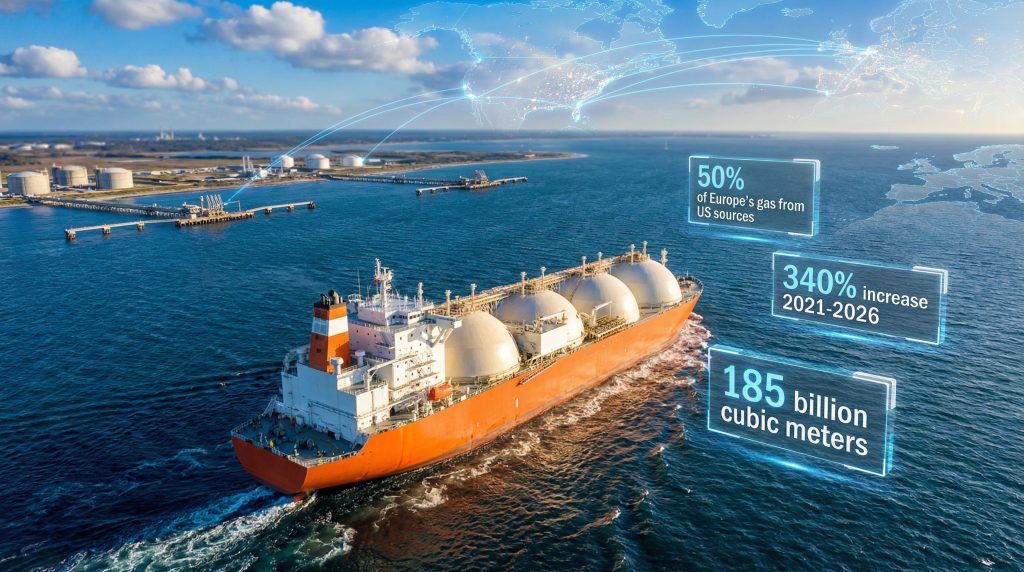
European energy systems now operate within a framework where approximately 50% of total gas requirements originate from American LNG facilities along the Gulf Coast. This concentration represents not diversification but rather a substitution of dependencies, with American suppliers replacing Russian pipeline gas as the dominant external source. Furthermore, the infrastructure supporting this arrangement operates near capacity limits during peak demand periods, creating systematic bottlenecks that compound supply vulnerabilities.
When big ASX news breaks, our subscribers know first
Market Concentration and Structural Dependencies
The mathematics of Europe's energy transition reveal the extent of its strategic exposure to American supply decisions. Current data shows European LNG imports reaching 185 billion cubic meters annually, with American exports to European markets increasing by 340% between 2021 and 2026. These figures illustrate not just growth but a fundamental reorientation of continental energy flows toward a single external source.
Regional Dependency Breakdown:
• Germany imports 45% of its gas requirements from US sources
• Netherlands shows 52% dependency on American LNG
• Poland demonstrates 67% reliance on US imports
• Spain maintains 38% import share from American suppliers
The concentration risks embedded within these statistics become apparent when examined alongside Europe's limited alternatives. Qatar's capacity constraints, combined with infrastructure limitations in African supplier nations, create structural barriers to meaningful diversification. Moreover, Australian LNG commitments to Asian markets further limit European access to alternative sources, leaving the continent with minimal flexibility during supply disruptions.
Infrastructure Bottlenecks and Capacity Constraints
European regasification infrastructure operates as the critical chokepoint determining the continent's ability to receive and process LNG imports. Current capacity utilization rates across major European terminals reveal the system's vulnerability to supply disruptions or demand spikes.
Terminal Capacity Analysis:
| Region | Annual Capacity (bcm) | Current Utilization | Critical Threshold |
|---|---|---|---|
| Northwestern Europe | 95 | 87% | 90% maximum |
| Mediterranean Ports | 45 | 82% | 85% maximum |
| Baltic/Eastern Europe | 25 | 91% | 95% maximum |
| Iberian Peninsula | 60 | 79% | 82% maximum |
These utilization rates indicate that European terminals operate with minimal spare capacity during normal demand periods. Winter heating seasons push utilization beyond safe operational thresholds, creating scenarios where additional supply cannot be accommodated regardless of availability or pricing. Consequently, the infrastructure constraints represent fixed limitations that cannot be resolved through market mechanisms or financial solutions.
How Do Global Markets Influence European Energy Costs?
The integration of American LNG into European gas markets has created complex pricing relationships that transmit domestic US market conditions directly to European consumers. Henry Hub pricing at American production sites correlates strongly with European Title Transfer Facility benchmarks, establishing transmission mechanisms for US market volatility. In addition, natural gas price trends demonstrate how external factors impact regional pricing structures across different markets.
Price Correlation Analysis:
• Henry Hub to European TTF correlation coefficient: 0.73
• Transport and liquefaction cost premiums: $3-4 per MMBtu
• Seasonal volatility amplification factor: 2.3x multiplier
• Contract flexibility percentage: 60% of flows under spot conditions
This pricing structure means that domestic American supply constraints, production disruptions, or demand increases translate directly into European energy costs. The correlation mechanisms operate regardless of European market conditions, creating situations where continental consumers bear the cost of American domestic energy dynamics.
Geopolitical Leverage and Energy Diplomacy
The concentration of European gas imports from American sources has created unprecedented opportunities for energy diplomacy and strategic pressure. Washington's authority over LNG export licensing, combined with American control over cargo allocation during supply disruptions, represents a new dimension of transatlantic power projection that operates outside traditional diplomatic channels. However, these developments coincide with broader challenges facing nations managing energy transition challenges in an increasingly complex global environment.
Leverage Mechanisms Include:
• Department of Energy export licensing authority
• Infrastructure financing through development banks
• Cargo diversion capabilities during emergencies
• Long-term contract negotiation influence
• Strategic reserve access during crisis periods
"The structural position of US LNG in European energy markets creates systematic opportunities for political influence that extend beyond traditional diplomatic relationships. Energy flows become instruments of policy coordination, with supply security contingent on broader alignment across trade, security, and geopolitical issues."
Alternative Supply Scenarios and Market Realities
European efforts to diversify away from American LNG face fundamental constraints that limit realistic alternatives in the medium term. Qatar's expansion projects represent the most significant potential alternative, but capacity additions won't reach full output until 2029, leaving a multi-year window of continued American dependence. Furthermore, policy makers must navigate the complex relationship between US tariffs and inflation when considering alternative supply arrangements.
Alternative Supplier Assessment:
• Qatari expansion timeline: 2029 for meaningful additional capacity
• African supplier infrastructure: Limited by financing constraints
• Russian supply restoration: Politically impossible under current conditions
• Norwegian production: Already operating at maximum sustainable levels
• Azerbaijani pipeline capacity: Insufficient for meaningful substitution
The realistic assessment of alternatives reveals that European diversification efforts face structural limitations that cannot be overcome through policy decisions or financial commitments alone. Physical infrastructure, geological constraints, and geopolitical realities combine to maintain American dominance in European LNG markets for the foreseeable future.
The next major ASX story will hit our subscribers first
Regional Variations in Import Dependency
European nations exhibit varying degrees of vulnerability to American LNG supply disruptions based on their geographic position, existing infrastructure connections, and historical energy relationships. Northwestern European countries benefit from greater terminal capacity and pipeline interconnections, while Eastern European nations face more constrained alternatives and higher dependency ratios.
Infrastructure Resilience by Region:
• Northwestern Europe: Multiple terminal access points and strong interconnections
• Mediterranean Region: Limited terminal capacity with expansion constraints
• Eastern Europe: High dependency with minimal alternative supply routes
• Iberian Peninsula: Good terminal capacity but limited European grid connections
These regional variations create scenarios where supply disruptions affect European nations differently, potentially fragmenting continental responses to energy security challenges. In addition, the asymmetric vulnerabilities could undermine coordinated European energy policies during crisis periods, particularly as US‑China trade impact creates additional market uncertainties.
What Are the Economic Implications of LNG Dependency?
American LNG imports carry significant cost implications for European consumers and industrial users compared to historical pipeline gas supplies. The premium pricing structure of LNG creates inflationary pressures across energy-intensive sectors while reducing the competitiveness of European industrial production relative to regions with access to cheaper energy sources.
Sectoral Cost Impact Analysis:
| Economic Sector | Additional Cost (€/MWh) | Annual Impact (€ billions) | Competitiveness Effect |
|---|---|---|---|
| Residential Users | 15-20 | 45-60 | Reduced disposable income |
| Industrial Production | 12-18 | 35-50 | Export competitiveness loss |
| Power Generation | 10-15 | 25-35 | Electricity price increases |
| Chemical Industry | 20-25 | 15-25 | Production cost disadvantage |
The cumulative economic impact of higher energy costs affects European competitiveness in global markets while reducing domestic purchasing power. Industrial sectors face particular challenges as energy-intensive production becomes economically unviable relative to competitors with access to lower-cost energy sources.
Supply Chain Vulnerabilities and Logistical Constraints
The LNG supply chain connecting American production facilities to European terminals involves complex logistical arrangements that create multiple points of potential failure. Shipping capacity, terminal scheduling, and cargo handling capabilities represent constraints that can disrupt supply flows regardless of production availability or contract arrangements.
Critical Supply Chain Elements:
• LNG tanker availability during peak demand periods
• Terminal berth scheduling and cargo handling capacity
• Storage tank availability at receiving terminals
• Pipeline distribution capacity from terminals to consumption centers
• Weather-related disruptions to shipping routes
These logistical vulnerabilities mean that European gas security depends not only on American production decisions but also on the complex maritime and terminal infrastructure connecting suppliers to consumers. Disruptions anywhere in this chain can create supply shortages that cannot be resolved through alternative sources. Moreover, oil price rally under tariffs demonstrates how trade policies can further complicate energy logistics.
Strategic Reserve Requirements and Crisis Management
European strategic gas reserve requirements have evolved in response to supply security concerns, but current reserve levels remain insufficient relative to the continent's dependency on external suppliers. The mathematical relationship between reserve capacity and consumption patterns reveals gaps in crisis preparedness that could prove critical during extended supply disruptions.
Reserve Adequacy Analysis:
• Current reserve capacity: 90-day minimum requirement
• Winter consumption rates: Exceed reserve replacement capability
• Strategic buffer adequacy: Insufficient for extended disruptions
• Regional reserve distribution: Uneven across European markets
• Emergency allocation mechanisms: Underdeveloped for crisis scenarios
The reserve system provides limited protection against extended supply disruptions or coordinated supply constraints. European reserve policies assume continued access to global LNG markets, an assumption that may prove optimistic during geopolitical tensions or infrastructure failures.
Future Capacity Expansion and Market Evolution
American LNG export capacity continues expanding through comprehensive infrastructure development projects along the Gulf Coast. These capacity additions will further cement US dominance in global LNG markets while potentially moderating price volatility through increased supply flexibility, though expansion timelines remain subject to regulatory and financing constraints.
According to industry analysis, US LNG exports have fundamentally altered global energy markets, creating new dependencies that extend far beyond traditional supply relationships.
Projected Capacity Timeline:
• 2026: Additional 6-8 billion cubic feet per day
• 2027-2028: Incremental 12-15 bcf/d capacity additions
• 2029-2030: Total new capacity exceeding 20 bcf/d
• Long-term projections: Continued growth through 2035
The expansion trajectory reinforces American market dominance while creating scenarios where European energy security becomes increasingly dependent on American domestic energy policies and infrastructure investment decisions. The capacity growth may provide some price moderation but does not address fundamental dependency concerns.
How Can Europe Mitigate Supply Risks?
European nations are developing various risk mitigation approaches to manage their dependence on American LNG, though the effectiveness of these strategies remains constrained by physical and economic limitations. Infrastructure investments, alternative fuel development, and demand reduction initiatives represent partial solutions that cannot fully eliminate dependency vulnerabilities.
As research from Brussels Signal indicates, US LNG exports to Europe have surged, raising concerns about creating new forms of energy dependency that mirror previous vulnerabilities.
Mitigation Framework Options:
• Strategic gas reserve expansion beyond current minimums
• Accelerated renewable energy deployment for baseload substitution
• Industrial fuel switching capabilities for flexible demand response
• Enhanced regional interconnection infrastructure for supply sharing
• Emergency demand curtailment protocols for crisis management
These mitigation strategies require significant investment and extended implementation timelines, meaning that European vulnerability to American supply decisions will persist regardless of policy responses. The physical constraints of energy infrastructure limit the speed and scope of diversification efforts.
Long-term Market Scenarios and Strategic Implications
Multiple scenarios exist for the evolution of transatlantic LNG relationships through 2035, with outcomes dependent on American domestic demand growth, alternative supplier development, and European decarbonisation policies. The scenario analysis reveals persistent American dominance under most realistic assumptions about market development.
Strategic Scenario Framework:
• Base Case Scenario: Continued US dominance with 60-70% European market share
• Diversification Success: Reduced dependency to 40-50% through alternative suppliers
• Domestic Constraint: US export limitations due to internal American demand growth
• Crisis Scenario: Supply disruptions forcing emergency European responses
The scenario analysis indicates that US LNG exports to Europe will remain fundamentally connected to American energy policy decisions for the foreseeable future, regardless of diversification efforts or alternative supplier development. This structural dependency creates long-term strategic vulnerabilities that extend beyond energy markets into broader geopolitical relationships.
This analysis reflects current market dynamics and infrastructure realities as of early 2026. Energy market conditions and geopolitical relationships may evolve, potentially affecting the strategic implications outlined above. Readers should consider multiple scenarios when assessing energy security risks and investment decisions.
Are You Positioned to Capitalise on Energy Sector Discoveries?
Discovery Alert's proprietary Discovery IQ model delivers real-time alerts on significant ASX mineral discoveries, including critical energy transition materials and commodities that power global infrastructure development. With major discoveries generating substantial returns for early investors, subscribers gain immediate insights into actionable trading opportunities across energy metals, rare earths, and strategic minerals. Begin your 14-day free trial today to secure your market-leading advantage in Australia's dynamic mining sector.