June 9, 2026
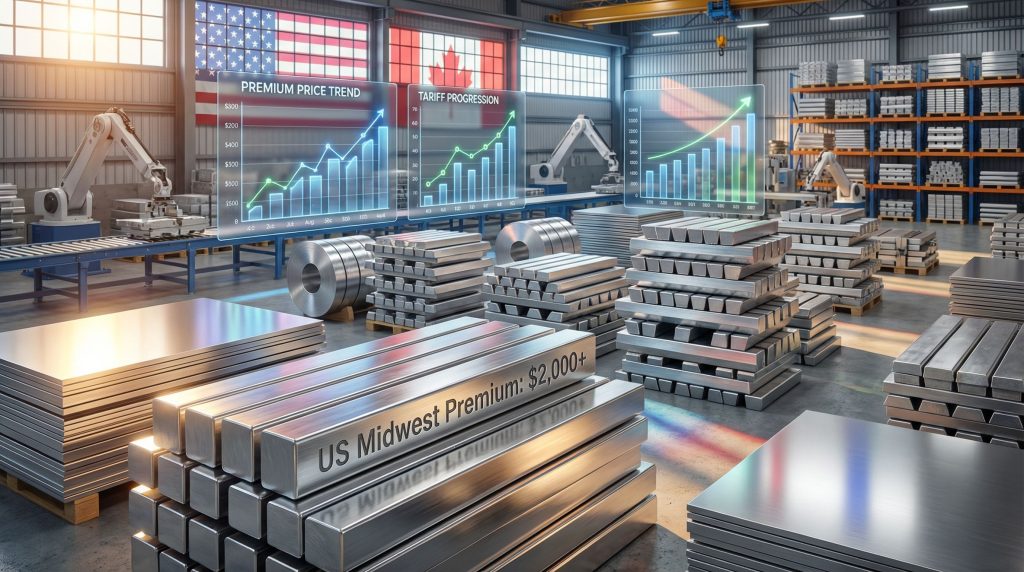
The US Midwest aluminium premium has emerged as a critical indicator of North American metal market dynamics, reflecting complex interactions between trade policy, supply chain logistics, and industrial demand patterns. Recent developments have demonstrated how US tariffs impact regional pricing mechanisms in ways that extend far beyond simple protectionist calculations. The unprecedented premium levels reached in early 2026 illustrate fundamental disruptions to established aluminium trading patterns across the continent.
Understanding Regional Aluminium Premium Dynamics in North American Markets
Base metals trading operates through a sophisticated pricing mechanism that extends far beyond simple spot market quotations. Industrial consumers purchasing physical aluminium encounter a multi-layered cost structure where regional premiums represent the gap between theoretical exchange prices and real-world delivery economics. These premiums reflect fundamental market inefficiencies, geographic constraints, and the complex logistics required to move metal from production centers to end-use manufacturing facilities.
Furthermore, the interaction between global benchmark prices and regional delivery costs creates opportunities for arbitrage that professional trading firms actively exploit. However, the current market environment demonstrates how policy interventions can disrupt these traditional arbitrage relationships.
What Drives Regional Price Differentials in Base Metal Trading?
The US Midwest aluminium premium exemplifies how regional pricing mechanisms function independently of global benchmark rates established on exchanges like the London Metal Exchange. While LME prices provide a baseline reference for aluminium valuation, they represent an abstract pricing construct that assumes perfect market liquidity and zero transaction costs.
Regional premiums capture the true cost of physical metal acquisition, incorporating multiple components that vary significantly by geography and market conditions:
- Transportation logistics from port facilities to inland distribution centers
- Warehousing infrastructure costs and storage capacity constraints
- Working capital financing expenses for inventory carrying
- Insurance and risk management premiums for physical commodity exposure
- Duty-paid delivery terms and associated customs clearance procedures
The premium structure reflects the disconnect between major import ports and inland industrial consumption centers. For the US Midwest market, this geographic separation requires approximately 1,000-1,500 miles of overland transportation from Gulf Coast entry points to manufacturing hubs in Michigan, Ohio, and Indiana.
The Midwest Premium Structure: Beyond Simple Transportation Costs
Industrial aluminium pricing in the American Midwest operates through a sophisticated assessment methodology that captures real-world transaction economics. Independent pricing agencies conduct systematic market participant surveys to establish representative premium levels through comprehensive data collection processes.
This price discovery process encompasses:
- Producer quotations from primary aluminium smelters and merchant suppliers
- Distributor pricing from regional wholesalers and trading companies
- End-user transaction data from automotive and construction industry purchasers
- Spot market activity reflecting immediate availability and delivery terms
The resulting premium can exhibit significant daily volatility due to the concentrated nature of regional supply sources and inventory management decisions by a limited number of major market participants. Unlike exchange-traded futures contracts with thousands of participants, regional physical markets depend on a smaller ecosystem of suppliers and consumers.
When big ASX news breaks, our subscribers know first
How Do Trade Policies Reshape Domestic Aluminium Market Economics?
Trade policy interventions create fundamental disruptions to established supply chain patterns and pricing mechanisms. The implementation of protectionist measures transforms market dynamics by altering the relative economics of domestic production versus international sourcing. Additionally, tariffs and investment decisions create cascading effects that extend far beyond simple tariff calculations.
Section 232 Tariff Framework and Market Response Mechanisms
The Trump administration's application of Section 232 national security provisions represents a dramatic shift in US trade policy toward aluminium imports. Beginning in June 2025, the implementation of 50% ad valorem tariffs eliminated previous exemption frameworks that had provided preferential treatment for major trading partners including Canada and Mexico.
| Timeline | Policy Change | Tariff Rate | Premium Impact |
|---|---|---|---|
| June 2025 | Section 232 implementation | 50% on all imports | Premium rises to $1,408/tonne |
| November 2025 | Sustained tariff regime | 50% maintained | Premium reaches $1,950/tonne |
| January 2026 | Continued enforcement | 50% maintained | Premium hits $2,182/tonne |
This policy framework operates as a fundamental restructuring of import economics. For aluminium trading at $2,500 per tonne on the LME, the tariff burden creates an additional $1,250 per tonne cost for imported material. Combined with ocean freight, insurance, and financing expenses, total landed costs approach $3,950-4,200 per tonne, establishing a structural floor for domestic pricing.
Supply Chain Reconfiguration Under Protectionist Measures
The elimination of preferential treatment for Canadian aluminium represents a particularly significant market disruption. Canada traditionally supplied substantial volumes to US markets under reduced tariff rates or exemption frameworks. Consequently, Canadian supply shifts have created fundamental changes to North American trade patterns as the blanket 50% rate removes previous differentiation.
Import volume data reveals the scale of market adjustment:
- Q1 2025: 1,070,000 tonnes (baseline pre-tariff implementation)
- Q2 2025: 834,552 tonnes (23.25% quarterly decline)
- Q3 2025: 687,586 tonnes (17.6% sequential decline, 35.6% cumulative reduction)
These sequential quarterly declines demonstrate substantial demand destruction as end-users reduced consumption rather than accept elevated premiums. The cumulative 35.6% import reduction represents approximately 400,000-500,000 tonnes of annual supply removal from US markets.
Moreover, the US‑China trade war dynamics have compounded these supply constraints by limiting alternative sourcing options for industrial consumers.
What Economic Forces Created the $2,000+ Premium Threshold?
Market dynamics in commodity trading often exhibit non-linear responses to supply-demand imbalances. Small percentage changes in available supply can produce disproportionate price movements when demand exhibits inelastic characteristics. The breach of the $2,000 per tonne US Midwest aluminium premium threshold represents such a market dislocation, driven by converging supply constraints and relatively inflexible industrial demand.
Demand-Supply Imbalance Quantification
The structural supply deficit created by import volume collapse forced industrial consumers into increasingly competitive bidding for available inventory. US aluminium consumption typically approximates 3.5 million tonnes annually, with domestic primary production contributing roughly 1.0 million tonnes. This creates a baseline import requirement of 2.5 million tonnes under normal consumption patterns.
The 2025 import trajectory, however, suggested an annualized rate of only 2.0-2.1 million tonnes, creating a supply gap of 400,000-500,000 tonnes. This deficit forced end-users to choose between accepting premium increases, reducing consumption, seeking alternative materials, or drawing down strategic inventory reserves.
Historical premium progression illustrates the acceleration:
| Date | Premium Level | Change from Previous |
|---|---|---|
| July 1, 2025 | $1,300/tonne | Post-tariff baseline |
| November 10, 2025 | $1,950/tonne | +$650/tonne (+50%) |
| January 8, 2026 | $2,004/tonne | +$54/tonne (threshold breach) |
| January 28, 2026 | $2,182/tonne | +$178/tonne (all-time high) |
Market Microstructure and Price Discovery Mechanisms
The acceleration in premium expansion reflects structural characteristics of regional physical markets that differ fundamentally from exchange-traded commodity futures. Physical aluminium markets operate with limited participants, concentrated supply sources, and relatively inflexible short-term demand patterns from industrial consumers.
Key volatility drivers identified in the market include:
- Pre-buying rushes followed by inventory rationalization as importers frontloaded shipments before tariff implementation
- Global supply disruptions in European aluminium production reducing international arbitrage possibilities
- LME warehouse stock depletion limiting the elasticity of global supply response
- Retaliatory trade measures from China and the EU creating uncertainty regarding market access and trade flows
The combination of these factors created a feedback loop where each quarterly import decline compounded scarcity conditions, driving disproportionate premium increases as marginal buyers bid aggressively for remaining available supply.
How Does Premium Volatility Impact Industrial End-Users?
Manufacturing sectors that depend heavily on aluminium inputs face significant operational challenges when regional premiums exhibit extreme volatility. The automotive industry, construction sector, and aerospace manufacturers typically operate on fixed-price contracts with downstream customers, making rapid input cost changes difficult to absorb without margin compression or contract renegotiation.
Manufacturing Cost Pass-Through Dynamics
The 67.8% premium expansion experienced over the six-month period from July 2025 to January 2026 created unprecedented cost pressure for industrial consumers. In addition to immediate supply concerns, tariff policy implications forced aluminium-intensive manufacturers to evaluate several strategic responses:
- Immediate cost absorption through reduced operating margins
- Contract renegotiation with downstream customers to pass through input cost increases
- Material substitution toward steel alternatives or composite materials where technically feasible
- Production reduction to reduce overall aluminium consumption requirements
The automotive sector, which typically consumes 250-300 kilograms of aluminium per vehicle, experienced particular pressure. With premium increases of $882 per tonne from baseline levels, the incremental cost impact approached $200-300 per vehicle for aluminium-intensive models.
Regional Competitiveness and Investment Decisions
Sustained high premiums fundamentally alter the economics of domestic aluminium production capacity. Primary smelter operations that previously operated at marginal profitability become highly attractive under elevated premium environments. The premium expansion effectively provides domestic producers with protection equivalent to the tariff rate plus additional scarcity rents.
Investment implications for the North American market include:
- Capacity restart economics for previously mothballed smelter facilities
- Foreign direct investment attraction for downstream processing operations seeking access to protected markets
- Supply chain reconfiguration as manufacturers evaluate domestic sourcing strategies versus international procurement
However, the sustainability of these investment returns depends critically on the permanence of the underlying trade policy framework and the potential for future policy reversals.
What Market Scenarios Could Drive Future Premium Movements?
Forward-looking analysis of regional premium trajectories requires assessment of multiple policy and market variables that could substantially alter current supply-demand dynamics. The extreme levels reached in early 2026 create both upward and downward pressure depending on policy responses and market adaptation mechanisms.
Policy Change Impact Modeling
The most significant variable affecting future US Midwest aluminium premium levels involves potential modifications to the Section 232 tariff framework. Several scenarios could produce material market impacts based on current aluminium premium trends.
Tariff Reduction Scenarios:
- Partial exemption restoration for USMCA partners could reduce premium pressure by 20-30%
- Graduated tariff reduction to 25% levels might lower premiums to $1,400-1,600/tonne range
- Complete tariff elimination would likely return premiums to historical $300-500/tonne levels
Trade Policy Escalation Scenarios:
- Retaliatory measure expansion could further constrain import availability
- Additional tariffs on downstream products might create complex cross-market arbitrage opportunities
- Currency intervention policies could alter the relative economics of import sourcing
Global Supply Chain Rebalancing Factors
International aluminium markets exhibit complex interdependencies that create potential feedback mechanisms affecting US regional pricing. European production disruptions, Chinese export policy modifications, and global warehouse stock movements all influence the elasticity of supply response to elevated US premiums.
Critical monitoring indicators include:
| Factor | Current Status | Potential Impact |
|---|---|---|
| LME Warehouse Stocks | Below historical norms | Limited arbitrage supply availability |
| European Production | Ongoing disruptions | Reduced global surplus capacity |
| Chinese Export Policy | Retaliatory measures active | Constrained supply source |
| Canadian Supply Response | Market reallocation underway | Alternative destination development |
The convergence of these factors suggests that US premium levels may remain structurally elevated even under moderate policy modifications, as global supply chains require extended periods to fully rebalance following major trade policy disruptions.
Strategic Implications for Market Participants and Policymakers
The unprecedented levels reached by the US Midwest aluminium premium create strategic challenges for multiple stakeholder groups. Industrial consumers, domestic producers, policymakers, and financial market participants each face distinct decision frameworks under the current market environment.
Risk Management Approaches for Industrial Consumers
Manufacturing companies dependent on aluminium inputs require sophisticated risk management strategies to navigate extreme premium volatility. Traditional hedging approaches using LME futures contracts provide incomplete protection, as they hedge base metal price risk but not regional premium fluctuations.
Emerging risk management strategies include:
- Premium-specific hedging instruments through specialised commodity trading firms
- Long-term supply agreements with domestic producers offering premium certainty
- Strategic inventory management to buffer against short-term supply disruptions
- Product redesign initiatives to reduce aluminium intensity or enable material substitution
Financial market developments have begun to address the premium hedging gap through specialised derivative instruments that reference regional premium assessments rather than exchange prices.
Macroeconomic Considerations for Trade Policy Design
The extreme market response to Section 232 tariff implementation illustrates the complex trade-offs inherent in protectionist trade policies. While domestic aluminium producers benefit from elevated pricing and capacity utilisation, downstream manufacturing sectors experience significant cost increases that may reduce their international competitiveness.
Economic multiplier analysis suggests that aluminium-intensive manufacturing sectors employ significantly more workers per dollar of output than primary smelting operations, creating potential negative employment effects that offset gains in upstream industries.
Policy considerations for future trade framework design:
- Graduated implementation schedules to allow market adaptation and supply chain adjustment
- Sectoral exemptions for critical downstream industries or national security applications
- Trigger mechanisms that automatically adjust tariff levels based on market conditions or domestic capacity utilisation
- International coordination with allied nations to prevent retaliatory trade wars
The sustainability of current premium levels ultimately depends on the balance between short-term market disruption and long-term structural adjustment in North American aluminium supply chains.
The next major ASX story will hit our subscribers first
Frequently Asked Questions About US Midwest Aluminium Premiums
Why Don't Regional Premiums Immediately Reflect Global Price Changes?
Regional premium movements operate independently of LME base metal price fluctuations due to distinct supply-demand dynamics affecting physical delivery markets. While LME prices respond to global macroeconomic factors, inventory levels, and speculative activity, regional premiums reflect local supply availability, logistics constraints, and industrial demand patterns. The US Midwest aluminium premium specifically responds to North American supply chain conditions, trade policy impacts, and regional manufacturing activity levels that may diverge significantly from global trends.
How Do Inventory Levels Influence Premium Volatility?
Physical aluminium inventory levels serve as critical buffers between production/import supply and industrial consumption demand. When warehouse stocks decline below normal operating ranges, small supply disruptions or demand increases can produce disproportionate premium spikes. The current elevated premium environment reflects depleted inventory positions across the supply chain, where distributors, manufacturers, and traders maintain minimal stock levels due to high carrying costs and supply uncertainty. This inventory scarcity amplifies price volatility as buyers compete more aggressively for available supply.
What Role Do Financial Markets Play in Premium Price Discovery?
Financial markets increasingly influence physical aluminium premium determination through several mechanisms. Professional commodity trading firms arbitrage price differences between regions, providing liquidity and price discovery. Investment funds focused on industrial metals create additional demand sources that affect physical market dynamics. Currency hedging activities by international suppliers influence their willingness to offer competitive pricing in specific regional markets. The development of premium-specific derivative instruments allows market participants to separate base metal price risk from regional delivery risk, creating more sophisticated price discovery mechanisms that better reflect local supply-demand fundamentals.
Ready to Capitalise on Metal Market Opportunities?
Discovery Alert's proprietary Discovery IQ model delivers real-time alerts on significant ASX mineral discoveries, instantly identifying actionable opportunities in base metals and other commodities before broader market recognition. Whether you're tracking aluminium supply disruptions or seeking the next major mineral discovery, start your 14-day free trial today to gain the market intelligence that positions you ahead of price movements and supply chain shifts.