August 7, 2026
What Strategic Implications Could US Military Operations Against Iran Have on Global Energy Markets?
Energy security calculations have fundamentally shifted as US military operations against Iran demonstrate the fragility of critical supply infrastructure. The global petroleum system depends heavily on concentrated chokepoints where disruption can cascade through international markets within days. Understanding these vulnerabilities requires examining both immediate tactical effects and longer-term strategic realignments.
Energy Infrastructure Vulnerability Assessment
Critical energy infrastructure operates within narrow margins of safety during periods of military escalation. The neutralization of Iran's mine-laying capabilities represents a significant reduction in asymmetric threats to commercial shipping, yet alternative disruption mechanisms remain active concerns for energy planners.
Modern tanker operations through contested waters require sophisticated risk assessment frameworks that incorporate real-time threat analysis. Energy companies maintain contingency protocols that activate when military operations reach predetermined escalation thresholds, triggering alternative routing decisions even when physical passage remains technically feasible.
The technical complexity of energy infrastructure protection extends beyond naval security to encompass loading terminals, processing facilities, and storage systems. Each component represents a potential vulnerability point where military targeting could create supply chain disruptions lasting weeks or months.
Strait of Hormuz Chokepoint Analysis
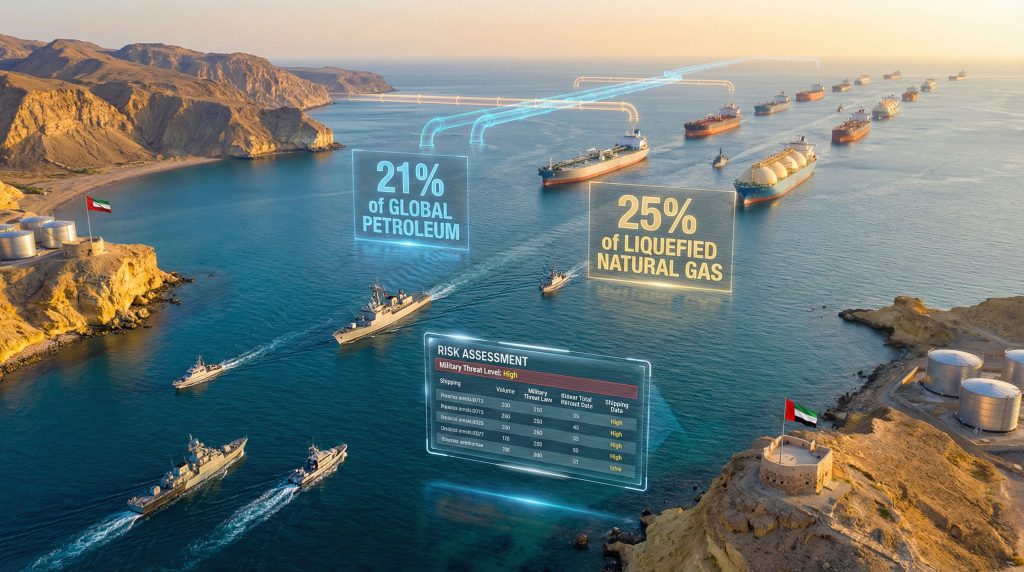
The Strait of Hormuz serves as the world's most critical energy chokepoint, with approximately 21% of global petroleum liquids transiting this narrow passage daily. This concentration creates systemic vulnerability where even temporary disruption generates immediate market effects across crude oil, refined products, and liquefied natural gas sectors.
Regional Energy Chokepoint Risk Assessment:
| Shipping Route | Daily Oil Transit | Military Threat Level | Alternative Routes Available |
|---|---|---|---|
| Strait of Hormuz | 21% of global petroleum | High | Limited capacity alternatives |
| Suez Canal | 12% of global trade | Medium | Cape of Good Hope route |
| Bab el-Mandeb | 6% of global petroleum | Medium | Around Africa routing |
Military assurances regarding passage security carry weight in shipping insurance calculations, yet energy companies must balance official security guarantees against their own risk assessment protocols. The explicit encouragement for continued Strait usage during active military operations represents unprecedented confidence in tactical superiority, though market participants require independent verification of actual threat reduction.
Alternative routing through the Cape of Good Hope adds approximately 6,000 nautical miles to Persian Gulf shipments, creating cost increases of 15-30% through additional fuel consumption, crew wages, and time delays. These economic penalties make Strait closure economically equivalent to substantial supply reduction even when alternative capacity exists.
Regional Supply Chain Disruption Scenarios
Supply chain resilience depends on redundancy across multiple systems including production facilities, export terminals, shipping routes, and destination storage capacity. Military operations create uncertainty cascades where each disruption mechanism amplifies others through reduced flexibility and increased vulnerability.
Iran's energy export infrastructure includes multiple terminals with varying vulnerability profiles. Kharg Island handles the majority of crude exports, while Lavan Island and Sirri Island provide additional capacity. The targeting priorities and damage assessment for these facilities remain classified, creating information asymmetries in market pricing.
Regional allies maintain reserve capacity that could theoretically compensate for Iranian export reduction, yet activation timelines and production increase capabilities require verification against current spare capacity data. Furthermore, OPEC production strategies and UAE export terminals represent critical backup infrastructure whose capacity utilization affects global supply elasticity.
When big ASX news breaks, our subscribers know first
How Are Current Military Actions Reshaping Middle East Energy Security Dynamics?
Military force projection fundamentally alters regional power calculations and energy security frameworks. The demonstration of comprehensive naval capability reduction sends strategic signals that extend beyond immediate tactical objectives to influence long-term alliance structures and investment decisions across the energy sector.
Naval Force Projection in Critical Shipping Lanes
Naval dominance in the Persian Gulf requires sustained presence of multiple specialized vessel types including guided-missile cruisers for air defense, destroyers for anti-ship operations, and mine countermeasures ships for passage security. The technical requirements for maintaining Strait of Hormuz security operate at significant scale and cost.
US Central Command maintains forward-deployed naval assets specifically configured for energy security missions. These specialized platforms include:
- Aegis-class cruisers with advanced radar systems for threat detection
- Littoral combat ships optimized for shallow-water operations
- Attack submarines for subsurface surveillance and threat interdiction
- Coast Guard patrols for merchant vessel coordination
The integration of emerging technologies including autonomous surveillance systems and AI-driven threat assessment represents operational evolution beyond traditional naval platforms. These capabilities provide real-time situational awareness that enables rapid response to emerging threats while reducing human operator risk.
Energy Company Risk Calculations and Operational Adjustments
Energy companies employ sophisticated risk management frameworks that incorporate geopolitical threat assessment, operational continuity planning, and financial hedging strategies. Military operations trigger predetermined protocols that may include route changes, insurance adjustments, and production scheduling modifications.
War risk insurance premiums reflect probability assessments of vessel loss or cargo damage, with rates varying based on perceived threat levels. Lloyd's of London maintains specialized frameworks for Persian Gulf transit insurance that incorporate real-time military situation updates and intelligence assessments.
Operational adjustments extend beyond immediate shipping decisions to encompass:
- Inventory management strategies to buffer supply disruption
- Alternative supplier identification and contract modification
- Production scheduling changes to optimize available transportation
- Financial instrument deployment to hedge price volatility risk
Alternative Route Development and Cost Implications
Alternative shipping routes provide critical redundancy during military operations, yet capacity constraints and economic penalties limit their effectiveness as complete substitutes. The Cape of Good Hope route adds 2-4 weeks additional transit time compared to Strait of Hormuz passage, creating inventory and cash flow implications for energy companies.
Pipeline alternatives including the Trans-Arabian Pipeline system and potential Turkey-Mediterranean routes offer land-based alternatives to maritime shipping. These systems require different risk assessment frameworks focused on territorial security rather than naval threats, yet maintain their own vulnerability profiles.
Cost implications of alternative routing include:
- Fuel consumption increases of approximately 25-35%
- Extended crew wage obligations and vessel utilization
- Port fee adjustments for alternative destination terminals
- Insurance premium modifications for different risk profiles
What Economic Warfare Strategies Are Emerging Through Energy Sector Targeting?
Economic warfare through energy infrastructure targeting represents a strategic approach that achieves political objectives through economic pressure rather than territorial conquest. This methodology creates sustained effects that extend beyond immediate military operations to influence long-term economic relationships and geopolitical alignments.
Infrastructure Degradation as Strategic Leverage
Critical infrastructure targeting focuses on high-value systems whose disruption creates disproportionate economic effects. Energy export facilities represent particularly valuable targets because their damage generates revenue reduction for adversaries while creating supply security concerns for international partners.
The neutralization of Iran's naval mine-laying capability represents strategic choice to eliminate asymmetric threat mechanisms while preserving energy infrastructure for potential future use. However, oil price movements suggest confidence in technological superiority combined with recognition of energy system importance for regional stability.
Iran's energy sector historically represented approximately 80% of government revenue, creating vulnerability to export disruption strategies. Revenue reduction through infrastructure targeting or shipping disruption achieves economic pressure without requiring occupation or governance responsibilities.
Market Volatility Creation and Control Mechanisms
Energy markets respond immediately to military escalation signals through volatility increases and risk premium adjustments. The psychological effects of military operations often generate market disruption that exceeds actual supply reduction, creating opportunities for strategic market influence.
Military operations targeting energy infrastructure create cascading effects that extend far beyond immediate tactical objectives, fundamentally altering global energy market dynamics and forcing strategic recalculations across multiple sectors.
Historical analysis reveals that major Middle East conflicts generate oil price increases in the 15-40% range during initial escalation phases, with duration dependent on infrastructure damage assessment and alternative supply activation. These price effects carry political implications in consumer countries that may influence support for US military operations against Iran.
Financial instruments including crude oil futures, energy ETFs, and volatility indices incorporate geopolitical risk premiums that respond to military escalation announcements. Understanding these mechanisms enables strategic timing of military operations to maximize economic pressure while minimizing consumer country opposition.
Regional Power Balance Shifts Through Energy Disruption
Energy export capacity directly correlates with regional political influence, creating strategic value in degrading adversary energy infrastructure while protecting allied capabilities. The selective targeting of Iranian facilities while maintaining Gulf Cooperation Council production demonstrates strategic differentiation in economic warfare application.
Regional allies including Saudi Arabia, UAE, Kuwait, and Qatar maintain energy export capacity that could theoretically compensate for Iranian reduction, yet political coordination and technical interoperability require verification. The economic benefits of increased market share during competitor reduction create incentives for allied cooperation in military operations.
Long-term power balance effects include:
- Revenue reallocation from Iranian to allied energy exports
- Infrastructure investment redirection toward secure production areas
- Political influence redistribution based on energy supply reliability
- Alliance strengthening through shared security frameworks
How Could Extended Military Operations Impact Global Oil Price Stability?
Extended military operations create sustained uncertainty that fundamentally alters energy market psychology and pricing mechanisms. Unlike brief conflicts that generate immediate price spikes followed by normalization, prolonged operations require market participants to incorporate ongoing risk premiums into long-term pricing models.
Supply Shock Probability Models
Quantitative risk assessment frameworks evaluate supply disruption probability across multiple scenarios including complete Strait closure, partial shipping reduction, and infrastructure damage of varying severity. These models incorporate historical precedent analysis combined with current military capability assessments.
The 1980-1988 Iran-Iraq War provides relevant precedent for extended Middle East conflict effects on energy markets. During this period, tanker attacks and convoy requirements generated sustained price premiums that persisted throughout the conflict duration, demonstrating market adaptation to prolonged uncertainty.
Modern supply shock models must account for technological differences including:
- Advanced precision weapons that enable selective infrastructure targeting
- Real-time satellite surveillance that reduces uncertainty about damage assessment
- Improved naval mine countermeasures that maintain passage security
- Enhanced storage capacity that buffers short-term supply interruptions
Strategic Petroleum Reserve Deployment Scenarios
Strategic petroleum reserves provide critical buffer capacity during supply disruptions, yet deployment decisions carry complex political and economic implications. Reserve releases signal crisis severity while potentially reducing price volatility that might otherwise encourage conservation or alternative supplier activation.
The United States maintains approximately 650 million barrels in strategic reserves, equivalent to roughly 35 days of total petroleum consumption at current usage rates. However, effective deployment depends on refinery capacity, distribution infrastructure, and coordination with private sector inventory management.
International coordination of reserve releases requires diplomatic framework that may be complicated during military operations. The International Energy Agency maintains protocols for collective reserve deployment, yet political considerations during active conflict may constrain multilateral cooperation.
Consumer Market Protection Strategies
Consumer market protection during extended military operations requires balancing price stability objectives against market efficiency considerations. Government intervention through price controls, fuel subsidies, or rationing systems creates economic distortions yet may be politically necessary during severe supply disruption.
Transportation sector vulnerability represents particular concern because fuel price increases generate immediate consumer impact and economic disruption. Commercial aviation, trucking, and shipping industries maintain limited ability to absorb sustained fuel cost increases without passing costs to consumers.
Protection strategies include:
- Fuel tax adjustments to buffer price increases for consumers
- Emergency allocation systems to prioritise critical transportation needs
- Alternative energy acceleration to reduce petroleum dependency
- Financial assistance programmes for transportation-dependent industries
What Are the Long-Term Geopolitical Consequences for Energy Alliance Structures?
Military operations in the Persian Gulf create precedents for energy security frameworks that extend beyond immediate conflict resolution to influence decades of future alliance structures and energy trade relationships. The demonstration of military capability to secure energy infrastructure establishes new parameters for international energy cooperation.
NATO Energy Security Coordination Mechanisms
NATO energy security frameworks require adaptation to address Persian Gulf scenarios that extend beyond traditional European energy concerns. The alliance maintains consultation mechanisms for energy supply disruption, yet military operations in distant regions test coordination between security commitments and energy dependencies.
European NATO members maintain significant energy import requirements that create vulnerability to Middle East supply disruption. This dependency generates political pressure for diplomatic solutions while constraining support for extended military operations that might trigger retaliation against energy infrastructure.
Coordination challenges include:
- Balancing military support commitments with energy security concerns
- Managing alliance solidarity when members have different energy dependencies
- Developing collective response frameworks for non-European energy disruption
- Integrating energy security planning with NATO defence planning processes
OPEC Production Strategy Recalibrations
OPEC market influence becomes significantly more complex when major member countries face military pressure or production capacity degradation. The organization's ability to manage global oil markets depends on cooperation between members who may have conflicting political positions regarding military operations.
Iran's OPEC membership creates internal alliance tension when other members must decide whether to compensate for Iranian production losses or maintain solidarity with a fellow member under military pressure. These decisions carry long-term implications for OPEC cohesion and market management effectiveness.
Alternative production capacity among Gulf OPEC members including Saudi Arabia and UAE enables market stabilisation during Iranian reduction, yet political coordination requirements may constrain rapid production increases. The economic benefits of increased market share must be balanced against alliance solidarity considerations.
China-Russia Energy Partnership Strengthening Scenarios
Extended US military operations against Iran create strategic opportunities for alternative energy partnerships that bypass Western-dominated systems. China and Russia maintain complementary energy trade relationships that could expand significantly during Middle East supply uncertainty.
Russian energy exports to China via pipeline systems provide alternatives to Middle East supply that avoid maritime chokepoints entirely. These overland routes offer strategic security advantages during naval conflict, potentially accelerating long-term energy trade reorientation away from traditional Gulf sources.
Partnership strengthening elements include:
- Accelerated pipeline construction for increased Russian-Chinese energy trade
- Alternative payment systems that bypass Western financial institutions
- Technology cooperation for energy exploration in politically secure regions
- Strategic coordination to exploit Western energy supply vulnerabilities
How Are Energy Companies Adapting Their Strategic Planning to Military Escalation?
Energy companies must fundamentally restructure their strategic planning frameworks to incorporate sustained military operation scenarios that create new categories of operational risk and investment uncertainty. Traditional business models assume political stability and predictable regulatory frameworks that may no longer apply during extended conflict periods.
Insurance Premium Calculations and Coverage Gaps
War risk insurance represents a specialised market sector that provides coverage for military operation scenarios, yet premium calculations become extremely challenging during active conflict when historical precedent provides limited guidance for current threat assessment.
Lloyd's of London maintains the primary market for maritime war risk insurance, with premiums varying based on threat perception, route selection, and vessel type. During military operations, insurance markets may restrict coverage entirely for certain regions or require prohibitively expensive premiums that effectively exclude commercial operations.
Coverage gap analysis reveals potential scenarios where:
- Standard maritime insurance excludes war-related losses
- War risk insurance becomes unavailable at any price
- Self-insurance requirements exceed company financial capacity
- Government intervention becomes necessary to maintain commercial shipping
Operational Continuity Planning Under Conflict Conditions
Business continuity frameworks must accommodate scenarios including complete supply chain disruption, communication system failure, personnel evacuation, and asset abandonment. These extreme scenarios require planning beyond traditional disaster recovery to encompass wartime operational requirements.
Energy companies maintain redundant operational centres, alternative communication systems, and emergency personnel protocols designed to maintain critical functions during infrastructure attacks. However, sustained military operations may exceed the duration and intensity assumptions underlying these contingency plans.
Key continuity planning elements include:
- Personnel safety protocols for operations in contested regions
- Alternative communication networks resistant to military interference
- Distributed operational control to prevent single-point failure
- Emergency supplier relationships for critical equipment and services
Investment Reallocation Toward Secure Energy Corridors
Capital allocation decisions must incorporate long-term security considerations that may override short-term profitability calculations. Investment flows toward politically secure regions accelerate during military operations as companies prioritise operational continuity over marginal return optimisation.
Secure energy corridor development focuses on regions with stable political systems, reliable military protection, and diversified transportation routes. These criteria favour investments in North American, Australian, and Northern European energy infrastructure over Middle East projects despite potentially superior geological conditions.
Investment reallocation trends include:
- Domestic energy production prioritisation for energy security
- Allied country partnerships for secure supply chain development
- Alternative transportation routes that bypass conflict-prone regions
- Technology investments that reduce dependency on vulnerable infrastructure
The next major ASX story will hit our subscribers first
What Technology and Innovation Responses Could Emerge From Energy Security Threats?
Military operations accelerate technology development cycles as energy companies and defence contractors collaborate to address emerging security challenges. The intersection of energy infrastructure protection and military technology creates innovation opportunities that may fundamentally alter energy industry operations.
Autonomous Shipping System Development
Unmanned shipping systems offer potential solutions for maintaining energy transportation during periods when human crew risk becomes unacceptable. Autonomous tanker technology could enable continued operations in contested waters where conventional shipping would cease due to insurance restrictions or crew safety concerns.
Technical challenges for autonomous energy shipping include:
- Navigation system reliability in GPS-denied environments
- Cargo handling automation for loading and discharge operations
- Emergency response capabilities without human intervention
- Cybersecurity protection against military-grade electronic warfare
Current autonomous shipping development focuses primarily on short-distance container operations, yet military security requirements may accelerate development toward long-distance crude oil transportation. The economic incentives for maintaining energy flows during conflict could justify significant technology development investment.
Distributed Energy Infrastructure Resilience
Centralised energy infrastructure creates vulnerability to military targeting that distributed systems could potentially mitigate. Microgeneration, local storage, and smart grid technologies enable energy system resilience that reduces dependency on large-scale infrastructure that represents attractive military targets.
Distributed infrastructure development includes:
- Renewable energy systems with local storage capacity
- Microgrid networks that operate independently during infrastructure attacks
- Mobile generation units that can relocate to avoid targeting
- Underground storage facilities resistant to conventional weapons
Real-Time Threat Assessment Integration
Advanced surveillance and intelligence systems enable real-time threat assessment that allows energy operations to adapt dynamically to changing military situations. Integration of satellite imagery, signals intelligence, and predictive analytics provides operational awareness that was previously unavailable.
Technology integration platforms combine:
- Satellite surveillance feeds for infrastructure monitoring
- Signals intelligence analysis for threat pattern recognition
- Predictive modelling systems for operational risk assessment
- Automated response protocols for threat mitigation
Which Alternative Energy Routes Could Become Critical During Extended Conflicts?
Extended military operations fundamentally alter the strategic value of alternative energy transportation routes that normally operate as secondary options to primary Persian Gulf pathways. Understanding these alternatives requires analysis of capacity constraints, development timelines, and political control factors.
Trans-Arabian Pipeline System Capacity Analysis
The Trans-Arabian Pipeline system provides overland alternative to maritime Strait of Hormuz transit, yet current capacity limitations and political control considerations constrain its effectiveness as a complete substitute for normal shipping routes.
Historical pipeline capacity reached approximately 500,000 barrels per day during peak operations, representing significant volume yet insufficient to replace total Strait transit. Modern pipeline technology enables capacity expansion, yet construction timelines measured in years limit short-term alternatives during immediate military operations.
Pipeline route alternatives include:
- Iraqi-Turkey pipeline systems for northern route alternatives
- Saudi Arabian Red Sea terminals for western maritime alternatives
- UAE pipeline networks for southern Persian Gulf bypass routes
- Potential Iran-Turkey connections subject to political resolution
Northern Sea Route Development Acceleration
Arctic shipping routes provide alternatives to traditional Middle East energy sources, particularly for Asian destinations where Russian energy exports could substitute for Persian Gulf supplies. Climate change effects on Arctic ice coverage create seasonal navigation opportunities that military operations may accelerate.
The Northern Sea Route offers significant distance advantages for Russia-Asia energy trade, reducing transit time by approximately 40% compared to traditional Suez Canal routing. However, seasonal limitations, icebreaker requirements, and specialised vessel needs constrain immediate capacity expansion.
Development acceleration factors include:
- Russian icebreaker fleet expansion for year-round navigation support
- Specialised Arctic tanker construction for extreme weather operations
- Port infrastructure development for increased cargo handling capacity
- International legal frameworks for expanded Arctic shipping
Overland Pipeline Network Strategic Value
Pipeline networks offer inherent security advantages over maritime shipping through geographic dispersion, underground protection, and reduced vulnerability to naval interdiction. Strategic pipeline development becomes politically attractive during periods of maritime security uncertainty.
Central Asian pipeline networks connecting with Chinese energy infrastructure provide alternatives to Middle East supplies that completely bypass maritime chokepoints. These systems require significant investment yet offer long-term security advantages that justify development costs during military uncertainty.
Strategic pipeline considerations include:
- Political stability of transit countries and bilateral relationships
- Technical specifications including capacity and product compatibility
- Security frameworks for infrastructure protection during conflicts
- Economic viability compared to alternative transportation methods
How Are Financial Markets Pricing Military Escalation Risks Into Energy Investments?
Financial markets employ sophisticated risk pricing mechanisms that attempt to quantify the probability and impact of military escalation scenarios on energy sector returns. These calculations become extremely complex during active conflict when traditional risk models provide limited guidance for unprecedented scenarios.
Volatility Premium Calculations in Energy Futures
Energy futures markets incorporate geopolitical risk premiums through volatility pricing that reflects uncertainty about future supply conditions. Military operations create sustained volatility that may persist throughout conflict duration, requiring traders to adjust pricing models for extended uncertainty periods.
The CBOE Crude Oil Volatility Index (CVIX) provides quantitative measurement of market expectations for oil price volatility based on options pricing. During military escalation, CVIX typically increases by 200-400% above baseline levels, indicating market expectation of significant price movement uncertainty.
Volatility premium components include:
- Supply disruption probability based on infrastructure targeting assessment
- Demand destruction potential from economic disruption effects
- Alternative supply activation timelines and capacity constraints
- Political intervention likelihood including strategic reserve releases
Sovereign Risk Assessment Methodologies
Credit rating agencies must reassess sovereign risk profiles for countries affected by military operations, incorporating factors including fiscal impact of military spending, energy revenue loss, and infrastructure reconstruction costs. These assessments directly influence borrowing costs and investment flows.
Iran's sovereign credit rating faces immediate downgrade pressure during military operations due to energy export revenue reduction, infrastructure damage costs, and increased military expenditure requirements. However, rating agencies must distinguish between temporary operational effects and permanent capacity degradation.
Regional sovereign risk factors include:
- Energy revenue dependency as percentage of government income
- Infrastructure reconstruction cost estimates and financing capacity
- Military expenditure increases required for conflict participation
- International isolation effects on trade and financial system access
Energy Sector Credit Rating Adjustments
Energy company credit ratings require adjustment for operational risks including asset seizure, infrastructure damage, force majeure contract violations, and insurance coverage gaps. These factors create potential for rapid credit deterioration that exceeds normal business cycle volatility.
Companies with significant Middle East exposure face particular scrutiny regarding asset protection, operational continuity, and revenue diversification. Credit rating agencies evaluate management frameworks for crisis response and alternative operational strategies during extended disruption periods.
Credit assessment modifications focus on:
- Geographic revenue concentration and alternative market access
- Asset protection strategies and insurance coverage adequacy
- Operational flexibility for rapid strategy adjustment during crisis
- Financial reserves sufficient for extended operational disruption
What Lessons Can Energy Planners Extract From Current Military Operations?
Energy sector strategic planning must incorporate lessons from military operations regarding infrastructure vulnerability, supply chain resilience, and crisis response effectiveness. These insights fundamentally alter assumptions about operating environment stability and required contingency planning depth.
Infrastructure Hardening Investment Priorities
Physical infrastructure protection requires investment in hardening measures that extend beyond traditional industrial security to encompass military-grade protection standards. Critical facilities need protection against precision weapons, electronic warfare, and sustained bombardment scenarios.
Hardening investment priorities include:
- Underground storage facilities resistant to conventional weapons
- Redundant control systems with distributed operational capacity
- Advanced air defence systems for facility protection
- Electromagnetic pulse protection for electronic infrastructure
The cost-benefit analysis for infrastructure hardening must balance protection investment against operational efficiency considerations. Military-grade protection significantly increases construction and maintenance costs yet may be essential for operational continuity during conflict periods.
Diversification Strategy Optimisation
Geographic and operational diversification strategies require recalibration to account for correlated risks that may affect multiple facilities simultaneously during regional military operations. Traditional diversification models assume independence between regional risks that military conflict may violate.
Optimal diversification frameworks must consider:
- Political alliance structures that affect security guarantee reliability
- Geographic separation requirements to prevent simultaneous targeting
- Operational redundancy levels sufficient for facility loss scenarios
- Supply chain independence to prevent cascading failure effects
Crisis Response Protocol Development
Crisis response protocols require development for scenarios including communication system failure, personnel evacuation, rapid operational shutdown, and extended facility abandonment. These extreme scenarios exceed normal emergency response planning to encompass wartime operational requirements.
Effective crisis response frameworks incorporate:
- Automated shutdown systems that protect assets during evacuation
- Remote monitoring capabilities for unmanned facility oversight
- Emergency communication networks resistant to military interference
- Rapid restart procedures for post-conflict operational recovery
How Could Extended Military Operations Impact Other Energy Markets?
Extended military operations create spillover effects that extend beyond crude oil markets to encompass natural gas, refined products, and electricity sectors. These interconnected systems experience correlated disruptions that amplify overall energy market volatility and complicate risk management strategies.
Natural Gas Market Correlations
Natural gas markets maintain complex relationships with crude oil through pricing mechanisms, transportation infrastructure, and geopolitical risk factors. Military operations affecting oil infrastructure often generate parallel concerns about gas supply security, particularly for liquefied natural gas exports from the Persian Gulf region.
The US natural gas forecast indicates potential price volatility as military operations affect global energy market psychology. Qatar represents the world's largest LNG exporter, with facilities that could face similar targeting concerns during regional military escalation.
Correlation factors include:
- Shared transportation infrastructure through common maritime chokepoints
- Joint production facilities where oil and gas extraction occur simultaneously
- Price relationship mechanisms linking crude oil and natural gas markets
- Alternative energy substitution during supply disruptions
Refined Product Supply Chain Effects
Refined petroleum products including gasoline, diesel, and jet fuel experience supply chain disruptions that may exceed crude oil market effects due to processing capacity constraints and storage limitations. Refinery operations require stable crude oil supplies and specialised transportation networks.
Middle East refineries process significant volumes for both domestic consumption and export markets, particularly for aviation fuel and marine bunker fuel supplies. Military operations affecting these facilities could generate refined product shortages that persist longer than crude oil supply interruptions.
Supply chain vulnerability points include:
- Refinery capacity utilisation rates limiting production flexibility
- Product storage limitations creating immediate shortage potential
- Specialised transportation requirements for different refined products
- Quality specification compliance for aviation and marine applications
Electricity Market Indirect Effects
Electricity generation systems experience indirect effects from energy market disruption through fuel cost increases, generation source switching, and grid stability concerns. These effects vary significantly based on regional fuel mix and electricity market structures.
Countries with significant natural gas-fired electricity generation face particular vulnerability to energy price volatility during military operations. The cascade effects from energy supply disruption to electricity costs create political pressure that may influence support for extended military operations.
Indirect effect mechanisms include:
- Fuel cost pass-through to electricity pricing mechanisms
- Generation dispatch changes based on fuel availability and pricing
- Grid stability concerns during fuel supply uncertainty
- Renewable energy acceleration to reduce fossil fuel dependency
What Are the Implications for US Domestic Energy Production?
US military operations against Iran create complex implications for domestic energy production including US oil production decline trends that may affect strategic calculations regarding military intervention sustainability and energy independence objectives.
Domestic production capabilities provide strategic flexibility during military operations by reducing dependency on potentially disrupted international supplies. However, production capacity constraints and infrastructure limitations affect the United States' ability to completely insulate from global market disruption.
FAQ Section: Energy Security During Military Operations
What percentage of global energy trade could be disrupted by Strait of Hormuz closure?
Approximately 21% of global petroleum liquids and 25% of liquefied natural gas transit through this chokepoint, making it the world's most critical energy shipping lane.
How quickly can alternative shipping routes compensate for Middle East disruptions?
Alternative routes typically require 2-4 weeks additional transit time and 15-30% higher shipping costs, with limited immediate capacity expansion capability.
What role do strategic petroleum reserves play during supply disruptions?
Strategic reserves provide short-term buffer capacity, typically covering 30-90 days of consumption, but require careful deployment timing to maximise market stabilisation effects.
How do energy companies adjust operations during military conflicts?
Companies implement crisis protocols including alternative routing, insurance adjustments, inventory management changes, and emergency personnel procedures to maintain operational continuity.
How do military operations in the Middle East typically affect global oil prices?
Historical analysis shows 15-40% price spikes during major Middle East conflicts, with duration dependent on strategic infrastructure damage and alternative supply activation.
Disclaimer: This analysis is based on publicly available information and should not be considered investment advice. Military situations evolve rapidly and actual outcomes may differ significantly from analytical scenarios. Energy market investments carry substantial risks during periods of geopolitical uncertainty.
Further Exploration:
Readers interested in understanding broader Middle East energy security dynamics can explore additional educational content from various geopolitical analysis sources and military conflict tracking platforms for comprehensive regional context.
Are You Looking to Capitalise on Energy Market Volatility?
Military operations and geopolitical tensions create significant opportunities for informed investors to profit from energy market volatility. Discovery Alert's proprietary Discovery IQ model delivers instant notifications about ASX mineral discoveries, including critical energy commodities that can surge during global supply disruptions, empowering subscribers to identify actionable trading opportunities ahead of broader market movements.