
June 21, 2026
The Hidden Cost of Gold: When Criminal Networks Infiltrate Federal Supply Chains
Few investors pause to consider what happens before a gleaming American Gold Eagle coin reaches their hands. The assumption is simple: a federal agency, bound by law, procures metal through a clean and auditable chain. That assumption, it turns out, has been wrong for roughly two decades. Understanding why requires examining not just one institution's failure, but the deeper mechanics of how illicit commodity flows exploit documentation gaps, physical transformation, and jurisdictional blind spots to infiltrate even the most regulated markets.
The issue of U.S. Mint buying cartel gold is not a peripheral scandal. It is a case study in what happens when statutory intent is never matched with operational enforcement, and it raises urgent questions about the integrity of American gold coinage at every level of the supply chain. Consequently, this matters deeply to investors who rely on the gold market outlook when making decisions about where to place their capital.
When big ASX news breaks, our subscribers know first
The Law That Was Never Enforced
The Gold Bullion Coin Act of 1985, enacted as Public Law 99-185, established a clear and deliberate mandate: gold used in U.S. Mint coins must originate from domestic American sources. The legislative intent was unambiguous, designed to insulate the nation's monetary products from the ethical and criminal contamination embedded in foreign artisanal and small-scale mining operations.
What the law never produced, however, was an enforcement mechanism with teeth.
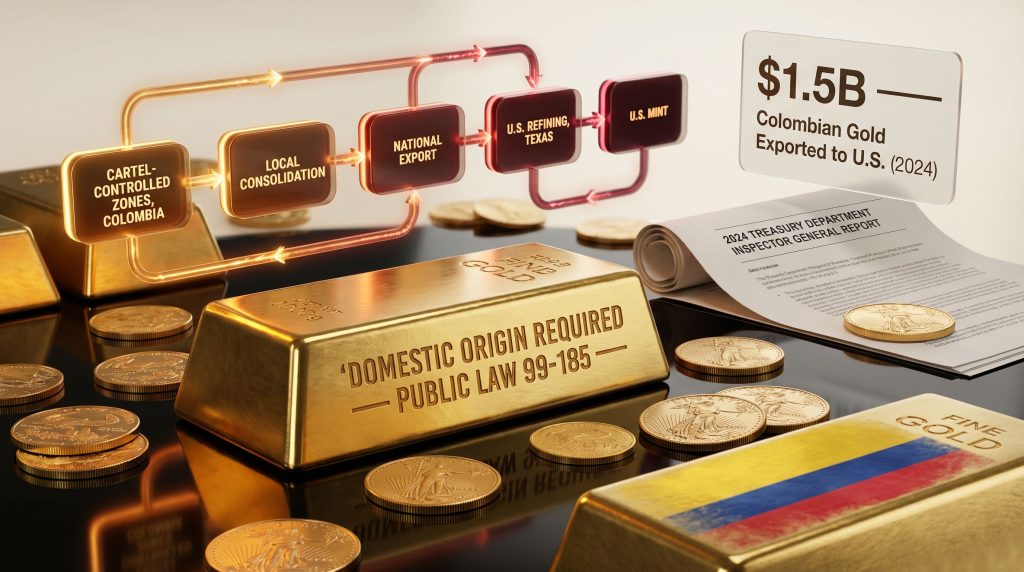
According to findings from a 2024 Treasury Department Inspector General report, the U.S. Mint operated for approximately 20 years without requiring its gold suppliers to disclose where they originally sourced their metal. This is not a bureaucratic footnote. The Mint generates more than $1 billion in annual sales of investment-grade gold coins, meaning the procurement framework underlying that revenue operated, for two decades, without the basic audit infrastructure necessary to verify its own legal compliance.
The structural explanation is straightforward. The Mint purchases gold from refiners and dealers, not directly from mining operations. This intermediary layer creates legal distance between the federal purchaser and the original source of the metal, effectively offloading traceability responsibility onto counterparties who faced no formal obligation to provide it. The result was a procurement architecture that was technically compliant at the transaction level while being entirely blind to what happened upstream.
A supply chain audit would have flagged the problem. But for two decades, no such audit was required, and none was conducted. The gap between statutory mandate and operational practice remained invisible precisely because no one was looking.
The Mechanics of Gold Laundering: How Cartel Metal Becomes American
To understand how gold from cartel-controlled Colombian mines ends up in U.S. Mint coins, it helps to trace the process layer by layer. Each stage introduces a new degree of insulation from the original source, and by the time the metal reaches a Texas refiner, its provenance has been so thoroughly obscured that standard commercial documentation cannot recover it.
Stage 1: Extraction Under Coercion
In Colombian mining towns such as Caucasia, small artisanal mining teams operate under the economic authority of the Gulf Clan, known in Spanish as the Clan del Golfo. Teams of approximately five miners pay the cartel roughly $400 per month for the right to extract and sell gold in controlled territory. This is not a loose arrangement. It is a structured taxation system that makes every ounce produced in these zones a cartel-linked asset.
Stage 2: Physical Transformation at Local Gold Shops
Miners sell raw gold to local shops, which also pay the Gulf Clan approximately $400 per month to operate. Workers at these shops melt gold from multiple sources together and pour the combined mass into a mould. This physical process is critical: once gold from different origins is melted into a single undifferentiated bar, standard metallurgical assay cannot recover the provenance of each constituent source. The metal's history is destroyed in a furnace.
Colombian law technically requires these shops to maintain ledgers confirming that all purchased gold was legally mined in authorised areas using approved methods, specifically hand tools without mercury. In practice, investigative reporting has documented that workers routinely operate outside authorised areas with prohibited equipment, and Colombian regulatory authorities rarely conduct field-level verification. The ledger system functions as a paper trail rather than a genuine compliance mechanism.
Stage 3: Government Export and the Illusion of Verification
Shops sell consolidated gold to a government-owned Colombian exporter, which checks the metal against a national database before shipping abroad. The verification problem here is structural: the database contains only the self-reported ledger data from the shop level, which is itself unreliable.
Checking a falsified record against a database that contains that same falsified record produces a clean result, not a genuine audit. Furthermore, export records indicate that bars worth approximately $255 million over roughly a one-year period were shipped from Colombia to Texas through this mechanism, as reported by the New York Times in April 2026 based on its investigation.
Stage 4: Domestication in the United States
Once the gold arrives in the United States and passes through a domestic refiner, American companies treat it as domestic metal. It is sold to the U.S. Mint, which has no mandatory requirement to look further upstream. The laundering is complete.
| Supply Chain Stage | Location | Key Actor | Traceability Status |
|---|---|---|---|
| Artisanal extraction | Cartel-controlled zones, Colombia | Mining teams under Gulf Clan control | None: no independent verification |
| Physical consolidation | Local gold shops | Shop operators and workers | Destroyed: melting eliminates provenance |
| National verification | Colombian exporter | State-owned entity | Nominal: checks falsified ledger data |
| U.S. import and refining | Texas, domestic refiners | Private companies | Absent: treated as domestic upon arrival |
| Federal procurement | U.S. Mint | Federal agency | Historically absent: no upstream audit required |
Colombia's Gold Corridor: Scale and Strategic Importance
The scale of Colombian gold exports into the United States provides essential context. According to UN trade data, Colombia exported approximately $4.1 billion in total gold in 2024, of which approximately $1.5 billion was directed to the United States, representing roughly 37% of total Colombian gold exports. Within this volume, a portion originates from mining regions where the Gulf Clan extracts economic rents from every transaction in the chain.
What makes the Colombian case particularly difficult to resolve is that the contamination is not concentrated in a single identifiable stream. It is dispersed across thousands of small transactions, melted together at regional consolidation points, and mixed with supplies from across the country before export. By the time bars reach Texas, the Colombian exporter's own documentation cannot accurately identify which portion originated from cartel-controlled operations.
This is a deliberate structural feature of the laundering mechanism, not an oversight.
The Gulf Clan's Industrial-Scale Mining Operations
The Gulf Clan's involvement in gold extraction extends well beyond taxing artisanal miners in village-level operations. In a case first reported by the Wall Street Journal in November 2024, the cartel conducted coordinated armed assaults against Zijin Mining Group, a Chinese state-controlled company listed on both the Hong Kong and Shanghai stock exchanges, seizing approximately 30 miles of tunnels from the company's Colombian operations.
The methodology of the seizure was anything but improvised. Armed operatives deployed explosives, engaged company security forces with gunfire in conditions that a Zijin company official characterised as resembling trench warfare, and drove security teams into retreat. Cartel-aligned miners then advanced through captured tunnels using industrial jackleg drills, conducting as many as 250 detonations per day to break through rock and extend their control.
The seizure ultimately cost Zijin two of the mine's three operational sections. The remaining section, the deepest and most resource-rich, stayed under company control where approximately 4,500 workers continued processing around 4,000 tons of rock per day, yielding an average of 53 pounds of gold daily.
The capacity to militarily displace a multinational, state-backed mining company signals a level of tactical coordination that fundamentally changes how risk analysts should model supply chain exposure in conflict-adjacent mining jurisdictions. This is not artisanal criminality. It is organised industrial seizure.
Beyond direct extraction revenue, the Gulf Clan reportedly functions as a parallel governance structure within the zones it controls, providing workers with controlled substances and other material incentives that create dependency alongside coercion. This dual structure makes it practically impossible for upstream exporters to cleanly separate cartel-linked gold from legitimate production, even when the intent to do so exists.
Two Decades of Institutional Blindness: Why the Gap Persisted
The failure of oversight at the U.S. Mint was not the product of a single decision or a brief lapse. It persisted across multiple administrations, budget cycles, and leadership teams for approximately 20 years. Several reinforcing factors explain how this was possible:
- Procurement model insulation: Because the Mint buys from refiners rather than mines, no single transaction in the chain carries an explicit obligation to disclose ultimate origin. Accountability stops at the immediate counterparty.
- Absence of audit mandates: No formal regulatory requirement compelled suppliers to conduct or disclose supply chain due diligence. Without a mandate, voluntary disclosure rarely occurs in commercially competitive environments.
- Regulatory arbitrage at the U.S. border: Gold that clears U.S. customs and is processed by a domestic refiner is treated as compliant regardless of its actual origin. The border represents a compliance reset, not a verification checkpoint.
- Commercial pressure: The post-September 11 gold boom created substantial commercial incentive to maximise procurement volume. Between 2001 and the early 2020s, gold prices rose from approximately $250–$300 per ounce to nearly $2,000 per ounce.
- Intermediary diffusion of accountability: With each layer of the supply chain, responsibility for provenance became more diffuse. No single actor in the chain felt compelled to investigate what happened before their transaction.
The supply chain failure also does not exist in isolation within the Mint's institutional track record. The agency has drawn sustained criticism from precious metals industry stakeholders for operational deficiencies, particularly regarding the Silver American Eagle coin programme. This broader pattern of institutional underperformance provides meaningful context for understanding how a procurement oversight gap of this scale went unaddressed.
The next major ASX story will hit our subscribers first
The Government's Response: Review Versus Reform
Following the New York Times investigation, Treasury Secretary Scott Bessent confirmed that a formal review of the Mint's gold procurement practices had been initiated. The stated scope of the review includes verifying that suppliers comply with applicable law, ensuring contractual and regulatory obligations are fulfilled, strengthening national security safeguards within the procurement process, and upholding market integrity standards for U.S. gold coin products.
The U.S. Mint has also acknowledged, in a significant admission, that foreign gold has served as its primary supply source, placing the agency in direct contradiction with the domestic-origin requirement established in the 1985 Gold Bullion Coin Act. The Mint has committed to implementing improved sourcing tracking mechanisms.
A review is not a structural reform. Announcing an investigation into practices that have persisted for 20 years without generating a single internal audit is an acknowledgement of failure, not a remedy for the conditions that enabled it.
A genuinely credible remediation framework would need to address every layer of the laundering chain simultaneously:
- Mandatory upstream disclosure: Suppliers must document gold origin to the mine level, not merely the refiner level. Refiner-level documentation has already been demonstrated to be insufficient.
- Independent third-party verification: Self-reported ledgers and exporter database checks have been shown to be ineffective. External auditors with field-level access are necessary.
- Real-time OFAC integration: Supplier databases must be cross-referenced against Office of Foreign Assets Control designations, flagging any entity with documented connections to sanctioned organisations including the Gulf Clan.
- Legislative reinforcement: The 1985 domestic-origin mandate requires accompanying enforcement mechanisms, disclosure standards, and meaningful penalties for non-compliance.
Broader Implications: The Gold Market's Provenance Problem Is Not Unique to Colombia
Colombia represents the best-documented case of illicit gold infiltrating regulated supply chains, but the structural conditions enabling it are not geographically exclusive. The same combination of weak field-level enforcement, documentation fraud, and refiner-level laundering exists across multiple major gold-producing jurisdictions.
In West Africa, artisanal and small-scale mining sectors across countries including Mali, Burkina Faso, and the Central African Republic have documented patterns of armed group taxation of miners that closely mirror the Colombian model. In the Democratic Republic of Congo, Chinese-operated mining concessions have faced documented human rights concerns relating to ASM labour practices.
The common thread across all these cases is a phenomenon commodity compliance professionals call the "first point of formality" problem: the moment at which informally sourced gold enters a documented commercial transaction is also the moment at which its history becomes theoretically verifiable but practically unreachable. Moreover, understanding gold as a safe haven requires acknowledging that the metal's integrity depends not just on price stability but on the ethical clarity of its origins.
What This Means for Investors in U.S. Gold Coins
For retail investors who hold American Gold Eagle coins as part of a portfolio or as a store of value, the supply chain revelations introduce several layers of risk that extend beyond ethical concern:
- Product integrity uncertainty: If the statutory domestic-origin requirement has been structurally unenforced for 20 years, the legal specification of the product cannot be confirmed. Investors purchasing a product marketed as domestically sourced may have received something different.
- Supply constraint risk: Genuine enforcement of domestic-origin requirements would require the Mint to either qualify domestic supply at scale or dramatically reduce production volumes. Either scenario would affect coin availability and could widen premiums in the secondary market.
- Reputational overhang: Sustained regulatory and media attention on the provenance question may affect how the international market values U.S. Mint products relative to alternatives such as Canadian Maple Leafs or Austrian Philharmonics.
- Regulatory uncertainty: The scope and timeline of the Treasury review remain undefined. Until binding structural reforms are implemented and publicly communicated, the compliance status of Mint procurement practices remains in a transitional state.
In addition, investors evaluating their options would benefit from considering the relative merits of physical gold vs ETFs in the context of these integrity concerns, as ETF structures carry their own distinct provenance and custodial considerations. For those still committed to owning physical metal, a thorough buying gold guide can help identify suppliers with stronger sourcing transparency. Furthermore, those concerned about central bank gold demand should note that institutional accumulation trends remain largely insulated from the retail coin supply chain debate.
Disclaimer: This article is intended for informational and educational purposes only and does not constitute financial, legal, or investment advice. Past supply chain practices do not necessarily predict future product integrity or market performance. Investors should conduct independent due diligence before making any purchasing decisions related to U.S. Mint gold coin products.
Frequently Asked Questions: U.S. Mint Buying Cartel Gold
Does the U.S. Mint purchase gold directly from drug cartels?
No direct transactions occur between the Mint and cartel organisations. However, investigative reporting by the New York Times, published April 26, 2026, documented how gold from cartel-controlled mining operations in Colombia enters the Mint's supply chain through a multi-layered chain of artisanal miners, local shops, a government-owned exporter, and domestic U.S. refiners. The Mint's procurement sits at the end of that chain without historically requiring disclosure of what occurred upstream.
What law governs the Mint's gold sourcing requirements?
The Gold Bullion Coin Act of 1985, enacted as Public Law 99-185, mandates that gold used in U.S. Mint coins originate from domestic U.S. sources. This requirement was not enforced through mandatory supply chain audits for approximately 20 years, according to findings cited in a 2024 Treasury Department Inspector General report.
How large is the Colombian gold export trade with the United States?
UN trade data indicates Colombia exported approximately $4.1 billion in total gold in 2024, of which approximately $1.5 billion was directed to the United States. Export records identified in the Times investigation show approximately $255 million worth of consolidated bars travelling through a specific route from Colombian shops to Texas over roughly one year.
What is the Gulf Clan's connection to gold mining?
The Gulf Clan, designated by U.S. officials including Secretary of State Marco Rubio as a violent and powerful criminal organisation with leaders on U.S. financial blacklists, operates as a coercive authority in Colombian mining regions. It extracts monthly fees from both artisanal mining teams and local gold shops, and has forcibly seized approximately 30 miles of industrial mining tunnels previously controlled by Zijin Mining Group through armed assault. The broader investigation into cartel gold supply chains reveals just how deeply these criminal networks have embedded themselves in global commodity markets.
What action has the U.S. government taken in response?
Treasury Secretary Scott Bessent announced a formal procurement review following the investigative findings. The Mint acknowledged that foreign gold has served as its primary supply source and committed to improved sourcing tracking. As of the reporting date, binding legislative or regulatory reforms had not been enacted.
Could enforcement affect American Gold Eagle availability or pricing?
A genuine enforcement of domestic-origin requirements could constrain supply significantly, as domestic gold production would need to satisfy all Mint procurement needs. Reduced supply during a period of high investor demand for physical gold would likely widen retail premiums. The timeline and scope of any enforcement action remain uncertain pending the outcome of the Treasury review.
A Systemic Failure Dressed as an Oversight
The revelation that U.S. Mint buying cartel gold has been occurring through Colombian supply chains is ultimately a story about institutional design failure operating at scale. For approximately two decades, a federal agency responsible for producing the nation's gold coins lacked the audit infrastructure to verify compliance with its own legal sourcing requirements.
The "metamorphosis" of illicit metal into certified American coinage was not a sophisticated criminal achievement. It was a foreseeable consequence of a procurement framework that asked no difficult questions.
Genuine remediation demands more than a Treasury review or an internal commitment to improved tracking. It requires enforceable audit mandates with field-level verification components, real-time screening against sanctions databases, meaningful penalties for non-disclosure, and legislative reinforcement of the domestic-origin requirement that has existed on paper since 1985. Without each of these elements in place, the structural conditions enabling 20 years of supply chain opacity will remain largely intact, and the gap between legal mandate and operational reality will persist regardless of how many reviews are announced.
Want to Know Which ASX Gold Discoveries Are Worth Watching Right Now?
Discovery Alert's proprietary Discovery IQ model delivers real-time alerts on significant ASX mineral discoveries, cutting through commodity complexity to surface actionable investment opportunities the moment they are announced — explore historic discovery returns on Discovery Alert's discoveries page to understand what major finds can mean for investors, and begin your 14-day free trial to position yourself ahead of the market.